Assassin's Creed Origins: 14 Most Promising New Features
Can Ubisoft save the franchise?
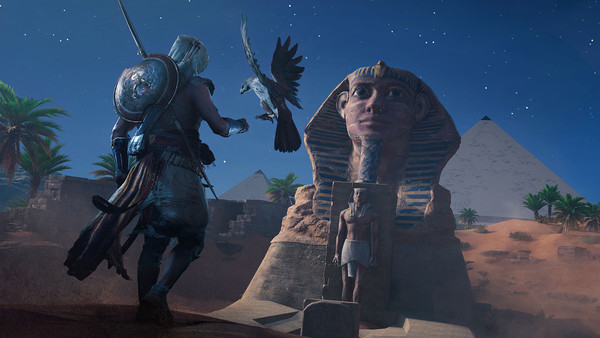
We are fast approaching crunch-time for Assassin's Creed. Not behind the scenes - Ubisoft's army of coders will be pulling double shifts to fix the game's horrendous facial animations as you read this - but culturally.
Can Assassin's Creed still matter in a world that almost doesn't want to give it another chance? Can it survive when Ubisoft actually cranked out two sequels in one year, so sure were they of the franchise's top-tier stature, or when we were all privy to those hilarious AC: Unity face bugs?
It goes without saying that only the most hardcore of Assassin's Creed fans were actively asking or pondering the future of this franchise, as even the silver screen adaptation did little to convince the masses that hooded assassins and world-dominating templars were a concept worth keeping up with.
Still, Assassin's Creed left an immortal mark on the industry and gaming as a medium across the late 2000s and early 2010s, and it will take another balls-up of Unity proportions to truly make the world turn the other way forever.
Make no mistake, Ubisoft need Origins to work on every level, but with the following new features in place, it might save the day after all...
14. Change Time Of Day With The Push Of A Button
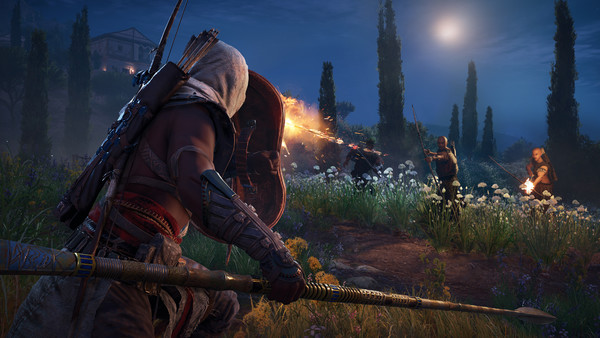
Part and parcel of designing a world around dynamic NPC encounters and almost Skyrim/Far Cry-esque mishmashes of A.I. scripting, we now have access to a dedicated button to change the time of day.
Done by holding down the right stick for a few seconds, you'll enter into a 'rest' period where the sun sets or rises, leaving you in the same spot, albeit with events fast-tracked by around 12 hours or so. This affects everything around you - from guard patrols to wildlife patterns - meaning it could aid in completing any number of missions, as well as how you approach the targets themselves.
If done well, factoring in the day and night directly into gameplay is a completely original idea, and could be a worthwhile, innovative expansion to the staples of Assassin's Creed.
13. Revamped Parkour - Climb (Almost) Anywhere

I hope - oh boy, do I really hope - this mirrors Breath of the Wild's "climb anywhere" mentality, as knowing you could point Link in any direction and see him go to work really made you 'take in' an open world in a completely different way.
As it stands, various hands-on reports from EGX have noted there IS a new climbing system that "felt" as though you could climb anywhere, but it's clear these climbing animations are still combinations of what has gone before.
At this stage we've had a solid decade of the same climbing and mantling methods, so here's hoping this overhauled system (in terms of application i.e. no more looking for handholds) brings something substantial to the table.
12. Ubisoft Used Satellite Imagery To Map Egypt
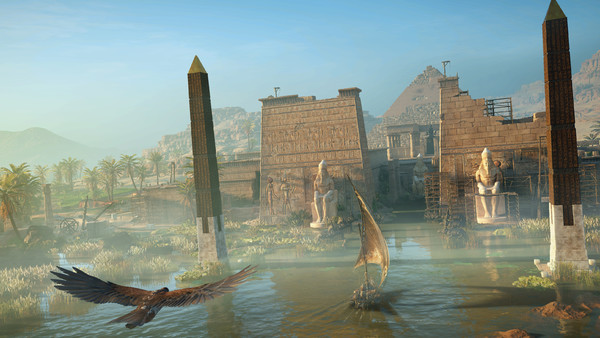
One for the history buffs, apparently Ubisoft have been hard at work referring to satellite imagery to map Origins' version of Egypt.
It stands to reason that Ubi's art department are some of the most talented around. You need only look to the likes of AC: Unity's interiors or the various other time periods and their respective architecture to know these guys always do their homework.
For Origins it's no different, as though the decision was made to travel back in time and 'free up' some of the gameplay possibilities afforded by a lack of records and historical accuracy, Ubi have maintained some sense of realism when it comes to the placement of pyramids and civilisations, alongside colour schemes and general aesthetic.
Say what you will about Assassin's Creed, it's always succeeded in letting us go on many magnificent virtual tourist trips.
11. A Full NPC Day/Night Cycle With Dynamic Mission Design
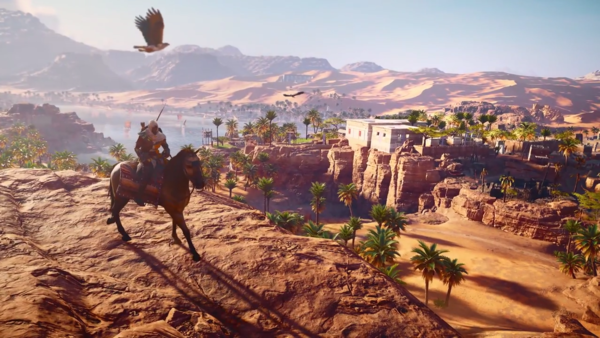
Returning to the idea of a full day-night cycle being prevalent in gameplay, Kotaku reports - courtesy of an interview with lead designer Ashraf Ismail - that Ubisoft wanted NPCs that "have a life, have a persistency, that have schedules, that have places to go to sleep, places to go eat, go to the bathroom, work”.
An example Ishmail gives of how this constantly moving world of characters and motivations factors into gameplay came from trying to track down a specific target:
"During the day he’s out scouring the land on his chariot. At night, he goes home to his fort and sleeps in his cabin. The idea is: ‘There you go: you have that info, he’s your target. Do what you want.’ Do you want to go in through the stealth approach to fight him? Do you want to go out in the open world where he is on a chariot and is an awesome vehicle combat situation? But it’s a completely different situation. We play around with this a lot.”
Besides drawing some comparisons to the freeform feel of 2015's MGS V: The Phantom Pain in terms of bending the world to your whim, this - if done well - sounds like enough of a departure from the standard Assassin's Creed faire.
10. Animal Taming
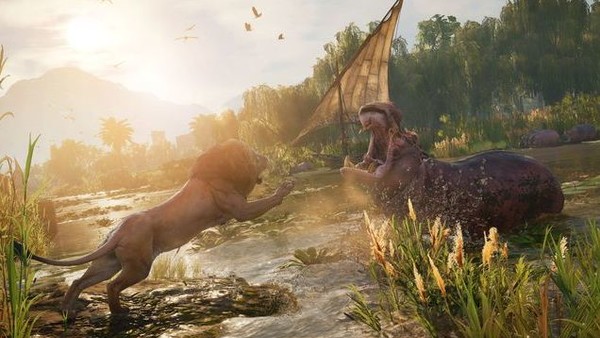
Though there are many new features built just for AC Origins, Ubisoft have always been ones to bring across gameplay tropes from their other franchises, too.
One is the Far Cry-style hunting and gathering crafting system, letting you build better ammo pouches or weapons - but also cribbed from Far Cry Primal is animal taming. Information is thin on the ground as to how this works, but like Primal's protagonist Takkar, Bayek also possesses the ability to somewhat 'mind control' animals, demonstrated by how he can pilot the eagle Senu around the map.
Perhaps over the course of Origins, will we then unlock the ability to control other animals and steer them into enemy encampments too? Ex-Ubi developer Michel Ancel is working on a wildlife-commanding open-world game called WiLD, which would be beaten to the punch if Ubi get there first.
9. Tons Of Side-Quests Are Inspired By Real People And Events

Another tidbit from the aforementioned Kotaku interview, Ashraf Ismail notes that in order to fully ape the sort of sprawling, interconnected tapestry of narratives present in something like The Witcher 3, the team "did a lot of research on Egypt [to find] a ton of stories".
He notes that there were "hundreds of stories that [involved] super-cool characters, people, real-life people who did really interesting things”, to which the team have adapted or been inspired by when populating their version of Egypt.
Indeed, Ishmail ends by saying they "wanted to be able to propose these stories to players", which very much sounds like the multi-step side quests we'll be partaking in were directly based on events that involved people and factions from ancient Egypt itself.
Considering The Witcher's world was consistently rich thanks to Andrzej Sapkowski's book series, there's nothing stranger than fiction - especially when it comes to human history.
8. A Scaled-Back HUD & No Mini-Map To Emphasise World Design
A feature cribbed from Skyrim/Elder Scrolls in general, Origins will be the first Assassin's Creed to ditch the 'corner minimap' look that was originally inspired by Rockstar's various open world titles.
This is apparently to emphasise the amount of work that's gone into visually representing Egypt in all its architecture-heavy glory. Ubisoft don't want you constantly taking your eyes off the world to consult your target's location or the next checkpoint, instead visually representing all this information on an overhead 'bar' a la Skyrim.
If - even after all that - you still think it's too much, there'll be a 'No HUD' option that removes everything. Whilst that may sound like a random thing to focus on, as Breath of the Wild can attest to, removing a HUD can increase immersion tenfold - especially when you'll be spending so much time picking a direction to see what you can find.
7. Full Map Open At The Beginning - The New Purpose Of Towers

Though vantage points haven't been axed together, the idea of specific towers being climbed to 'un-fog' the map has.
Now you can clamber up towers to populate the map and your view with various icons, State of Decay-style, but the actual play-space won't be greyed out or otherwise obscured until you do. Also in are a range of pyramids including notable high school history favourite Giza, which climbing up will allow you to see even further, planning wider-reaching tombs and targets to plunder or take out as you see fit.
Point being: We finally have an Assassin's Creed where the whole map is just waiting for you to explore it.
Many of these alterations might fit under the "quality of life"/fairly inconsequential bracket, but it shows that Ubi are listening, upending the base tenets of Assassin's Creed that will, in theory, make Origins feel like a distinct step in the right direction.
6. Various Bow & Arrow 'Types' ('Machine Gun' And 'Shotgun' Bows?!)
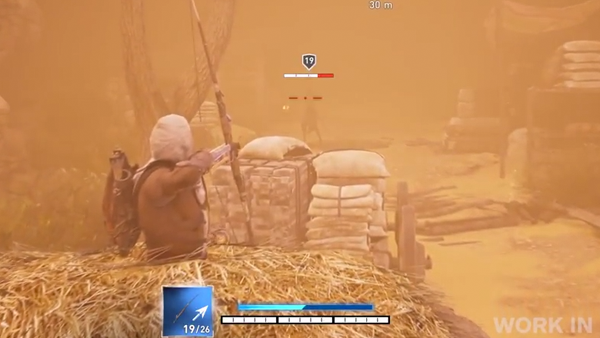
Onto something a little... stranger.
We've known that Bayek's weapon of choice was a bow and arrow for quite some time, but more recent revelations actually discuss a 'machine gun'-like bow, and a 'shotgun bow'.
The latter was actually in the reveal trailer where we saw Bayek fired five arrows in a wide spread all at once, though the machine gun/uzi bow stretches the realms of reality just a bit too much. Letting you literally mow down foes as Bayek notches a good 10 arrows every few seconds, it joins the 'Predator bow', which is Origins' version of a sniper rifle/more long range weapon.
Why Ubi couldn't have just let us stick with technology and weapons that were around at the time I'll never know, but gameplay-wise this at least ensures you've got a steady arsenal at your disposal no matter what happens.
5. Literal Eagle Vision

Taken from Far Cry Primal's 'owl flight' tech, or the various Ghost Recon games' mobile in-flight tech, we now have access to a ancient Egyptian version of a 'drone' in the form of Senu.
Somewhat of a callback to Assassin's Creed's own 'eagle vision' that's appeared in every game, now we have literal eagle vision used to survey encampments and tag enemies ahead.
This gets away from the increasingly outdated look of showing bright red or yellow character outlines through walls or roofs, as having NPCs semi-awkwardly 'floating' in the environment always jarred with the otherwise polished aesthetic of AC.
Unity and Syndicate were notably bad for this, and if Senu works out nicely, it begs the question for future AC games - where does the series go from here?
4. That Overhauled Combat System

By far the most notable and discussed element of Assassin's Creed is the new combat system. Gutting the old 'just keep pushing buttons to win' setup and replacing it with literally the behind-the-back 'Dark Souls model', we now have a completely different approach to any encounter.
In Ubisoft's words they've built something focused on hitboxes, meaning if the tip of your swung sword doesn't hit the frame of your attacker, it won't do damage. This is contrast to past systems where hitting buttons would 'match' your hero and enemies together for semi-canned animations once you were within range.
Now it really matters whether you're wielding a sword, spear, dagger etc. There's a genuine and immediate difference to crowd-managing with dual swords as wider arcs can catch multiple enemies - or you could hang back and poke them to death with a spear.
This approach to combat is why Dark Souls is so revolutionary, and it's no wonder a franchise as big as AC is taking all the right components going forward.
3. The Origin Of The Assassin Brotherhood
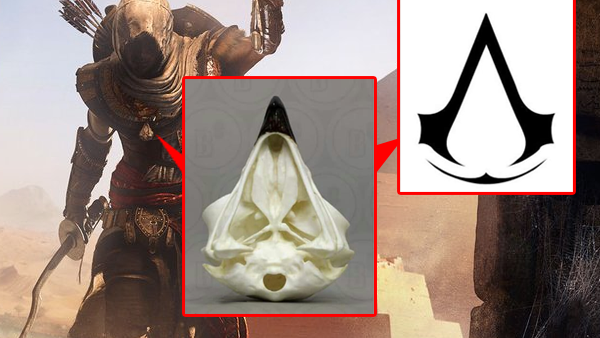
Lore-wise, Ubisoft are hanging the entire appeal of this "Please come back..." instalment on the origin of the Assassin order, or the Brotherhood (depending on which game you came in on).
Besides being the name of the instalment itself, Bayek is known locally as a 'Medjay', essentially a militaristic keeper of the peace who answers to the Pharaoh. It's not too big a leap to assume that some contrasting, morally grey instructions were once sent his way, leading him to start the Brotherhood as a separatist faction, attempting to spread goodwill without any overarching governmental mandate.
Such was the story in Metal Gear Solid with Big Boss ceding from the US to form the Militaires Sans Frontieres, was the centre of Captain America going rogue in Civil War, and it would be a perfect fit here.
Let's just hope Ubisoft give us enough solid motivations and characters to retroactively hang their entire franchise on.
2. Camels To Ride & Elephants To Take Down
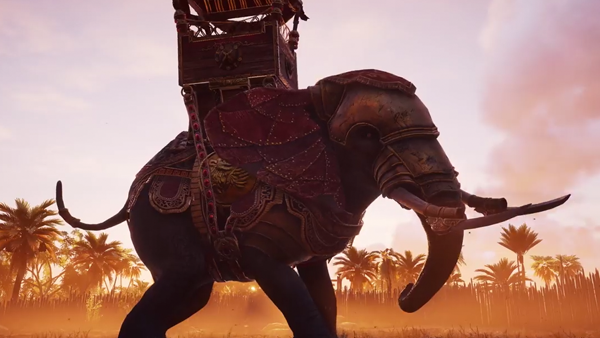
Ever wanted to recreate that scene in Return of the King where Legolas takes down an entire Oliphant full of orcs?
Now you can, as Origins includes elephants wandering the plains stocked with high-value cargo. Whether it's specific targets or loot chests, the ones that come heavily guarded will have to be mounted so you can reap the rewards.
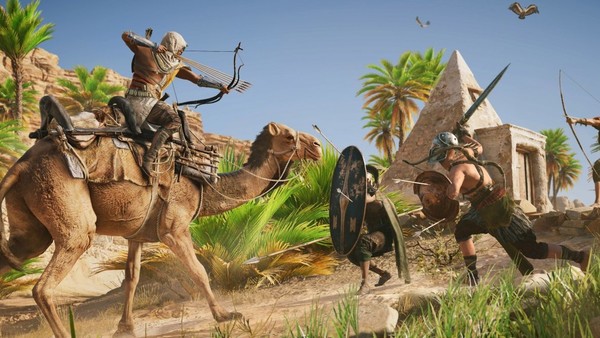
How this manifests in terms of specific animations is up for debate, but we've also got camels to ride alongside. In many of Origins' screenshots we've seen Bayek fire from upon camels too, as well as using them to leap onto groups of enemies.
If Origins can manifest some sort of 'train robbery heist'-type setup where the train is an elephant and you're riding along on a camel... hell, that might save the franchise right there.
1. Arena Fights With Mini-Bosses & Loot
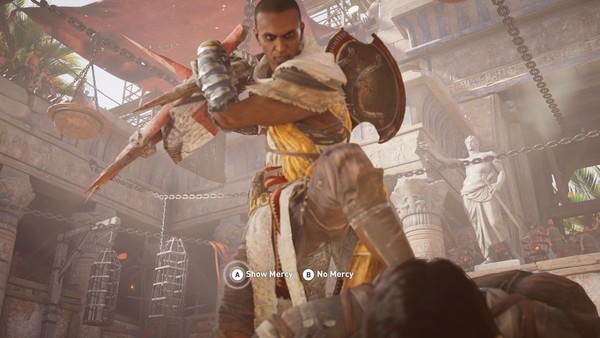
Back to the new combat model, as one of the coolest utilisations of its new systems comes through arena battles.
Most likely introduced as part of the main story and left as an optional extra, the arenas are comprised of minibosses, various specific weapon-wielding foes and options to play to the crowd. Getting through these bouts and putting on a good show will give you increasingly better gear - both clothing, armour and weapons for Bayek.
Simply because the new combat system makes every weapon matter - providing they've been moulded to be a huge variety of shapes - spending time in the arena will benefit you in the long run. The very appeal of this will hinge on how meticulously balanced and fun said new combat feels, but if it works, it'll work in very distinct way.