8 Video Games You Wrongly Thought Were Innovators
What if we told you GTA III wasn't as original as you thought?
8. Doom
 Doom seemingly set the stage for networked multiplayer gameplay and since then - thanks in part to the ease of use of such services of Xbox Live and the PSN - we take being able to game remotely with other players for granted. When Call of Duty, Battlefield and their many offspring came along we were wowed even more and ultimately if we were playing against bots, as we would have it the old days, then it wouldn't be nearly as much fun as going against actual meat bags. But years before any of these existed a little game called Midi Maze was born in the heady year 1987 on the Atari ST. Although not the first network shooter (probably Maze War takes that title), it was the first to offer mere home computer users an easy way to hook up anything from two to sixteen players in one single game world via the use of the computer's inbuilt MIDI ports. Connected in a ring, the players needed a dedicated Atari ST and TV each, and once online could move in 3D to shoot their opponents just like today's FPS'. Sure the game was crude with flat shaded wireframe walls and smilie faces for avatars but it was utterly fun - lugging your Atari ST and then giant 19" TV to a mate's house was more than worth the effort. It even had a level editor, something glaringly left out of many of today's first person shooters, Halo notwithstanding. Yes, Midi Maze was a true innovation in LAN gaming and should be lauded as such.
7. Splinter Cell
 Sam Fisher's first venture into Tom Clancy's Splinter Cell world wasn't the first time video game stealth tactics had been available; Thief for example came out four years prior and offered similar shadow-hiding takedowns and sneaky play. But with Splinter Cell you really had so many options and tools at your disposal it truly offered variety in executing your mission. Neither SC or Thief was the first though - Saboteur was an 8-bit game released in 1985 for various formats of the time and the fundamental storyline was that you played a stealthy ninja and you had to sneak into various areas to achieve the main goal of stealing a floppy disk containing a list of enemy names. Our black-clothed assassin would find himself cornered in tunnels, warehouses and command centres and the controls consisted of running, crouching, using weaponry and objects found in crates as well as throwing stars and other objects. He could also perform hand-to-hand combat when necessary although that should be circumnavigated where possible. You see, in Saboteur you could limit the noise your ninja made and thus avoid guards rather than confront them. Of course you also needed to ensure you didn't get in their line of sight too. Saboteur had a storyline not a million miles from Splinter Cell and similar - albeit 8-bit - 2D graphics 'engine'. It was a game ahead of its time with its embryonic stealth elements and the need to improvise depending on the situation - one definitely worthy of note.
6. Mass Effect
 Mass Effect offers a combination of RPG, shooting and verbal interaction via the use of sentence selection. Really it's an exploration AI chat engine and believe it not it wasn't the first by far... The Commodore Amiga 500 was capable of remarkable graphics seemingly impossible given the CPU speed being a miniscule 7Mhz. Yes that's around five hundred times slower that CPUs of today. Still, the 1988 game Captain Blood provided vivid true 3D fractal graphics and planets that rotated as you scanned them. The basic premise of Captain Blood was to travel to various systems and probe the planets and then gain trust of the alien creatures found there via the use of emoji-style icons. The communication interface allowed you to speak their language fluently and so it was like Mass Effect but instead of choosing full English sentences you had to actually figure out each races' speech pattern using various buttons which represented individual words. Graphically it doesn't hold a candle to Mass Effect, but Captain Blood offered interaction and exploration that at the time was neigh on unheard of, plus Captain Shepherd's verbose command of English had nothing on Captain Blood's multilingual xeno language skills.
5. The Sims
 In 1962 a comic strip entitled The Numskulls appeared in The Beezer ultimately landing in The Beano in the 90s and it was about the lives of little people living in someone's head. A cross-section of the head often showed them going about their day, and it was an amusing look into the lives of tiny people inhabiting a bigger person's world. Whilst this synopsis sounds a bit like The Sims, it was Little Computer People released in 1985 that started the voyeuristic tiny-folk game trend. In LCP's bisected house lived a wee man who would function fully autonomously but could be interacted with as the player saw fit. It was one of the first games where there wasn't really any point; a visual zen garden comprising of a person in his house and you as an onlooker who could entertain the little man or be entertained by him but not actually achieve anything substantial. LCP was an ambitious project that players embraced and relaxed with during a time when many games were little more than noisy side-scrollers, shooters and beat 'em ups.
4. Skyrim
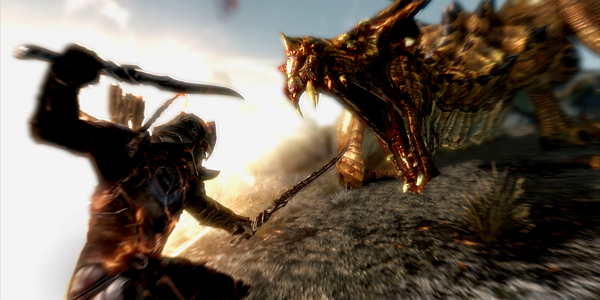
 The late Mike Singleton, a programmer with insanely forward-thinking game design coded The Lords Of Midnight in 1984. Clearly Tolkien inspired, it allowed the player to form strategies to fight the antagonist via unique pseudo 3D graphics and cunning RPG gameplay. After a few similar sequels, he wrote the truly innovative game Midwinter which, whilst set in a post-apocalyptic future, looked very much like an early Skyrim. True it had futuristic elements and vehicles and sniping and so on but playing it then and playing Skyrim now it is actually spooky how the two feel so alike. The world of Midwinter was a mountainous snow-covered one with the occasional rolling fields where many variables had to be taken into account in order to be able to explore it and find the many cabins and buildings dotted on the landscape. Rendered entirely in 3D it offered a totally new first person experience of free roam and RPG and, although it's fair to say it looks very basic now, at the time it was worlds ahead of others. Given Singleton's history into making role playing games, Midwinter was a paradoxical future version of Skyrim's Nordic past coded in the long lost days of 1989.
3. Grand Theft Auto III
 Let's be honest, GTA 3 sold systems. It was a killer app that nothing at the time could touch. If you owned a PC or console you almost certainly owned GTA 3, it was just that ground-breaking... or was it? Heading back again to the days of the Amiga 500 and Atari ST we find ourselves in 1991 playing Hunter, a true 3D third-person game where you had the use of any number of vehicles to finish various missions. Different game modes offered an early incarnation of free-roam and was by far the most interesting to players as it removed the limits that preset missions confined the player to and thus encouraged map exploration. Cars, boats, helicopters, hang gliders and so many more vehicles were available to the player and even a wind surfer could be mounted to venture out in Hunter's hunter-green unique world. As with many early games on this list visually it was way ahead of its time. The true polygonal landscape along with actual physics and day/night cycles was pretty much beyond anything seen up to that point. The ability to simply complete the task at hand employing whatever vehicle you wanted or even do the whole thing on foot felt new and exciting, and it would be a full ten years later before the GTA franchise opted for similar 3D open-world game mechanics found in GTA 3. Hunter created the term 'sandbox' and it was every bit a killer app of its time as GTA 3 was.
2. Assassin's Creed
 When you think of Assassin's Creed you may think of stealthy take downs and free roam. What it did too though was offer a very impressive unique flowing protagonist whose movement and gorgeous parkour-styled action hadn't been done before. But let's go back to the time of Prince of Persia which has been made, remade, remastered, paid homage to and appeared on almost every format ever - and even became a movie too. The 1989 version of PoP however was where it all began... Set in a non scrolling flip-screen environment, the Prince must battle various enemies, avoid traps and puzzles all the while running and jumping his way through the vivid Persian world. Gameplay isn't hugely similar to Assassin's Creed; it has no stealth or assassin elements and the progression is extremely linear offering little chance of exploration. Where it does compare is the graphics - ridiculously smooth rotoscoping of the programmer's athletic brother resulted in slick animation that was entirely new. The hero jumps, crouches, hangs of ledges even scrambles up walls in a very similar way to the AC franchise. The location setting and visuals help with this comparison and although the two games are worlds apart technically, they both offer a fluid experience where playing the main character actually feels organic and real. It's no surprise then that the movie of Prince of Persia is more akin to watching a cinematic Assassin's Creed than its 8 bit inspiration.
1. Alien: Isolation
 The developers of Alien Isolation must have had a checklist of things they wanted to nail - the look and feel of Ridley Scott's movie Alien, the exploration of System Shock 2's mostly abandoned spaceship and a fearsome beast you simply cannot kill. A sole main enemy you cannot kill? That's an interesting new step for gaming... But over thirty years ago and without sound, without colour and even without true pixel graphics came the Sinclair ZX81, a mute home computer offered extremely limited black and white blocky visuals and the crudest gameplay. And on it in 1981 was one 3D Monster Maze that changed everything. Controls were nothing more than four cursor keys and there wasn't any combat or anything else to do but traverse the maze-like environment avoiding a monster. You were warned of it closing in on you not via a motion tracker's blip but via simple sentences such as "Rex lies in wait!" and "He is hunting you!" culminating with the terrifying words "Run he is behind you!" The game served up block by block 3D walls later emulated by games such as Dungeon Master and Eye of the Beholder and it was that brand new POV perspective that caused the real anxiety the player felt. Much like the most recent Alien Isolation you couldn't fight the monster, only avoid and escape. Yes nearly thirty four years ago a game came out which had a single enemy who hunts you in a maze-like environment and cannot be killed. Without 3D Monster Maze it's worth wondering if we would even have half the games we have today and it's interesting to note that despite having no sound and very basic onscreen representation, the game offered just as much if not more fear than the new Xenomorph game does with all its bells and whistles. And so we go from one of the oldest games to one of the newest, and hopefully we've paid some respect to the games that truly innovated in a time where 16KB of RAM and video resolutions of 256x192 were the norm. What forgotten gem games do think were the real innovators in video gaming? Serve up your nostalgic thoughts in the comments!