8 Video Game Mechanics That Were Too Complicated
These mechanics were too damn complex for their own good.
It's always great to see a video game come up with a clever and creative mechanic we haven't ever really seen before - at least not quite like this.
It's tough to do, and so frankly who can blame most developers for leaning back on the tried-and-true mechanics they know will work with most players instead?
But to the same token, sometimes developers offer up strange, left-field riffs on these concepts which are ultimately injected with so much added complexity that it becomes a net-negative to the experience overall.
And that's absolutely the case with these video games, each of which introduced a feature or mechanic which ended up being a bit too complex and arcane for its own good.
There might've been some interesting ideas there but it was just too mired in busy-work for its own good, or perhaps the developers did a poor job of actually explaining how the systems worked.
Whatever the reason, these mechanics left players en masse complaining that they actively undermined the game's sense of fun, enough that some of these features were heavily revised when the games in question were remastered...
8. Leveling - The Elder Scrolls IV: Oblivion

Let's kick things off with The Elder Scrolls IV: Oblivion, which despite being one of the most beloved RPGs of all time also made a total hash-job of one of the most basic aspects of any RPG - leveling up.
Rather than level up in linear fashion by killing things and completing quests, players would only do so every time they improved their major skills by a total of 10 points, and only upon leveling up could attributes then also be raised.
Coupled with the game's poorly thought out enemy-scaling mechanic, this arcane progression system had the tendency to result in extreme unbalancing, with players often accidentally encountering huge difficulty spikes by being under-powered through no fault of their own.
This pissed players off enough that some created their own mods to give the game a more conventional, experience-based leveling system, and in addition to follow-up Skyrim offering a more streamlined means of leveling, the recent Oblivion remaster also mercifully revamped it.
7. Minigames - Danganronpa 2: Goodbye Despair
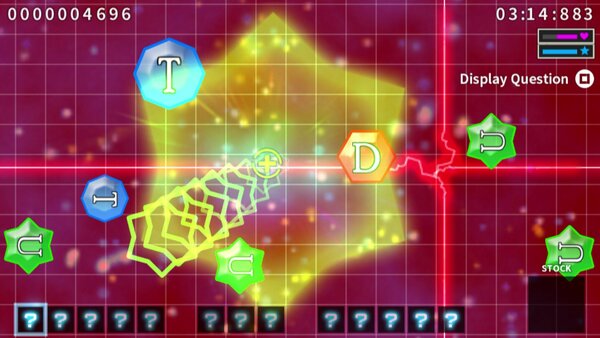
For all of its brilliance, there are a great many who absolutely loathe the class trial minigames in Danganronpa 2: Goodbye Despair, and rightly so.
Developer Spike Chunsoft decided to vastly expand these minigames from the original Danganronpa, yet the minigames are so abstract and tenuously connected to the central murder-mystery that they feel like a needless complication of its stellar visual novel throughline.
These minigames interrupt and upend the flow of the main story while offering up gameplay that's more confusing than entertaining.
How, precisely, does a snowboarding minigame relate to anything in the narrative, and how did Spike Chunsoft find a way to make Hangman’s Gambit even more complex this time around?
It's just too much of a muchness - the numerous minigames, each with their own distinctive, esoteric rules, add an entirely unneeded layer of contrivance on top of what's such a compelling and engrossing story without them.
It's OK to just let visual novels be visual novels.
6. Motion Controls - The Legend of Zelda: Skyward Sword

It's the least surprising news in the world that Nintendo very nearly ditched the mandatory motion controls from The Legend of Zelda: Skyward Sword, because they remain by far the game's most controversial feature.
In its original Wii release, the game could only be played with the MotionPlus peripheral, and there was no option to play it with a more conventional control scheme.
As impressive as the Wii's motion controls were for their time, they also weren't terribly well-suited for a game as mechanically involved as Zelda, and as fun as the idea of slashing your sword around with a Wiimote sounded in theory, the reality was quite different.
The motion tracking was awkward and finicky during combat, and even basic movement and menu navigation felt clunky, enough that it often seemed like players were fighting the controls more than the game's actual enemies.
The attempt to innovate is laudable, but not giving players a more straight-forward, traditional control scheme as an alternate option was a massive own goal by Nintendo. The learning curve was just too damn steep for its own good.
Thankfully 2021's Nintendo Switch remaster finally allowed players the opportunity to play Skyward Sword with a button-only control scheme.
5. Junctioning - Final Fantasy VIII
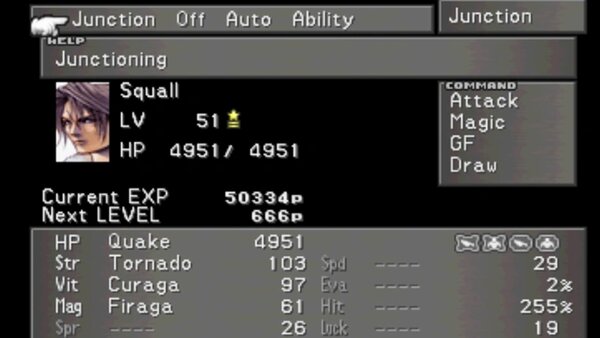
Final Fantasy VIII is one of the most divisive mainline entries in the hit RPG franchise for several reasons, perhaps most of all its polarising Junction system, which is basically the game's means of customising the player's loadout.
You'll need to assign Guardian Forces (GFs) to specific party members, and as they level up they'll learn magic abilities which can then be applied to specific stats.
That's an incredibly broad overview and it might sound simple enough, but there are a few key issues here - for one it's horribly and hurriedly explained by the game itself with a cascade of word-salad tutorials.
Then there's the fact that, for a legion of young players, this was probably only their second-ever RPG after Final Fantasy VII, and so to throw them in the deep end with such an arcane, willfully convoluted customisation system felt almost passive-aggressive.
If you dared take a break away from the game for a week or two to deal with real life, good luck remembering how any of it worked, compared to Final Fantasy VII's easily understood Materia system.
Over 25 years on, the moment someone brings up Final Fantasy VIII in conversation it's still just a matter of time before someone starts complaining about Junctioning.
4. First-Person Aiming - Metal Gear Solid 2: Sons of Liberty
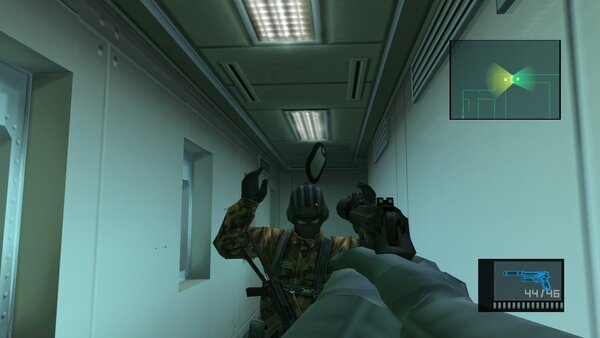
Metal Gear Solid 2: Sons of Liberty is one of the greatest gaming sequels of all time that offers a colossal technological leap over its predecessor, as well as introducing killer new features like first-person aiming.
As brilliant as the mechanic is in theory, the execution is woefully awkward for a few reasons.
First and foremost, this being a 2001 game released before consoles had mastered twin stick FPS control schemes, you're unable to move your character while aiming, making stick-up situations limited and clumsy.
Then there's the imprecise pressure-sensitive gunplay on the original PS2 release, requiring you to half-press the Square button to lift your gun, and then full-press it to shoot.
This also made it easy for butter-fingered players to press a little too hard and accidentally cap a guard they had no intention of shooting.
As neat as the idea of first-person aiming was in Metal Gear Solid 2, it ended up feeling so aggressively counter-intuitive that it was often more trouble than it was worth, making stealthy stick-ups more messy and inelegant than they really should've been.
3. Equipment - Tales of Zestiria
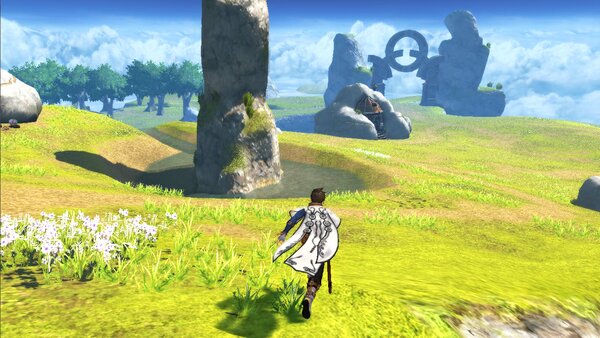
Tales of Zestiria is a decent entry into the Tales RPG franchise, albeit with one with an intensely annoying equipment system - one so maddening it might well cause you to put the game down and never come back to it.
In Tales of Zestiria, equipment can be given special skills through four skill slots, with certain combinations resulting in extra effects. And on top of this, you can create additional, more powerful gear by fusing two items together.
Turning gear customisation into what's effectively a hyper-convoluted and poorly tutorialised puzzle is no bueno, made worse by a tough-to-navigate menu interface, ensuring few could be blamed for just dipping out entirely.
It's a textbook example of a system that's buried in layers of complexity for no good reason. It isn't fun, it's just a tedious, confusing, and irritating detraction from the rest of the game.
There are surely many who made it to the end of the game while still having no clear idea of quite how it all worked.
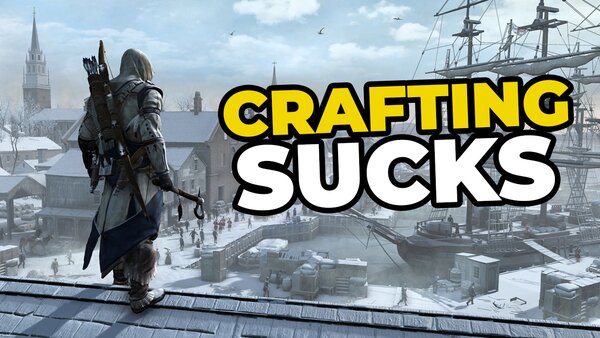
2. Crafting - Assassin's Creed III
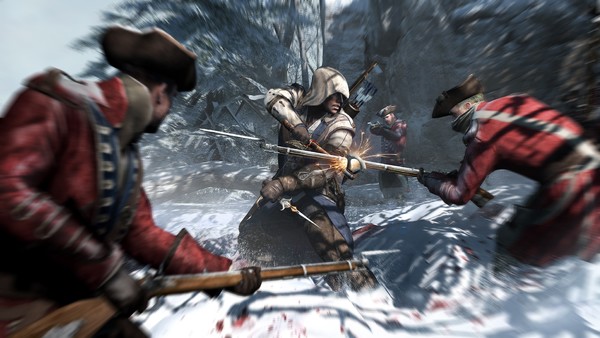
What would any stealth-action game be without its own headache-inducing crafting and economy system, right?
Assassin's Creed III isn't content to merely be an entertaining sequel - it also inundates players with a series of crafting mechanics that are both unnecessarily complex and overtly tedious.
A big part of the problem is that it's an interconnected series of systems which require players to think way too hard about resource management and navigate way too many menus.
And even once you've gone through the palaver of actually crafting something, you then have to faff about with the busy-work of actually selling it via a caravan.
It's mind-numbingly over-egged for something that's also not remotely fun, and only detracts from the actual meat of the game - y'know, the sneaking and stabbing and stuff.
That this labyrinthine nonsense made it through the game's QA phase is frankly baffling, though Ubisoft did at least listen to the vocal criticism and simplify these systems for sequel Black Flag, while also streamlining them for the 2019 remaster of Assassin's Creed III.
1. Food - The World Ends with You
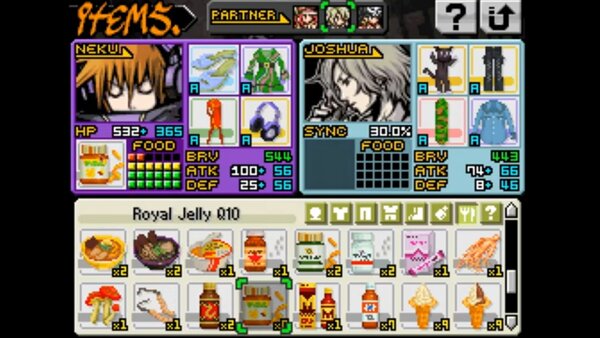
Much as The World Ends with You is a brilliant RPG, it's also a game that's absolutely overloaded with an excess of systems upon systems upon systems.
Case in point, the game even has an entire mechanic devoted to eating, which is the only way for players to permanently increase their stats.
It isn't simply a case of eating x item to boost x stat - every piece of food takes a specific number of battles to be digested, but there's also a limit to how much food the player can digest in a single day.
That is, unless you pick up the Hollow Leg sticker which allows you to eat as much as you want.
The player's digestion is also visualised on a frankly insane 24-piece grid, at which point one has to ask - who the hell cares about any of this?
It's such a daft over-think of a simple gaming mechanic as to feel almost self-parodying, further unaided by how terribly vague the game is about actually explaining it all. Just... no.