7 Reasons No Man's Sky Should Be Considered For Game Of The Year 2016
Quell the hate, Hello Games did a lot of things remarkably well.

There's being raked over the coals, and then there's face-planting the embers yourself before the whole world starts piling on, cheering and fist-pumping the ensuing chaos as you're struggling for air.
Such a description is apt for No Man's Sky's wet fart of a game launch; one that since - and for almost four months after - has resulted in both director Sean Murray and Hello Games remaining completely silent, enduring seas of hatred and accusations of false advertising as the game didn't live up to the expectations of a hyped-up populace - or the many statements Murray himself had made beforehand.
So back to the drawing board they went, emerging with a staggering amount of changes, fixes and fan-requests intended to restore consumer faith in what No Man's Sky 'is', hopefully providing the basis to look at the game overall, instead of focussing on the negativity.
That said, is No Man's Sky one of 2016's finest games? Well, weirdly, if you'll just hold those pitchforks by your sides for a second, I'll explain.
--
7. A Genuinely Original, Innovative Premise
You need only look to the candidates for this year's Game Awards to get a feel for how stagnant and over-reliant on formulas the industry is right now. The nominations for GOTY are DOOM, Inside, Overwatch, Titanfall 2 and Uncharted 4: A Thief's End - otherwise known as, "three first-person shooters, another Uncharted and a physics-based platformer."
Now, they're immaculate games, I'll make that clear, but as for being creations that feel as though they could only have been made on new hardware, or ones that push the industry forward? We're far from that distinction.
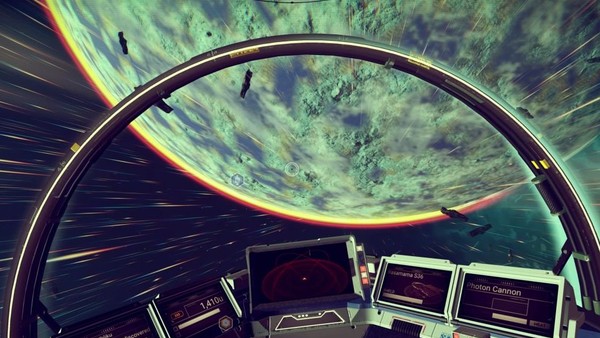
Over to No Man's Sky, and its base idea of procedurally-generating an entire universe of content had genuinely never been done before, and certainly not to this scale. Elements of first-person shooting, survival and crafting are in there too, but as it's constantly twinned with this universe-sized sense of scope, you're forever dwarfed by the possibilities of level design alone.
For better or worse, Hello Games proving you can generate this much content to such a proficient degree at all is something other developers can learn from, and that alone is worth celebrating.
6. Balancing The Game's Core Formulae Is A Work Of Genius

Think about it - almost all other developers would say "The player needs X item at X time, we'll put it here", but Hello Games coded a universe to do that on its own.
Buying up crafting components, scanning creatures, building bases, making items, trading, dogfighting, exploring, terraforming, underwater exploration - at any given time there a ton of things you could be doing, but it all hinges on a constant back and forth with the game's generative formulae.
That is to say, no matter whether you're blowing apart rocks or collecting them, NMS needs to feel balanced, exuding the feeling that you're not 'breaking it' through experimentation - a feeling you get almost immediately when playing something like a Bethesda game.
For example, if you've downed your ship, you'll need plutonium to appear - but not so much that it dominates the planet itself, or makes it feel like the place you're exploring is defined by such an element. If you're setting up a home base or looking to augment your ExoSuit, the components necessary need to pop up with enough frequency that it doesn't feel like a fruitless endeavour, as well as reacting to whichever weather conditions have dogged you for the past few hours.
All round, the game needs to dole out rewards, items and a sense of progress without feeling like it's doing so, and that, is a very hard thing to get right - especially when you factor in all the algorithms that govern a planet's creation.
5. That Impeccable Art Style

Aside from the aimless arthouse project that is 2013's Proteus, is there anything else that even comes close to No Man's Sky on an aesthetic level?
Inspired directly by the literary descriptions and book covers of Isaac Asimov, Arthur C. Clarke, and Robert A. Heinlein, you could pause at any point and have a gorgeously-coloured, life-rich 'painting' screenshot you could hang on a wall.
The same is being said of Playdead's Inside, another phenomenal game where aesthetic art design has resulted in a very screencap-happy product, yet for as much effort has gone into ensuring No Man's Sky's coding results in all sorts of aesthetically pleasing visuals, we're yet to give it the time of day.
As part of the Foundation Update, Hello Games even added a 'Photo Mode'; a direct response to thousands of fan requests that removes the HUD completely and lets you take more professional-looking images.
4. Music Direction
Last of the "it's procedurally generated, wow!" points, but when you've designed a game's score to react in real time to whatever the player is doing, that's pretty damn impressive.
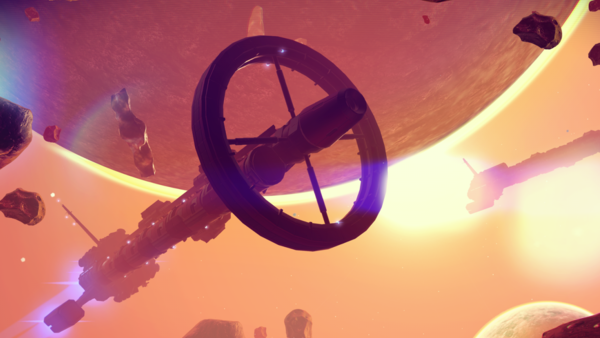
Regardless of if you're slinking through an underwater cave or blasting the holy hell out of some angry dinosaur-looking aliens, the game takes a constant read of whatever 'biome' you're walking around in i.e. which enemies are present, what the weather's like, which items and resources are nearby etc. and pulls from a bank of instrumentation to provide a modular score.
You'll hear guitars and drum flurries kick if you enact a space battle, just as everything will subtly fade away and transition if you evade your pursuers and dock on a nearby freighter.
Again, No Man's Sky's sound design got mangled in the mess that was everything post-launch, but it's just as incredible an achievement as what's on screen.
3. An Unprecedented Feeling Of Genuine Exploration

Okay, now this is a weird one, because it comes specifically from the way Hello Games and Sean Murray advertised and showcased No Man's Sky for the duration of its development. Which is to say: They barely nailed down any particular gameplay loops, and pretty much refused to categorise its core features until launch.
As a result, on that fateful first day, popping in NMS literally meant you didn't really know what to expect - and it's a quality that fed into exploring your first planet, fixing up your ship and eventually boosting off the surface to explore the cosmos.
Simply because of how this detail unfolded surrounding the game; the effort it takes to leave a planet and the lack of knowledge as to whether there were characters, aliens etc. waiting for you amongst the stars, it meant the first time you touched down in a space station and actually saw other sentient life, that was honestly a pretty amazing moment.
And those first experiences count for a lot: Your first unique life form, first network of underground caves, first Sentinel duel - they all felt unique thanks to how the game presents its content in this huge environment of dynamic interaction, and that's not a sensation you get from more heavily scripted video games.
2. Its Settlement Building Mechanic Dominates Fallout 4's
Fallout 4 was an incredibly technical and mechanically deep game, sure, but for as much as critics praised its Settlement mechanic, actually using the thing was cumbersome and awkward at best.
Items would snap and clip to the wrong parts of what you were going for, the interface involved 'piloting' a first-person perspective around your build-space, and although there were tons of items on offer, actually building anything required you fight the game's systems just to match what was in your head.
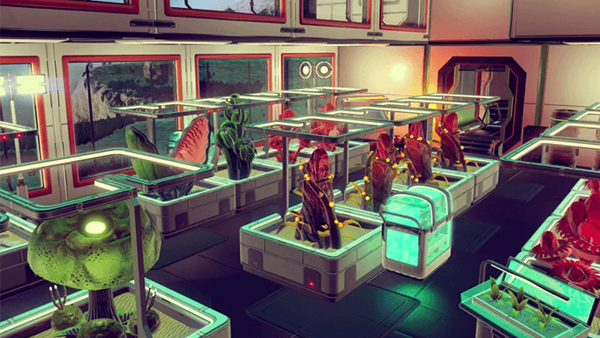
For No Man's Sky, items hover where they're 'supposed' to go, before slotting into place, and say you're building from the inside, you can easily 'punch through' walls to extend corridors. Extending ladders is as easy as climbing them yourself, as the game will auto-place the next piece above you as you ascend. The HUD even overlays icons as you cycle through items to denote where they could connect.
It's just effortless, and whilst you can knock the lack of available items overall, exudes a genuine sense of usability that was nowhere to be seen in Bethesda's release.
1. Nothing Else Pulls Off So Many Interworking Gameplay Mechanics

One minute you're scavenging for supplies and items, using your mining tool to break down components before darting in a cave to let your suit's environmental systems recover. The next, you're building a base by crafting items together, shooting a few mechanical sentries and after that, you're blasting off the surface to trade with specific space stations and dogfight with fleets of pirates.
Docking on any number of freighters, learning alien languages to 'decode' their subtitles, recruiting workers to beef up your armoury or constructing an indoor conservatory - all happen without loading screens, without pausing and without obtrusive tutorial prompts or an invasive guiding hand.
No Man's Sky plops you on a planet regardless of which mode you're playing, gives you a few text boxes containing vagaries as to what and where to go, and then whispers, "Proceed". You're then free to get immersed in FPS shooting elements, survival and crafting, space combat and light adventure game mechanics.
Seriously, what other game does that?
--
Could you learn to love again, or has No Man's Sky burned all its goodwill across the last few months? Let us know in the comments!