10 Video Games That Will Change How You See The World
With the world going to hell these days, maybe it's time to adopt a different viewpoint.

Video games are time wasters. Things to do when you're bored, and there's nothing else to do other than shoot some dudes that you're told are bad guys, but you're not really sure why.
After all, isn't that all games are good for?
But what about the games that have something to say? The ones that bring along some deep and emotional story lines, well developed characters, and more importantly the ones that leave an impression on the player long after they're done?
Not only do these games exist, but in this day and age they are plentiful; there's nothing wrong with sitting down to enjoy a game and finding that your entire ideology and viewpoint on the world at large has changed over the course of its run time.
In fact those are some of the best games we can experience, the ones that ask the big questions, the ones that make us question exactly what we thought was right and wrong in the world, or the ones that make us think twice about how these virtual world operate.
After all, games are an art form - whether the media wants to accept that or not. These games prove it.
10. Bioshock

The original Bioshock games ask the question: what would happen if an underwater paradise fueled by the rich and populated entirely by super powered individuals actually existed?
Honestly it goes about as well as you would expect.
Perhaps the most interesting thing about the game as a whole however is its world. Borrowing and heavily discussing the philosopher Ayn Rand's theories on Objectivism, Bioshock manages to cement itself as a heavy criticism on the ideology as a whole.
To put it simply Objectivism is the belief that a man can flourish if he puts his needs before others and is left to his own devices, or indeed without the intervention of any local governments. Rapture proudly displays this ideology with it's numerous banners stating: "No Gods, or Kings. Only man."
However, this ideology simply cannot sustain itself in any long term environment, and Andrew Ryan (the founder of Rapture) personifies that.
So it's no wonder that Rapture failed when viewed through the lens of Objectivism; Andrew Ryan forbids his city from outside intervention, effectively putting himself as a central political figure that meddles in the affairs of the individual.
Essentially Andrew Ryan is Raptures' God, its King, and everybody else are just men.
9. Deus Ex

With all of the hype surrounding Cyberpunk 2077 it would do well for us all to remember one of the original crap sack dystopian sci-fi epics, Deus Ex.
To many, Deus Ex is one of the defining moments in the cyberpunk genre. Dealing with concepts like transhumanism, conspiracies, and the advent of cloning, the entire franchise reeks of dystopian sci-fi that falls not too far from where the world may actually be heading.
The two recent entries in the series, Human Revolution and Mankind Divided - while good games in their own right - never truly managed to capture the feel and atmosphere of the original Deus Ex. Everything is just too shiny, too sparkly gold and vibrant to properly reflect the somber and run down future that was made so iconic by the original game.
This future is a bleak reflection of what so many in modern day worry will actually become of our own lifestyle should we keep going down our current path.
Corporation control with the likes of the Illuminati and the advent of cybernetics and augmentation is a real possibility in the future of our world, and Deus Ex stands as a rather grim reminder.
8. Journey

Journey is an anomaly of a game, and indeed is an anomaly on this list. Unlike most of the other entries Journey is a game that acts as more of a spiritual exodus, rather than a heart crushing reality check.
Such a cathartic release however is paramount to how Journey plays out; the endless walking over deserts and hills is never interfered with by words, or story, or anything really as the player simply travels. Journey is content to be exactly what it says on the tin: a journey.
Occasionally the player will meet up with others sharing in the same experience and the two will travel together, again not saying anything, yet still experiencing the journey together.
It is perhaps one of the most relaxing and poignant uses of multiplayer to date, bringing with it the simplicity of co-operation without communication, the ability to just exist beside people while you both go about your quest is one that strangely brings everybody together.
When the player finally reaches the end it will feel less like finishing a video game, and more like some sort of spiritual retreat that changes your life without ever really trying.
7. Kenshi

Unlike other games that may try to break your spirit with its concepts or its high minded ideals and lofty beliefs, Kenshi will break you just by sheer force of will.
If there is any game that exemplifies the most pessimistic and traumatic side of humanity it is Kenshi, without a doubt.
Every decision you make does not matter, it will inevitably end in the worst possible way. Try to do some honest work and mine on your own? Bandits beat and rob you. Move to somewhere else and try to settle down? Congratulations, you've been kidnapped by crazed cannibals and are about to be cooked alive. How about you stop running, stand tall and take the fight to them for once? Whoops, you're dead.
The only way to survive in Kenshi is to trust nobody, move with caution, and harden yourself against the ever terrifying world. Even then there's no guarantee you'll come out of it all without losing an arm and a leg.
Kenshi pulls no punches and simply does not care how optimistic you were before going into it; life is cruel, and this game will make sure you learn that lesson the hard way.
6. The Total War Series

While the Total War series won't be bringing any mind bending philosophies into play, or really make the player question any sort of existential facts about life, it will do something very important - and that is teach at least some parts of history.
What better way is there to see the world other than through the lens of what has come before? Whether it be watching and participating in the formation of Rome (or even its fall) or vying for a position as the Shogun of Japan, the Total War series provides accurate enough depictions of these events as they happened.
Granted, the games can of course go off kilter and provide some ridiculous version of history via player choice, but still the important historical figures, factions, and even religions are all there for the player to explore and discover as they go.
Unfortunately much like Assassins Creed before it Total War seems to be taking less of a focus on their historical accuracy as of late, instead deciding to focus on the fantastical elements.
While this is all well and good, there was something special about just how much one could learn from playing one of these games.
5. Nier Automata

Upon first inspection Nier Automata seems like nothing more than the standard action game with the added incentive of purposefully well endowed android girls in tiny skirts, just to spice it up a bit. While none of that is wrong, it certainly doesn't do justice to just how deep and introspective the entire experience can be.
After finishing the game once, players are given the chance to play through again, only this time with all of the feelings of sorrow and regret that they can handle.
It's here in the second play through that the player will start to realise just how... off everything is. When playing as 9S the player has the new ability to hack into enemies, no big deal right? It's just a new, cool game play mechanic.
That is until you reach the Beauvoir boss fight.
What was before just a simple beat the boss, move on kinda deal now becomes some sort of empathetic and existential nightmare as hacking into the robot reveals her memories. The act exposes just how human the robots are becoming, revealing their emotions, dreams, and passions all at once.
Knowing just how human these supposedly soulless husks actually are really puts a damper on the rest of the fighting.
4. Stardew Valley

Taking a step back from the more outlandish and disturbing lenses of the rest of this article it's time to look at the world in it's most simple of lights, farming simulators.
Stardew Valley is perhaps the single most relaxing and wholesome game to ever be committed to a hard drive. There're no wars here, no extreme moralistic viewpoints on life; all that exists in the Valley is peace, crops, and cows.
So it's hard not to instantly fall into the humdrum life of a farmer and care for little other than the crops and the townsfolk themselves. It's in this simplicity that the game works so well. It's such an instant pick-me-up that all of life's stresses simply melt away as you guide you little pixel art avatar around the fields.
Regardless of who you are, Stardew Valley will change your disposition for the better: no more anxiety or stress to toil away at your soul like other, much more intensive games.
Instead, the valley will welcome you with open arms, bringing some optimism into a rather depressing and gloomy world that sorely needs it.
3. Disco Elysium

To describe Disco Elysium is like trying to describe exactly what the hell Eggboy is rambling about as he raves away in the abandoned church. You're not really sure even he knows, all you can be sure of is that it's "HARDCORE" and "TO THE MEGA". Whatever that means.
Disco Elysium is a game just as much as it is a series of social and political ideologies strung up in front of the player. Every decision the player makes is secretly guiding them and the character itself towards a place on the absurd political chart.
No matter what political ideology you happen to stumble into the game will delve deep into it and question the player on why exactly they have chosen that one, even when the player had no idea they had accidentally stumbled into defending the political center.
The player can fight back of course, decide to say that it's actually the only logical step to subscribe to Advanced Race Theory, maybe even dabble with a bit of Neo-liberalism while they're at it.
Or maybe they can decide that none of that matters and follow good old Eggboy as he keeps on being hardcore, hardcore to the mega baby.
2. Metal Gear Solid
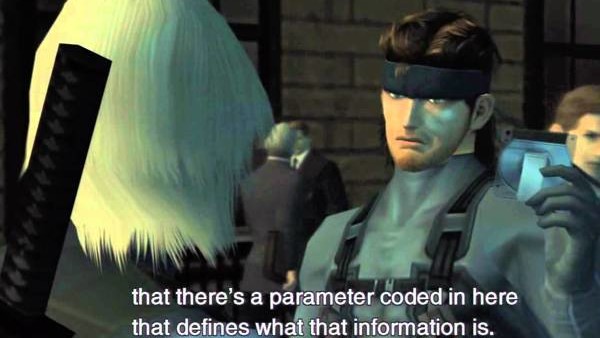
Trying to explain every piece of social commentary that the Metal Gear Solid series has layered within its hundred hour saga would require an entire dissertation, and really, who has the time for that?
So let's try and sum it up in around 200 words.
Metal Gear is both a warning and a celebration on the effects that technology has on the modern day. Hideo Kojima doesn't miss a beat in any of the games in the franchise when it comes to scientific ideologies and theories, particularly those concerning genetics or robotics.
Perhaps the most infamous example of this comes from Metal Gear Solid 2's absolute fever dream of an ending. The whole thing brings up questions of free will, human experience shaping memories and identity, and an entire monologue dedicated to society's values of memes - the concept of passing on knowledge and ideologies through human interaction and proliferation.
When viewed in this light the entire saga becomes more of a convoluted thesis than it is a game. Not that that's a bad thing; it just means that more often than not you'll come away feeling just a little less sure of what the hell is going on in the world.
1. The Last Of Us

The Last Of Us is one of those games that just simply begs to be played as much as it does to be watched. After five or six emotional gut punches the protagonists Joel and Ellie finally reach their destination and the game decided it isn't quite done making you cry yet.
When given the choice between saving the world from the mushroom kingdom version of the zombie apocalypse or holding onto his surrogate daughter figure, Joel chooses the more morally reprehensible choice.
On first inspection this is an awful decision; not only does it doom the entire human race, but the man has to kill some of the smartest people working on a cure that to his - and our - knowledge nobody else can do.
But after spending so many hours with him and Ellie the player just *gets* it. The man is broken, his daughter is dead, and before Ellie he didn't think that he could ever love in the same way again. How could he force himself to give up another daughter to such a cruel and unfair world?
Is it the right choice? No, but it damn well isn't the wrong one either.