10 Video Games That Owned Themselves
Don't read this! Ten of the worst entries ever!

A quick glance at the computer games section of your local supermarket or digital entertainment emporium reveals that the medium, despite the polite dismissal of your gran as being 'for the kiddies', is serious business. Presented with a tedious array of armour-clad lads clutching heavy artillery like one would their first-born, you'd be forgiven for believing there's not a single shred of humour to be found anywhere on gaming's range of big black boxes.
This might be the case for earnest po-faced mass market triple-A titles, but it's actually a million miles from the norm. Almost since their inception, video games have, probably as a direct consequence of a mainstream media which for the longest time denied them any artistic legitimacy, came with a tongue firmly planted in the cartridge slot. It was hard not to when pub punters were being asked to suspend their disbelief in the face of a dozen pixels as an abstract for tennis.
From Earthbound and Undertale to Frog Fractions and Fat Princess, we've gradually seen games ridicule even their own conventions. But best of all are those which put the target on their own back. Take note Duke Nukem Forever: If you can't laugh at yourself, how can you laugh at anyone else?
10. Sonic Mania

As esteemed as the spiny speedster once was, Sonic has made himself drastically and devastatingly easy to mock over the latter half of his 30 year tenure, thanks to a slew of terrible, noodle-armed disasters and a fandom which has turned self-parody a fine art. SEGA themselves have even got in on the act, releasing an utterly preposterous movie, one originally animated by competition winners working off a rough description reading 'small blue man'.
The Sonic the Hedgehog movie didn't have much right gently ribbing the series given it was contributing to the problem, but 2017's Sonic Mania, a gushing love letter to lapsed fans and the best Sonic game of all time, did. Christian Whitehead's delicious dose of erinaceidae action affectionately lampoons some of the more ridiculous aspects of Sonic culture, though the most sardonically subtle comes under the bright lights of the game's second level, Studiopolis.
After besting the zone's boss - a climate-flipping egg-o-matic itself parodying Sonic & Knuckles' weathervane Cluckoid badnik - the TV feed cuts to a test card, accompanied by an annoying buzz. This is no standard studio static though; it's the exact same buzz which plagued SEGA's 25th Anniversary livestream, one infamously beset by technical issues.
Now that's a pointed barb.
9. World Of Warcraft

World of Warcraft launched in 2004, and in the sixteen years since, a small country has been entirely consumed by Azeroth. Helping perpetually part these inextricable digital denizens from a wad of cash per mensis is the game's cynically-crafted, bite-sized quests, guaranteeing a dollop of achievement endorphins per session. There are now an astonishing 15,000 of the blighters across WoW and its six expansions, ranging from such engaging tasks as 'kill 10 goblins' to 'collect 20 goblin ears'.
To be fair, latter day WoW quests have become a little more dynamic, thanks to phased storylines and diversified objectives beyond killin' 'n' lootin'. Back in the vanilla days however, they were as grindy as Tony Hawk with a pepper mill - and even the quest planners grew tired of contriving reasons why your little cowman should harvest 15 raptor eggs.
One of mid-level zone The Badlands' many content scrolls, Rise of the Machines, brilliantly exposes this ennui. The quest, whose chief objective is to kill a malevolent golem known as Lord Argelmach, also tells put-upon players 'You will also need to collect 10 Intact Elemental Cores'.
Why? Simple: 'You know this because you are psychic'.
8. Parodius

In the mid-'80s, Konami, much like the rest of the video game industry, were sick as a whole potato farm of chips of space shooters, having released a slew of sci-fi shmops across the past decade, from Space Invaders clone Space King and Gyruss, to the scrolling Scramble and its defining sequel, Gradius. It was during the development of the latter title that Konami learned the background of every game needn't be black, leading to the release of the first so-called 'cute 'em up', TwinBee (adorably titled 'RainbowBell' in North America').
1988's Parodius - or, to give it its full title, Parodius: The Octopus Saves the Earth - was the next logical step. As the name suggests, Parodius was a direct parody of Gradius, and instead of tedious ships, the player commands characters from other Konami games, including Goemon and Knightmare's Popolon Knight. Bosses include a janken hand, a ghost with a drawn-on face, and a giant penguin. Meanwhile, instead of pulsating chiptunes, each stage is scored by musical masters comprising Tchaikovsky, Dvorak and Bizet.
Sadly, Parodius never left Japanese shores, though that's understandable given it was crammed full of utterly incomprehensible, untranslatable cultural references.
7. Discworld

Though Terry Pratchett's phenomenal Discworld series, at least in its earliest form before evolving into full on social satire, was written to lampoon the conventions and clichés of the fantasy genre, its point 'n' click adaptations - the third, Humphrey Bogart-infused Discworld Noir excepted - stuck rigidly to the tired tropes and often hair-pulling logic of adventure games, and then some.
The first Discworld takes use-custard-pie-on-yeti puzzles to their most frustrating conclusion. At one point, full-bearded protagonist Rincewind must incriminate a donkey to fashion a mustache. And that's a simplified version.
Perhaps this is parody; the game, after all, is acutely self-aware, punctuated by one fourth-wall breaking exchange in the fourth act. After schlepping back and forth across the Disc to accomplish the most trivial of tasks, Rincewind, now in need of a magical sword, meets a magical dwarven swordsmith. The pointy-hatted hero is gobsmacked when the smith says he'll tune up his sword right away, asking incredulously, "Aren't you going to tell me you won't do the task until I find some obscure item from somewhere?"
Eventually, the pair agree there's a natural order to uphold, and the 'wizzard' (sic) must nab some elderberry wine.
Even the author himself, crackling with his typically dry wit, mocked the game's arcane insanity, telling his own fan community, "To get the walkthrough, you have to take the sponge from Nanny Ogg's pantry and stick it in the ear of the troll with the tutu, then take the lumps and put them in the pouch with the zombie's razor."
6. The Secret Of Monkey Island

Ron Gilbert might have picked up the idea for The Secret of Monkey Island from the Pirates of the Caribbean ride at Disney World (in a curious twist of fate, the later movie took its cue from the game), but it was other adventure games - and in particular, Sierra's death factories - from which he drew most inspiration for its famed trenchant humour.
Between the manual gleefully telling players that, unlike certain rival games, curiosity won't kill Lucasart's cats, and an astonishing rubber tree pasquinade which put King's Quest directly in the crosshairs, Monkey Island also found time to gently deride itself. During the game's closing cut-scene, as Guybrush Threepwood and Elaine Marley enjoy the fireworks - actually the spirit of ghost pirate LéChuck exploding into a gazillion pieces - the novice pirate comes over all philosophical:
"At least I learned something from all this," he tells his prospective belle.
"What's that?" she asks, a romantic glint in her eyes.
There are three dialogue options here, but only one correct choice:
"Never pay more than 20 bucks for a game." The end.
5. Thimbleweed Park
In 2014, Gilbert, having re-announced himself to the mainstream industry with his Double Fine collaboration The Cave, wondered if anybody out there still had an appetite for old-school style point 'n' clicks - and more importantly, if they'd be prepared to fund one.
The answer was yes to both, and the result of the subsequent Kickstarter campaign was Thimbleweed Park, an adventure which sold itself as a long lost Lucasarts gem. Naturally then, to satisfy its backers - or producers, to use a more accurate term - the modern classic was a knowing pixel-hunter, absolutely chock-a-block with references and in-jokes designed to tickle the nostalgia nerves of long-time fans.
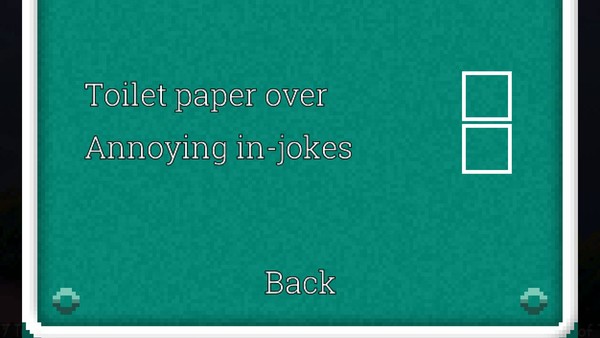
Unfortunately, Thimbleweed Park's excruciating faithfulness to an abandoned genre held a mirror up to why adventure games had lost currency in the first place. Abstruse item puzzles and wall-to-wall nods to 'MMucasFlem Games' and exploding hamsters helped make the game inaccessible to newcomers, almost by design. Recognising it was part of the problem it was parodying, a later patch added both gameplay hints, and, for the benefit of the mouse-averse millennials, an option to turn off 'annoying in-jokes'.
4. Banjo-Kazooie: Nuts & Bolts
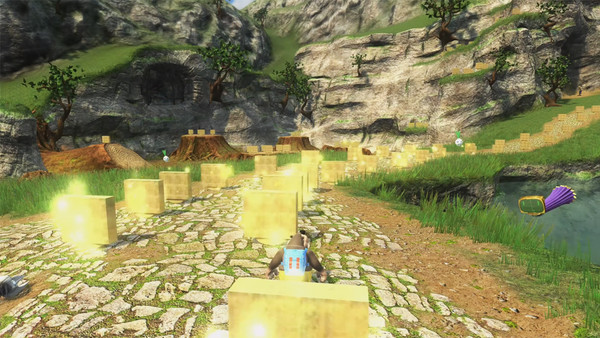
What's more fun than completing a jigsaw, than completing a jigsaw that forces you to find all the pieces on a beach, desert and even a haunted house first? For fans of the N64's bird-and-bear 3D platformer Banjo-Kazooie, the answer was nowt, with the possible exception of completing a jigsaw with googly eyes.
Unfortunately for them, developers Rare decided to completely shake up the puzzle for their first Xbox Banjo game, following Microsoft snatching the underfunded software darlings from Nintendo in 2002. Though originally planned as a remake or direct sequel, by this point designer Greg Myles was utterly shagged out from making collectathon after collectathon, the most recent being the tepidly received Starfox Adventures, and decided to go in a new direction.
The outcome was a peculiar build-your-own-car/platformer hybrid, half Lego, half the abysmal Gummi Ship sections from Kingdom Hearts. However, the game begins by breaking the hearts of item enthusiasts, sharpening their box-ticking pencils, everywhere. A rotund Banjo, having let himself go through years of inactivity, is forced to whip himself into shape by floating Pong spirit the Lord of Games (don't ask), by "collecting as many pointless things as possible." The world is then filled with thousands of spinny gold trinkets, but before the flabby fuzzster can even take a step, the LoG declares it tedious.
It's somewhat ironic then, that years later, Playtonic, a team made up of many former Banjo staffers, released Yooka-Laylee - a collectathon de force. It also, unsurprisingly, if unfairly, was criticised for being the oldest of hats.
3. Flower, Sun And Rain
Goichi Suda's Flower, Sun and Rain precariously walks a line more dangerous than Philippe Petit's in gently ribbing itself, drawing attention to the fact that the obscure PS2/Nintendo DS adventure game is, you know, sort of crap.
Like all of Suda51's divisive output, it is at least confident. The story revolves around 'searcher' Sumio Mondo who, in a general parody of video games' lack of urgency in the face of disaster, spends so much time helping the natives of Micronesian island Lospass solve their problems, he forgets the reason he was sent there - namely, to diffuse a bomb.
This, for reasons that can be summed up as 'gameplay contrivance', results in a Shadow of Memories style timeloop, as Sumio repeats the same day, solving everybody's problems episodically. It's all a lot of hot gibberish, then, but with a sly wink to the player.
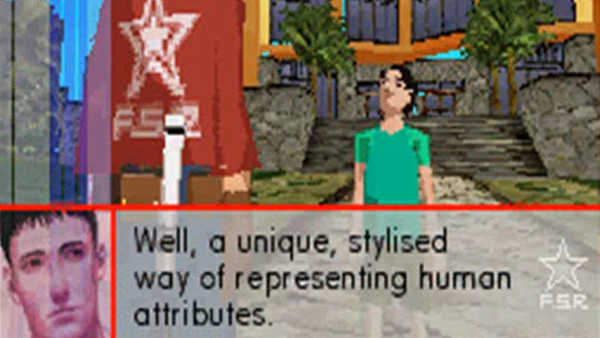
In one episode, an obnoxious kid called Shoutaro winds Sumio up something silly, pointing out the internal flaws in the game's logic - why, for example, is he wearing a dark suit on a Pacific island? - and even mocking its primitive graphics. Sumio - channelling Suda's rebuttal to critics of the PS2 original - explains the subpar visuals as "a unique, stylised way of representing human attributes". Riiight.
2. Donkey Kong Country
Rare's sparkling capacity for self-deprecation was in full evidence years before a portly Banjo huffed and puffed in pursuit of a ziggurat of joke jiggies, as seen in the Twycross company's watershed platformer, Donkey Kong Country.
After Nintendo became mightily intrigued with the Stamper brothers experiments' with SGI technology, they rather trustingly signed over one of their most important albeit dormant properties, Donkey Kong, to the Brits. The result was 1994's eye-popping swing-a-thon, which helped re-establish the long-absent ape, whilst making stars of Rare in the process.
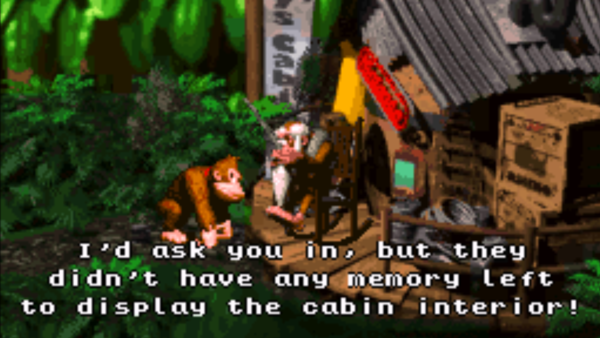
You'd think, eager to please their new bosses, Rare would have treated gaming's first gorilla's legacy with appropriate respect and decorum. Nope: the OG DK was re-contextualised as an onerous, faded mascot, perpetually put out by the modern era's polygons and colour palettes. When he's not handing out withering insults masquerading as 'tips', 'Cranky' Kong rants at his successor about the parlous state of '90s vidya games, including cracking quips such as "I bet they wasted half the memory already, just on this section alone!" and "I've got more game play in my little finger than you've got in this whole game!"
1. Don't Buy This
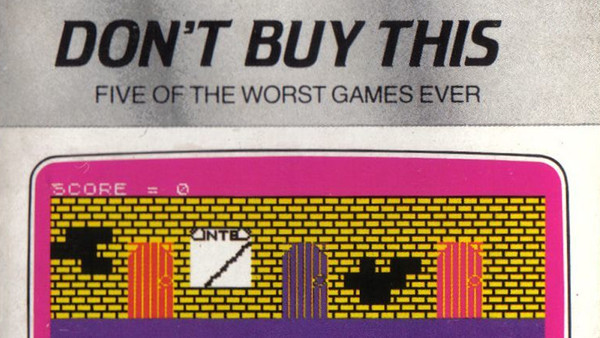
There's a fine art to advertising. Stopping short of self-proclaimed superlatives, most games nevertheless make fanciful, boastful claims on their marketing literature, hoping to convince the sap with sixty smackers in hand that the latest live service experience is well worth all of them. Few games ever truly deliver on their bluster. One ZX Spectrum title however, released in 1985, did so dramatically - and not exactly to the delight of anybody who bought it.
Don't Buy This: Five of the Worst Games Ever does exactly what it says on the cassette inlay. Rather than bin the utterly abysmal submissions sent to their studio, the publisher instead decided to package them into a sort of Greatest Sh*ts compilation, and flog it for £2.50. The liner notes warned that the unholy quintet disgraced the Speccie, whilst they encouraged buyers to "copy it at will". Any unhappy customer who wrote to complain earned a badge or sticker.
And wouldn't you know it, a set of games so bad that even the publisher discouraged people from buying it turned out to be a commercial hit. Nothing resonates with the British public quite like irony.