10 Video Game Genre Flips That Blew Our MIND
When developers flipped genres upside down, but managed to stick the landing.

Video games often seem like a simple relationship to most players, where gamers have the needs, and developers supply the goods.
You’re a fan of first-person shooters? You’re going to need your annual FPS fix (e.g., CoD). Fan of hack-and-slash? God of War has you covered. American football? Buy Madden. Want to explore the dating scene as a red-cheeked Japanese high school girl right out of an Anime? Well… you’re definitely a niche gamer, but there’s plenty on Steam and PSN to keep you satisfied.
It’s a transactional relationship that most developers wouldn’t dare betray - risk doing so, and they'll face the wrath of many an angry gamer via forums or classy review-bombing. Yet… sometimes a developer does have the guts to subvert expectations and stray from the norm.
In theory, it shouldn’t work - and more often than not, it doesn’t. But this list explores the exceptions to the rule: when a studio had an out-of-the-box concept, pulled off the daring feat, and somehow made it back at breakfast time for a smoked kipper.
10. NieR: Automata

You can always count on game director Yoko Taro to scoff at genre conventions. His high-fantasy ARPG Drakengard 3 sucker-punched players by shifting from a conventional Dynasty Warriors/God of War-style hybrid to a rhythm-game-based final boss battle. Meanwhile, the original Nier briefly switched genres so often it sometimes felt like it was doing it just for giggles.
Now let’s look at his arguable masterpiece, Nier: Automata. Not only does it represent the pinnacle of his work so far, it’s also his most relentless and erratic in terms of genre shifting. Just consider this list: action RPG hack-and-slash, bullet hell, on-rails shooter, 2D side-scroller, top-down twin-stick shooter, and text adventure - this game jumps through all of those genres… within the first hour!
To its credit, the game does calm down afterwards, settling into a third-person action-exploration core with unique offshoots at specific moments. And as scattershot as that all sounds, it somehow all works thanks to the glue that holds it together: a compelling, fascinating, and emotionally gruelling storyline about a central duo of androids attempting to find their humanity in the middle of a bleak, pointless conflict.
Without that central core, it could have easily felt like developer-level trolling. But paired with PlatinumGames’ trademark action mechanics, Taro instead delivered one of the essential games of that console era.
9. Undertale

What starts out feeling like a DIY version of SNES cult classic Earthbound quickly evolves into something much deeper and more compelling - memorable not only for its scrappy charm, but for the sheer number of genres it flips through, all propelled by the way players choose to approach its flexible narrative structure.
The gamer must pilot adolescent main character Frisk, navigating the monster-filled Underground from the opening moments, where they meet a colorful cast - none more memorable than Toriel, a kind, motherly figure, and Flowey, a talking flower with a real chip on his shoulder who taunts players about save-scumming.
From that fork, players can choose how they want to reach the end goal: kill everyone, kill only some, or kill no one. It seems simple enough, but based on the gamer's actions, the game can veer from a charming fantasy world sim, where the player chat their way out of conflict (and even go on a date or two), to an ominous survival-horror title complete with a battle-for-the-ages final boss.
What makes Undertale so unique is that these mental genre flips are all driven by the player’s choices, and no one else’s - making the switches feel organic, and making them work.
8. Inscryption

When Inscryption was released in 2021, it quickly gained recognition as a cult sensation and one of the year’s most unusual and surprising titles, earning several major nominations and awards. At its core, it presents as a deck-building card game with distinctive artwork, but surprisingly, it incorporates multiple unexpected twists that set it apart from similar games.
What begins as the expected card format in a dark gothic cabin - where the gamer is playing matches under tough roguelike rules - reinvents itself every few hours, dipping into elements of escape-room puzzles, top-down old-school RPG, and even FMV adventure game.
It handles some truly bizarre genre swerves, yet the reason it works is part of its magic. The plot is told from the gamer’s point of view, and as it unravels and expands from what looks like a simple game on the surface, their experiencing it all in real time. It grips the player right up until its final baffling moments.
Now that’s how you reinvent deck-builders.
7. Frog Fractions
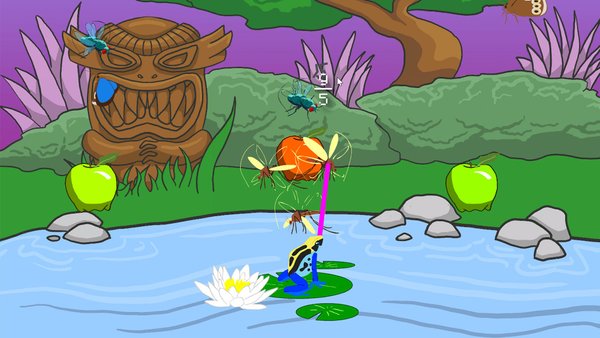
Not many kids who lived through the '90s hold much nostalgia for those old ‘edutainment’ games. Outside of letting us get away with playing video games during school - albeit extremely cheesy, barren, and non-engaging ones - you won’t find many people screaming for the return of the genre anytime soon. So one might be puzzled about the motivation for developer Stormdancer to attempt to do just that.
Well… it turns out that was never the intention to begin with.
Presented as a simple Flash game, homaging the (happily) forgotten genre, you play as a frog in a pond supposedly doing fractions in the name of fun education. But two hours later, when the credits roll, you realize you haven’t done a single piece of mathematics. Instead, you’ve: ridden a fire-breathing dragon to shoot down enemy bugs, flown to Mars and become its mayor to implement new laws, gone to court and fight your case Ace Attorney–style, and explored the deep ocean in search of new species.
Who would’ve thought a game like this would span the arcade shooter, bullet hell, flight game, text adventure, economic sim, political sim, underwater exploration, courtroom drama, and visual novel genres - all while doing everything possible to avoid its initial promise of math equations.
It all works, because that’s the whole point… and it’s frankly hilarious.
6. Brütal Legend

A rare situation where video game fan-favourite Tim Schafer and his Double Fine studio managed to land a big-budget deal, but it didn’t come without its speed bumps. Greenlit by Vivendi, axed by Activision, rescued by EA, and finally launched to middling sales - the result didn’t find its audience (at least initially), and one of the reasons could’ve been its zigzag road of genre destinations.
Jack Black (who was a major marquee name at the time) plays Eddie Riggs, a leather-clad, muscular roadie, whisked away to an underworld designed straight from the cover art of classic metal CDs. The story was filled with on-point punchlines, gorgeous and authentic worldbuilding, and quality voice acting - with cameos from Ozzy to Lemmy. Regardless, of the fan service, it did struggle with knowing what type of game it wanted to be.
At first, it presents itself as a third-person hack-and-slash with, eventually, open-world vehicular elements… so far, so 2009. But as the plot evolves, the world expands, and the gameplay ambitions grow, in come large-scale Stage Battles blending RTS and tower-defense mechanics, alongside rhythm-game solo boss battles.
The problem for many wasn’t that these elements existed, but how late in the game they appeared, creating pacing issues. Still, for its loyal audience, Schafer has never again been let loose at this budget and scale; the fact that he threw in every idea and the kitchen sink is part of its charm.
5. Doki Doki Literature Club

For those poor unsuspecting dating sim fanatics who picked up a copy of Doki Doki Literature Club expecting a straightforward couple of hours filled with cute anime girls chatting about cosplay outfits, getting good grades, and deciding which dreamy boy to grab sushi with on the weekend… oh boy, were you in for something.
At first, that is the premise: your unnamed protagonist bonds with adorable school chums like Sayori and Natsuki, contemplating a bright, technicolored future where the most stressful thing you do is write poetry in a scenic classroom. Then comes a brutal, disturbing plot twist: a major death that knocks the wind out of the majority of the audience.
From that point, the game transforms into a psychological horror opus with some of the best fourth-wall breaking since Eternal Darkness. Save file corruptions, distorted music, glitched dialogue, and more come crashing in as you try to navigate a suddenly hostile and ominous world.
Most will be hard-pressed to find another title like it. The reason it’s so memorable - and works so well - is precisely because of that genre swerve, veering the gamer straight off the road and plunging deep down into the black abyss below.
4. Asura’s Wrath

Oh, what an absolutely bizarre and brilliant gem this title was. Released in a year packed with iconic entries from the Far Cry, Borderlands, and Call of Duty franchises, this weird Capcom game didn’t stand a blooming chance… and it didn’t help that it felt as relentlessly erratic as a kid who just vacuumed up their entire Halloween stash.
Playing as Asura, betrayed by his fellow demigod protectors of Heaven and Earth (bear with me here). The game drops players straight into a bombastic god-tier battle that made the recently released God of War 3 look like your nan’s tea party by comparison - at one point, it literally has the gamer fight an opponent wielding a weapon the size of a planet. Right from the off, it makes clear its mandate: a caffeine-fuelled hybrid of Dragon Ball Z and a Kratos-style QTE revenge quest.
Well… it doesn’t stop there.
Soon, it throws the campaign into awkward on-rails shooting sections, frantic third-person combat, and eventually morphs into what’s essentially an interactive anime series with zero warning. It’s a lot, coming at the screen all at once, and the gameplay itself doesn’t always stick. But... It’s so OTT, unique, and unpredictable that it ends up being engaging from beginning to end - a rare feat in modern gaming.
3. Deadly Premonition
Certainly, most gamers worth their salt are fully aware of this critically lambasted game’s (2.0/10 from IGN) weirder-than-weird redemption arc. But for those that don’t: it was a terrible game with a story was so full of adorable quirks and goofiness that it became a so-bad-it’s-sort-of-charming white buffalo of gaming (think The Room of video games).
Blatantly ripping off the premise of David Lynch and Mark Frost’s iconic Twin Peaks TV show, it has special agent Francis York Morgan arriving in a small American town to investigate a nefarious murder, only to discover dark supernatural elements. It reads quite genric actually.
Well, cult developer Swery65 then proceeds to throw every popular genre of the late 2000s - survival horror, dating sim, open-world action, life sim, detective mystery - into a blender and flicks it to purée level. What comes out is a funky-smelling paste that does all of these things, and absolutely none of them particularly well.
Amazingly, you tolerate the bad, because the game is filled with such adorably odd characters and dialogue that you can’t help but sort of like it - and want to see how its ludicrous plot unravels. It has to be played to be believed... but you all know that by now.
2. The Stanley Parable: Ultra Deluxe Edition

It’s quite difficult to nail down what genre The Stanley Parable belongs to in the first place, before it bafflingly shifts into different lanes. It starts life as a witty walking sim with sly commentary on the illusion of choice in video games, deliciously delivered by its narrator, Kevan Brighting (give this man more work already!).
The plot begins with Stanley at work, suddenly finding himself in an abandoned office. He attempts to navigate his way out, but the task quickly becomes more difficult than expected. Looping puzzles grow stranger, endless branching narratives hound the protagonist, and leaving most gamers questioning whether choice exists at all - and, for that matter, whether the narrator is even an ally.
Later expanded into the Ultra Deluxe Edition, the narrator and Stanley venture even further left field, with players exploring surreal scenarios like endless holes and bizarre alternate realities. Strangely enough, it all works, thanks to the narrative device keeping the player’s feet on the ground throughout.
Still to this day, it's a one-of-a-kind experience due to its unpredictable, clever nature, and there's a fantastic PC VR mod out there that needs a play too.
1. The Messenger

Nowadays, we are absolutely flooded with indie-developed retro homages to both the 8-bit NES era and the 16-bit Super Nintendo era - but how many developers have decided to subvert the trend by smashing both enticingly together?
That’s exactly what Sabotage Studio did (who later developed the lovingly retro JRPG Sea of Stars homage), with a game that plays like a straight-up (yet tongue-in-cheek) Ninja Gaiden clone with pitch-perfect 8-bit graphics and music to boot: move the ninja forward, platform, dodge, and face off against some controller-smashing bosses - rinse and repeat, until the big baddie.
Then, the campaign hits what feels like the endgame… only for the gamer to discover that was only half the battle. Suddenly, not only do the graphics and audio shift into 16-bit, but the gameplay itself transforms - from a linear side-scroller into a full-on, sprawling spaghetti-mapped Metroidvania that stands as one of the best of the sub-genre.
It was a brilliant idea that makes one wonder why it hadn’t been done before. Regardless, it absolutely nailed the concept of a blatant genre shift that blew players away.