10 Things You Didn't Know About Castlevania
Vampires, Whips, and Trivia? It's either a Tuesday night or little-known Castlevania facts!

No matter how much faith they had in the game they were releasing in 1986, the folks at Konami likely never realized just how prolific the action-horror game Akumajo Dracula would become. Known in the west as Castlevania, the game predominantly follows the trials and tribulations of the Belmont family in their never-ending crusade against the vampire, Dracula.
Originally released for the Japanese Famicom Disk System in 1986, the latest major game release was Castlevania: Lords of Shadow in 2014. It's no secret that Konami has relegated the series to mostly the pinball machine world, but there have been over 20 major releases in the series in the thirty-plus years of the franchise's history.
The series has been referenced in numerous other media forms as well, including children's cartoons, comic books, and most recently - an animated series on Netflix which is utterly fantastic. But even if you've played all 20+ Castlevania games there are likely some secrets even you don't know. Light some candles to set the mood and get your holy water and bullwhip while we look at some Castlevania history you might not be aware of.
10. Castlevania Is Full Of References To Other Franchises

If you've played the original Metal Gear Solid with Castlevania save data on your memory card, then you got to witness Psycho Mantis ask Snake if he liked the other Konami franchise. Of course he does, it's a mostly great series. But did you know that the references go in the reverse, too?
Castlevania games are replete with random Konami references, such as being able to kneel in various spots of the first game to summon small Moaui head statues from Gradius. In Dawn of Sorrow you can kneel between two sets of spikes to summon Konami's old mascot 'Konami man'. There are even some deep-cuts, like an item in Circle of the Moon which will turn the character into Beartank, a character from the 1998 fighting game Rakugakids, that likely few have even heard of.
But the references don't end with other Konami titles. In Aria of Sorrow, the player can acquire an item from the Cagnazzo enemy - named after a character from Dante's Inferno - which calls forth a Cagnazzo-like entity which punches enemies repeatedly while yelling 'Ora, ora, ora' like the Star Platinum stand from Jojo's Bizarre Adventure.
9. Many Changes Were Due To American Sensibilities

The original title of the franchise was Akumajo Dracula, which translates as Demon Castle Dracula. However Senior Vice-President of Konami America at the time, Emil Heidkamp translated it closer to Dracula's Satanic Castle. Heidkamp expressed concerns over American sensibilities over the religious context of a 'Satanic' title and the name was changed to Castlevania as a reference to the Transylvanian setting and the whole game taking place within Dracula's Castle.
Nintendo of America further added to changes to the western releases with their prohibitions to blood, nudity, and religious imagery. This can be seen in such blatant changes as putting togas on nude marble statues, to recolouring the blood in Bloodlines, all the way to subtly changing the way allies react to being hired in Castlevania III. In the Japanese version they kneel and kiss Belmont's hand, but in the western version they just shake hands politely.
One of the more interesting changes is the in-game soundtrack of the Game Boy release Castlevania II: Belmont's Revenge. In the original release, the songs have titles like New Messiah and Sons of Satan, but the western release has them named as BGM 1 and BOSS 3, respectively.
8. Igarashi Koji Isn't The Original Creator

Now, don't get me wrong - Igarashi Koji is a masterful developer and he was a leading force behind one of the best in the series: Symphony of the Night, which basically created the Metroidvania subgenre. Igarashi's future wife worked on the Castlevania team and he is said to have played the game she was working on, Rondo of Blood, during his breaks from writing Konami's 1994 dating sim, Tokimeki Memorial.
After Tokimeki's success he was allowed to join the Castlevania team. But here's the thing: Igarashi gets blanket credit for Castlevania's existence, when in reality he didn't join the Castlevania dev team until Symphony of the Night - which he wasn't even he lead developer on.
Credit for the actual creation of the franchise should be placed on Akamatsu Hitoshi. Hitoshi wrote, designed, and helped program the first Castlevania game, and he then directed the following two games: Simon's Quest and Dracula's Curse. Igarashi would admit in an interview that his favorite game in the series was Akamatsu's final title, Castlevania III: Dracula's Curse - so much so that it is the basis for the Netflix animated Castlevania series, which Igarashi helped Warren Ellis dream up way back in 2007.
7. The Creator Disappeared After Konami Disrespected Him

Akamatsu Hitoshi had a grand vision for Castlevania, and for the most part he achieved it. An argument could be made that he was more of a film director than a game developer, given his take on game design. He compared making Castlevania to making a movie numerous times.
After the first game in the series, which was a huge success, he went on to make the following two sequels, Simon's Quest and Dracula's Curse. Unfortunately both of those games sold poorly and Konami, as Akamatsu would later say, cared about profits over talent. Akamatsu was effectively demoted and has only a few minor credits to his name after that.
After working in a Konami gaming center for a short while, Akamatsu eventually resigned from the company. From there, in the early 90s, he seems to have basically disappeared from the industry. Outlets have tried to find him for interviews in recent decades, but no one seems to be able to find the man.
This has, of course, resulted in conspiracy theories claiming that Akamatsu never really existed in the first place. One theory is that Akamatsu's name was a pseudonym for Igarashi Koji, who started with Konami around the time of Akamatsu's resignation. Spooky.
6. The Credits Are Full Of References To Films

References to other media don't end with the gameplay. In the first game, there are numerous coded references to legends of classic film franchises. This is due to two major points: The original designer, Akamatsu Hitoshi, was a huge fan of western movies, and Konami's rule that no real names could be placed in the credits of their games.
Some of the more prominent names are Vran Stoker and Belo Lugosi: thinly veiled references to Dracula author Bram Stoker, and arguably the most famous actor to play the character in film, Bela Lugosi. We also have Trans Fishers and James Banana, which are references to to Terence Fisher and James Bernard - the former being the director behind Dracula and other entries in the Hammer Films era of horror movies, the latter being the composer for said films.
Also included in the credits is Barber Sherry, a reference to Barbara Shelley, known as "The First Leading Lady of British Horror", who sadly passed away a few weeks ago on January 4th after a bout with COVID-19.
5. Symphony Of The Night Almost Had Room Decoration

Being able to decorate a room is a major feature of games like the Sims and Animal Crossing. But you can also see a much simpler version of this trope as having an area that slowly morphs and changes as you progress or achieve objectives in the game. You can see it in A Plague Tale: Innocence, where trophies appear in the ruined castle, or Assassin's Creed IV: Black Flag on the shelf by your desk that slowly fills with novelty figurines of the characters in the game.
One of the greatest games in the series, Symphony of the Night, had you playing as Dracula's half-blood son, Alucard. During development there was some thought put into the idea that Alucard's bedroom would appear in the game and it would contain a character called 'Skeleton Carpenter'.
As you progressed through the game, said Carpenter would progressively build Alucard more furniture in the room. Alucard was also going to be able to pick up collectibles and decorations to place in the room. Unfortunately this genius feature was cut before the game was completed.
4. Alucard Is A Good(ish) Catholic

In Symphony of the Night, Alucard can happen upon a church with a confessional. If he sits on the right side, normally where the priest would in a confession, a female ghost may appear on the left side. The ghost may either confess her sins to Alucard as if he were the priest or she may attack him, angrily.
Likewise if the player has Alucard sit on the left side he will lean forward and confess his own sins to the ghost of a priest. If the ghostly priest appears he will accept Alucard's confession, tell him to rest for a bit, and drop a healing item when he dissipates.
This would fit narratively as Dracula is based on Vlad III, the ruler of Wallachia and Transylvania, also known as Vlad the Impaler. Vlad was a Roman Catholic for most of his life. However in the game's lore, Dracula is actually Mathias Cronqvist - who is based on another Catholic, Matthias Corvinus, the King of Hungary during Vlad III's reign. Interestingly, the real Matthias is often known as Matthias the Just.
3. The Belmonts Were Almost The Dantes

The hero of the first game is Simon Belmont, or in the original Japanese Shimon Belmondo. Simon is the descendent of the first man to fight Dracula - Leon Belmont, a former crusader who would found the cursed Belmont line to Christopher, Trevor, Richter, and beyond.
But in the original design, the character was supposed to be a tribute to Peter Cushing, of Star Wars fame, and Dante Alighieri. Cushing played Abraham Van Helsing in the Hammer Dracula films and, of course, Alighieri wrote the Divine Comedy. His name was to be Peter Dante.
Both Dracula and the Divine Comedy would give plenty of inspiration for the series, but not in the naming of the series' first hero. The creator of the series took a lot of inspiration for Simon from the legendary Romanian folk-hero Făt-Frumos, a handsome, proud, and courageous prince who defeats mythological beasts. His name is often translated from Romanian as 'Prince Charming'. Add in Indiana Jones' whip and you've got Simon almost to a 'T'.
Unlike either Făt-Frumos or Indiana Jones though, Simon was almost able to equip an item that would allow him to turn into a lycan. Can you imagine Harrison Ford as a Romanian Werewolf?
2. Yoko Is A Lot Older Than She Seems
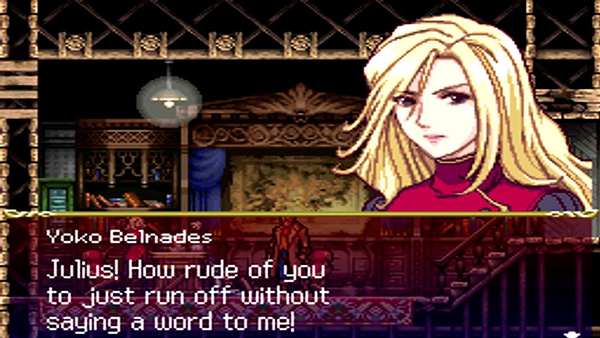
Yoko Belnades is a young witch serving the church during the events of the games Aria of Sorrow and Dawn of Sorrow, which are set in Japan. Aria of Sorrow, Yoko's debut, was released in 2003 on the Game Boy and though it didn't sell well in Japan it did do well in the west, which is ironic given the shift from a European setting to a Japanese one.
Yoko was originally conceived as a character in the 1993 Sega Genesis release Bloodlines, the only Castlevania release on Sega's console . She was planned to be an analogue to the earlier character Grant Danasty, and would play like a ninja who would throw shuriken. Her name in Bloodlines was planned to be Yoko Felnades, so it's possible she wasn't originally intended to be a descendant of Sypha Belnades like the final character is.
Fans refer to the two games Yoko appears in as Chronicles of Sorrow, even though no official work contains such a title.
1. There Was Almost An Open-World Castlevania In 2006
Konami has several well-known franchises under its belt aside from Castlevania, such as...Silent Hill. So what would you say to the news that Silent Hill: Origins developer Climax Studios pitched an open-world Castlevania set in Venice, starring a depressed rock star who inherits the Belmont whip?
Welcome to the shattered world of rock star Michael Cross, who is mourning the suicide of his girlfriend. While vacationing in Venice, Italy, he rushes to the aid of the person in the next hotel room over to find a member of the Belmont clan mortally wounded. They tell him to take their crucifix and whip, head to a particular address, and then give Cross a message from his dead girlfriend.
And that would have began an open-world adventure in Venice, filled with mask-wearing citizens who turn monstrous in the evenings, complete with a day/night cycle. Cross apparently would have been much like Devil May Cry's Dante by using the Belmont whip up close and pistols at a distance. Cross could also equip masks taken from defeated enemies to learn new abilities.
Had this game been greenlit by Konami, it could have done what Symphony of the Night did to create Metroidvanias by creating a new subgenre: Devilvania, perhaps?