10 Things We Want From Elder Scrolls 6
Our next trip to Tamriel could be the best one yet.

The Elder Scrolls V: Skyrim was a genre-defining game, the sort that captured and commanded mainstream attention like few others can. You might argue that Oblivion or Morrowind were the better games in the series, but Skyrim’s popularity and longevity have been pretty much unmatched since it released in 2011.
The Elder Scrolls Online might have tided some fans over, but plenty of others are clamouring for a new single-player Elder Scrolls game, a chance to explore new dungeons, meet new characters, and put new cabbages in new baskets.
Given that Fallout 4 wasn't officially unveiled until a few months before release, it's unlikely that we'll see any concrete announcements regarding The Elder Scrolls VI any time soon. Both the Elder Scrolls and Fallout series tend to operate on 4-5 year development cycles, and while it's already been more than five years since Skyrim was released, Bethesda's Pete Hines has sternly reminded the world that TES VI is not currently in development.
Considering Skyrim sold over 30 million copies across nearly six years though, it's pretty much a given that a new Elder Scrolls game is in the works to some degree. While Skyrim and its remastered versions still hold up well all these years later, there are certain features, locations, characters, and hopefully, bugs we'd rather didn't show up again, and others that we’d love to see realised or refreshed in the next instalment (except the bugs, of course!).
10. A Fresh Setting

Since Morrowind, each Elder Scrolls game has been named for its respective location (Oblivion took place partly in Cyrodiil, and partly on the plains of Oblivion, but The Elder Scrolls IV: Oblivion sounds a lot cooler than The Elder Scrolls IV: Cyrodiil). If Bethesda chooses to follow this convention once more, it's likely we'll see another instalment that's heavily entrenched in a particular province's history, lore, and political tensions. A lot of the series’ allure lies within its flora & fauna, its architecture, and its diverse species and cultures, so choosing a fresh and enticing setting is crucial.
Having already experienced Skyrim, Cyrodil, Morrowind, and High Rock in standalone games, as well as other provinces in The Elder Scrolls Online and the original Elder Scrolls: Arena, we’re eager to see more fleshed out versions of places like Elsweyr, Valenwood, or the Summerset Isles.
A joint campaign set across Elsweyr and Valenwood would be perfect. Getting the chance to explore dense rainforests and arid desert wastes would make for a nice change from freezing to death in the Nord homeland, and there's plenty more to learn about the Khajiit and Bosmer, two species that took a back seat in The Elder Scrolls V.
9. Classes And Star Signs

One advantage Oblivion had over Skyrim was its class system. Rather than offering up every available skill carte blanche, Oblivion’s classes and star signs helped you to form a more focused character from the get go, letting you choose between a wide variety of different character moulds.
Classes had their routes in Dungeons & Dragons, and determined which skills and abilities your character could more easily progress in, without locking you out of pursuing other avenues if you chose to do so. Star signs, on the other hand, granted the player magical abilities or attribute bonuses.
The former element was completely removed from Skyrim, while the latter was replaced with a set of stones which could be prayed to, in order to unlock similar benefits. Although this might have made for more freedom early on in the game, it removed the sense of identity that came with choosing to be a Witchhunter, Bard, or a Pilgrim at the outset of Oblivion.
Benevolent modders reintroduced classes and star signs into Skyrim, and completely altered the way players approached the game in the process. Hopefully, this feature, or something similar, will return in the next series instalment.
8. A Substitute For Dragons

Dragons were one of Skyrim’s main selling points, winged beasts that could appear at a moment’s notice and engulf an entire village in flames. As the Dragonborn, you were a solo Dragon-buster, the one individual with the power to slay Alduin, but that didn’t mean you should always try to take on the fire-breathing menaces in a straight fight.
Random dragon encounters were often too difficult to win, and were best avoided until you were absolutely sure you’d have the advantage. Oblivion had something similar going on; gates to the plains of Oblivion that would open up in the middle of a meadow or at the top of a mountain, and were often very challenging to close.
The Elder Scrolls VI arguably needs something similar, a kind of boss-centric gimmick that could present a threat to the player at any time, forcing them to remain alert and ready. Nobody wants to see dragons make a return (otherwise what was the point in killing them all?), but other ‘radiant’, high-level enemies wouldn’t go amiss.
7. More (And Better) Factions

Skyrim borrowed a lot from Fallout: New Vegas, with one of its most notable acquisitions being the inclusion of factions. New Vegas was all about backing a horse, choosing the best (or worst) of a bad bunch and installing them as the leader of post-apocalyptic Vegas. Skyrim has similar elements, but they didn’t feel quite so fleshed out or integral to the game’s political landscape.
Sure, you could choose to side with the globalist, expansionist Imperials or the anti-immigration Stormcloak nationalists, but regardless of which you picked, the world around you would remain largely the same. You could even go ahead and assassinate the Emperor, despite being an Imperial soldier yourself, and no one seemed to care in the slightest.
It would be great if the next Elder Scrolls game introduced more than just two major factions, especially if these groups had more of an impact on the country as a whole.
6. Silent Protagonists
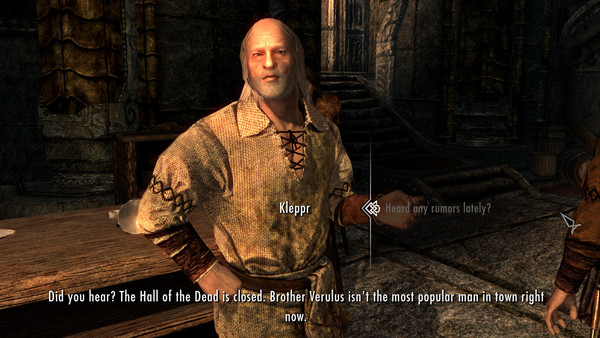
In hindsight, Fallout 4’s conversation system was a failure. Bethesda introduced voice acting as a way of making you feel more connected to your character, but it wound up greatly reducing the amount of conversation options at your disposal.
In the end, most of Fallout 4’s quests could be approached by picking from four options: kill all the people, be nice to all the people, be a sarcastic jerk to all the people, or ask another question. There was very little depth or variety to the game as a result, and if Bethesda were to go down a similar route with The Elder Scrolls VI, we could see the same results.
It all comes down to budgetary concerns. It’s theoretically possible to implement a fully voice-acted conversation wheel that’s full of interesting and varied options, but it takes a great deal of time, money, and work to see it through.
There are also other factors to consider, like the many varied species available in The Elder Scrolls universe. To force players to choose only human races, all for the sake of voice acting, would be disastrous, so too would be picking an Argonian or Khajiit, only to find that they talk like Nolan North.
Perhaps a return to silent protagonists would be the best bet after all – it would keep the game’s roleplaying aspects feeling unique to each player, and would save Bethesda a lot of time and money that could then be spent on other parts of the game.
5. New Guilds, And Some Old Favourites

Completing guild quests is one of the most enjoyable parts of the Elder Scrolls series, often more so than the games’ main quest. The problem is, they’ve kept to a fairly rigid formula over the years: you steal stuff for the Thieves Guild, fight stuff for the Fighters Guild (or closest approximation), mage stuff for the Mages Guild, and stab stuff for the Dark Brotherhood.
Most people tend to gravitate towards the Thieves Guild and the Dark Brotherhood, simply because their questlines involve so much more mystery and intrigue, and contain a lot more interesting characters. Quests for the Mages Guild and the Companions (Skyrim’s answer to the Fighters Guild) pretty much revolved around clearing out regulation dungeons to collect trinkets.
Bethesda should seriously think about trying something new when it comes to guilds; nobody wants to see the Mages or Fighters Guilds disappear, but perhaps they need to be revamped a little, so we’re not simply re-treading old ground.
Some new guilds might be in order too. Skyrim offered up the Bard’s College as an ancillary guild of sorts, but its quests mostly involved searching caves for lutes and drums. Maybe TES VI has a Hunter’s Guild or an Explorer’s Guild? Maybe there’s a Blacksmith’s Union that helps you train in smithing, but later turns out to be selling weapons to criminals and bandits? These are just elevator pitch ideas, but they’d go a long way towards freshening up the series while staying true to its roots.
4. Some Gameplay Balancing

It’s fair to say that Skyrim’s gameplay quirks weighted it heavily towards certain play styles. So long as you trained your stealth and archery skills to a high enough level, you could pretty much best any enemy, ducking out of sight even if they’d already spotted you several times over, and dealing them with a killer shot from out of the shadows.
It was also fairly easy to strap on your finest set of heavy armour, take up your nastiest looking warhammer, and start swinging for the fences.
Trying to master magic, on the other hand, was a completely different matter. Although you could eventually unlock incredibly powerful spells that made you almost untouchable, it seemed like so much more of a grind to earn them, when easier, more direct options were available. Early destruction and conjuration spells felt weak, while skills like alteration and illusion seemed to serve very little purpose in battle, especially when any enemy stronger than a mudcrab got within three feet of you.
Bethesda could do with balancing out their core skill groups, perhaps taking some of the power away from melee and ranged abilities, and lending a little extra, at least in the early game, to magic users. At the very least some more battlemage armour wouldn’t go amiss, so that mages don’t need to enter every battle wearing little more than a dressing gown made of burlap sack.
3. Survival Elements

Nobody wants to see The Elder Scrolls turned into yet another Minecraft/Day-Z wannabe, filled with mundane crafting tasks and punchable trees. That doesn't mean the lessons learned from survival games should be avoided whole cloth, however, as some such features can really enhance the way you play an open world RPG.
We saw this with Skyrim, when various modders added dynamic cold, hunger, thirst, and fatigue elements to the game, as well as ways to combat them. You could equip heavy fur coats to avoid the chill, cook food over a warm fire to prevent starvation, and steering clear of water was essential if you wanted to avoid freezing to death. These gameplay tweaks were similar to those found in Fallout: New Vegas’s hardcore mode, but they completely transformed the way you went about playing Skyrim.
Were similar features to be implemented into The Elder Scrolls VI, they’d probably need to remain optional. A lot of people like to play Skyrim as a story-driven RPG or a straight-up exploration game, so forcing them to endure Bear Grylls-ian trials seems a little unfair. But that doesn’t mean the option shouldn’t be there, for those who want to give it a try.
2. Funny Bugs, Not Game Breaking Ones

Bugs tend to divide Bethesda fans. I’m not talking about cazadores, either, which are universally hated, but rather the frequent and varied glitches that can both make and break an otherwise enjoyable campaign.
Skyrim and Fallout 4 were both riddled with bugs upon release, and while some of these created hilarious, unscripted moments that were more entertaining than the vanilla game itself, others served only to halt or even erase your progress, rendering hundreds of hours of play time a waste.
Bugs are an inevitability - such is the nature of game development - and if Bethesda were to QA test every single corner of their vast, expansive game worlds, we'd undoubtedly have to wait a lot longer before being able to explore them ourselves. But we can at least pray to Talos that we get a lot more floating Argonian heads and animation lock ups than we do game breaking bugs and crashes to desktop.
Speaking as someone who couldn’t progress through Fallout: New Vegas without first acquiring a specific kind of cowboy hat, game breakers aren’t fun.
1. Mod Support

Bethesda landed themselves in hot water back in 2015, when they attempted to introduce paid mods to the Skyrim Workshop on PC. The idea was that mod creators could now charge money for their work, thus generating income for what was often a substantial undertaking. Although it sounded like a noble concept on paper, the feature was panned by players and modders alike, and was dropped only a few days later.
The company has had a tumultuous relationship with the modding community ever since, flip-flopping on their promise to support mods on console versions of Fallout 4, before eventually going through with it. Having since included mod support on both PC and console versions of Skyrim: Special Edition, it seems likely that the same will happen for the next Elder Scrolls game.
Ultimately, the Elder Scrolls needs mods in order to stay relevant after release. Thanks to their long development cycles, each time a new Bethesda game comes out, they already feel a little outdated in the graphics department. That’s where modders step in, to touch up water effects, improve animations, or even implement new features that Bethesda’s team hadn’t considered while building the game.