10 Most Overrated Video Games Of The Decade (So Far)
These games are good, but they aren't THAT good!

2025 officially kicks off the second half of the decade, making now the perfect time to look back on the prior five years to see just how well – or poorly – the eighth console generation came to a close and the ninth console generation got going.
Undoubtedly, this decade’s given gamers some truly amazing offerings, such as Alan Wake 2, Spider-Man 2, God of War: Ragnarök, and Elden Ring. At the same time, though, many players endured some truly awful ones, too, including Suicide Squad: Kill the Justice League, Forspoken, Babylon’s Fall, and of course, The Lord of the Rings: Gollum.
But what about the projects that land somewhere in the middle, delivering good (if not great) experiences that simply don’t deserve the massive amounts of industry praise and consumer love they’ve received?
Well, wonder no longer, because that’s what this list will dive into by discussing the 10 most overrated video games of the decade (so far).
To reiterate, none of these picks are bad or even mediocre. On the contrary, they’re still superb creations that come highly recommended. It’s just that they’re not quite as revolutionary, immaculate, and/or overwhelmingly enjoyable as critics and casual gamers might have you believe.
10. Resident Evil Village

2017’s Resident Evil 7: Biohazard was precisely the shot in the arm the series needed. In addition to being the franchise’s first mainline foray into first-person POV, its likeable new protagonist (Ethan Winters) and backwoods locations resulted in the scariest and freshest Resident Evil journey in years.
Its sequel – 2021’s Resident Evil Village – was a solid continuation that felt like both a direct successor to Biohazard and a spiritual successor to the masterpiece that is Resident Evil 4.
After all, it leaned into gothic horror by bringing Ethan to a snowy European village (where he fights werewolves, deranged villagers, and aristocratic castle dwellers). Consequently, it won multiple Game of the Year awards, and some people still champion it over Biohazard as a top-tier part of the saga.
Although it’s good, it’s not that good.
Primarily, it’s much easier than Biohazard, with wonky A.I. and Ethan’s ridiculous ability to live through anything making it a breeze to survive any situation. On that note, Ethan’s less interesting and perceptive than before, and there are numerous story contrivances and inconsistencies that yield a less polished, frightening, serious, and compelling narrative and setting.
Even the big baddies pale in comparison to what preceded them.
9. Pokémon Legends: Arceus

Several modern Pokémon games could take this spot because their mere existence prompts nostalgic fans to forgive issues such as technical setbacks, lackluster visuals, monotonous plots, limited features, and repetitious gameplay.
2022’s Pokémon Legends: Arceus – which garnered perfect or almost perfect scores from numerous noteworthy publications – is the most overrated of the bunch, though.
Why? Because of how easily and frequently its fresh and experimental features (a new region, expanded exploration, lifelike Pokémon) overshadow its glaring problems.
Despite some post-launch patches, Pokémon Legends: Arceus remains a technical mess whose multitude of bugs, glitches, slowdown, and graphical hindrances (poor lighting, pop-in textures, etc.) hinder its charming art style and open-world flexibility. At times, it’s downright unplayable, and the Nintendo Switch’s outdated hardware can only share some of the blame.
Adding insult to injury is its sluggish pace, with a prolonged tutorial slowing things down before the game requires that tedious and obligatory research tasks be completed before moving on with the main story.
Even when it’s running smoothly and the player has the most freedom to sightsee, Pokémon Legends: Arceus routinely includes empty and unappealing environments that are difficult to navigate.
Oh, and the amount of required backtracking is really unfun.
8. Splatoon 3

When the first Splatoon released in 2015, it signified the birth of one of Nintendo’s most exciting and beloved new properties. Thankfully, its 2017 sequel improved upon it in several ways, just as 2022’s Splatoon 3 shook things up a tad with new weapons, storylines, customization options, maps, modes, and gameplay dynamics.
As such, there’s a clear argument to be made that – overall – it’s the best Splatoon thus far.
Even so, and with the figurative rose-colored glasses removed, it’s easy to see that Splatoon 3 doesn’t push the franchise forward nearly enough (and actually does some things worse than Splatoon 2). Therefore, it falls short of the hype that initially surrounded it (and still does to a certain degree).
For one thing, Splatoon 3’s Tableturf Battle card game is an unfulfilling and superfluous addition that complicates – rather than complements – the experience. Regardless of whether it’s improved since launch, the game’s online connectivity continues to be intolerably unreliable, too.
Some maps (such as Mincemeat Metalworks and Brinewater Springs) are lackluster as well, and there’s too much grinding and currency required to unlock things.
To put it simply, there’s still too much frustrating and underwhelming ink covering Splatoon 3’s surface and cracks.
7. Deathloop

Developed by immersive-sim masters Arkane Studios – who’ve repeatedly proven themselves with the modern Dishonored and Prey series – 2021’s Deathloop should’ve measured up to their prior pedigree.
It's centered around an assassin named Colt Vahn who needs to kill eight Visionaries (and avoid being killed himself) to stop a time loop. With its engaging four-part day/night cycle, combat, and push to achieve the “golden loop” one-day cumulative victory, Deathloop seems chock full of clever systems and satisfying tension.
Nevertheless, it didn’t entirely merit being nominated for – if not winning – so many accolades across huge ceremonies such as the D.I.C.E. Awards, the Game Awards, and the Golden Joystick Awards.
Even with its ostensible variety, the gameplay gets repetitive quickly, with the same processes needed to execute the bounties. The player’s ability to craft and modify things isn’t as entertaining or significant as it appears, either, and although Colt and main antagonist Julianna Blake are absorbing characters, the rest of the adversarial Visionaries fall flat.
Beyond that, it's too easy to complete and thankless by the end due to its empty narrative/twists and basic side quests (among other issues). It may seem ingenious in concept, but Deathloop is often the opposite in execution.
6. Stray

Annapurna Interactive has quickly become one of the most alluring publishers in recent memory, with What Remains of Edith Finch, Flower, Gone Home, Telling Lies, and The Unfinished Swan being but a few of their many superbly touching and inventive titles.
2022’s Stray seemingly deserves a place on that list, too, as its inherently endearing premise – navigating an adorable stray cat and its drone companion as they evade robots, interact with NPCs, solve puzzles, and struggle to reach the surface world – positioned it to be an affective work of art.
Unsurprisingly, it earned rave reviews and an abundance of award nominations upon release. Once the novelty and charm wear off, however, Stray becomes a consistently cute yet also consistently boring walking simulator.
Throughout its journey, the cat is tasked with mundane quests that offer little more than superficial and fleeting rewards. Compounding that issue is the detached nature of the cat narratively and emotionally; however realistic it might be, it’s hard to connect to a central character that barely has agency or expressiveness in their own adventure.
There’s also a lot of underdeveloped lore that ultimately makes Stray seem like an empty shell hidden beneath an undeniably loveable feline face.
5. Assassin’s Creed Valhalla

The follow-up to 2018’s Assassin’s Creed Odyssey, 2020’s Assassin’s Creed Valhalla essentially applies Ubisoft’s tried-and-true open-world approach to a couple of new backdrops – Norway and England – and a couple of new frameworks (Norse mythology and Viking conquests).
By and large, it’s still a winning recipe for those who’ve not grown completely tired of the developer’s well-worn formula, particularly because of its well-crafted narrative, player agency, visceral (though uncharacteristic) combat, and beautiful landscapes.
As balanced and worthy of some worship as it may be, however, Valhalla is significantly buggier and more bloated than many diehard defenders like to admit.
Sure, the glitches are occasionally amusing, but before long, they just become irritating and disruptive (to the point that large portions of progress may go unsaved). Furthermore, Valhalla can take upwards of 100 hours to finish – due in part to having nearly 800 collectibles to find – thereby taking Ubisoft’s knack for overstuffing their games to new heights.
There’s also the generally useless raven companion, as well as the horrendous microtransactions, uneven pacing, padded out settings, and a sense of anticlimax when all’s said and done.
As good as it is, Valhalla is prime example of why quality is better than quantity.
4. Hitman 3

As a whole, the recent World of Assassination trilogy was a terrific way to revitalize the Hitman franchise for a second time following its brief but notable post-Absolution hiatus.
For the most part, 2021’s final entry in the three-part saga upheld the glories of its immediate predecessors, receiving numerous award nominations/victories and placements on many “best of” lists by the end of 2021 and start of 2022.
According to creators IO Interactive, it’s attracted at least 50 million players and become “the most successful Hitman game of all time” as well.
That said, Hitman 3 disappoints in a few key – and too frequently overlooked – areas.
For instance, it houses multiple underwhelming maps (such as bookends Dubai and Carpathian Mountains), and the narrative’s emphasis on seriousness over silliness sporadically makes it feel clichéd and unmemorable. Oh, and it doesn’t always resolve prior plot points in fulfilling ways.
There’s also an overarching sense of sameness and/or pointlessness regarding rewards and gear that sucks some of the potential novelty and thrill from the experience.
Hitman 3’s still a good time that’s worth diving into if you’ve already completed its two precursors, but it’s easily the emptiest and least satisfying chapter of the trilogy.
3. Marvel Rivals

The current video game market is saturated with free-to-play business models and hero shooters aiming to capitalize on the successes of landmarks such as Overwatch and Apex Legends. 2024’s Marvel Rivals combines both approaches into a mostly likeable player-versus-player recipe.
The game is full of life, with gorgeous visuals, plenty of customization, and roughly three dozen enticingly distinctive heroes to take into battle. Given the amount of hero shooters that’ve failed in recent years – such as LawBreakers, Battleborn and Concord – the fact that Marvel Rivals nails its Marvel aesthetic and provides an occasionally good time is worth commending.
However, even its mid-70s Metacritic scores (as of this writing) and widespread love from gamers seem inflated considering some of the game’s major faults.
For instance, its main menus are awkwardly designed and difficult to navigate, with prerendered transitional animations slowing things down further. As with many free-to-play projects, cosmetic unlockables are costly yet they also take far too long to unlock purely by leveling up.
Worst of all, many characters’ movements and powers are clunky and egregiously limited, making it a slog to move and fight across several overly large yet barren environments. The clumsy tutorial options don’t help much, either.
2. Returnal

Although they’ve been creating games for roughly 30 years, it was 2021’s roguelike third-person shooter Returnal that put developer Housemarque on the map. At the same time, it became one of PlayStation’s biggest new IPs.
Framed around an astronaut who gets stuck in a time cycle while investigating a peculiar signal, Returnal’s horror/sci-fi vibe and gameplay loop makes it as addictive as it is scary. Of course, its immersive audio/visuals and unique weapons/perks are the cherries on top of that inherently appealing sundae.
Nonetheless, Returnal isn’t quite the masterpiece its reputation indicates.
While it presents a variety of tools with which to rescue yourself and fight foes, they could be more diverse and substantial (not to mention less randomly generated). On the surface, the plot is interesting, but it runs out of steam long before Returnal reaches its climax, too.
Adding insult to injury, and recognizing that roguelikes are usually unforgivingly difficult, the game’s strict Suspend Cycle and checkpoint rules mean that players potentially waste hours on productive runs that never get saved. Unsurprisingly, only about 20% of players roll credits because of its toughness and/or tedium.
It’s fair to say that Returnal isn’t all it’s cracked up to be.
1. Super Mario Wonder
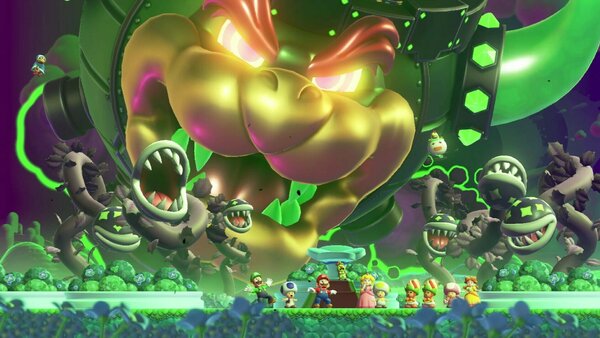
It’s bears repeating that saying something is overrated is not the same as saying it isn’t good, and it’d be foolish to imply that 2023’s Super Mario Bros. Wonder is anything less than another stellar side-scrolling romp with gaming’s favorite plumber.
Indeed, it looks, sounds, and plays great, with delightful graphics, music, levels, and gameplay making every moment immersive and fun. Plus, the new badges, power-ups, and Wonder Flowers ensure that the game checks off virtually every box longtime Mario fans could expect while also throwing in cool changes for good measure.
Therein lies the problem, though, as beneath its gimmicky surface, Super Mario Bros. Wonder is largely the same old formula Nintendo have relied on for literal decades at this point.
After all, Bowser shows up to ruin Mario and friends’ day by stealing something important from their kingdom, motivating Mario to conquer undeniably familiar foes and worlds (in undeniably familiar ways) as he chases after Bowser’s flying craft.
There’s a greater sense of “been there, done that” to the title than many people want to admit, and although the gameplay additions are nice, they aren’t nearly as revolutionary or impactful as the pre-release marketing (and some reviewers) suggested.