10 Horror Games That Don't Rely On Jump Scares
There are different kinds of fear, and these games look to explore them all.

If you were to hide behind a corner, waiting for someone to approach... then chances are there's something wrong with you.
But this is my example, so bear with me.
You stand there motionless, just waiting, knowing that they're approaching. Your heart beats in your chest as you feel them getting closer. Your muscles are coiled, ready to spring. Then your target appears and you leap forward, screaming, while a musical sting explodes with brass behind you.
They jump, physically shaken as their fight or flight instinct is awoken.
And why wouldn't they? That's a primal instinct that we all have, and it's so very easy to provoke for a cheap scare.
There are horror film franchises built on that exact sensation. Hell, there are horror game franchises built exclusively on it, too. What's more difficult is making people scared without relying on this feeling; creating an overwhelming sense of dread that pervades the very soul from beginning to end.
These games manage to do just that. While some of them also use jump scares, they never rely on them, instead creating an atmosphere that leaves you getting more and more scared throughout your time invested, in these terrifying worlds.
10. Hellblade: Senua's Sacrifice

In Hellblade, you play Senua who is making the journey through Hell in order to get the soul of her murdered lover back.
If that and the armies of undead monstrous vikings weren't enough, Senua also has to deal with some severe mental health difficulties that have only gotten worse since she lost her anchor to the world.
Those difficulties present themselves all throughout the game in many ways, but mostly through a series of voices in Senua's head that are with the player all the way through. They whisper to Senua, some of them assuring her, others telling her that she can only fail and that she causes all the problems she's encountering, plus the troubles those she loves have gone through.
In an inspired bit of gameplay, the voices are useful in combat, warning when an enemy is about to strike from behind, allowing the player to dodge or counter. Through the course of the game you come to rely on these voices, even missing them when they're temporarily gone.
You find yourself trusting the voices that tell you you're worthless, and everything wrong with the world, and that's genuinely horrifying.
9. Fatal Frame 2

There's a moment, near the start of 2003's Project Zero 2 (Fatal Frame II in some countries) where Mio and Mayu, the twin sister protagonists, are about to enter a very haunted village. The village of Minakami (All God's Village) has a legend surrounding it that says any who enter through the woods will be lost to the village for all time.
At this point in the game, the twins have only experienced a creepy vision, but not seen any ghosts, and haven't even discovered the camera that will let them try to fight back against the unquiet dead.
As they arrive at a door, Mayu wonders aloud if anyone is there. A hand comes to rest on her sister's shoulder as she replies to confirm, but as we see her reach up to touch said hand, Mayu walks by instead, meaning that unidentified hand certainly isn't Mayu's. The hand withdraws and a creeped out Mio looks back to find... nothing.
There are plenty of jump scares in the game, but it's moments like this that slowly build an ever-pervasive atmosphere, making those jump scares so effective, and leaving the player genuinely creeped out in ways other horrors of the time couldn't hope to match.
8. Friday The 13th

Friday The 13th is an asymmetric multiplayer title that sees all but one of the players portraying several campers running all over Camp Crystal Lake, looking for the items they need to make their escape from Jason Voorhees.
That last player controls Jason and chases them, using special abilities to appear where they least expect it, setting traps, and slowly killing as many of the campers as possible.
While the gameplay itself doesn't rely on jump-scares for the players, the creation of jump scares should always be something the Jason player is thinking about. He needs to use his abilities to appear outside the building where players are located, bursting through the door, throwing knives at them when they least expect it, and smashing through the window.
While the other players are expecting this, the characters react as they would in the films, becoming so scared that their terror affects all of their actions, making them louder and easier to track.
And the panic created when your character is running squealing through the woods with the classic theme playing to indicate Jason is somewhere close - that's where the fun lies.
7. Siren

Siren is one of those games that doesn't lend itself easily to being described.
You play as one of several survivors from a curse that has affected an entire village, turning everyone into a kind of intelligent zombie. Each level presents you with a small area being patrolled by these "Shibito", and tasks you with escaping from the area.
This might be as simple as crossing the road or as complex as collecting items and running from an alarm. Really, it's better than it sounds (and, thanks to some awful British dubbing, it sounds terrible) to play the game.
As the game progresses and the curse takes hold, your characters start to get linked into the hive mind connecting the Shibito, allowing you to psychically tune into them and see through their eyes.
Normally, you use this to watch them as they go about their patrols, helping you find a clear route through the area.
The true terror comes when, looking through those eyes, you catch a glimpse of yourself from behind, crouched in the bushes you thought were safe, as the Shibito comes up behind you, a sickle raised to strike.
6. Alone In The Dark: The New Nightmare

Alone In The Dark is one of the granddaddies of the survival horror genre but, by the time 2001's The New Nightmare came out, it had fallen into the mold set by the Resident Evil games. There was a creepy mansion where terrible experiments were going on. There monsters to be fought, many of which needed to be lit by a torch before shooting them. And there were two characters; Edward Carnby, who'd been a primary character of the series since it began, and new character Aline Cedrac.
It's when playing as Aline in the original PlayStation version of the game (the game was re-released on the PS2 without the hallway scene, only adding to the feeling of insanity it causes) that we find Judas De Certo trapped in a mirror. He calls to Aline as she makes her way down a corridor, repeating her name.
Solve the puzzle you're doing and it lasts maybe two minutes. But, get stuck, as this writer did...
Aline, aline, ALINE, aLiNe, aline, ALine, aliNE.
Over and over the voice calls to you, rising and falling in both pitch and timbre, terrifying, and never ever ending.
5. The Thing

The Thing is a sequel to John Carpenter's 1982 film of the same name where players take the role of Captain Blake, a special forces team leader sent to the same Antarctic outpost to figure out what happened to the research team.
There are plenty of monsters in the game, all of them offshoots of the Thing itself, but they're cannon fodder for the most part and no match for your team. That team will be bolstered through the game by finding engineers, medics, and other soldiers to come with Blake and give the player access to new abilities.
It's actually with the team that the horror lies as, like the film before it, the game plays on paranoia. Any member of the team may become infected and the only time you'll find out is when you test them or they turn against you. Conversely, these team members have different levels of trust with the player and will turn against Blake if they don't trust him enough.
It's a rare game that can manage to simulate paranoia like this, but The Thing does so with aplomb.
4. Anchorhead
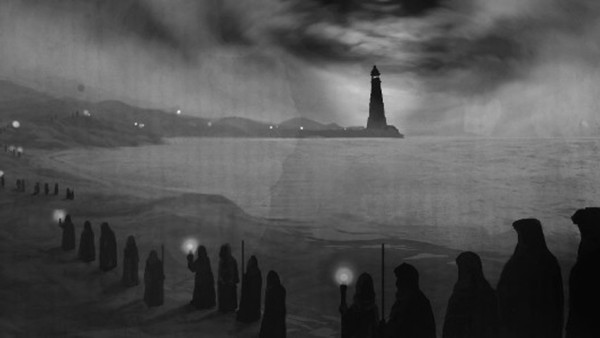
To say that Anchorhead is dripping with atmosphere is an understatement. Every location you enter in this text adventure is succinctly described, and yet they slowly build a picture of a town drowning in its own secrets and stuffed to the gills with dread.
A dank, drafty old drinking hole lit by flickering, oil-burning lanterns. Smoke collects in greasy pools among the rafters, and shadows crowd thick around. The bar runs the length of the room to your right, while to the south a low doorway opens onto the street. Mill workers and fishermen occupy a few of the tables, drinking beer or puffing grimly at long-stemmed pipes. Each is wrapped in his solitude, soaking up the general miasma of dreary fatalism.
Coming out at a time when most games were aiming to have photorealistic graphics, Anchorhead knows it's not the sort of game that's for everyone.
But those that it is aimed at will find an adventure heavily inspired by Lovecraft and a master at building the same sort of slowly seeping tension that have left his works so highly regarded all these years later.
Oh, and it's free to play in your browser too.
3. Detention

The White Terror was a 38-year-long period of martial law in Taiwan, during which 140,000 Taiwanese were imprisoned and 4,000 of those executed as political dissidents after an anti-government uprising in 1947 was violently suppressed.
During this period of oppression, schoolchildren could, and sometimes did, find themselves forcibly conscripted as child soldiers, "democracy" was a word that could get you locked up, and the family members of those who were taken away often found themselves in mortal danger.
It's against this backdrop that Detention is set. Senior student Fang Ray-shin and Wei Chung-ting try to wait out an incoming typhoon in their school classroom and wake to find the school has transformed into a nightmarish version akin to the Silent Hill dimensional shifts.
Bit by bit a tale of jealousy, betrayal, and guilt is uncovered as the player walks the school hallways, and the hints of life before the oppression make the tale so much more horrifying than the demonic "lingered" that Ray encounters.
And, come the end of the tale, the opportunities presented to the worst of the worst by the nation's martial law will be shown to be truly monstrous.
2. Eternal Darkness

Eternal Darkness: Sanity's Requiem was first released on the Gamecube in 2002, and the psychological horror blended the lines between reality and gameplay with its patented sanity system.
It starts simple. Whenever the player is spotted by an enemy, their sanity meter starts slowly draining until the enemy has been dealt with. As the bar gets low then the player finds that gameplay is altered slightly.
Perhaps they'll leave a room only to find themselves back where they started. Maybe the camera angle shifts, skewing vision a little. Maybe the walls bleed or the heads of enemies and statues detach and start chasing you around the room.
Or maybe you die all of a sudden, the game asks you to load, you start to and then it asks if you want to delete all your save games. You panic, wondering what you've clicked wrong and hit no, but the box moves over to yes and the files start deleting in front of your eyes and... you're suddenly back where you were.
This can only occur so late that you've struggled to get there, and it's so terrifying that any player will be on edge for the rest of the game.
1. Silent Hill 2

Silent Hill 2 isn't all that far removed from most survival horror games of the time. There are puzzles to solve, items to manage in a limited inventory, monsters to avoid, and the ever-changing dimensions of Silent Hill games.
Protagonist James Sunderland comes to the town after receiving a letter from his deceased wife Mary, and discovers Maria who looks just like his dead wife.
The very human horror of Silent Hill 2 is spread throughout the game, but you only truly realise the enormity of it all during a sublime ending sequence. Seeing the player simply walk down a long hallway and listen to dialogue from his past, here we find out that Mary was ill and James, more to relieve his own suffering than hers, euthanized her.
This reveal makes a lot more sense of what the player has experienced through the game. Relentless executioner Pyramid Head at one point seems to have sex with one of the zombie nurses while chasing the player and, as James sees himself as Mary's executioner, it seems obvious that James has a lot more to feel guilty about than just euthanazia.