10 Hilariously Awkward Times Video Games Tried To Be Mature

Nothing says 'mature depiction of sex' like controllable hip-thrusts and a timing window.
With great rendering power comes great responsibility, and thus, over the years, gaming has matured in all sorts of directions. We've seen facial detail get way more realistic (and creepy), full bodies either hand-animated or motion-captured used to portray everything from brutal stabbings to intense love scenes, and the medium itself attempt to craft stories that should illicit reactions from the entire emotional spectrum. That said, it's been a rocky road to get to this point, and honestly - we're yet to reach completely smooth ground. You have to admire the work of guys like David Cage and titles like Fahrenheit/Indigo Prophecy, Heavy Rain and Beyond: Two Souls, as at least people like Cage are daring to dream, daring to craft something that isn't just another shooter or another 2D side-scroller. They might fall flat on their faces, but influence is inevitably still seen across future games, who in turn try their best to do the same. Cutscenes and in-engine animation took a noticeable step up across the 2000s, as developer ambitions matched perfectly with production budgets and the sheer possibility of what games could be. It was a truly prosperous time and has gone on to be regarded as one of the most defining periods in gaming history, but for all the industry has achieved, there have been some monumental missteps...

10. "Hold X To Pay Respects" - Call Of Duty: Advanced Warfare
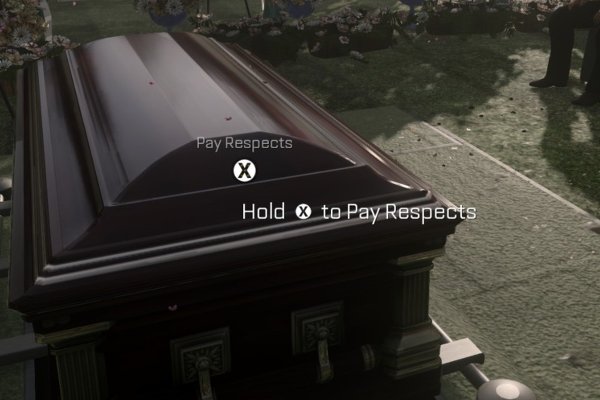
It's the first 'proper' Call of Duty on new consoles, you're Activision and you're attempting to get as far away as possible from the mediocrity that was the barely iterative Call of Duty: Ghosts. You recruit Kevin Spacey as your lead villain, get vocal darling Troy Baker as your hero, hell, you even tap into the Modern Warfare lineage by modulating its title into something more alluring and futuristic. Then... you decide to take a cue from Ace Combat: Assault Horizon, as that game had a hilarious scene where you prodded a button during a cutscene just to raise a character's hand in victory. In Advanced Warfare, this manifests just after an explosive, jaw-dropping opening that sees your fellow soldier get blown to smithereens, as you're promptly attending a very well realised funeral... American flags adorn all sorts of surfaces, Kevin Spacey stands looming, channeling his best Frank Underwood and hinting that you're in for one hell of a ride. You approach the coffin and- what? "Hold X To Pay Respects" pops up on the screen, as the world waits for you to choke back the tears, stand upright... and honour your fallen comrade with a quick-time event.

9. Fahrenheit's Various (Controllable) Sex Scenes

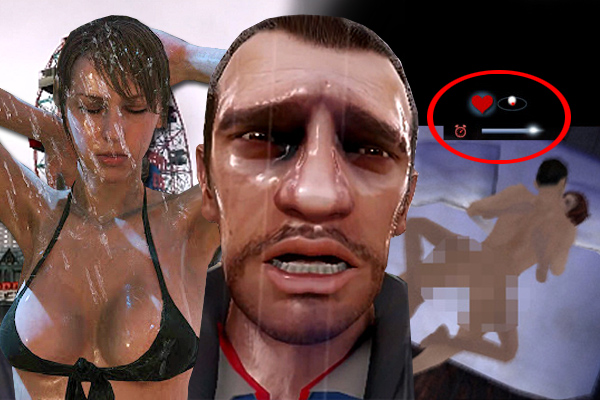
If there's one emotion video games are yet to pull off, its sexual allure, and especially the act of kissing or sex itself. More often than not it still comes across as two sentient mannequins head-butting each other, but even getting to that was something that took time. Enter Fahrenheit, one of the first games to ever do the whole 'branching narrative' thing, and the first that really got creator David Cage's name out there. Without delving into the downright asinine plot (you fight an embodiment of the internet at one point), its shift from murder mystery to Matrixian 'underground freedom fighters going against the mechanical overlords' narrative came with a bevy of moments where heroes Lucas Kane and lovers Tiffany and Carla were shown getting more than intimate with one another. To that end, Fahrenheit had full, graphic nudity alongside analogue stick interaction that controlled Lucas' hips (yes, really). It was terrible, but at the time we'd seen nothing of the sort and many gamers championed it anyway. It didn't matter that a vague collection of polygonal shapes with faces were awkwardly juddering alongside each other, THEY WERE IN LOVE, DAMMIT.

8. Quiet's 'Romance' - Metal Gear Solid V: The Phantom Pain

As much as I love Hideo Kojima and Metal Gear Solid in general, the fact his team were working to incredibly stringent deadlines, only served to make Phantom Pain feel severely unfinished in various areas. One such notable aspect of the plot that's hinted at throughout and forms a core part of an emotional finale is Quiet and Venom Snake's relationship. Intended as a callback to Otacon's iconic "Can love bloom, even on a battlefield?" line from MGS 1, it's laughably handled thanks to Venom essentially being a mute, alongside Kojima portraying the act of finding someone attractive with the subtlety of a Zack Snyder's cinematography, zooming in on butts and cleavage every chance he gets. As such, what was supposed to be a 'hidden feelings get acted on as two individuals spend more and more time together' setup, turns into a laughably forced set of scenes, including Snake and Quiet literally frolicking in the rain, sharing all sorts of supposed-to-be intimate looks, and the two of them taking an 'intimate' shower together. Ocelot even ensures you know what they're going for by chiming in and saying she's "Fallen in love with the legend", and although MGS V is about reputations preceding reality, the entire idea that Snake and Quiet are the 'heart' of Phantom Pain is just laughable.

7. No Russian - Call Of Duty: Modern Warfare 2
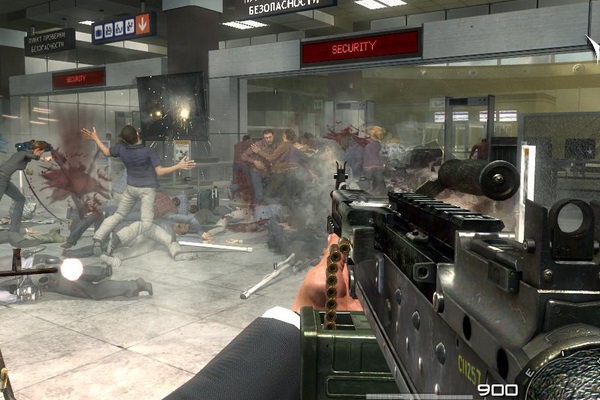
Routinely popping up as one of the most controversial game levels of all time, COD 4 made headlines around the world, thanks to putting you in the shoes of an undercover agent with the option to fire on innocent Americans, the goal being to maintain your cover. Designer Mohammed Alavi mentioned in an interview with PCGamer that the studio wanted to "do three things": "sell why Russia would attack the US, make the player have an emotional connection to the bad guy Makarov, and do that in a memorable and engaging way." The problem was again with subtlety, as although it should be more immediately affecting, replicating being on the ground during a terrorist attack, everybody who played the level was just put off by sheer subject matter alone. Infinity Ward had you walk through the carnage with the option to fire as some sort of "How desensitised are you?" moment, but it came out of nowhere, only serving to forcing you into watching what was happening, rather than dying trying to stop it, and ultimately it was only in service of a cackling villain who got blown away regardless. Including the option to skip the sequence didn't exactly show IW truly believed in what they were doing, and the sequence stands the test of time as showing video games trying to elicit some sort of reaction, without really knowing what that is, or how to go about it.

6. Niko's Various Comments On Violence - Grand Theft Auto IV
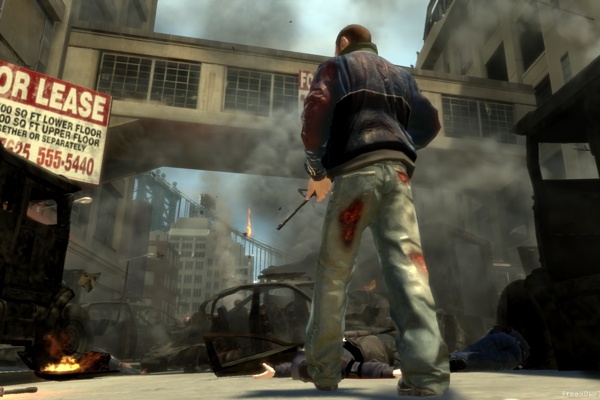
The GTA series attempting to prompt questions as to the allure of violence being the solution to all problems tends to fall on deaf ears, when said allure has made Rockstar into multi-millionaires. It didn't stop them from trying with GTA IV though, which saw Russian immigrant Niko Bellic attempting to make a name for himself in Liberty City, only to find the American Dream he'd been sold was a lie, and he'd have to carve his way through all who opposed him regardless. Somewhere in there was a truly brilliant story, but is mostly the reason why GTA IV feels so 'off' by comparison to its brethren (Rockstar would go back to enforcing ludicrousness wholeheartedly in GTA V), as by proxy of being a GTA game, the character still had to take missions for people, run errands, be up for going on killing sprees, and have no issue slaughtering anyone if the need arose. The disconnect between how Niko talked about wanting to 'leave a life of violence behind' in the cutscenes versus being a gun-toting madman in-game birthed the term 'ludonarrative dissonance'; the act of playing a game in a way that betrays how they're set up otherwise. From the moment Niko executes Vlad, to the entire blood-splattered run you take him on to vanquish your enemies, almost every time the game tries to suggest that Niko is heading down a path he can't escape is contradicted by indulging in the very same actions straight after.

5. The 'Descent Into Madness' - Far Cry 3
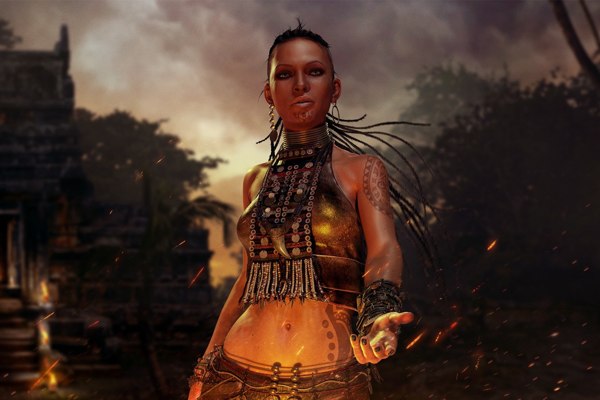
I've covered just how spectacularly Far Cry 3 missed the mark by killing off Vaas way too early, but what was left behind still tried to show character Jason Brody losing himself to a survivalist and primal nature, being forced to adapt and kill, following the kidnapping of his friends. The problems came immediately after that initial setup, as Ubisoft just couldn't think of a way to show Jason becoming 'one with the island' over the assumption that he'd want to do the right thing and save his crew. It led to half-naked tribal leader Citra's lady lumps front and centre across all initial footage of the game, having her represent this side of Brody that was supposedly being tapped into. Cut to scenes where Jason receives a bevy of supernatural tattoos, talks to his girlfriend in the most dismissive and banal way possible, learns how to use weapons professionally just by picking them up, and has the overarching ideology of losing his humanity represented by a last minute, on-screen choice. We never get to truly empathise with Brody, never hear him talk about struggling with his motivations or how to hold onto his former values through in-depth inner monologues. Instead, he's a normal, rational student figure one minute and a friend-sacrificing maniac the next, setting up the most cack-handed final choice you'll ever have to make.

4. Mass Effect's Relationship Systems

At the time? Brilliant. Now? A little.... basic, to say the least. See, whilst the vast majority of horny players took one look at the hunky Jacob or sultry Miranda (the endless close-ups of her backside doing wonders for the teenage mind) and thought, Chris Rock-style, "What do I got to DO, to get with you?!, we sort of missed the part where it boils down to a game of 'pick the right response to unlock the sex scene'. Thanks to Bioware's layout of the dialogue wheel putting every positive option right at the top, you knew every time what was necessary to make with the nakedness. Mass Effect 2 made you out to be even more desperate as each crew member was spread out in various positions across the Normandy, meaning you were forever riding elevators just to 'check in' on if your lover of choice had some new dialogue. Maybe taking them on more missions would do it? Is that it? Is that how I see the bewbs? Maybe taking them on a mission and then talk to them immediately after? Nope, just the same "I'm still thinking about our last chat" line until the end, where a variety of invisible meters determine which character comes to visit you before the final mission. It's just... like... real life?

3. Hotline Miami 2's 'Rape' Sequence

Both Hotline Miami games are easily some of the most stylish, fun and imminently replayable titles of all time, and although I personally adore the sequel and how it expanded every idea of how the darkest parts of the human psyche can be unbelievably appealing, the opening attempted rape scene ends up feeling like shock factor for the sake of it. The first indication that developers Dennaton weren't entirely sure on its inclusion comes from the option to skip the scene entirely. Second, it doesn't serve the plot. Both games are about how we can lose ourselves in a mentality of killing for necessity and later for fun - that embrace of thematically dark subject matter being represented in the sequel through a police officer who you can choose to let kill for an easier trip through levels, or a set of 'fans' who glorify the the original title's gore-happy killer. As a tone-setter it works to some degree, but the very nature of rape should never be callously included as such a thing. Where the first Hotline had a woman you rescue slowly restoring normalcy to Jacket's life through ever-changing homestead level design, Wrong Number connotes the same idea of rescuing someone, only to play with the idea of raping them as a 'we're edgy, get it?!' setup instead.

2. Hatred's Main Character

Unpacking the disastrous mess that is Hatred is rather like looking into Marilyn Manson's appeal; it's routed in a time where reactionary shlock-horror sold ridiculously well (the 90s), and to the point, continuing to frame Hatred's selling point as a Columbine-esque fever-dream only made it a total laughing stock in the modern world. That didn't stop developers Destructive Creations for getting out ahead of it, commenting that Hatred was a 'response' to how 'soft' and 'mainstream' gaming had become. They somehow missed the fact a game called Grand Theft Auto was the highest-selling property of all time, but, well, things just weren't gnarly enough, erm... man. Naturally, Hatred released and found a teensy audience in angry high-schoolers looking to vent rage by shooting people in the face, but outside that, it was a turgid experience both out of time and especially in mind.

1. Trevor's Torture Scene - Grand Theft Auto V

Coming off the back of GTA IV, Rockstar had their 'new direction' for GTA (that of moral choices and weighty characters) thoroughly rejected by the general consensus. People didn't want mopey Niko and a grey n' brown city, they wanted violence, nihilism and explosions. They wanted that naughty, controversial game grandmothers daren't speak of, that experience that courted controversy but backed it up with solid gameplay and the hidden intention of simply holding up a black mirror to society. You could be your worst self in GTA, but you'd probably enjoy it, and therein lies pure genius. To that end, the now swimming-in-cash Rockstar designed a DIY torture scene for GTA V, where character Trevor attempts to extract information from a screaming 'terrorist', simply so someone with a gun has a better reason to use it on someone else. Trevor later tries to clarify his (and by definition, Rockstar's) stance on torture through a few throwaway lines of dialogue surrounding how "torture's for the torturer useless as a means of getting information", but it falls flat, considering the character doesn't have any moral standing, and whose entire appeal is being as ridiculous as possible. He positively revels in doing the worst things to his victim, and as there's no way to get out of the scene (Rockstar said if you don't want to play, turn the game off) it completely fails to truly mean anything, outside of trying to generating headlines for the sake of being something GTA is 'supposed to do'. Which supposedly mature moments in games were terribly handled despite even the best intentions? Let us know in the comments!

Watch Next


Gaming Editor
Gaming Editor

WhatCulture's Head of Gaming.