10 Best "Everything You Know Is A Lie" Moments In Video Games
Turning your world upside down.

There have been countless unforgettable and mind-blowing moments in video games over the decades. Ever since developers were able to transform sprites and polygons into captivating narratives, creators have continued to find innovative and intriguing ways to tell their stories.
Shocking reveals, hard-hitting deaths, and ambiguous endings are all effective ways in which games have succeeded in surprising us. However, nothing makes plots more enthralling than a great twist.
When done right, a plot twist has the power to re-contextualise everything that we thought we knew about what we've just seen. Moreover, a well-executed twist should also leave us with something to think about as we ponder over what these new revelations mean, not just in terms of the story, but their grander significance too.
And out of the myriad of twists out there, none are as effective as those which reveal that, up until that point, we've been lied to the entire time.
By pulling the rug from under our feet at just the right moment, these video games created some of the most jaw-dropping moments in gaming history.
Nothing was as it seemed in these video games.
--
Note: There are massive spoilers inside each page's paragraphs.
10. Call Of Duty: Black Ops Cold War (2020) - A Secret Soviet Spy

Though the Call Of Duty franchise is best known for its high-octane action and big budget spectacle, the series isn't all mindless action. Alongside a selection of jaw-dropping twists in Modern Warfare 2 and Black Ops, Cold War stands out as being one of the biggest and most unexpected gotcha moments in recent years.
Set in the early 1980s, Cold War sees player-character Bell recruited by the CIA as part of a team tasked with eliminating dangerous Soviet spy Perseus.
Teaming up with fan-favourite characters Woods and Mason, we're told that Bell has known the team for years, serving with leaders Adler and Sims in Vietnam. With the second mission Fracture Jaw framed as a flashback of Bell's time in Vietnam searching for a Russian presence, there's no reason to believe anything is awry.
Towards the finale, however, a bombshell revelation reveals that Bell was previously one of Perseus's associates. After being left for dead, the CIA recovered him and subsequently brainwashed him into believing they were allies.
Understanding the truth about the shady practices of the US government, players now have a choice to tell Adler where Perseus is or lie and, in one ending, even ambush him.
9. Dark Souls (2011) - Anor Londo Isn't What You Think

Throughout the opening hours of Dark Souls, our chosen undead has the pleasure of exploring (and repeatedly dying in) a selection of environments equally as bleak and decrepit as the last. From the crumbling structures of Undead Burg, the slimy bowels of The Depths, and the poison-filled nightmare that is Blighttown, none of these areas can by described as particularly pleasant.
By the time we reach the end of Sen's Fortress and slay the Iron Gollum, we've came to accept that there's only more misery and bleakness ahead.
And that's when Dark Souls transports us to Anor Londo, a large new area blanketed in welcoming sunlight. And even though this level is by far the most difficult yet, the welcome change of scenery suggests that there's still some hope left for the dying lands of Lordran.
However, this is Dark Souls and nothing joyful is allowed to exist. Not even sunshine.
After meeting Gwynevere, players can now see Anor Londo for what it truly is.
Attacking Gwynevere will reveal that she, and the sunshine, was nothing but an illusion. With the magic destroyed, the area is plunged into darkness as the soundtrack becomes more sinister.
Anor Londo is just as hopeless as everywhere else.
8. Braid (2008) - The Real Villain

From the ingenious mind of Johnothan Blower, who'd later go on to create The Witness, Braid is a challenging indie platformer in which protagonist Tim is on a quest to save a princess from a "horrible and evil monster".
Presented in a storybook-like style alongside a beautiful soundtrack, Braid's premise is as basic a plot as it gets. At least at first glance.
As the game progresses and Tim unlocks more time-manipulating powers to traverse the progressively harder levels, more is gradually unveiled about the relationship between Tim and the Princess. It turns out they were once close until Tim drove her away because of an unspecified mistake.
It's not until the final level where Braid flips everything on its head.
Here, the goal is to catch up with the Princess as she flees from who we assume to be the villain. But when we eventually do reach her, the game reveals the reality of the situation.
It transpires that we'd saw this event in reverse. In actuality, the Princess has been running from Tim the entire time and using the traps to slow him down. The truth is that Tim was the villain of the story the whole time.
7. The Dark Pictures Anthology: Little Hope (2020) - The Bus Driver

The second installment in Supermassive Games' The Dark Pictures Anthology, Little Hope continued the studio's style of atmospheric choose-your-own-adventure horror. This time, the series takes the scares to a small town with witchy secrets.
The horror begins when a bus crash strands a group of college students and their professor in the titular town in the dead of night. With the town being deserted apart from some spooky apparitions and a supernatural fog keeping them there, the group's only option is to find the bus driver, who went missing after the crash.
What follows is the player making a series of crucial decisions that determine who survives to sunrise and who's brutally killed.
Being a loving homage to schlocky horror, though, it's only fitting that Little Hope had a monster of a twist right at the end.
The reason that the group couldn't find the bus driver was because Will Poulter's character was the driver this entire time. And in an extra twist, the bus driver was the survivor of the house fire at the start of the game.
Everything we just saw was a hallucination brought on by the driver's traumatic past, with our choices determining if he's able to forgive himself.
6. Prey (2017) - It's A Simulation
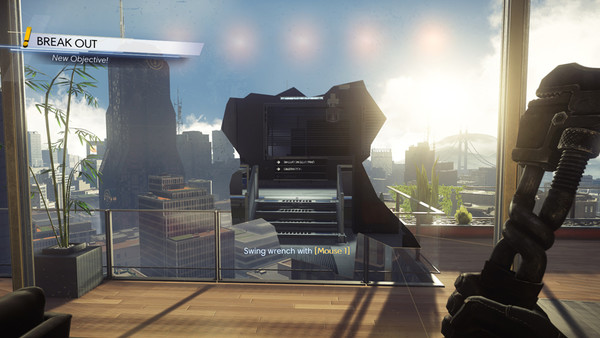
Although this reveal happens in the opening act of the game, this twist was nevertheless a huge surprise.
Beginning in protagonist Morgan Yu's apartment, the start Arkane Studio's Prey sees Morgan set off for work like it was just another day. They dress, have a look round their spacious home, and make their way to the roof where a helicopter is waiting to take them to their place of work.
The first sign that something isn't right is that Morgan's job consists of performing rudimentary tests like hiding and pressing buttons. Things get weirder when a shapeshifting alien attacks the observing scientist
A cut to black sees Morgan wake-up back in their apartment; but this time things take a sinister turn. The friendly engineer who greeted you previously is now dead, and a mysterious caller instructs you to leave the building immediately.
Breaking the apartment window is the only means of escape. However, rather than leading outside, it opens into the lab's corridors.
Morgan, it turns out, has been on a space station called Talos I this entire time and has been used as a guineapig in an experiment of his own creation.
Now Morgan must find a way to escape this alien-infested place.
5. Dead Space (2008) - Nicole's True Fate

When it comes to horror characters, none have as harrowing an ordeal as engineer Isaac Clark from the Dead Space series. And even before he has the pleasure of injecting a terrifyingly large needle into his eye in the sequel, he had to fight his way through the claustrophobic and Necromorph-infested hallways of the Ishimura.
When contact with the mining vessel is lost, Isaac is sent as part of the rescue team. And with his girlfriend, Nicole, still onboard the Ishimura, Isaac has a personal connection to the mission. After being stranded on the Ishimura and learning more about the grim fate the crew endured when a mysteries artefact known as The Marker was brought onboard, Isaac eventually contacts and reunites with Nicole soon after.
Together once again, the pair are set to travel down to the planet to destroy the artefact. But when Isaac arrives, he's told the unnerving truth that Nicole has been dead this whole time, taking her own life in the video message we see Isaac watching at the start of the game.
This Nicole we've been seeing was a hallucination created by the Marker to manipulate Isaac (and therefore players) into fulfilling its bidding.
4. Spec Ops: The Line (2012) - War Trauma

Set in a near future Dubai which has been buried in sand by severe sandstorms, the hard-hitting third-person shooter Spec Ops: The Line centres around Captain Martin Walker and his mission to find Colonel John Konrad.
Taking notes from Joeseph Conrad's iconic novel The Heart Of Darkness (which was also the basis for Apocalypse Now), this game is a journey into madness in which Konrad is the equivalent of the novel's diabolical Kurtz, who's committed several atrocities since taking control of the buried city.
As Walker makes his way to find Konrad, he witnesses the horrors the colonel left in their wake and is likewise forced to commit morally questionable acts of violence himself. Not long into the campaign, Spec Ops becomes less of a conventional shooter and more of a provocative character study.
When Walker finally arrives at where Konrad is holed-up, everything changes.
It turns out that Konrad has been dead the entire time. The Konrad that Walker has been communicating with up to this point has been a hallucination he created to take responsibility for his own horrific actions.
No matter which ending players choose, Spec Ops: The Line is a profound examination of trauma.
3. Shadow Of The Colossus (2005) - The Colossi Weren't Evil
The plot of Shadow Of The Colossus was so simple and perfectly executed that it's likely nobody saw the ending coming.
At the start of the game, protagonist Wander brings the body of his recently deceased girlfriend, Mono, to a sacred temple. It's here the disembodied voice of a godlike being called Dormin informs him that it is possible to reclaim her soul if Wander succeeds in destroying the idols in the temple.
To do so, however, Wander must travel across the lands and defeat gigantic stone beasts, each of which represents one of the idols. There is, however, Dormin warns, a price to pay for these actions.
As far as objectives go, Wander's couldn't be more straightforward. And with the goal of bringing back his loved one, players likewise have no reason to question the morality of his intentions.
But the slaying of each colossi begins to have a physical toll on Wander, who grows paler and sicklier as the game progresses.
It's only with the death of the final Colossi that players realise that they've been deceived. The beasts were preventing the malevolent Dormin from escaping his imprisonment, and you foolishly released him by killing innocent creatures.
2. BioShock (2007) - "Would You Kindly"

In the opening of BioShock, mute protagonist Jack is in a plane crash and, through sheer coincidence, stumbles upon the underwater city of Rapture.
As soon as he sets foot in the city that's since fell to ruin, he's contacted by Atlas on a radio who asks Jack to help rescue his family and eliminate Rapture's sinister patriarch, Andrew Ryan.
From here, Atlas is our guiding voice through this subterranean dystopia. He's the one who explains how plasmids and ADAM works as well as telling us where to go and what to do next.
When we finally make it to Ryan's offices, though, we're greeted by a shocking reveal.
Audio logs explain that Jack was a product of experimentation in which he was programmed to obey any command that followed the phrase "Would you kindly", the words Atlas has been politely directing us with throughout the game. Moreover, in a second game-changing twist, Atlas was none other than Ryan's rival, Frank Fontaine.
Not only does this twist reframe everything we thought we knew about Ryan's authoritarian rule over Rapture, but this plot point also functions as a metacommentary on player agency. Like Jack, we, too, blindly followed Fontaine's commands.
1. Silent Hill 2 (2001) - What James Did

If M. Night Shyamalan has taught us anything, it's that great psychological horrors are made all the better with a tantalising twist.
One of the most well-known and effective examples of these twists within video games came towards the end of iconic survival-horror Silent Hill 2.
Playing as everyman James Sunderland, this unsettling horror sees him travel to the titular town after receiving a letter from his wife asking him to meet him there at a "special place". What's especially strange about this, though, is that Mary has been dead for three years.
As he searches for his wife in the fog-covered town, James encounters monstrous figures and a handful of troubled characters, one of which looks eerily like his wife.
Describing the ensuing events as strange would be an understatement, but things become even weirder when James eventually discovers a video of him and his wife.
Not only does this video confirm that Mary has definitely been deceased all along, but it also reveals that it was James who killed her after being unable to see her suffer with an illness.
Everything James has suffered through in this hellish purgatory has been a symbolic, self-inflicted punishment for his guilt.