Why Return Of The Joker Is Secretly The Best Batman Movie
Most DC fans probably haven't even seen it...

Of all the comic book characters in all the comic book universes in all the world, Batman has definitely been in the most films.
To date, DC's Dark Knight has starred in a whopping 63 films, 14 of which were released in theatres. With countless more set to come, and with there being so many of them, it should come as no surprise that every Bat-fan has their favourite.
Most will likely option either one of Tim Burton's Batman films or one of the entries in Christopher Nolan's Dark Knight Trilogy as being the defining Bat-flick - some may even mention the animated Mask of the Phantasm, which has slowly but surely accumulated a cult following in the years since it bombed at the box office. But there's another Batman film that makes a compelling case to be considered the best of all, and it's one most fans probably haven't even seen.
Batman Beyond: Return of the Joker was an animated movie that released in the year 2000, directed by Curt Geda, Toshiko Masuda and Shojiro Nishimi, from a script written by Paul Dini, Glen Murakami and Bruce Timm. Situated within the DC Animated Universe, Return of the Joker was a full-length feature film that followed on from the Batman Beyond TV series of the late nineties, wherein a retired Bruce Wayne trains a new, younger Batman to take on the cowl in a now futuristic Gotham, one that boasts many of the same challenges as the one of old.
The story sees (as you may have already guessed) the return of the Dark Knight's most fearsome adversary, and though it may be considered blasphemous to argue that the best Batman movie doesn't even have Bruce Wayne underneath the cowl, or even a theatrical release, Return of the Joker more than deserves to be held in the same regard as the other greats of the genre.
5. It's Bruce Wayne, But Not As You Know Him

Since the publication of Frank Miller's The Dark Knight Returns in 1986, there's been a general obsession with possible futures and the Caped Crusader. Dozens of alternate realities and potential deaths and retirements have been optioned in the years since, and even though Miller's work is definitive, there's something altogether more interesting about Batman Beyond.
The show debuted in 1999 and was created by Batman: The Animated Series alumni Alan Burnett, Bruce Timm and Paul Dini. The show was set in 2039, 20 years after Bruce Wayne hangs up the cape and cowl for good, but it's the manner of his retirement that immediately distinguishes the premise as a compelling feature. Bruce only gives up because he physically cannot continue to be Batman anymore, and with two decades spent living as a recluse in Wayne Manor, he's left with plenty of time to stew over his career, which makes the moment Terry - a young teenager whose father is murdered in a criminal conspiracy - discovers his secret, galvanise his own internal torment.
Bruce eventually grows to let Terry into his life and take up 'the mission' all over again, but their time together is fractious. Terry isn't the man Bruce was, and that takes some adjusting. There's also the element of Gotham's past returning to haunt the pair throughout the series, but the Joker was treated differently. BTAS had always leaned into the supernatural nature of the character, but his absence - as well as Bruce's refusal to explain the history of his greatest adversary to Terry - intimated a looming threat.
Under typical terms, most would probably say that a 'Batman film' must have Bruce Wayne as Batman, but the point here is that this is still Bruce's film even if he isn't the Batman of the future. It's about the mantle as much as it is Bruce himself, who is played to perfection yet again by Kevin Conroy. Also, by re-contextualising the character in a new setting, Batman Beyond provided an enjoyably unique interpretation of the character, as well as a solid base for Return of the Joker to work its magic.
4. It Tells The 'Last' Joker Story

Return of the Joker takes place about a year or so after Terry McGinnis first dons the cowl as Batman, and effectively provides the 'last' Joker story. These tales are something of a tradition for DC, and are told with a sense of finality, with the likes of Alan Moore's Whatever Happened to the Man of Tomorrow? and Neil Gaiman's Whatever Happened to the Caped Crusader? concluding Superman and Batman's respective journeys.
Return of the Joker too conforms to that tradition, and it is excellent. Why so? Well like all great Batman stories Return of the Joker is a mystery, that mystery being how has the Joker returned after so long - why now? - and whether or not that 'return' is actually genuine. It's gripping from start to finish, but everyone who's seen it will point towards one sequence in particular as the one that sets the film apart over all others - the 10 minute flashback that caps off the second act.
At this point in the story Bruce has taken the cowl off Terry, due in part to his inability to take the Joker seriously and Bruce's own fear of Joker, while the Clown Prince has ransacked Wayne Manor and left Bruce for dead. Searching for answers, McGinnis speaks to Barbara Gordon, the former Batgirl, now a police commissioner with the GCPD, who reveals the last encounter Batman ever had with Joker, and it is horrifying.
As the story goes, Joker and Harley Quinn kidnap Robin (Tim Drake), which leaves Batman and Batgirl to tear up Gotham looking for him. They discover that he's being held hostage at the now derelict Arkham Asylum, but it soon becomes apparent this wasn't an average scheme. It turns out that Joker had been physically and psychologically torturing Drake for weeks, to the point where the boy's personality was warped into a tormented mini Joker. Incensed, Batman lashes out at the Clown Prince, who taunts the Dark Knight throughout before revealing that he knows his true identity.
Finally, Bruce is left wounded on the floor, and Joker gives the order to Tim to murder his adoptive father. Tortured with laughter, Bruce makes one last plea for Tim to fight it, only for Drake to turn his weapon on the Clown prince and kill him then and there.
The entire sequence is bonechilling and breathtaking in equal measure, and exudes a haunting atmosphere. Not only that, but it effectively brings a close to the Joker in the DCAU, before Terry resolves the mystery for good in the concluding chapter.
3. The Tone Is Nightmarish
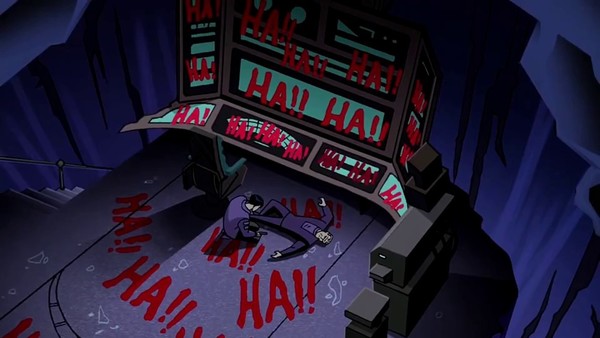
The best Batman stories all tend to have an element of mystery about them, and though Return of the Joker is no different, there is another classic Bat-related element that differentiates it from the competition - the emphasis on horror.
Anyone who's familiar with BTAS will be able to wax lyrical about how it managed to balance both the light and dark aspects of Batman to impart a definitive version of the character, or even those episodes that left them with nightmares at an early age (looking at you, Joker's Favor), but in almost every aspect, Return of the Joker is more terrifying, to the point where the version that originally aired was heavily censored.
The original, uncut version is the superior product, and it shows. Mark Hamill is at his terrifying best as the Clown Prince of Crime, with his initial introduction where he kills an unruly thug turning the creep factor up by a whole other notch. Even then however, there's an almost imperceptible element of horror at play, and it stems from the emphasis on the Joker's supernatural elements. Terry is still Batman when he arrives on the scene, but he's naive; he considers the villains of Bruce's past to be gimmicky and unthreatening, and though the former Batman never encouraged that perception, McGinnis saw the Joker as the most ridiculous of all.
Of course, the audience knows otherwise, which adds another level of horror to the proceedings. Add to that the mystery behind the character, along with the nasty visuals of the uncensored cut and the sequence where he invades the Bat-Cave, and you're left with a surprisingly unnerving tale about the Joker's dark and twisted legacy.
2. Terry McGinnis Earns The Mantle

Compared to other members of the Bat-Family, Terry McGinnis wasn't always all that well received. Batman purists will often maintain that much of the character's appeal stems from Bruce Wayne's steely persona, so when a young, talkative and quip-driven figure like Terry came along, some argued that very appeal had diminished.
Everyone is drawn to Batman for different reasons, but it's important to remember that the character isn't just one man, but a legacy instead. It's a message that's echoed throughout the Caped Crusader's comics, TV shows and feature films, and Batman Beyond was no different. In this case, the mantle fell to Terry, and over time - thanks in part to a fan favourite portrayal from Will Friedle - he managed to win everyone over, even Bruce.
Still, there was always the sense that McGinnis was yet to receive his own definitive story, the kind that would illustrate the character's ownership of the mantle. Return of the Joker was that story, as it depicts McGinnis as he finally settles into the costume, and becomes his own Batman.
It's a fantastic transformation to see play out, and it's only through Terry that the 'Joker' - the brainwashed and unaware adult Tim Drake - is defeated.
1. It Illustrates The Legacies Of Joker And Batman Perfectly

At the end of the film, Bruce imparts one piece of advice to Terry, saying:
"I've been thinking about something you once told me, and you were wrong. It's not Batman that makes you worthwhile, it's the other way around. Never tell yourself anything different."
It's one of the best lines Conroy has ever delivered, and the best thing about it is not just that it brings Terry's journey full-circle, adopting the mantle and accepting his role, but also in that it speaks to the legacy of the character. Batman can be an oppressive presence, and one that can dwarf the wearer in a great many ways. One of the biggest fallacies surrounding the character is that the mask represents Bruce's true nature, but Terry doesn't have any of that baggage.
In actual fact, it takes Terry to make Bruce realise that Batman isn't everything. This development illustrates McGinnis' importance, but there's another character that provokes the pair to look inward and assess the legacy of the mantle - the Joker.
By all accounts, Joker is considered nothing but a horror story in Neo Gotham. When the nightmare returns, he's only capable of doing so having mentally tortured Tim Drake, a former ward of Batman. Drake thus embodies the synonymy of Batman and the Joker, and is tormented by both of them, even 40 years on from the offending incident when he was abducted.
As was previously mentioned, Batman Beyond: Return of the Joker could be described as the 'last' Joker story. It finds strength in finality, but also in reappraising what both Batman and the Clown Prince represent, as well as in the devastating effects a legacy can have. It tells the perfect Batman story, and manages to do so in an unfamiliar world. Adaptations don't get much better than that.
Watch Next
DC Quiz: How Well Do You Really Know Batman Beyond?
