The Jungle Book: 17 Easter Eggs & References You Need To See
Forget about your worries and your strife...
It seems that no matter what medium they're working in these days, Disney can do no wrong. After the massive global success of the exceptional Zootopia, they've scored another delightful success with their second live action remake after Cinderella.
Jon Favreau's take on Rudyard Kipling's classic tale is an exercise not only in great story-telling but also in love for Disney. It is a fan's love letter to the house that Walt built and a stunning achievement in narrative and effects, laced with some exceptional action sequences and brilliant central performances. To say that it will deserve to be considered among the Oscar contenders next year is no exaggeration. That it will be among this year's highest box office earners also seems assured - or at least it deserves to be.
It's just that good.
Despite the fact that the film is set in a jungle (obviously), and the inherent limitations of referencing other universes, The Jungle Book is also stuffed with Easter Eggs, references and in-jokes, making it a multi-layered pleasure for fans. Favreau has created an affectionate, nostalgia filled charmer, and spotting the nods is incredibly fulfilling...
17. The Castle Make-over
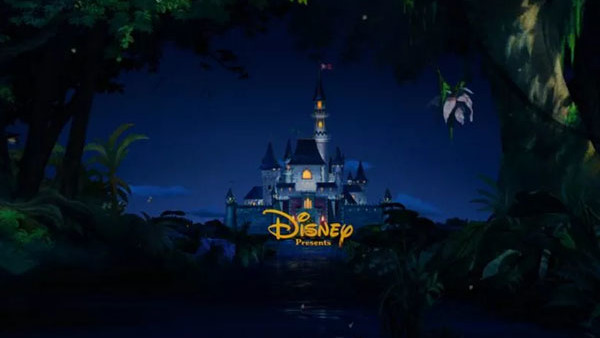
As tends to be the way these days, the Disney castle ident that plays before the film starts is given a bespoke redesign treatment fitting the film. Obviously there aren't too many castles in the middle of the jungle but the redesign to look more like Eastern architecture is a nice touch and the pull-back from the hand-painted cell into the very real jungle is magical.
The way the castle is integrated and the drifting camera that takes the audience into the forest also feels extremely reminiscent of the opening tracking shot through the trees in Bambi...
16. Fantasound

From the very first moment, Jon Favreau's commitment to soaking every detail of the film in nostalgia and the familiar magic of Disney is very evident. As the castle appears, the music consciously channels the 1967 original, as Favreau revealed when explaining his approach to the sequence:
"... John Debney re-orchestrated the opening Disney theme over the logo using the orchestration that they would have used then, with harp and chimes, a much smaller orchestra, a very different orchestra from whats being used now."
More generally, the film is - incredibly - filmed using Fantasound, the invention by Walt Disney designed to change the way cinema audiences experienced movie sound when Fantasia came out. Unfortunately for Disney, investors balked at the idea of his five speaker system that would "float" secondary sounds around the theatre to give a more immersive experience.
That same principle is used for The Jungle Book - which isn't surprising since Jon Favreau typically uses it to inspire his creative teams - with Favreau and Debney isolating instruments to build a soundscape. The result is subtle but brilliant, and it's testament to the director's approach to detail.
15. The Redone Scenes
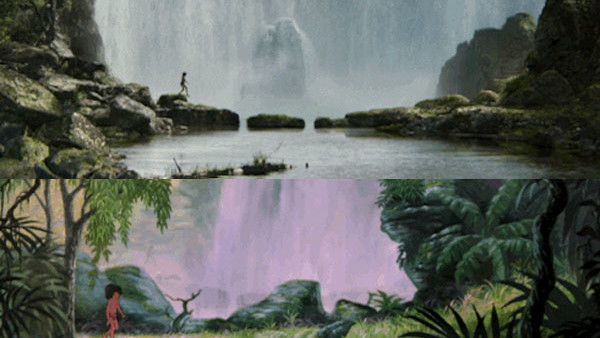
Somewhat inevitably, the film is full of images and scenes mirrored exactly from the 1967 animation. It isn't just a matter of the narrative guiding the scenes broadly - they're consciously rebuilt with the same composition and the nostalgic feel is tangible.
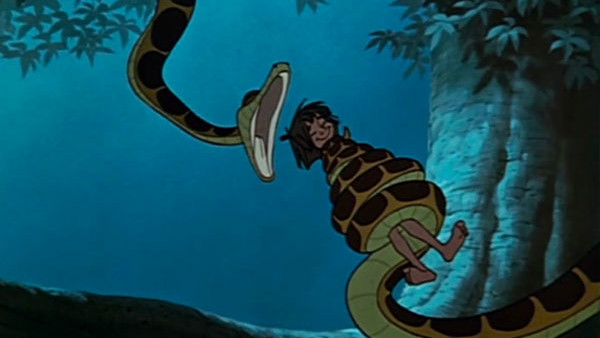
Take for instance the scene where Kaa ensnares Mowgli and goes in for the killer blow...

And in the original...
Other scenes that are definite redos include the Bare Necessities sequence that sees Mowgli riding Baloo down the river, the shot of Mowgli lost in the jungle and the shot of Mowgli and Bagheera walking past the waterfell in the top image.
This is very much an affectionate homage to the animation, without every beat being exactly the same.
14. Rocky The Rhino
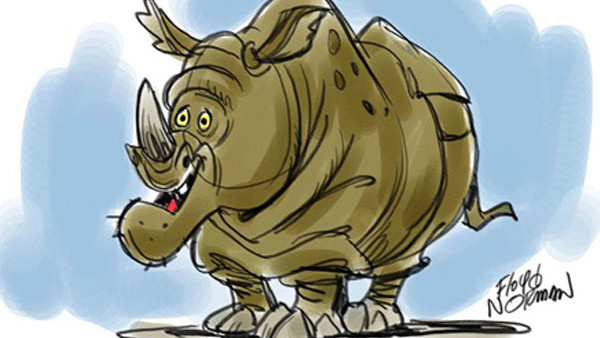
Though he's not a major character in the film, one Disney creation who was intended to be included in the 1967 was rescued from the cutting room floor.
Rocky The Rhino, who is voiced by comedian Russell Peters, was originally planned to appear in the cartoon as part of the sequence with the vultures, which was ultimately changed when the Beatles had to pull out.
Rocky was a visually-challenged rhino who would have been voiced by Frank Fontaine and animated by Milt Kahl before he was edited out.
The live action version also sees the restoration of the key buffalo stampede sequence that was excised from the animation but was in the book. In the book that stampede is actually what kills Shere Khan, though obviously here it just helps spirit Mowgli away from him.
Meanwhile Ikki the porcupine - Garry Shandling's final role before his death - is based on a minor character from the book.
13. The Elephant Parallel

The elephants in Favreau's version are markedly different from the bumbling eccentrics in the 1967 version. Here they're magisterial and almost spiritually appreciated for shaping their forest, and while they don't have a language that Mowgli can understand, it seems very much like that is to do with their status, rather than them being "dumb".
While that's a big difference, there is still some allusion to Mowgli's dynamic with the elephants in the cartoon. At the end he obviously rides the young elephant after saving him (and is thus validated as one of the true forest animals) but even before then, the pair share a moment that is loaded.
In the animation, Hathi Jr - the young elephant - is an analogue for Mowgli: both struggle to know their place and live up to expectations, and the same happens in Favreau's film. That's the weight behind the short scene that sees the pair share a moment when the elephant troop first appears.
In terms of other characters who didn't make it or were adapted significantly differently - the vultures so famously based on the Beatles in 1967 are shorn of their personalities and appear only to herald the arrival of Shere Khan.
12. Winter Is Coming
It may not be entirely intentional, but it definitely feels like there's a Game Of Thrones nod in Favreau's film.
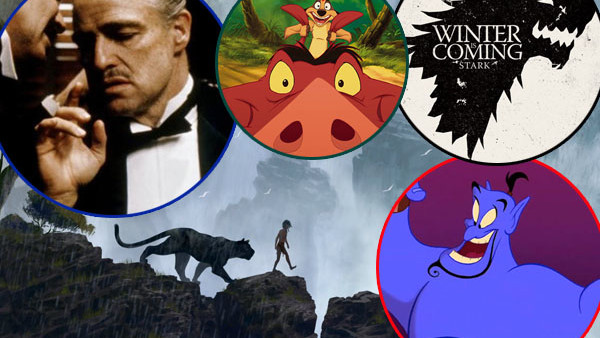
When Baloo convinced Mowgli to stay in the jungle and work with him, he does so under the pretence that he must prepare for hibernation by stocking up on honey. He explains that he's not simply being greedy - despite the obvious revelation that he actually is - but that "winter is coming" and he doesn't want to be caught out and die.
It's such a pointed phrase, done with such a knowing wink that the mischief must be at least partly intentional.
11. The Godfather

There's definitely a sense that King Louie is being presented as the don of the jungle. That much is reinforced by the way he's framed when Mowgli first meets him.
He sits in shadow, barely visible on his throne, talking in a slightly sinister manner about offering Mowgli protection and everything he could ever wish for before he eventually reveals what he looks like.
That framing is definitely a nod to the way Marlon Brando appears at the start of The Godfather, with both films invested in preserving the immediate mystique of the character.
10. More Cowbell!
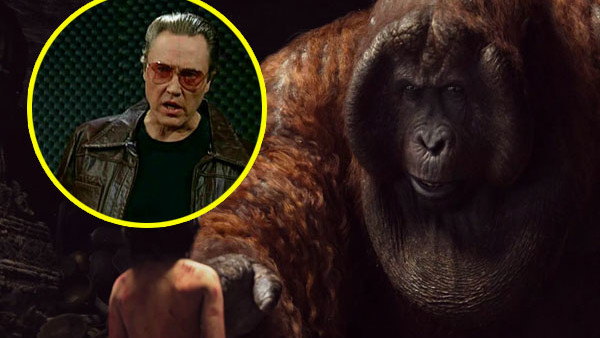
If you thought a possible Game Of Thrones easter egg was the strangest thing to appear in The Jungle Book, you can guess again. Much like there's a brilliant but completely bonkers Breaking Bad reference in Zootopia (or Zootropolis as it is unnecessarly rechristened in the UK), there's a Saturday Night Live reference in the King Louie sequence that is as affectionate as it is odd.
But then as it's dedicated to Christopher Walken, you can sort of understand that.
In among Louie's "treasures" - which amount to rusted pots and metal - there's a cowbell that he picks up to shake at Mowgli. That - for fans of SNL - was a real WTF moment, as it ties into Walken's most famous SNL creation - the "More Cowbell" record producer. A surreal, but hilarious little touch.
9. The Genie's Lamp
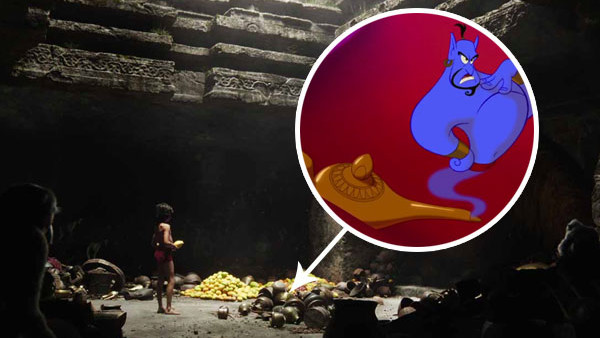
As well as the cowbell, the treasures in King Louie's temple also includes another familiar artefact from Disney's wider universe. Barely visible among the detritus is the unmistakable shape of the genie's lamp from Aladdin.
How gutted Louie would be under all that rubble if he knew he had something in his possession that was genuinely capable of summoning Man's Red Flower...
Incidentally, the chase sequence through the temple that sees King Louie attempting to catch Mowgli was said to have been based on the Monstro chase in Pinocchio. Obviously without the underwater setting.
8. The Songs

Despite Favreau's film firmly not being considerable as a musical, there are two songs from the 1967 animation in there - "The Bare Necessities" and "I Wan'na Be Like You" - though the second one was necessarily changed slightly to reference the fact that Louie is now a Gigantopithecus. The word was also rhymed twice by Supercalifragilisticexpialidocious writer Richard Sherman for good measure in the new version.
Those two songs aren't the only musical elements that were retained from the '67 version: parts of the overture also survive in the film's score.
Though this is definitely a more faithful adaptation of the story that Rudyard Kipling wrote, the identity and spirit of the 1967 version are both preserved in affectionate ways. The music is only one part of it, but it's a big sign-post for the agenda for nostalgia - as is the presence of King Louie who wasn't in the book at all.
7. The Pawpaw

During the temple sequence, King Louie offers Mowgli some pawpaw fruit from his personal stash, offering a brief potted history on the fruit (and finally explaining to generations of confused children what one is after the 1967 classic left it unclear to most audiences). This is undoubtedly a reference to the lyrics in the original version of The Bare Necessities when Baloo sings about picking "a pawpaw or a prickly pear".
If it weren't a nod back to the '67 film, the pawpaw wouldn't be an authentic element in the film. The fruit might be cultivated in India now, but it's only just been introduced relatively recently from Central America and it wouldn't have been around for King Louie to share at the time the Jungle Book is set.
6. The Wolfpup Cameos

in a pleasant little family reference, all of the wolf pups in the film are named after motion capture actors and other crew members (though only Gray is really mentioned in the film itself).
Interestingly the sons of actors Naomi Watts and Liev Schreiber - Sasha and Kai - make their film debuts voicing two of the pups and director Jon Favreau's son Max joins them. His daughter Madeleine plays Raquel the Rhino (Rocky's daughter) and Favreau himself appears as the pygmy hog who gets a licking from Baloo in the honey climb scene.
And cult director Sam Raimi voices a giant squirrel and American Dad's Dee Bradley Baker provides other animal voices.
5. Mowgli's Scars
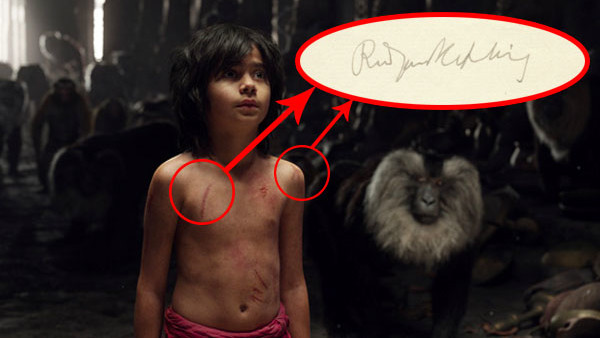
Though they are narratively unexplained (other than as the marks of a rough and tumble life generally), Mowgli has two scars on either side of his chest that exist as strange homages to the character's creator.
The scar on the right side of his chest appears to be in the shape of the letter "r" (until it's crossed out by another scar courtesy of Shere Khan at the end of the film) and also the mark on his left shoulder is a distinct "k". Together they obviously reference The Jungle Book writer Rudyard Kipling.
4. Winnie The Pooh
In the original book, Baloo is not the bumbling, charming comedy character he was in the 1967 animation, but such was the reception of the performance and the character that Phil Harris' version is widely considered the definitive one. Bill Murray's casting and performance clearly owes a lot to Harris' before him.
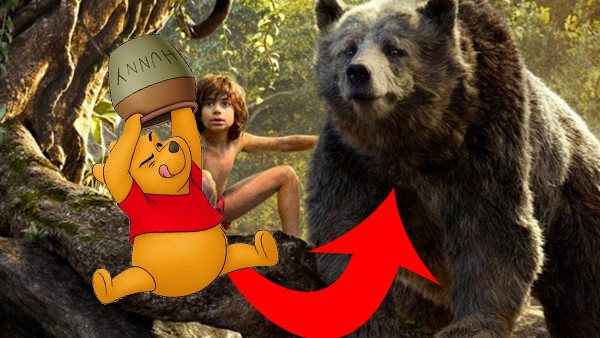
And it would be foolish not to suggest that this even more sloth-like version of Baloo, with his all-consuming desire for honey doesn't owe something to another Disney bear: Winnie The Pooh. If he were to wear a tiny red jumper and no pants the pair would be indistinguishable.
There's also something of Rabbit in Bagheera's annoyance at Baloo's thirst for honey too.
3. Baloo's Famous Line

At the very climax of the film when Mowgli sets off to harness the fire and kill Shere Khan, Baloo pointedly looks to his friend and says to Bagheera ' "if anything happens to that kid, I'll never forgive myself". It's almost the exact same line the bear says in the 1967 original, though Phil Harris says "little guy" rather than "kid".
There's also a reference to Baloo's famous back-scratching (which itself became an Easter Egg in Zootopia), which was included in the trailers for the film but which didn't make it past the final edit.
In another case of characters reusing lines from the other version of the film, Kaa says "trust in me" to Mowgli just before trying to eat him - mirroring the entrapment song the snake sings in the '67 version.
2. The Lion King

It might be a tiny moment on screen, but the shot of a warthog and a meerkat standing side by side in the final battle with Shere Khan at the Truce Rock is a lovely little nod to The Lion King's Timon and Pumbaa. Neither spoke or were given names, but their moment was there for Disney fans to appreciate.
The film actually shares a good deal with The Lion King narratively: there's the idea of an orphaned child attempting to fit in with other species, a buffalo stampede helping save his life, the main villain falling to his death in flames... It's all very similar, and the Timon And Pumbaa nod feels like a conscious acknowledgement of those parallels.
1. The Famous Book
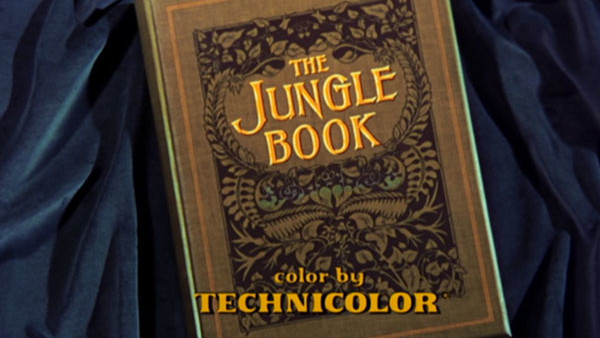
In the olden. golden Disney days, films would open with a real storybook that would blend into the animation. Favreau chose to reverse the trope for the end of his version of the movie:
I noticed that The Jungle Book starts with a real book on blue velvet opening up and theres a drawing. And you push into the drawing and it becomes a cartoon. But the book never closes. So my fantasy was to close that book. So I talked to Disney and they said, Well, it might be in the archives. I say, Please see if you have the book. They dug it up. They found the leather-bound book from the movie.
But they said, You cant touch it. Somebody showed up with a white glove. Nobody could handle it. We set up to match the table exactly. So the end of the movie we freeze on the frame. It goes to a drawing.
In order to capture the effect of the book bouncing along to Christopher Walken signing I Wanna Be Like You and then opening up, serious effects work had to be called on:
So there was the archivist with a broom handle under the table bouncing the book up and down. Then once it opens it goes back to digital and the pages flip with little vignettes from the movie. Its super-cool.
talk about high-tech.
Which other Easter Eggs and references did you spot in The Jungle Book? Share your favourites below in the comments thread.