What Makes The Hitcher A Twisted Coming Of Age Masterpiece
The Hitcher isn't just an amazing horror film - it's also a road movie masterpiece.
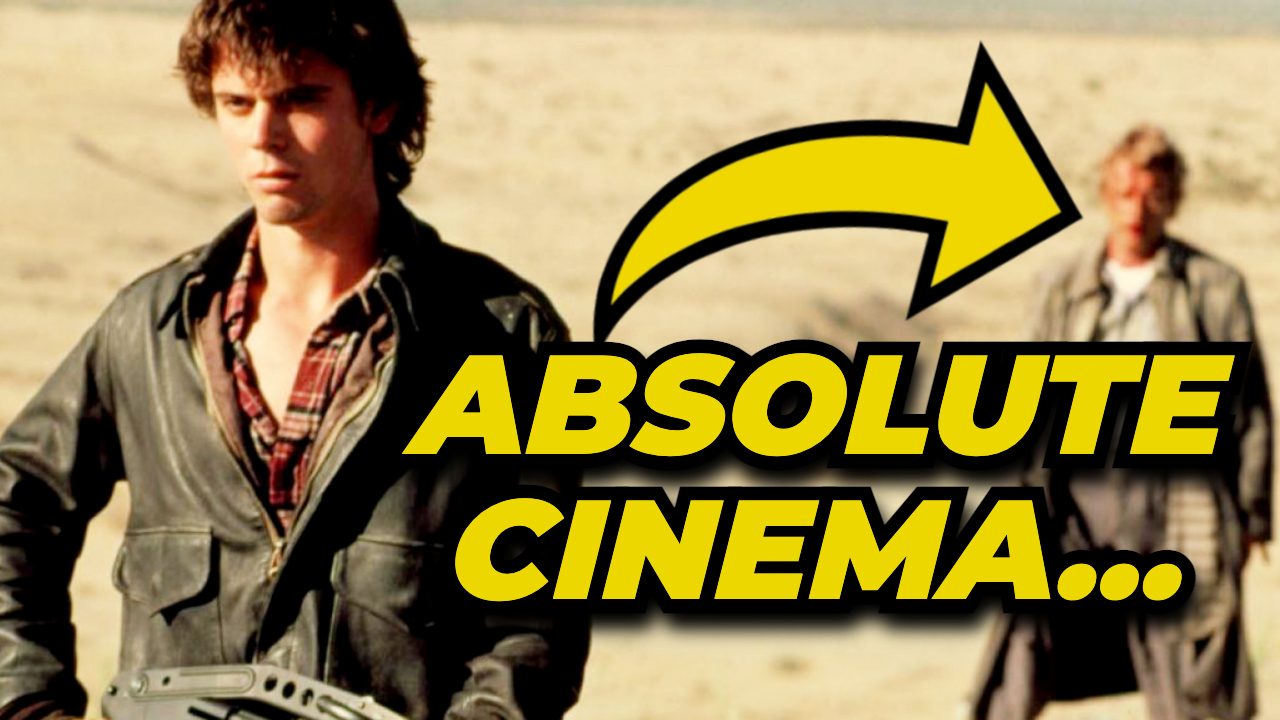
Every now and then, I'll come across something I like to call a "rabbit hole" movie - a film that sinks its hooks into you so immediately and with such venom that you can't help but fall under its spell and pursue your curiosity to a basically obsessive degree. You could call it a bit of a personality reset, in that way - a real "stars aligning" moment where personal taste, filmic brilliance, and behind-the-scenes context provoke a chemical reaction so ridiculous that you want to claim the whole movie for yourself - which is what happened to me with Robert Harmon's 1986 cult horror movie classic, The Hitcher, last year.
A road movie with teeth, and one of Rutger Hauer's most iconic starring roles, The Hitcher is also quietly one of the greatest films ever made - an everything film in the same vein as The Texas Chain Saw Massacre that masterfully subverts the coming-of-age story in a dark, fantastical way. That particular feature was a calling card of screenwriter Eric Red, who deployed a similar trick with his story for Kathryn Bigelow's vampire-Western Near Dark in 1987, complemented there by some sumptuous, dusklight photography from Adam Greenberg, and in The Hitcher by the seering compositions of John Seale, an expert minimalist who was then distinguishing himself in Hollywood for his collaborations with fellow Australian Peter Weir.
Cumulatively, the key influences of Red, Seale, Harmon, and Hauer came together to make The Hitcher one of the most visceral films of the 1980s, and ironically, one that boasted more bite for the compromises it had to make than it would've done had Red's vision been relayed with pure fidelity. Its story - of terror, isolation, and repressed darkness on the American highways - unfurls its most abject horror in the margins of our imaginations, like a bad dream you can't wake up from.
In conjuring that particular kind of uncanny, and at times thoroughly liminal dread, The Hitcher carves a legacy as not only one of the most affecting and smartest genre films of the eighties, but also, given its thematic undercurrents - its psychosexuality, its subversion of Reagan-era Americana and the perceived tranquility that accompanied it - one of the decade's most unique and complex.
Here's why The Hitcher is a stone-cold masterpiece.
[Article continues on next page...]
The Hitcher - A Cult Classic Still Waiting For The Mainstream
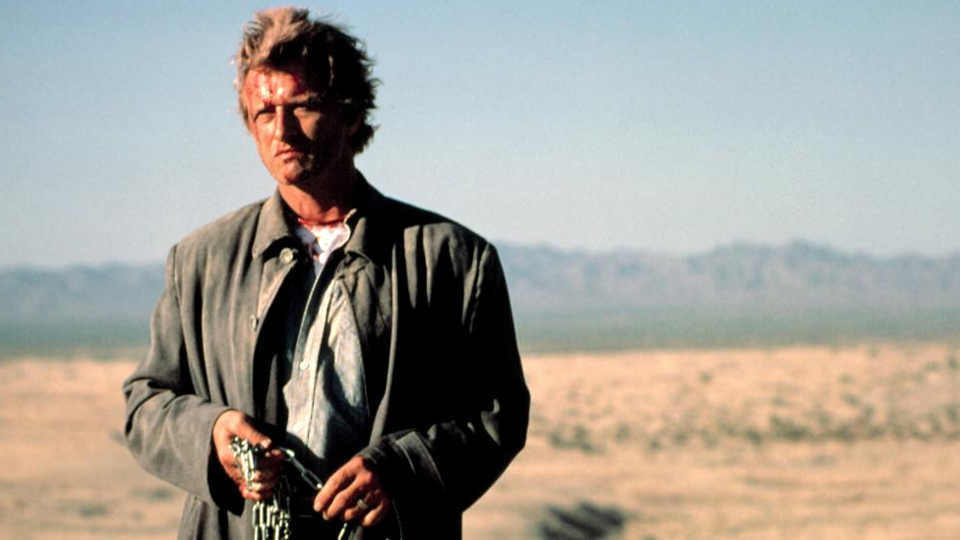
Like some of the best horror movies, The Hitcher commences its story in darkness. Our lead, C. Thomas Howell's Jim Halsey, is a young 20-something out on the road for his first big job, delivering a car from the Windy City to the Golden State. There's a sense of freedom and peril to Jim's journey, akin to something like a rite of passage. Just as he's crossing from east to west - echoing the old, perilous journeys of America's past - so too is he crossing the threshold of adulthood. But the evolution of wagon trains to cars and dust trails to tarmac hasn't made things much safer. Instead of outlaws and war parties, the westward travellers of the 1980s have to contend with different threats, including that most disturbing of post-Vietnam era phenomena - the serial killer.
On this occasion, the sicko in question is the eponymous Hitcher himself, John Ryder, played by Rutger Hauer in perhaps his greatest starring turn. As The Hitcher, Ryder turns the car from a symbol of independence and freedom into a rolling coffin, stabbing, shooting, and disembowelling the good samaritans who stop to lend him a hand. To Jim, though, he's a lot more than that. When he encounters Ryder on that stormy Texas night, it feels almost pre-ordained. Ryder isn't there simply to torture and kill Jim, but to throw down a challenge.
"I want you to stop me."
With these words, Ryder is daring Jim to push back - to fight his own battle as a man out on the road. Layered into this initial encounter are additional clues as to Ryder's purpose and origins - exchanges that grimly mirror real-life serial killer episodes, but ones that also speak to supernatural and psychological motifs. He's able to outmanoeuvre the police by weaponising their discomfort with homosexual overtures towards Jim (a sexuality that emerges as a core component of Hauer's performance), and, once ejected from Jim's car, reemerges and disappears periodically throughout the film with spectral menace.
The Hitcher wastes no time at all in laying its cards on the table, with Harmon, Seale, and Red evoking the multifaceted terror of their story but a few minutes after the opening titles have concluded. It's all there - the coming-of-age anxiety, the repressed psychology - even the idea of the highway as a sprawling, lonely place it was easy to disappear in, reconfigured into a sort of liminal, dreamlike hellscape.
Like the worst nightmares, it's a setting that Ryder lures Jim deeper and deeper into. The open road, ironically, becomes a fixed track, and while Jim is given momentary places of respite, this world between worlds is the Hitcher's domain. All Jim can do - like us - is punch his ticket, sit back, and see where the journey takes him.
[Article continues on next page...]
What Makes Rutger Hauer's Hitcher One Of The Greatest Horror Movie Villains
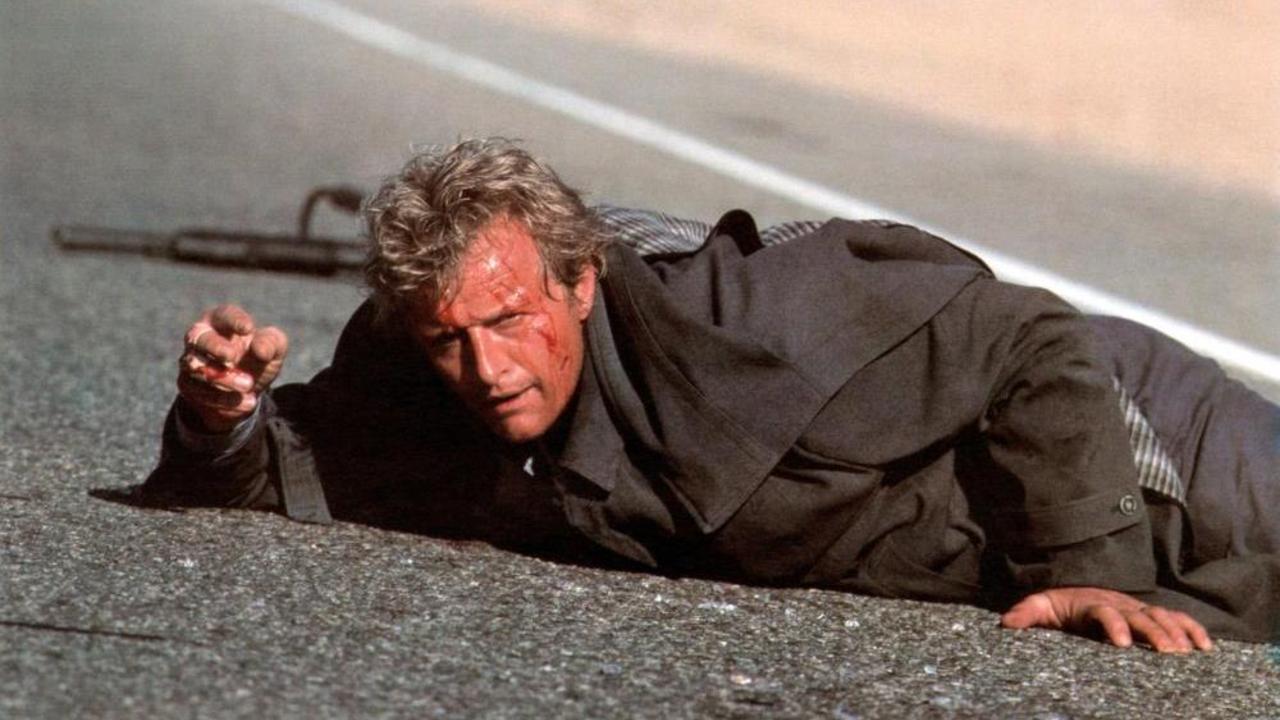
From that initial encounter, The Hitcher's coming-of-age subversion becomes evermore apparent. Jim's ticking off all of his firsts - his first job, his first road trip, and eventually his first romance, which arrives in the form of Jennifer Jason Leigh's Nash. Nash is a diner waitress who helps Jim by cooking him some grub, lending an open ear, and, sometime later, freeing him from a police arrest, with Ryder having framed Jim for his highway rampage in an escalating game of mental torture. It's a game Ryder takes to sickening depths the further he pushes Jim away from his safety nets, with one truckstop sequence quite literally tearing Jim and Nash's burgeoning romance apart in a moment of pure guttural horror - one made all the more unnerving for what it leaves out of frame than what it leaves on it.
Throughout the film, Hauer plays Ryder almost as if he's some divine trickster god, cutting a playful, sadistic figure whenever he's on screen with a smirk that could cut through steel. With his performance, Hauer intimates both an earthly and uncanny threat, the multitudes contained within his portrayal invoking both contemporary fears of roadside sickos and the iconography of Old West mythology. The latter feature is cemented especially by Seale's sunbaked, arid photography, as well as through Ryder's trench-coated, shotgun-wielding silhouette.
Together, they recollect old school genre imagery and further connote not only the supernatural dimensions of the character as a figure possibly thrown up by the past, but also the metatextual and more genre-minded elements of Red's screenplay.
It's a throughline shared between The Hitcher and Red's other eighties masterwork, Near Dark, which also dwelled on Old West and coming-of-age motifs, but the former is absolutely the more visceral example of his writing. According to Red, The Hitcher unfurled from a lonely drive and the disquieting vocals of Jim Morrison on "Riders on the Storm", and much like The Doors' song, it resulted in something thunderously elemental. Hauer - with his piercing eyes, playful smile, and dirty blond hair - was the perfect lightning rod to animate it into something monstrous.
[Article continues on next page...]
Why The Hitcher Is A Road Movie Masterpiece
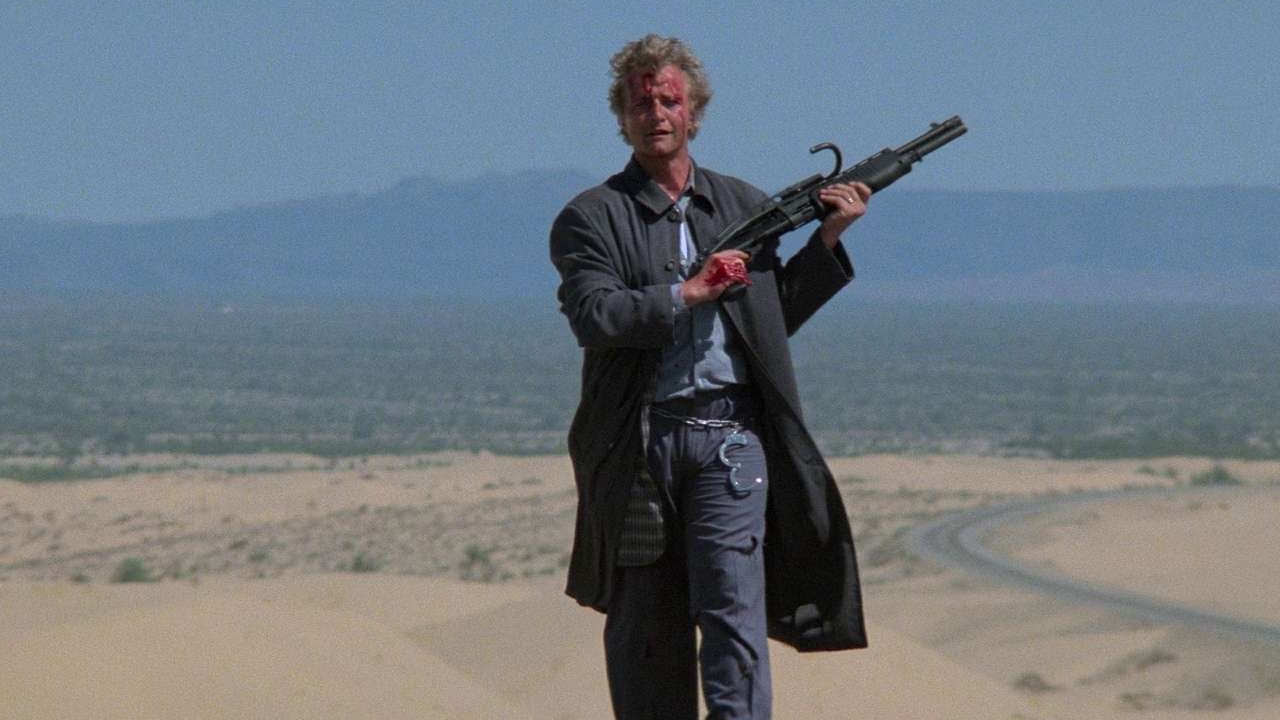
And make no mistake, The Hitcher is a monster of a movie - not just in its violence and dark psychology, but in the multiplicitous depths of its thematic content. Ryder's illusiveness lends the character to endless interpretation - is he the Devil? A dark reflection of Jim's repressed sexuality? Or maybe just the world's luckiest psychopath? Does his appearance speak to Old West folklore, or reflect a zeitgeist left helpless and perplexed by a seemingly inexplicable trend of violent crime?
The answer to all of this is "yes", basically. The Hitcher is everything and everyone - a rollicking good time at the movies, absolutely, but so fascinatingly constructed and executed that it opens up avenues of obsessive interpretation.
You can leave all of this Hitcher-fuelled mania (Hitcher Madness?) to the side, of course. On a technical and storytelling level, Harmon's film is wonderful all around - that rare example of a film where three distinct creative influences in writer, director, and cinematographer meshed together and produced something totally uncompromising. But it's also a film that hinges upon its central casting. Rutger Hauer is The Hitcher both in character and in spirit, and his ineffable charisma is the binding agent that makes the movie's molecular discomfort vibrate at such a powerful frequency. It's impossible to imagine anyone else matching him in the role, and indeed, one of the main reasons neither The Hitcher II nor its 2007 remake landed was because they tried to replace him.
There ain't no Hitcher without Rutger Hauer. That much should've been obvious.
Neither of those misguided attempts at reigniting Red's concept tarnishes the legacy of the original, however. It remains one of the smartest and most subversive horror films of the eighties - and one we really don't talk about nearly enough.