Star Wars: The Force Awakens - 10 Moments Everyone Misunderstands
That's not how the Force works.
By now, the question isn't whether or not you have seen Star Wars: The Force Awakens, but rather how many times you've seen Star Wars: The Force Awakens?
J.J. Abrams film did what many feared was impossible: it really, truly brought Star Wars back. It may not be a perfect film, but for an Episode VII, coming a decade since the last of the prequels, it's the one the universe and its fans needed right now. It's also one that not only stands up to repeat viewings, but almost necessitates them - just one of the many reasons why it is (unadjusted) the highest grossing movie of all-time in both the UK and the US.
When you first see The Force Awakens - especially if it was a midnight screening - there's a whole lot of hype and excitement, and the film blows past at such a incredible pace that it's difficult to really take it all in. On second, third, seventh or whatever you're up to viewing, the picture becomes clearer, you notice more things, you appreciate it a whole lot more, and it makes far more sense when you're not a tired and emotional wreck.
Even then, though, there are still a few things you're left wondering - like what was all that business with Maz Kanata about? In some instances this is due to changes to the movie from initial plans, in others, mysteries are solved in the accompanying novel, and in a few, the answers are staring us in the face, whether we get that or not.
10. Rey's Dream Sequence Is Easy To Follow

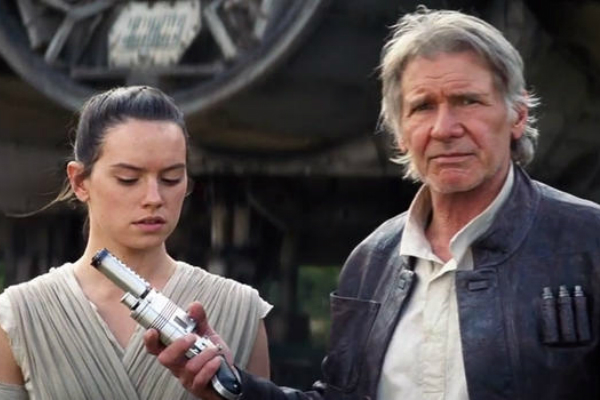
If we're ignoring just how and why she got her hands on Luke's lightsaber (which I am because it's a whole lot harder to explain - the short story is that it seems a lot was cut or changed late in the day concerning that character), then the most confusing scene from Maz Kanata's Castle is the vision sequence Rey has when taking hold of said lightsaber.
It starts back on Cloud City taken from The Empire Strikes Back, and then moves on to show Luke's hand on R2-D2 (a shot from the trailers), before showing the Knights of Ren, led by Kylo, with what appears to be slain bodies all around them, then Rey being left on Jakku, taken in by Unkar Plutt, and finally a face-off in the snow with Kylo Ren. Also heard are Obi-Wan's words (both from Alec Guinness and Ewan McGregor), saying that these are Rey's first steps.
The easiest bits to explain are Cloud City, being left on Jakku (both clearly the past), and the meeting with Kylo Ren (this then happens at the end of the movie). The stuff in between is a little, er, less obvious, and causes all sorts of confusion about whether it's the past or the future we're seeing. Luke's hand is assumed to take place before he becomes a reclusive figure, perhaps his last moments with R2-D2, but then there's the question of what appears to be fire in the background.
As for the Knights of Ren, the most commonly held theory is this is the slaughter of the Jedi Academy. However, there are various other theories and interpretations out there. For example, it's been mooted online that it's not Luke's hand we see on Artoo, but Anakin's (this is despite the fact that it's been confirmed that it is Luke's hand), and also the fire is a funeral pyre for the young Jedi.
As for the Knights of Ren, there's a theory that Kylo is saving Rey here, as he's still battling with the Light Side, or that it actually happens in the future (and, for one final alternative, that this takes place on Endor when he goes to retrieve Vader's mask, and the bodies are slaughtered Ewoks). All seems bonkers, but it's easy to see why this scene has caused some confusion.
9. Captain Phasma Doesn't Just Give Up

In the build-up to the The Force Awakens, Captain Phasma - played by Game Of Thrones' Gwendoline Christie - looked like being one of the most bad-ass new characters around. A Stormtrooper, but in chrome and with a rather dashing sash, she was instantly, effortlessly cool. And then, when the film arrived, it turned out she didn't do an awful lot.
There was a little bit of ordering Finn around, walking amongst the First Order ranks, and then her biggest moment was getting captured by Han, Chewie and co., where it appeared she gave up rather easily. However, there is a little more to it than that. In the novelisation, it's revealed that Chewbecca physically puts pressure on her, actually close to crushing her armour, which is when she eventually relents.
Also, there's the fact that the character will be back for Episode VIII, so that wasn't all we've seen of her, and there should be much more to come. Another point regarding Phasma's surrender that has been theorised online since the film's release is that she was a double agent, hence why she willingly gives up. We've already had one Stormtrooper defect in The Force Awakens, plus she gets shoved down a garbage chute, so that idea doesn't really make a lot of sense, if any at all.
8. Everything With Snoke
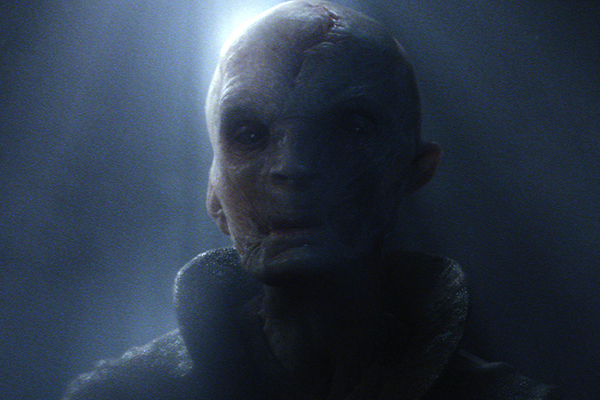
Captain Phasma wasn't the only character fans were left feeling rather despondent about after seeing the film, with Supreme Leader Snoke - mo-capped by Andy Serkis - not quite seeming to deliver on the idea of him being the new overarching bad guy of the trilogy. He's only seen having a couple of conversations with Kylo Ren and General Hux, and does little else. Except that's not entirely true.
For a start, he's the one who seduced Kylo Ren to the Dark Side, so he's obviously strong with the Force. Even more than that, there's the suggestion that he's been in the background plotting for a long time, and is aware of the Skywalker lineage, including Rey's awakening, perhaps even playing a part in orchestrating it all. That will only be strengthened if it turns out he actually is Darth Plageuis (a notion that will persist no matter how much Lucasfilm deny it), but even if he is *just* Snoke, then he's still going to be a major player going forwards, starting with further training Kylo Ren in The Last Jedi.
After all, he's this trilogy's Palpatine, and the Original Trilogy didn't truly show the Emperor's power until the final instalment. Oh, and while he may not be that big (he's probably going to be hilariously small, though it'd cool if he were a towering figure), it is clearly a hologram, something that did cause a lot of confusion and debate when the film was released.
7. Why Han Goes Onto The Bridge

No, I'm still not over it either. The death of Han Solo was always likely to happen in The Force Awakens, but that didn't make the moment any less emotional. It is, simply, the most devastating death of any Star Wars film to date. Perhaps one of the most devastating in cinema, in terms of how beloved Han was for almost 40 years.
Worse still, though, is the idea that his death wasn't fitting for the character, that this is HAN SOLO and he should go out in a blaze of glory, while piloting the Falcon, with some fans complaining that his death was more about setting up Kylo Ren's character than it was a finale for the scruffy-looking nerf herder. Now, while his death does undoubtedly play a major part in the development of Kylo Ren (more on that later), that completely misunderstands the point of this moment and Han the character to say that it wasn't fitting, or it was all about Kylo.
When Han steps onto that bridge, he's got to be aware that he may die. But he also knows that he has to do it, and it's not just so Kylo Ren can become a better villain. It's because of Leia. They'd drifted apart, but she asked him to bring their son back. How could he not attempt that? He'd already got to be the Han Solo of old in this film, piloting the Falcon and trying to talk his way out of impossible situations, but this was who he really is, or at least the person we see him become in the original trilogy. He dies trying to save his and Leia's son, after she asked him to. It was necessary for the film and this new trilogy, but it was also perfectly judged, from that shout of "Ben!" to the last caress of the face.
6. Rey's Battle With The Dark Side

Rey's lightsaber fight with Kylo Ren was not only one of the highlights of The Force Awakens, but one of the best lightsaber duels the entire saga has yet delivered. It had the passion and emotional resonance of the originals, but mixed with the improved fight choreography that we witnessed in the prequels.
From that moment Rey managed to Force-summon the saber out of the snow, a callback to The Empire Strikes Back, to her victory over Kylo, it was full of frenetic energy as the two relative novices fought it out. But while Kylo Ren's fight between the Light and the Dark had been much more prominent, what was perhaps missed in this sequence was Rey's own pull to the Dark Side.
In fairness it doesn't get played up too much in the film, but rather it's another thing left to the novelisation to clarify, stating: "'Kill him,' a voice inside her head said. It was amorphous, unidentifiable, raw. Pure vengeful emotion. So easy, she told herself. So quick. She recoiled from it. From the Dark Side."
This actually makes perfect sense, if she is indeed the continuation of the Skywalker lineage (which remains up for debate). Much like Anakin and Luke (and indeed Kylo, who is her cousin if the theories are true), Rey feels the pull of the Dark Side, but crucially, like her (presumed) father, she doesn't give in to it.
The moment when Rey effectively seems to pause during their fight, and appears to channel the Light Side of the Force (a moment that has been ridiculed by some), is the closest we get to seeing that on the screen, a subtle indication of her inner struggle, the moment she chooses the Light and lets it flow through her.
5. Kylo Ren Is Now Irredeemable

Ah, fan theories. Kylo Ren's arc is going to mirror that of Darth Vader, so of course he will be redeemed by the end of the new trilogy, right? Or, even crazier, Kylo Ren is a double agent, and is taking down the First Order from within. He killed Han for that reason - it was all part of the plan. Both of those have genuinely been stated a fair bit since The Force Awakens, and, well, no.
The double agent idea doesn't make any sense, because he quite clearly feels the pull of both the Light and the Dark Side, and he's been made into such a complex villain that him being a double agent would be plain stupid, not to mention no one would ever agree to a plan killing Han.
As for the redemption, it's more understandable (and the novelisation even discusses how the act weakens him, rather than strengthens him as expected), but, frankly, you do not come back once you've killed Han Solo. Ben Solo may have felt that he was being pulled in different directions, but by killing his father, and then fighting Finn and Rey (and now off to receive more training from Snoke), he has ensured that he is not redeemable.
Going down that route would be too derivative of the original trilogy anyway (although they obviously don't have too much of a problem with that), but this is Han Solo he killed, a character people have such a strong connection too. There is possibly a way you attempt to write that redemption arc (and Kylo's redemption is probably a point more up for debate than others), but a lot of Star Wars fans wouldn't buy it.
4. The Map "To Luke Skywalker"
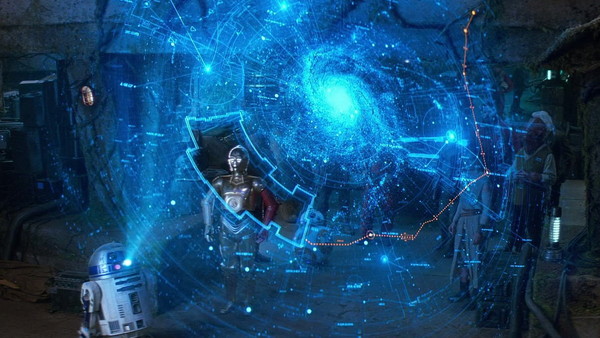
The MacGuffin of The Force Awakens (which was clearly changed late in the day from being Luke's old lightsaber) was the map that led to Luke Skywalker. Part of it is hidden in BB-8 right at the very beginning of the film, while the rest is contained within R2-D2, who is in low-power mode with his master gone, and only wakes up towards the end and reveals that he has the rest of it.
While the way the whole Artoo being woken up thing is handled is a bit messy and convoluted, that's not the main misunderstanding. It's more the belief that this is, as mentioned in the paragraph above, a map to Luke Skywalker. As though Luke went into hiding, but decided to leave a pretty clear trail to his whereabouts.
That alone is a bit senseless, but it's also pretty impossible when it turns out that Artoo downloaded the data he holds from the Empire's databanks. This means that the map predates not just Luke going into hiding, but everything else that's happened in the thirty years since Return Of The Jedi. Han Solo states that people believe Luke is searching for the first Jedi Temple, which seems a much more likely origin; the map actually leads to that and Ahch-To, rather than specifically Luke himself.
3. The Very Late Luke Reveal Was The Right Choice

#WheresLuke?
Luke Skywalker was missing from almost all of the promotional material heading into The Force Awakens, save for the shot of his hand on Artoo, leading to an outcry over the fact that he was being kept back for the movie, despite having second-billing on the poster. And then, when the film was finally released, Luke was only in the very last scene, and didn't have a single line of dialogue.
Whether it was before the film or after it, those complaints and questions completely missed the entire point. The search for Luke, whether through his lightsaber or a map or whatever, is what drives this film forward. His absence, meanwhile, is completely necessary for the new characters to take centre stage and really evolve, evidenced by the fact that Luke appeared heavily in Michael Arndt's original script, but had to be cut down when he took over the film (Mark Hamill himself has spoken about how he thought Luke should've returned earlier).
It also fits with the character, based on what we know of Kylo Ren killing the other Jedi he was training, that he'd exile himself (in particular if he's also feeling guilt over fathering a child as well), while it serves to build more of a mystery that they can explore in the future films, and certainly makes his presence in The Last Jedi even more intriguing. In short, Luke Skywalker was in The Force Awakens for about a minute, and that was not only a very deliberate move, but also the right one.
2. Rey Is Not A 'Mary Sue'

A Mary Sue is a female character type, introduced into a series, who comes from a lowly or unusual background and is essentially perfect at everything no matter how unlikely it seems. It spins from fan-fiction, in particular serving as an author's avatar within the story, but is now used as a criticism in fiction in general of any female protagonist who appears to be perfect (and, of course, it's typically women who receive this criticism, not men - that would be the lesser used Gary or Marty Stu).
Anyway, the reason I'm rambling about Mary Sues is that Rey has, since The Force Awakens came out, been extensively accused of being one (most notably by Max Landis, writer of Chronicle). Oh, she can fight with her staff. Oh, she knows how to pilot the Falcon. Oh, she can withstand Kylo Ren's mind tricks, and use some of her own. Oh, she totally kicks ass with a lightsaber in her hand. Oh, this is bulls**t.
Firstly, this is just one film of a planned trilogy, which will see Rey's character develop even more. She'll have ups and downs - not everything will be a success - and we'll get to see different character traits and/or flaws. Secondly, the majority of that stuff comes from a logical, narrative place; she was abandoned on Jakku from a young age and had to learn how to fight and scavenge in order to survive, while (given she has a fighter pilot's helmet in the place she calls home) obviously harbouring dreams of piloting a ship and escaping that planet.
As for her ability to withstand Kylo, use mind tricks, and wield a lightsaber (against a Kylo hampered by his injuries, no less), all that does is show a natural connection to the Force, but one that still needs a lot of training and refinement, as we see with Anakin and Luke when they're younger, more raw Force-users. To misquote Han, that IS how the Force works.
1. The Reason The Plot Is Similar To A New Hope

The Force Awakens is just a reboot of Star Wars (A New Hope). It's too derivative. It basically amounts to fan-fiction. There's nothing new or original. You can't go two pages into the internet without seeing stuff like that thrown around like criticism's going out of fashion.
There's a couple of things wrong with those criticisms, which have been pretty constant and commonplace since the film was released. One is that it's too harsh on what J.J. Abrams has created. Yes, it follows a lot of similar beats (and I'll get to that reasoning soon) but there's plenty of new stuff in here too. For example, Kylo Ren is the most fully-formed and interesting villain to be introduced in a Star Wars movie (I'm not saying he's better than Vader, but on the basis of one movie he's much more layered). Star Wars has always been about family, but this delves deeper into the meaning and importance of marriage and parenthood. There are battle sequences in this film which look incredible, and unlike any other. We've got a Stormtrooper who actually becomes a proper character. A female Jedi. New characters, new relationships, new adventures.
Now, as for the stuff that's similar... Yes, The Force Awakens does hit extremely similar beats to Episode IV. That much was obvious long before the film was released, and it's absolutely intentional (and not in some sort of fan-fiction or copying kind of way either). That's Star Wars. As George Lucas said (for better or worse), "it rhymes." Hell, before Star Wars, there were the Flash Gordon serials and The Hero with a Thousand Faces and all the other stuff that George Lucas lifted liberally from. So of course the structure of this film (especially as it's the one charged with 'bringing Star Wars back), and the beats it hits, match-up closely with that very first film. It's not a bad thing. It's just doing what it's supposed to. It's being Star Wars.
Which criticisms of Star Wars: The Force Awakens do you think miss the point? Shout out any more down in the comments.