Riddick: 7 Crimes Against Cinema It Commits

7. Casual Sexism
 There are two female characters in Riddick, one who is killed within 60 seconds-or-so of us meeting her, and the other is Katee Sackhoff's Dahl, who appears to be a strong, no-nonsense femme fatale-type character, who we assume will probably be the only character in the movie to square up to Riddick. The problem, as sites such as Empire have pointed out, is that Dahl ends being subject to a woefully misogynistic treatment that totally undermines her character. It's implied early on that Dahl is a lesbian, though by film's end, it is very clearly implied that she has sex with Riddick, suggesting that the protagonist, the ultimate macho man, is wanted by all women, regardless of their orientation; if they're gay, he'll damn-near turn them straight! It's a creaky line to walk, and given the film's prior rapey vibes from villain Santana, just layers the film with yet another supremely icky subtext. For all of Dahl's opportunity to be a feminist icon from the outset, she's ultimately reduced to gratuitous nudity and subject of the much-discussed "male gaze". The film might be aiming to throw back to 80s B-movies, but this is just downright tacky.
6. Vin Diesel's Performance
 It's never a good sign when a movie's script asks Vin Diesel to spend the first act narrating it heavily. Though Diesel has given one truly great performance in his career - in Sidney Lumet's Find Me Guilty - it's generally acknowledged that he's best cast as the silent but deadly type, as suits Riddick's usual modus operandi quite nicely. However, given that the opening sections feature only Vin Diesel, the only other option is silence, and though that often seems preferable here, Diesel is forced to chew through several pages of unconvincing, often corny dialogue, in order to finally get the plot moving. In addition to that, Diesel, perhaps aptly, comes across as incredibly tired throughout, fielding out the one-liners without much enthusiasm. Given the paycut he had to take to be in the movie, perhaps it's simply a case of his mind being on more prosperous projects...
5. Narrative Padding
 Riddick runs in at 118 minutes, and you feel almost every minute of it. The film clearly has only enough material for around 90, but the distended opening portion, which has Riddick getting the lay of the land, resting up, befriending a dog-like creature and battling natural predators, drags on for far too long, while a flashback sequence is also thrown in there for good measure. What should have collectively lasted no longer than 10-15 minutes max ends up taking up an entire act of the movie, by which time I had already resolutely lost interest in what was going on. Such a minimalist approach was surprising for sure - that it reminded me of There Will Be Blood's opening portion only compounds the weirdness - but in a film that desperately needs to get to the point and deliver on its action-based promises, it feels stuck in first gear for so long.
4. A Terrible Villain
 Ruthless, crude bounty hunter Santana has to be just that for the narrative to work; he is a villain who we want to see Riddick murder, and by virtue of his creepy, rapey, angry demeanour, actor Jordi Molla doesn't exactly have to try hard. However, it's not really an impressive performance, more one that survives on the strength of its intentional and unintentional hilarity, by way of the ridiculous one-liners he is forced to shout, and Molla's often unconvincing delivery (listening to him try to pronounce the word "frequency" is nothing short of painful). He's more an irritation than anything else, and short of one tripwire-tense sequence in which he attempts to disarm a bomb-lock planted on a locker, he doesn't get a lot of narrative meat to play around with. That said, when he meets his extremely grisly end - having his face graphically split in two - it is a crowd-pleasing moment for sure.
3. Riddick Spends Too Long Off Screen
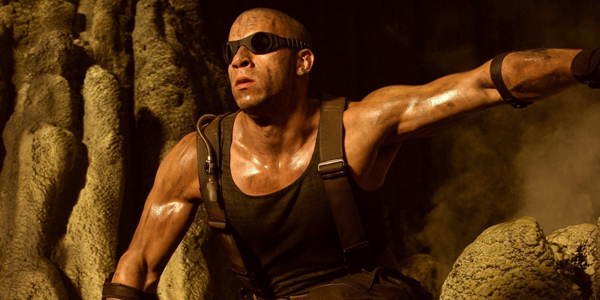 Riddick's second-act is just full of wheel spinning, for while it introduces us to the two teams that are hunting Riddick down, this also involves keeping Riddick off screen for long portions of time, as we meet the characters (who often aren't worth the bother of developing), while our steely protagonist keeps hidden out of sight. Riddick instead creeps around, occasionally interacting by headset and sneaking up on some of the hunters, but basically, it's slasher film 101, albeit moving at a glacial pace that again makes it clear that the film is considerably outstaying its welcome. This point only makes it clear that the film needs to be severely edited down, but speaking of the editing...
2. Awful Editing
 This film is edited with the fashionable yet irritating choppiness that unfortunately defines so many action films nowadays. When Riddick is fighting both humans and monsters, it's difficult to make out quite what's going on, as director David Twohy insists on having editor Tracy Adams cut so frantically that the only result is annoyance on the part of the audience. Given the movie's favourable R-rating, there's not really any excuse not to just show us the violence in all of its glorious detail, with steady shots that take their time. Twohy, whose prior films in the series were much easier to stomach editorially, instead opts for the ADD approach to action editing that has become depressingly abundant these days. It's difficult to become involved in even the movie's strong suit - its hardcore action - when we're forced to try and discern coherence from a mass of cluttered images.
1. Lazy Third Act
 Riddick's third act is a blessing and a curse; it is easily the strongest portion of the movie, but it is also that which is most indebted to the original film, as Riddick stages a fight against the remaining monsters while also trying to escape to a ship with questionable comrades (whose allegiances may or may not be true) in tow. It's pretty much the same operating procedure as with the first film, and though it has been 13 years since the original, many will no doubt have been swotting up on their Riddick knowledge by re-watching Pitch Black before seeing the new film, which in effect will set them up for a disappointment. Right down to Riddick disappearing into the night at the film's end, it follows a depressingly similar beat, rather than coming up with something fresh. Clearly, Twohy was keen to revisit this world, though just didn't have enough prime material to make it work. Have you seen Riddick yet? What do you think of it? Let us know in the comments below.