As obvious as it seems to be to everyone but Woody Allen that he is a card-caring member of the intelligentsia, he just can't seem to embrace this fact. In order to show his affinity for the "every man", he occasionally chooses to show the working schlub as the true "genius". For Bullets Over Broadway, Allen's idiot savant of choice is Chazz Palminteri. Chazz Palminteri plays the role of Cheech, a no-nonsense tough guy, who despite his unquestioning personality, still retains deep insight into the human condition. Cheech, the hired muscle of a mafia Don, secretly writes a play for the playwright David Shayne (John Cusak), an intellectual who couldnt write a sincerely meaningful play if his life depended on it. For Cheech, it doesn't take mental gymnastics to understand the world, and this is supposedly what makes his writing so strong. Putting aside the "reality" question if such a person could really exist, Chazz Palminteri does a good job of making us believe he could. Playing the role without a lot a fuss is the key to making us blindly except the existence of a Cheech in the world. My one major line of criticism about the performance (and the thing that made me rank Palminteri last among the nominees) is that Palminteri slightly overplays the "Joe Six-Pack" angle. This is undoubtedly because Allen places this world in a stylized existence that never really was, but the problem is Allen still attempts to make a statement about the world as it actually is, which turns the reliance on stereotypes into a weakness. Even with this complaint though, it is still a great performance that is worthy of nomination.
4. Paul Scofield in Quiz Show
Quiz Show tells the compelling story of how television executives in the 1950's worked to fix popular game shows in order that the "right" contestants won (like the suave, good ol' red-headed American, Charles Van Doren, over the fuzzy-haired, glasses-wearing Jew from Queens, Herbie Stempel). The strength of the film though goes beyond its fascinating "based on a true story" narrative. While the nagging suspense of the exposing of a cover up is well crafted by director Robert Redford, what transforms the film from a solid dramatization of a pop culture event in 1950's Americana to something of a more universal dramatic appeal, is the insight the film has into its characters as people. For the character Charles Van Doren (Ralph Fiennes), this is most effectively done by giving us a glimpse into his family life, in particular the relationship he had with his father, Mark Van Doren (Paul Scofield). The Van Dorens were a well-regarded literary family in America, and the imposing figure of Academic royalty that Mark presents himself as gives an understanding to motivations of his son, Charles. Despite his genuinely well meaning, supportive attitude towards his son, Mark's towering presence can not help but put implicit pressure on his son to measure up to his father's legacy. Scofield, who previously won an Oscar in 1966 for one of my all-time favorite performances as Thomas Moore in A Man for All Seasons, plays the role of patriarch about as well as has ever been portrayed on film. What I love about Scofield's performance is his side-stepping of the typical "domineering father", an arch-type that has been abused on film as much as the slow-motion victory shot. Scofield instead opts for a much more realistic paternal portrayal. Scofield's Mark is not cartoonishly bombastic, but the very nature of his personality is a constant albatross for his son, one that presses him to do "what it takes" in order to achieve something of significance. It's a complex and rather unique father-son relationship, but one that Paul Scofield (unsurprisingly) illuminates with ease and confidence.
3. Gary Sinise in Forrest Gump
I think the surprising and astonishing success of Forrest Gump (#27 highest grossing film of all-time and #22 adjusting for inflation) has to do with the film's iconic nature. In fact, I can not recall a film that is as self-consciously iconic as Forrest Gump. The film basically inspires to be the fairy tale of the Baby Boom generation, and given the response of audiences and critics (including a Best Picture win from the Academy), it appears to have succeeded in its mission. Now the film does require a pretty hefty suspension of disbelief (according to the movie, a semi-mentally handicapped man is the catalyst for important 20th Century American events ranging from Elvis Presley's dance moves to the uncovering of the Watergate break in), but the key figure that allows us to swallow the sugar-coated, Disney-style pap while still retaining a semblance of dignity and self-respect is the unforgettable character of Lt. Dan, portrayed by the one and only Gary Sinise. The reason why Sinise's performance is so good, and so vitally important to the film, is that Lt. Dan's complex, emotionally guarded personality is the needed counterpoint to Gump's straightforward simplicity. The benign sweetness of the surprisingly insightful Gump would quickly tire without an anchor into a more realistic tableau of human emotions, which is provided by the often feisty and angry, but secretly caring, Lt. Dan. Sinise understands this perfectly, and for every note of Hanks' sweet tea sayings, Sinise responds in kind with the frustrations of a suffering man who knows that Gump can not relate to his feelings, even though his quaint ideas may have more wisdom than he would like to admit. It's really tough to pull off the kind of schmultz that Forrest Gump successfully gets away with, and as good as Hanks' performance is, without the humanity of Sinise's performance, the movie would likely be a laughable farce instead of an instant classic.
2. Martin Landau in Ed Wood
Tim Burton is one of the most inconsistent directors in the history of cinema. From absolute garbage (Alice in Wonderland) to unique brilliance (Edward Scissorhands), you're never quite sure what you're going to get from the off-beat auteur, but in my book, the pinnacle achievement in his filmography is Ed Wood and a large part of the film's success has to do with the outstanding performance of Martin Landau as Bela Lugosi. Ed Wood is an unconventional biopic about the eponymous protagonist (Johnny Depp) who is commonly cited by film historians as the worst director in the history of cinema. At the heart of the film though is the relationship between outcasts, the man perpetually on the fringe, Mr. Wood, and the once-great but now forgotten Bela Lugosi. At his old age, the world of fame and fortune long passed, Lugosi had little other than his pride and memories, but the endlessly energetic and optimistic Wood gave purpose again to an otherwise aimless life. What makes Laundau's performance so impressive is he not only manages to get the mechanics of Lugosi right (from the voice, to the mannerisms, to the posture and presence), but he nails the character that the film needs him to be. Even if there had never been a Bela Lugosi, and the story of Ed Wood was purely fictional, Laundau's performance would still be sensational because it goes far beyond mimicry. Landau is able to capture the waning bitter years of a legend whose time has past (like Gloria Swanson as Norma Desmond in Sunset Boulevard, but with less histrionics), a man who can not and will not (except through the aid of booze and drugs) accept the fact that his glory days are behind him. The fact that he is able to so accurately imitate the classic horror movie star just adds the perfect cherry on top.
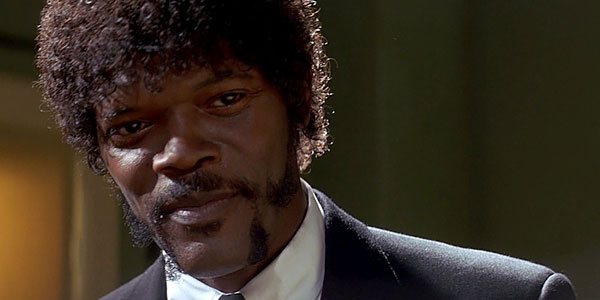
1. Samuel L. Jackson in Pulp Fiction
Landau may have taken home the Oscar for his performance, and he would easily be my number one pick in numerous years, but anyone competing in 1994 always had one big obstacle in his way, because he was going up against one of the greatest movie characters of all time: Jules Winfield. This classic character that made Samuel L. Jackson a household name and would go on to spawn a career that would lead Jackson to appear in more $100 million-plus grossing movies than any other actor in history, is one of my favorite creations in the history of film. Jules from Pulp Fiction is hands down one of the coolest cats in the history of Earth (fictional or non-fictional, film or any other medium, this universe or any other parallel universes). Even if the only scene Jules had appeared in was the scene in which he and Vincent (John Travoltra) kill the guys who messed with Marsellus (Ving Rhames), the "What ain't no country I've ever heard of. They speak English in what?" speech and the reciting of the fake bible verse Ezekiel 25:17 would be enough to give him the Oscar in my book. The sheer bravado of Jules, and the possible existence of a human being like Jules, is so revolutionary that even if Samuel L. Jackson had solely banked his career off of variations of the character (which he has to some extent), he still deserves a life-time achievement award. Beyond creating the untouchable bad ass aura of Jules Winnfield, Jackson also has great chemistry with John Travoltra's Vincent Vega. Their friendship is the driving force of the film, and the humorous back and forth between the characters is easily the most memorable part of the film. The ease with which Jackson transforms between nonchalant aloofness and intensely furious anger is also quite impressive. There are very few supporting actor roles that I can think of off hand that I would rank ahead of this. It's purely iconic, a role that will forever go down in the annals of cinema as one of the best. Its just too bad the Academy did not see this at the time.
A film fanatic at a very young age, starting with the Teenage Mutant Ninja Turtle movies and gradually moving up to more sophisticated fare, at around the age of ten he became inexplicably obsessed with all things Oscar. With the incredibly trivial power of being able to chronologically name every Best Picture winner from memory, his lifelong goal is to see every Oscar nominated film, in every major category, in the history of the Academy Awards.