Jason Bourne Review: 7 Ups And 3 Downs
Matt Damon's back in what could be the start of a whole new trilogy.
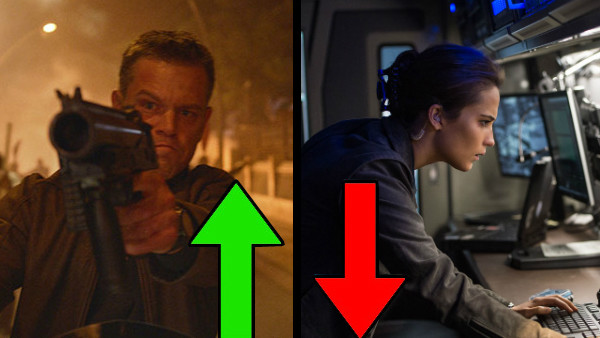
Rating: ★★★★
It looks like Summer 2016 is saving the best for last. Since Captain America: Civil War kicked off blockbuster season in astounding fashion it's been nothing but bland retreads or pointless reboots. Gruelling puts it lightly. But, as we enter the school holidays and things would normally wrap up, all of a sudden Hollywood's kicked things up a notch
Last week we got Star Trek Beyond, an Original Series-hued actioner that Skyfall-ed the franchises, and now there's Jason Bourne which (contrary to some of the negative press surrounding this one) is for my money the best in the series, and promises some very exciting things in the future. If Suicide Squad can deliver next week then we may have the trifecta.
This is another in a lengthy line of long-gestating sequels - it's been four years since the last film in the series, and nine since Matt Damon last appeared - but unlike Alice Through The Looking Glass or Independence Day: Resurgence, this is one that feels worth the wait; with star Damon reunited with director Paul Greengrass, the man behind the famed parts two and three, Bourne feels as exciting as ever.
Now there are some creaks under the hood as a series that was running low on plot in part three churns out its fifth film, but overall this is an unexpected success. Here's seven Ups and three Downs from Jason Bourne.
Ups:
7. The Title Has A Purpose

Ooh, there's a new Bourne movie, what they gonna call it? The Bourne Legacy's taken, but from Van Lustbader's continuation of Robert Ludlum's novels you still have Betrayal, Sanction, Deception, Objective, Dominion, Imperative, Retribution, Ascendancy and Enigma. Or they could just make something new - Resurgence is forever tarnished as a word thanks to ID4Eva, but I think The Bourne Resurrection would be a solid title for this one.
And... it's just called Jason Bourne. They didn't even go with The Bourne Jason for some nice brand synergy.
However, naming the movie just the character's name has more to it than telling audiences this definitely won't have Jeremy Renner back (sorry Jez, it'll take more than revealing you have a nice farmhouse to save that character). Identity is an essential part of the film, with focus very much on how a Bourne with his memories returned can function, and whether he actually is David Webb any more. To call it the most intimate isn't quite fair, but the movie justify going the John Carter/Jack Reacher route.
6. The Topical Inflections (Mostly) Work

It takes Jason Bourne less than twenty minutes to the S-word. Snowden, not SPECTRE. This is post-NSA-leak Bourne and the movie won't let you forget it.
At first it feels rather odd. Bourne was incredibly modern in the early-naughties, but it played into more obscure paranoia rather than tangible real-world parallels. When a hack near the start is said to be worse than what JGL did, I winced. But as the movie goes on and finds its footing, it begins to use these elements more carefully as a backdrop to the story that makes Bourne's pulling out of anonymity that bit more believable.
There's a lot of different aspects to it; you have a social media giant whose CEO is a mash-up of all the Silicon Valley guys behind Facebook, Twitter, WhatsApp et al and grapples with essential issues of security and unsanctioned government monitoring; there's more Treadstone-esque black ops programs because of course no one learns; best of all, a big chase sequence is set in Athens during a riot, something that looks like it's out of some dystopian sci-fi, with faceless armed police and fire flying everywhere, yet it's an all too real image.
5. The Memory Elements Aren't As Forced

OK, it's time I made a shocking mid-point confession. I'm not a massive fan of the Bourne series. I don't dislike them. Identity's a film with a really tight plot that's always overlooked because it was Doug Liman, who people didn't like until Edge Of Tomorrow, not Paul Greengrass directing it, yet it's no classic. Supremacy is just a great action movie, fair enough, but Ultimatum is more a run of sequences and Legacy is... well... it barely counts.
My big problem with them all is the plot, and how random memory flashes became a lazy part of the narrative - Ultimatum picks up straight after the previous film, yet all of a sudden Bourne remembers a whole movie's worth of key info.
Thankfully, because Webb got his key memories back in that third entry, Jason Bourne can run about a bit more unencumbered, with the memory flashes we do get slight and fitting better into the wider plot. Bourne's probing what he knows, not randomly learning more.
4. The Action Is, Obviously, Great

What Bourne's always had, on top of the amnesiac plot, is the action (and this is why Greengrass is usually cited as the series' MVP). No one can shoot shakey cam action quite like him, with a fully aware sense of place and brutish choreography. Things haven't really dulled with Jason Bourne, with the same confidence of approach to the immense, blurred close-ups and snappy editing still here.
The action beats in Jason Bourne give both director and actor the chance to show the full range of what they can do. There's a really nice variety in here, with the Athens chase, several fist fights, a London-set bit of espionage and a massive finale in Las Vegas that hits just about every beat imaginable, and it's all consistently engrossing.
Once again it's the ability to keep up the pace that's so impressive. Few action movies can maintain the adrenaline rush for longer than a couple of minutes (just look at the problems in Spectre), but several sequences here threaten to never end, which really push Bourne's intensity in the face of exhaustion.
3. The Supporting Cast Excel

There's been a lot of talk about the limited dialogue Matt Damon has in Jason Bourne. I tried to count the lines to verify, but got too wrapped up in the action to focus on it, which is really all that needs to be said about Bourne's characterisation here - regardless of what he says (although it feels like more than twenty-five), the silent former spy works as an action hero.
It's not a one man show though, and for a series that's always brought its A-game with the supporting cast, Jason Bourne is one of the best. You have Julia Stiles back a Nicky Parsons, which is good continuity, but the newbies shine. Tommy Lee Jones is standardly solid as the CIA chief and doesn't appear to be phoning it in and Vincent Cassel is a very nice surprise as "The Asset", a sniper assassin who hounds Bourne throughout the film, although the standout is Alicia Vikander. Her CIA up-and-comer is a little underwritten in the mid-section, but the actress still sells it, especially at the end where she gets some proper meat to work with.
The only one who doesn't get enough time is Riz Ahmed as the social media giant Aaron Kalloor, who deserved more than his limited sub-plot.
2. It Works As Reboot, The Start Of A Trilogy And By Itself

As a concept, Jason Bourne is an odd movie. The series still feels incredibly modern and cutting edge, but it's been almost a decade since we last saw Jason; when Legacy came about the franchise was a little past it, and that was four years ago. So while it's a follow-on, it also needs to operate on a more accessible level for those who remember Bourne's previous life even less than David Webb. And that's saying nothing of future franchise potential (because Universal have always fancied this as a never-ending Bondian run).
Excitingly, it works on all those levels. There's a montage at the start that fills you in a the character beats of the previous films before snapping to 2016, and all the hushed whispering of "Oh my God, it's Jason Bourne?!?" at the CIA locks in the character's legacy in this world, but the main narrative is mostly new, dealing with fresh internal problems and new discoveries about Bourne's past.
The ending really solidifies this. No spoilers, but it manages to wrap up all the key character beats from the film while still leaving the door just ajar enough that there's plenty of room for more. I wouldn't be surprised if this is the start of a new trilogy.
1. It Takes The Best Bits From The Previous Movies And Makes Them Better

In Jason Bourne you have the following: an early sequence of an assassin hunting Bourne and a colleague, a London-set sequence where Bourne is trying to intercept an innocent, an intense fist fight in a bland location that becomes one of the movie's standouts, a line of CIA agents of varying duplicitous allegiance, a frantic car chase against a former foe.
That's right - what Greengrass has essentially done is distilled everything that worked best in the previous films into one coherent whole, with added age and melancholy. As someone who's never been won over by a single Bourne movie fully (although I do still love Supremacy), this worked brilliantly, allowing me to appreciate everything on its own level.
Die-hards may be a bit more sceptical, but there's enough new stuff to stop it being a straight up greatest hits, and almost feels a bit similar to Mad Max: Fury Road in the way it's playing the same notes in a new style. Like Bond, Bourne's found its formula, and it works.
And now for the downs...
Downs:
3. But It Is Still Taking From The Previous Movies

But yeah, for all I've just said, it is still taking from the previous movies. While Jason Bourne is enjoyable, it doesn't feel all that envelope pushing as a result.
It's a common reboot tactic to reconstitute previous movies into something new, and while Jason Bourne isn't as explosive as some of the more obvious recent examples, there's an underlying sense that more new stuff could have been in here. There's not as much advancement on a structural level, so while the plot is modern, it's a little too stuck in the past. Nothing totally wrong with that - look at how quickly we've forgotten how every sequel used to be just a retread - but it means the film isn't as forward-thinking as it seems to think it is.
One thing that really did get my eyes rolling is the list of ten different secret black ops departments; it does fit in the film, but that's the same reveal we've had in every other movie, and the "oh no, there's another secret CIA program" schtick was getting really tired by Legacy. If we are getting more Bourne, it'd be good to drop all that rubbish.
2. It's Not As Strong On An Emotional Level

I talked in the Ups about the societal commentary side of the film, but sadly it doesn't quite strike as hard a chord on the emotional side. Jason Bourne's an interesting character and the daddy issues he explores here fit nicely in the bigger picture, but it's never quite as involving as it could be.
This is always a potential issue when you're making a movie that's so built on the viscerally of its action. Take a look at Greengrass' other films, specifically United 93 and Captain Phillips. They're using real life events to power the story, which immediately gives us a stronger connection and understanding of the characters before a single frame's been shown, but importantly the director scattered emotive beats throughout those movies to build to their heartbreaking pay-offs. Here there's not the time given to doing the same here.
It may be something inherent with Bourne as a person; now he has his memories back, he's essentially a different character, so there's considerably less of the initial appeal to explore. He works as a plot-driven character (and, as I said earlier, is a cracking action hero), but maybe can't command emotional relevance in the same way. Then again, the same was once true of Bond, and look how 007s developed.
1. The Plot Can Be All A Little Too Convenient

Overall I really liked the plot of Jason Bourne, especially how it juggled so many different strands, with Bourne, the CIA (which is convoluted by itself), the social network, the hackers and the asset all running parallel. The problems came when trying to link them all together; the crossovers between each element often felt a bit convenient, or otherwise rushed.
This has always been a problem with Bourne movies, with the feel more important than the logic, but it's particularly obvious here; Bourne gets essential text messages with seconds to spare, finds tech even Q would find too specific just lying about, randomly bumps into key characters and plot twists come at the most opportune moment.
Greengrass and Damon have said that they held off on making the film so they could get the plot totally right. Maybe they should have given it just a bit more time to get the draft perfect (and then this could play on the whole "tenth anniversary" schtick).
Have you seen Jason Bourne? What did you think? Share your thoughts on Matt Damon's return down in the comments.