Halloween Kills Review: 5 Ups & 5 Downs
A sloppy, gory return for Michael Myers.

A year after it was originally meant to release, Halloween Kills is finally out, with fans hopeful that co-writer and director David Gordon Green will rustle up a fitting follow-up to 2018's continuity-rejigging sequel of-sorts.
But audiences should certainly lower their expectations, as while Halloween Kills absolutely delivers on the grisly promises of its title, and should prove just entertaining enough for fans, it's also a far cry from the sturdiness of the 2018 film.
Ever since the film premiered at the Venice Film Festival in early September, the critical response has been wildly mixed, and given that there's shockingly little of substance on offer beyond its brutal death scenes, it's an understandable response.
While this isn't likely to turn anyone off from wanting to watch the upcoming threequel Halloween Ends, it's hardly a ringing endorsement for the idea that we needed a new trilogy of films to continue Laurie Strode's (Jamie Lee Curtis) story.
All in all it's still one of the stronger Halloween sequels, but that really just shows how few of the series' 12 movies to date are genuinely good. With that in mind, here's where Halloween Kills stumbles...
Downs...
5. It Suffers From Awkward Middle Sequel Syndrome

By the end of Halloween Kills, it's painfully clear that David Gordon Green and co. didn't have much of a plan for how to create a compelling three-film arc centered around Laurie Strode.
As such, this second entry smacks of a typical awkward middle-entry that basically has to spin its wheels, not doing too much to upset the established order while keeping the structure in place to set up the third - and presumably final - entry.
One senses the ultra-violence was amped up in an attempt to compensate for the fact that the script doesn't really have much new to say, nor much for its main characters to do.
The climactic setup for Halloween Ends, while compelling to a point, feels as perfunctory as it is predictable, ensuring this entry lacks the imagination and impressive creativity of the 2018 film.
More often than not, it feels like a garden variety Halloween sequel, and that's a damn shame.
4. Not Enough Laurie

Perhaps the film's most egregious sin, however, is how little Laurie is actually in it. Jamie Lee Curtis' role is shockingly small, having around 15 minutes of screen time cross-cut throughout the film to give the impression she's in it more than she actually is.
Worse still, in what feels like a peculiar homage to her role in Halloween II, Laurie spends almost the entire movie confined to a hospital bed.
Even when she does get moving, anyone expecting her to get much involved in the action should brace themselves for crushing disappointment.
This is really just emblematic of the fact that the film is constrained as a middle-chapter, unable to really do anything substantial between Laurie and Michael, turning her into a fairly unnecessary supporting character in her own franchise.
At least Halloween Ends should redress the balance by bringing her firmly back into the fold.
3. The Painfully Thin Script

Halloween 2018 certainly had its silly moments, but its script came from a place of real thoughtfulness compared to most other films in the series.
The same can't really be said for Halloween Kills, the screenplay for which feels like it was hastily scrawled down to meet a studio deadline but needed a few more passes before getting the greenlight.
By far the worst aspect of the script is a major subplot involving Tommy Doyle (Anthony Michael Hall) forming a lynch mob to take down Michael.
Beyond the group's laughable repeated utterance of the mantra "Evil dies tonight!," the subsequent critique of mob mentality is howlingly clumsy, told as though written by a child.
The "who are the real monsters?" hand-wringing is groan-worthy at best, there's eye-rolling comic relief and frequently atrocious dialogue, and the prior exploration of Laurie's trauma is largely sidelined.
Hopefully this isn't an indication that Halloween 2018 was a stroke of luck, because Green and co. really need to try harder for Halloween Ends.
2. The TERRIBLE Character Decisions

It's par the course that people make stupid decisions against their own self-interest in horror films, but Halloween Kills takes this to a near-self-parodying level at times.
The mob of Haddonfield residents abandoning logic to fear is portrayed in cartoonishly over-the-top fashion to the point that it's not really believable.
Elsewhere, characters aware of Michael's dangerous potential routinely don't aim for the head when attacking him, which 12 entries into the franchise is absolutely laughable.
Then there are characters who needlessly split up with predictably disastrous results, ensuring that audiences may end up feeling compelled to root for Michael given the utter lack of self-preservation instincts on display.
Panic can make people do stupid things, but there's a point where it just feels like careless, lazy writing, and that's certainly the case here.
1. David Gordon Green's Sloppy Direction

David Gordon Green did such a great job helming the 2018 film that there wasn't much of a reason to expect otherwise this time.
Though there are certainly some strong visuals throughout - largely thanks to Michael Simmonds' sharp cinematography - overall this feels much more careless and thrown-together.
Michael's kills are sometimes choppily edited, there's far too much cross-cutting between characters, and the gut-wrenching suspense of the 2018 film is largely lacking, save perhaps for a single mid-film chase scene.
The final set-piece in particular is a visually slapdash mess, giving the impression that Green was either asleep at the wheel or simply didn't have enough pre-production time to properly prep for the shoot.
These significant issues aside, though, there should be just enough here to send fans home happy(ish)...
Ups...
5. Michael Myers Kills. A LOT.

If nothing else, Halloween Kills absolutely, positively lives up to the promises of its title. This film is a bloodbath, touting by far the largest body count of any Halloween film as Michael mercilessly slaughters his way across town.
If some felt the 2018 film was a bit too restrained on the violence front, few are likely to have the same complaint here: right from Michael's early standoff with a team of firefighters, Myers is a blood-letting machine driven only by his need to dismantle the human body.
The kills are varied, frequently revolting, and on occasion even uncommonly cruel.
There's perhaps nothing quite as awesome as Dr. Sartain having his face stomped into a fine paste from the previous film, but the inclusion of more blackly comedic kills - especially with the less-equipped members of the mob who end up being hoist by their own petard - is a smart choice.
Michael has arguably never been this much of a terrifying force of nature, even if this is really the only aspect of the film that successfully one-ups its predecessor.
4. The Rock Solid Ensemble Cast
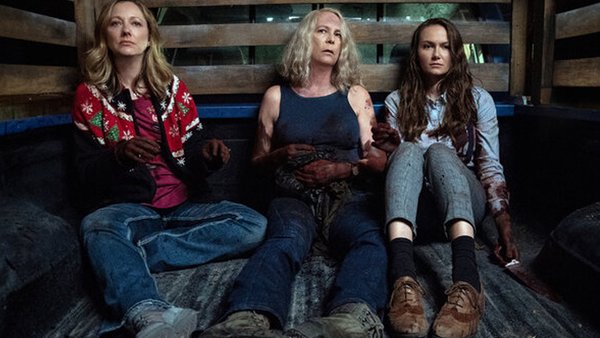
The script may be all over the place, but the cast at least deserves credit for giving it their all.
Jamie Lee Curtis isn't in the movie for long nor gets to do much of significance, but her commitment to playing Laurie is never in doubt, and audiences are likely to be left hanging on her every word.
As her daughter Karen, Judy Greer gets to do a little more of the dramatic heavy lifting this time and absolutely delivers, while Andi Matichak gets some additional shading as Laurie's granddaughter Allyson.
Even though he's trapped in the worst part of the movie, Anthony Michael Hall is intensely entertaining as a middle-aged version of Tommy Doyle - he's one of the more developed presences among the legacy cast, and Hall looks like he's having a ton of fun.
Will Patton also turns in fine work as Deputy Hawkins, who while not in the movie much is lent some of the script's most meaningful character development.
3. The (Mostly) Satisfying Fan Service
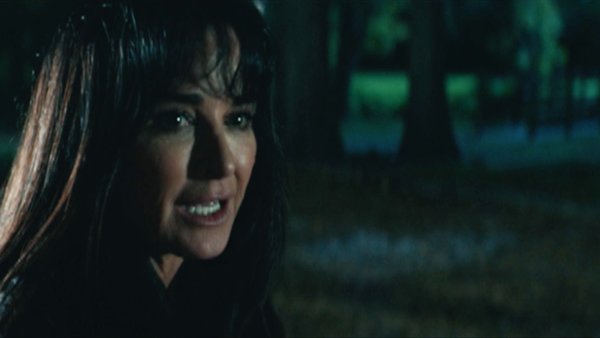
Far more so than Halloween 2018, this sequel is immersed in fan service and delivering a slew of franchise references to please the long-time fanbase, if be largely lost on newer initiates.
For starters, some shrewdly-deployed flashbacks help flesh out the events of the original film in some gratifying ways, there are numerous cameos from legacy characters - even one or two audiences may not be expecting - and, amusingly, nods to some who have effectively been wiped from the timeline.
Not every returning character gets a ton to do here - especially Lindsey Wallace (Kyle Richards) - but their presence should nevertheless prove valuable to fans.
Green also ensures to fleetingly follow up the less-significant events of the previous film, most notably including a brief appearance from fan favourite character Julian (Jibrail Nantambu).
If you've got the time, it's worth watching Kills back-to-back with the 2018 film, because watched this way you'll be able to catch the many nods, references, and small slivers of subtle continuity between the two.
2. The Fantastic Musical Score

By far one of the most-praised aspects of the previous film was the delirious musical score from John Carpenter, his son Cody, and Daniel Davies. Thankfully the trio are all back for this sequel and deliver another riveting, pulse-pounding accompaniment to Michael Myers' rampage.
While there's no denying that this new score follows the lead of the 2018 film, that's not really a bad thing, yet there's just enough variation on offer here to make it feel distinct in its own way.
Carpenter of course knows how to exploit the series' iconic ticking sound to anxiety-inducing effect, while again throwing grungy guitars into the mix for a little added flavour.
Carpenter's creative involvement with this new batch of films may ultimately be incredibly limited, but it's neat that he's still contributing something major to its aesthetic identity.
1. The Compelling Character Development

Despite the overall thinness of the script, Halloween Kills does just enough to offer up some genuinely intriguing character development amid its more ridiculous plotting.
The idea that Michael Myers himself is completely indifferent to Laurie and kills for another reason entirely is further explored here, yet without writing themselves into a corner by irreversibly committing to a single concrete answer.
Deputy Hawkins gets perhaps the most significant fleshing-out, though, a regret-filled backstory lending considerable weight to his present-day motivations to put Michael down.
His scenes opposite Laurie are also some of the film's most dramatically and emotionally convincing.
It's just a shame these considered moments are so often suffocated underneath the script's more low-effort elements. Hopefully Halloween Ends achieves a more winning balance of meaningful character work and crowd-pleasing brutality.