First Reformed: What Does The Ending Really Mean?
Decoding Paul Schrader's tricky, Oscar-nominated drama.

Paul Schrader's drama First Reformed was one of 2018's most provocative and unforgettable movies, an entrancing character study of a Protestant minister (Ethan Hawke) whose faith is questioned in light of immense personal and professional turmoil.
Though Hawke's career-best work was bafflingly snubbed for a Best Actor Oscar nomination, the film did at least receive a Best Original Screenplay nod for Schrader's incisive script.
First Reformed asks challenging questions of its audience about faith, mental illness, life and death, and this culminates in an ambiguous, much-debated ending sequence.
Like any filmmaker worth his salt, though, Schrader has refused to give fans a concrete explanation for the film's final moments, and so the burden instead falls to viewers to parse those puzzling closing images for themselves.
But by taking a close reading of the film, poring back over the ending again and even factoring in the entirety of Schrader's own career, we can arrive at something approaching a reasonable explanation of what that surreal climax really means...
6. The Ending

Firstly, let's recap that ending. The movie of course revolves around Reverend Ernst Toller (Hawke), who is suffering through a battery of physical and mental maladies.
Where to begin? His church attendance is dwindling, he's more than likely suffering with stomach cancer, he's haunted by the death of his son in the Iraq War (after encouraging him to enlist), and an environmental activist he's been counselling, Michael (Philip Ettinger), ends up committing suicide.
This cumulatively fractures Toller's mental well-being to the point that he decides to sacrifice his own life to make a statement about the state of the world.
He retrieves a suicide vest he confiscated from Michael's home and plans to blow himself up inside the church, taking a fleet of corrupt politicians and Earth-ravaging industrialists with him.
But once Toller realises that Michael's wife Mary (Amanda Seyfried) is at the church, despite him warning her not to attend, he ditches the vest and switches to plan B.
Toller then wraps himself in barbed wire and pours a glass of drain cleaner, but before he can take a swig, Mary enters the room. At this point, Toller walks towards Mary and the two enter a passionate embrace, enjoying a prolonged kiss before Schrader cuts to black. The end.
And now that we've refreshed how the movie ends, let's dig into the finer details...
5. Does Reverend Toller Live Or Die?
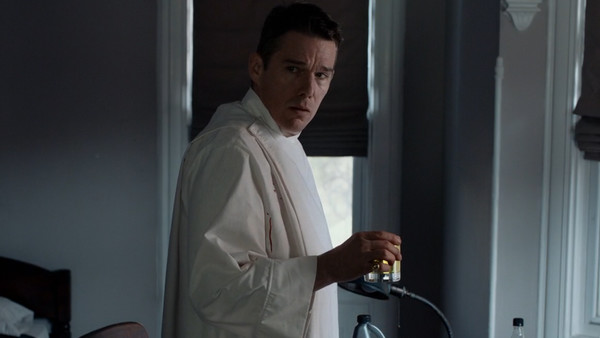
The crux of the debate around the film's ending is whether what we're seeing actually happened or not. One school of thought suggests that, yes, Toller was moments away from drinking the toxic fluid before he found salvation in the arms of Mary.
The other meanwhile states that this final scene is merely Toller's dying vision, and he did actually consume the drain cleaner and subsequently die as a result.
And indeed, there's certainly a good amount of evidence pointing to the latter ending being the "true" one.
For starters, it's far more consistent with the movie thematically that Mary is in fact a transcendent vision, and this appears to be backed up by the way in which Schrader shoots the final scene.
First Reformed is an extremely mannered, restrained film from a stylistic perspective: beautifully framed, yes, but mostly static and employing movement as sparingly as possible.
That final scene, however, shows Toller and Mary kissing while the camera spins around numerous times and the melodramatic hymn "Leaning on the Everlasting Arms" blares out in the background. It's practically surreal compared to the rest of the movie, and entirely at odds with its formal tone.
There are also some more practical suggestions that Toller wasn't really making out with Mary. For one, the door was locked when Pastor Jeffers (Cedric the Entertainer) tried to open it earlier, so how could Mary suddenly enter it? And wouldn't the embrace cause Toller major stomach pain as the barbed wire was compressed into his chest?
Schrader himself said, "When you look at it closely, she suddenly appears, the room is much lighter, the footsteps go away." While that's hardly a commitment to confirming the vision theory, it does at least make it clear that Schrader most certainly had this in mind as a possible explanation for what takes place.
But there is also evidence in Schrader's own prior filmography that he intended the movie's ending to serve as an homage to two of his most iconic collaborations with director Martin Scorsese...
4. The Last Temptation Of Toller
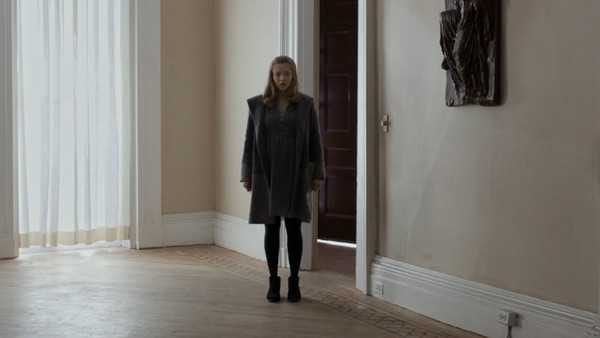
The ending to First Reformed has undeniable echoes of Scorsese's Schrader-scripted 1988 biblical drama The Last Temptation of Christ.
The film revolves around Jesus Christ (Willem Dafoe) encountering a crisis of faith once nailed to the cross, envisioning a life where he marries Mary Magdalene (Barbara Hershey) and gives in to the whims of Satan. But ultimately, Jesus prevails over the temptation and dies on the cross, saving the soul of man in the process.
Similarly, First Reformed sees Toller encounter a jarringly optimistic vision while in the final moments of his life.
In both instances, the love of a woman named Mary appears to be the protagonist's salvation, and it's impossible not to see this as Schrader riffing on not only the Bible but also his own prior work.
Scorsese's film of course lacks the same ambiguity about what's real and what isn't, but there's enough shared DNA between the two films for it to be a significant clue about Toller's true fate.
If you're not fully convinced yet, then consider that there's also another of Schrader's movies that he pays tribute to...
3. Toller As Travis Bickle
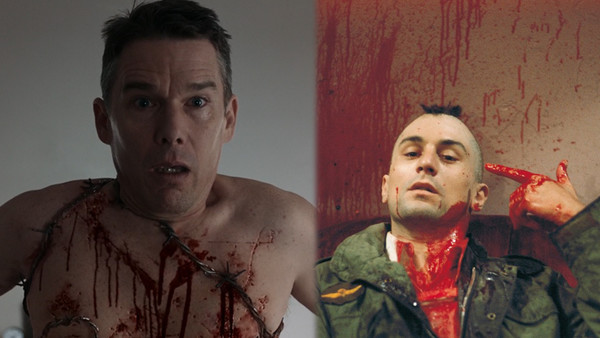
Scorsese and Schrader's Taxi Driver may not have the same religious overtones as both Last Temptation and First Reformed, but it's certainly a spiritual movie in its own way, with dejected war veteran Travis Bickle (Robert De Niro) struggling to cope in an uncaring New York City.
There's a popular theory that Taxi Driver's peculiarly happy ending isn't quite what it seems, and that despite Bickle apparently being lauded for his violent vigilantism, this is merely his dying vision after sustaining mortal wounds in the climactic shootout.
Travis' fantasy sees him heralded as a hero, repairing his personal relationships and getting another shot at life. This isn't a million miles away from the idyllic final embrace in First Reformed, where Toller's problems appear to melt away despite the reality that he's actually dead on the floor with a gut full of Drano.
As meticulously planned as this all sounds, interviews with the cast however suggest that Schrader's approach to shooting the film was actually far looser than you might expect.
And with that in mind, we must consider the eventuality that even Schrader himself isn't really sure what it all means...
2. Schrader's Uncertainty

A revealing interview with Cedric the Entertainer shines considerable light on Schrader's thought process while making the movie, most notably that he hadn't actually arrived on a concrete ending for the film even once shooting had started.
"It is one of these things where you are not sure what is going to happen. He had a couple of different ways that he wanted to end the movie. I didn’t see it until one of the screenings...Even when we were shooting, we all believed that Ethan’s character was going to go through with it."
It's certainly possible that this may have been an act of psychological chicanery on Schrader's part, to get his cast on edge and have them unsure of exactly how Toller's story would end.
Or it's possible that Schrader himself was having his own crisis of sorts, unsure whether or not to commit to Toller's fiery plan.
As such, there's a persuasive case that First Reformed isn't so much about whether or not Toller blew himself to holy hell, but that one way or another, Toller does indeed have a spiritual re-awakening...
1. Toller's Spiritual Salvation

When asked directly about the meaning of the ending, Schrader himself said:
"I don’t have the answer. Both answers are correct. On one level, it’s a miracle. Grace descends and he’s saved from his suicidal ways. On the other hand, there he is in Gethsemane with the cup in his hand and he’s saying, 'Lord, please let this cup pass from me.' But he doesn’t, and he drinks it, and now he’s on all fours, purging out his stomach. And God, who hasn’t talked to him for the whole film, now comes over to him and says, 'Rev. Toller, would you like to see what heaven looks like? I’m going to show it to you, right now. I’m going to open the gates. It looks like one long kiss.' And that’s the last thing he sees.'"
Schrader has been careful to give both main theories equal footing in interviews, and if we take his comments at face value, both potential endings can be said to represent a spiritual revitalisation for Toller.
If Mary really does enter the room, unlikely though it might be, then his soul is saved (in the mental health sense of the word), and he's able to approach whatever remains of his life with happiness and dignity.
But if it's a dying vision, then the ecstatic kiss bolsters Toller's belief and points him towards what lies beyond once the Drano has worked its way through his body.
Whether Toller ultimately lives or dies, he achieves a personal salvation of sorts, and that's the best any of us - religious or otherwise - can hope for in this crazy world.
What's your take on the ending of First Reformed? Shout it out in the comments!