Fight Club Film Theory: Tyler Durden Isn't The Only Character Who Doesn't Exist
We just lost cabin pressure. Again.
David Fincher's Fight Club turns 20 years old (!) later this year, and ever since it first hit cinemas, audiences have been fascinated by its intoxicating blend of acid-tongued nihilism and blackly comic social satire.
And of course, Fincher's film is often cited as boasting one of the best-executed plot twists in cinema history, with the climactic revelation that - spoilers! - that anarchic soap salesman Tyler Durden (Brad Pitt) does not exist, but is in fact a dissociated personality in the mind of the unnamed narrator, commonly referred to by fans as Jack (Edward Norton).
Though that's enough of a mind-bender for one movie, there's a fan theory that's been gaining significant traction in recent years, that another plot twist is hiding in plain sight, that Tyler Durden isn't the only fabricated character in the film.
As it turns out, femme fatale Marla Singer (Helena Bonham Carter) is also a personality created in Jack's mind.
Fight Club as a whole is defined by its unreliable narrator, and in many ways that's what makes it so fun to dissect. There is no strictly-defined objectivity to the events we see play out on screen, and Durden himself even says as much when explaining the various perspectives through which Jack views Durden's acts.
The viewer is largely left to decide for themselves exactly how events play out, namely what is reality and what is imagined. This is obviously focused primarily on Tyler, but when examined through the lens of this theory, it can also apply to Marla too.
The primary theme of Fincher's film is of dissociation, both in terms of its protagonist's mental state and also how he relates (or doesn't, in fact) to society.
This is ultimately what sets the stage for an internal struggle between two diametrically opposed - and yes, fictional - forces, Tyler Durden and Marla Singer, who represent conflicting possible futures for Jack.
And with that in mind, let's take a deep dive into the most convincing clues that Marla doesn't actually exist...
6. Jack & Marla

"All of this, the gun, the bombs, the revolution, has got something to do with a girl named Marla Singer."
Like Tyler Durden, Marla exists in Jack's mind as a reaction to the world around him, namely a society that increasingly devalues traditional (and often toxic) traits of masculinity.
There are countless pieces of evidence, admittedly circumstantial, which point to Marla's non-existence, both through her interactions with Jack and the world around her.
Let's start out simple - she shows up to lung cancer support groups while smoking cigarettes and nobody says a thing to her. That's pretty weird, but in of itself excusable, right?
If we look to how she relates to Jack, the picture becomes clearer. Marla starts finishing Jack's sentences shortly after they're first acquainted, in a similar fashion to how Tyler understands Jack's self-satisfied "single-serving friend" shtick immediately, because they're sharing the same brain.
Furthermore, Marla says that she saw Jack practising telling her off for attending the meetings, which is quite clearly a sly nod towards the central twist of the movie - and Marla simply being another part of it.
Hilariously, when they're divvying up their support groups, he tells her, "you can't have the whole brain", which again feels like a playful nod to the fight between Marla and Tyler for control of Jack's psyche.
In more overt physical terms, Jack watches Marla walk into traffic with the cars passing by her as though she isn't even there - and that's because she isn't. Jack is effectively having an argument with himself on the sidewalk, and just as he projects scenes that aren't real with Tyler, he's doing the same with Marla.
Marla also sells some clothes and is curiously seen taking several pairs of what are clearly men's jeans. You could argue that she stole the jeans, being poor and all, but could it not also point to the fact that these are, in fact, Jack's jeans?
There's another clothing link later, when Marla talks about the bridesmaid's dress she bought from a thrift store for $1, telling Jack that he "can borrow it sometime", pointing to not only their shared body but the possibility that Jack might enjoy dressing up as a woman.
Elsewhere, they both talk about being "on their way out" when Marla makes a suicide attempt, and when Tyler appears to rescue her, she talks about herself in the third person as "infectious human waste", which immediately conjures up thoughts of the later scene where Jack and Tyler steal fat from the liposuction clinic (which has an "infectious waste" sign visible).
The timeline doesn't sync up, but again, it's not entirely discounted because we're seeing a distorted, unreliable version - and timeline - of events.
And finally, deep in the movie's third act, Marla makes the off-hand comment to Jack that the Project Mayhem goons were burning their fingertips with lye.
Now, it's fair to say that the average person has no idea what lye looks like, especially as it's a totally generic, powdery white substance, and so for Marla to have such a specific piece of knowledge again points to her sharing a brain with both Jack and Tyler.
5. Marla As Jack's Spirit Animal
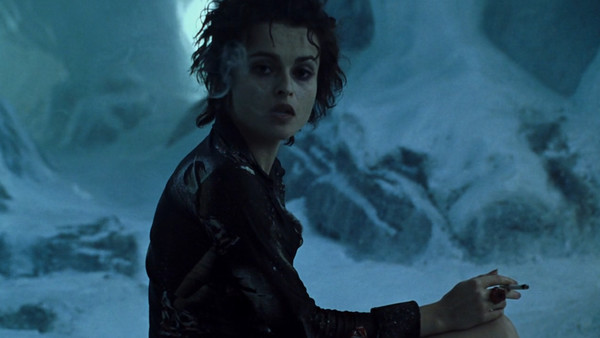
As for what it all means thematically? Marla is depicted as a sickness-of-sorts in the early stages of the film, referred to as a wound that Jack can't stop tonguing, and when he imagines himself screaming at her, "I need this, now get out!", he's not talking about the physical meeting space - he's talking about his mind.
However, over the course of the film Marla's true function, to balance out Tyler and present an alternate future for Jack, becomes clear.
That she appears in his dream in place of the penguin, his power animal - or his spirit animal as we say nowadays - speaks volumes to the role she ends up playing in Jack's story.
There will be those fans who insist that the theory is in of itself a giant plot hole, and that Marla must exist because a waiter takes her order late in the film.
But it's important to remember that a) we're not seeing a reliable version of events and b) it's made abundantly clear that Project Mayhem's followers gladly humour their leader's evident madness.
The subjective nature of the narrative means that these moments pointing to Marla's concrete existence don't really matter, and to cling to them is to totally miss the point - everything is up for questioning and doubt in Fincher's film, and that's exactly the way he wants it.
But there is one piece of extremely compelling "evidence" that surely stands above the rest...
4. The Curious Case Of The Dildo

Arguably the strongest piece of evidence for Marla being imaginary occurs in an otherwise seemingly innocuous scene that's basically played for laughs.
Jack's luggage gets confiscated by airport security because it was vibrating, which alerts the bomb squad despite the fact that, as an airport agent explains, 90% of the time it's a customer's dildo being set off.
Jack's bemusement at the scenario is hilarious and understandable, but the scene takes on a whole other meaning if you consider that Jack and Marla reside within the same body, and Marla may well have been the "person" who packed Jack's suitcase.
After all, why wouldn't Marla pack a dildo?
It's never resolved one way or another if the suitcase did actually have a dildo in it or not, but watching the scene with this theory in mind, the security guard's reluctance to assign the potential dildo as Jack's "definite article" only adds more fuel to the fire that, in fact, it's not really Jack's dildo at all - it's Marla's.
In fact, there's another dildo-related gag later on that also seems to support the theory - when Tyler prevents Marla's suicide, he notices a large dildo at her bedside, and she immediately quips, "Don't worry. It's not a threat to you."
Though it can be easily dismissed as nothing more than a comical one-liner, Marla might also be hinting at their shared personage because, well, when they "have sex", it's really just Jack masturbating anyway.
And now that we've looked at the connection between Jack and Marla in depth, it's time to consider the duality of Marla and Tyler...
3. Marla & Tyler
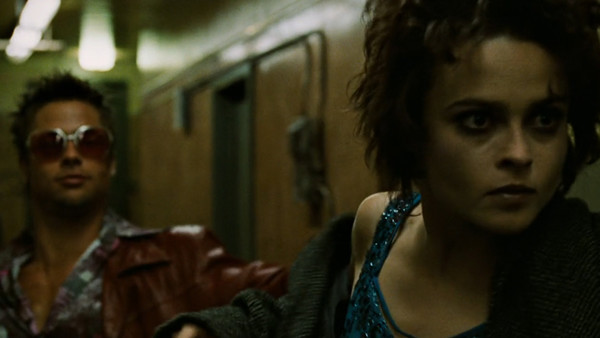
There are some very obvious tells early on that something is up with Marla and Tyler, namely that Tyler tells Jack not to talk about him to Marla, and the two don't really directly interact outside of their sexual escapades.
Jack even compares this to the surreptitious behaviour of his own parents, and it's an apt comparison as Marla and Tyler are effectively parental proxies - two sides of Jack's psyche duking it out for control.
Even the sex scene between the two is basically a CGI fever dream where the two bodies are fused together in a fantastical state. With our theory in mind, this would actually be an act of masturbation, tying in with the many, many references to masturbation made throughout the film (namely, "Self improvement is masturbation.")
There's also plenty more to consider from a non-sexual context: the speed with which Tyler gets to Marla's apartment to prevent her suicide, for instance, could imply he never really left, being the same person and all.
Plus, Tyler saving Marla to save himself would also tie up the nagging question raised by Jack - "How could Tyler, of all people, think it was a bad thing that Marla Singer was about to die?" It doesn't really vibe with his nihilistic mindset, unless he's doing it out of self-preservation.
Sure, the mechanics of Jack basically preventing his own suicide is a big, wide-open can of worms logically-speaking, but again, it ties into the overarching idea of Jack's/Tyler's/Marla's narrative being unreliable.
It also presents an interesting paradox, that Marla and Tyler need to try and co-exist out of fear that destroying the other will destroy the whole - no matter that the end of the film proves Jack's ability to "kill" one of the personalities under the right circumstances.
But make no mistake, Marla and Tyler are firmly opposed throughout the film in an existential battle for Jack's soul...
2. The Battle For Jack's Psyche

As mentioned, Marla and Tyler are two elements of the same whole - the "mother" and "father" fighting for dominance of Jack's mind.
Tyler represents a new masculine "ideal", rejecting the status quo of the Calvin Klein male and building a new kind of aspirational figure, albeit one that's fundamentally angry and destructive.
Conversely, Marla is a manifestation of guilt, anguish and regret, as well as the basic human desire for intimacy, which at the beginning of the movie Jack has effectively been stealing from the terminally ill.
Tyler abhors the more sensitive and in-touch future that Marla might present to Jack, while Marla attempts to tame the angry hyper-masculinity that Tyler teases out of him.
Throughout the film a back-and-forth of wills takes place as each persona fights to win Jack over, and as one prevails, the other one weakens. This is evidenced by the scene where Jack chews out his boss with a clear influence from his dealings with Tyler, causing weakness (i.e. a fear of breast cancer) in Marla.
Jack and Marla even discuss this dynamic in the kitchen of the Paper Street house, where Marla mentions how both she and Jack are weak people attaching themselves to a "stronger" entity, and it's ultimately a not very-strongly coded message about these three jostling personalities.
Jack feels the push-and-pull early on in the film after his apartment is blown up: he initially calls Marla but quickly hangs up and ultimately decides to "activate" Tyler by calling him.
But the further on the story goes and Tyler's influence over Jack increases, the more dishevelled Marla becomes as her own influence deteriorates.
She starts the film off looking relatively well-groomed and appealing, while Tyler is nowhere to be seen, but in the second half of the movie she looks ever-more tawdry and hopeless, while Tyler reigns supreme.
And yet, if we put the thematics to the side for a moment, the real key behind the theory just might come down to the film's indelible final image...
1. The Final Shot Says It All

The final shot of the film sees Jack and Marla looking out into the city as Project Mayhem's plan is flawlessly executed, with the credit card buildings all detonating and collapsing around them.
It's such a stirring image that it's easy for fans to miss a theory-supporting visual clue hidden in plain sight: Jack and Marla look almost identical.
As they hold hands, a trouser-less Jack wears a jacket that, in the scene's low lighting, looks almost exactly like the skirt/fur coat combo Marla is wearing. The only major tell of who is who is their different hair styles.
But it's a telling image: with Tyler dead, Marla appears to have won, and the symbolism of the two wearing the same clothes while holding hands seems to point to their three-way conflict now resolved as a two-party partnership.
Watch Next
How Well Do You Remember Fight Club?
