9 Brilliant Performances That Were Robbed Of Best Actor Oscars

9. Jeff Bridges - True Grit
 An easy way to tell if somebody's good at their profession is to see if they make their job look easy. This is especially true of acting, where the actor's primary objective is to make us believe that they're somebody else. The trademark of a genius performance is when an actor can make us forget that we're watching an actor at all. Jeff Bridges' portrayal of U.S. Marshal Rooster Cogburn in 2010's True Grit is such a performance. It must take a lot of guts to step into the boots of an icon. Bridges found himself in this position when he agreed to portray Cogburn, a role which film legend John Wayne made famous (and won an Oscar for) in 1969. As wonderful as the Duke's performance was, however, Bridges does him one better. In the 1969 film, we're aware that the "one-eyed fat man" we see on the screen isn't an Old West lawman but John Wayne, one of the greatest movie stars of all time. While that's not really the Duke's fault (it's a handicap that comes with being a superstar), Bridges improves on Duke's performance by making us believe that we're watching a real-life marshal on a manhunt. Of course, I can only speak for myself, but every time I watch True Grit, I find myself thinking not of Jeff Bridges but Rooster Cogburn. Had Bridges won the Best Actor Oscar in 2011, he would have joined the elite group of actors who have won Oscars two years in a row (Bridges had won the Best Actor Oscar the previous year for his performance in 2009's Crazy Heart). Unfortunately, the award went to Colin Firth for his performance in The King's Speech. Firth's performance was good, but it wasn't as involving as Bridges'.
8. Tom Hanks - Cast Away
 Cast Away seems to be much maligned today, and I don't understand why. A lot of people fixate on the fact that Tom Hanks spends much of the movie talking to a volleyball. Granted, on paper, it sounds silly, but it makes perfect sense in the context of the film. After all, everybody needs somebody or something to talk to in order to keep one's sanity, especially a man marooned on an island. One of the great things about Tom Hanks' portrayal of Chuck Noland is how well he plays the conversations between himself and "Wilson," but it's far from the only thing. One of the most difficult things for any actor to play is a one-person show. What makes it so hard is that the actor knows that the only thing that will make the show work is their performance. There are no co-stars to pick up the slack, no days off, no regular pleasures that I assume most actors take for granted. We rarely see one-person films; one of the closest things we have to it is Cast Away. For ninety-five percent of the film, the only actor we see is Hanks. Hanks does a fine job of carrying the film on his shoulders. When he's finally able to start a fire, we feel as overjoyed as he does. When he attempts his first escape from the island and ends up cutting his leg on coral, we feel the pain along with him. When he finally makes it back to civilisation, we feel a vast sense of relief, just like Hanks. Hanks' powerful performance lost its rightful award to Russell Crowe's one-note performance as Maximus in Gladiator. Crowe portrays Maximus as a typical action hero, something far easier than what Hanks pulls off in Cast Away.
7. Jeff Bridges - Starman
This is probably going to be the most controversial entry on this list, since the performance that ended up winning the 1984 Best Actor award (F. Murray Abraham as Salieri in Amadeus) is pretty brilliant. The reason that I feel Jeff Bridges was more deserving of the award is twofold. First, Jeff Bridges is, in my humble opinion, the best actor working right now. The man's a chameleon; he's different in every role he plays. It's a tragedy that Bridges, who was nominated for his first Oscar at the tender age of 22 (for Best Supporting Actor in 1971's The Last Picture Show), didn't win an Oscar until he had reached his sixties. My first argument is a personal bias; I'll admit it. My second argument, however, is based on the styles of each performance. Abraham's performance, while powerful, is too big; it's a performance more suited for stage than film. Abraham's performance consists primarily of speeches delivered with an extra-large dollop of emotion. As I said, it's not a bad performance; it just doesn't fit the movie mold. Bridges' performance, however, is built on subtle nuance. Bridges' portrayal of the alien visiting Earth finds its strength in small touches: the way Bridges moves his mouth when he speaks, the robot-like cadence of his voice, and the jerky way in which he moves. These are the kind of small touches that film accentuates so well. Any good film performance needs to utilize these small touches, and Bridges does so beautifully. Had Abraham's and Bridges' performances been competing for a Tony Award, Abraham's performance would be the most deserving. In a film-oriented competition like the Oscars, however, Bridges comes out on top.
6. Robert Duvall - The Great Santini

5. Michael Caine - Sleuth
 Warning: Sleuth is famous for its twist-filled plot. It's amazing to watch unfold; however, it's impossible to talk about the film without using spoilers. If you haven't seen the film yet, you might want to skip this section. Sleuth holds a special place in Academy Awards history; it's the only film which had its whole cast nominated for Oscars. Of course, when a film's cast consists of two actors, that's an easy goal to achieve. Both Laurence Olivier and Michael Caine were nominated for the 1972 Best Actor award for their performances in the film adaptation of Anthony Shaffer's play. While Olivier is fantastic (as usual) as the snobby, eccentric, conniving mystery writer Andrew Wyke, it's Michael Caine, as the self-made, adulterous hairdresser Milo Tindle, who's the most deserving of the Best Actor honor. While Olivier does an amazing job with his role, he doesn't have to shoulder the burden of playing two characters, as Caine does. You see, after Andrew learns of the affair Milo's been having with his wife, he invites Milo to his country manor to play a "game." Wyke will tell Milo where to locate the diamonds that will help Milo provide for Wyke's wife. The only catch is that Milo must "rob" Andrew: he must put on a disguise, break into the safe where the diamonds are kept, and get out of the house undetected. Unfortunately, Milo fails at this last task. He's caught by Andrew, who pulls a gun and shoots Milo dead. Andrew is confident that he's going to get away with murder. His hopes are dashed, however, by Inspector Doppler, a police detective investigating Milo's disappearance. Doppler visits Andrew's home and discovers a mess of clues that prove Andrew's guilt. Andrew grows increasingly desperate as Doppler searches the house. Just as Andrew's terror reaches its breaking point, Doppler rips his face off, revealing Milo's face. The first time I saw the film, I was totally surprised by this twist; in fact, just about everybody who's seen the film says the same thing. This surprise stems from the fact that Caine's portrayal of Doppler is totally different from his portrayal of Tindle. The accent's different, the walk is different, the mannerisms are different. There's nothing about the two performances that's similar. I'm not an actor, so maybe playing two parts in one film isn't too difficult, but it's certainly memorable. Instead of Caine, the Best Actor Oscar went to Marlon Brando for his performance in The Godfather. Brando's performance as Vito Corleone isn't bad by any stretch of the imagination, but the fact that he rejected the award in embarrassingly tacky fashion (hiring an actress to dress up as a Native American and deliver an overwrought speech about the plight of the American Indian) makes Brando undeserving of the honor. Caine's performance is equal to Brando's, and Caine probably would have accepted the award.
4. Peter Sellers - Dr. Strangelove Or: How I Learned To Stop Worrying And Love The Bomb
 It's hard to find an actor who's as much of a chameleon as Peter Sellers. Sellers dabbled in a number of genres, but he seemed to quickly find that his character-acting style was tailor-made for comedy. Watch Sellers' comedy filmography and you'll find Sellers playing a wide assortment of characters, including a sweetly naive Indian actor (The Party), a black-marketeer (The 1955 version of The Ladykillers), a suave professional gambler (1967's Casino Royale), and the inept-but-dogged French police inspector Jacques Clouseau (the Pink Panther franchise). No film better displays Sellers' talent, however, than Stanley Kubrick's 1964 masterpiece Dr. Strangelove, Or How I Learned To Stop Worrying And Love The Bomb, in which Sellers plays three different roles. We first see Sellers as RAF Captain Lionel Mandrake, who discovers that the U.S. General he's serving under, Jack D. Ripper (Sterling Hayden), has launched an unauthorized nuclear attack on Russia. After U.S. President Merkin Muffley (Sellers again) discovers the unauthorized attack is underway, he tries to call it off but discovers that he needs a certain cease code in order to call off the bombers, a code known only to Ripper. Mandrake knows this, too, and after Ripper commits suicide, Mandrake discovers the cease code and sets about getting the code through to Washington. Meanwhile, the President's scientific advisor, former Nazi Dr. Strangelove (Sellers yet again), advises President Muffley on what should be done should a nuclear holocaust occur ("Animals would be bred and SLAUGHTered..."). Sellers does a fantastic job with each part, giving each character a distinct personality, style, and mode of dealing with the impending chaos. In fact, Sellers plays each part so differently that it's almost impossible to tell that it's one man playing all three parts. Sellers did such a great job that he was nominated for the Oscar for Best Actor of 1964. Unfortunately, Sellers lost to Rex Harrison, who won the award for his phoned-in portrayal of Professor Henry Higgins in My Fair Lady.
3. Jack Lemmon - The Apartment
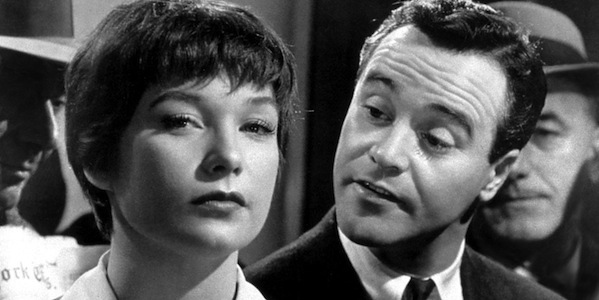
Billy Wilder produced one of the most impressive bodies of work to ever come out of Hollywood. Wilder had incredible range; his work veered from film noir (Double Indemnity) to quirky WWII films (Stalag 17) to uproarious comedies (Some Like It Hot). Wilder's 1960 film The Apartment, however, towers over all of Wilder's other work. The film is a perfect encapsulation of Wilder's worldview, blending cynicism with biting wit and a tender core.
Every element of this film is excellent, but it's Jack Lemmon's portrayal of C.C. "Bud" Baxter that really makes the film work. Baxter, a lonely bachelor who whiles away his days as a nameless number-cruncher for an insurance corporation, climbs the company ladder by lending out his apartment to his managers, who use Baxter's apartment to entertain their extra-marital sex partners. They thank Baxter through promotions and glowing personnel reports.
Baxter eventually secures a major promotion after lending out his apartment to Jeff Sheldrake (Fred MacMurray), the company's personnel director. Baxter's victory turns sour, however, when he discovers that Sheldrake's beau is Fran Kubelik (Shirley MacLaine), Baxter's own love interest. Baxter, depressed, returns to his apartment to find Fran sprawled on his bed, fresh off a suicide attempt. The film shows us how the aftermath of Fran's suicide attempt affects Baxter, Fran, and Sheldrake. The film ends on a perfect note; there's a touch of cynicism, but it's underlined by a hopefulness that leaves us feeling uplifted.
We have to be interested in Baxter to like this film, and Lemmon does a good job of making us like him. As Lemmon stands in the rain, staring up at his apartment window and imagining what's going on behind the shades, it's impossible to not feel pity for him. Lemmon adds to Baxter's likability through his innocent flirting with Fran. By the end of the film, we're rooting for Baxter to step out from under Sheldrake's thumb and get together with Fran.
Lemmon's performance is a masterwork of quiet, understated acting, one that certainly deserved the 1960 Best Actor Oscar. Unfortunately, the Oscar went to Burt Lancaster for his over-the-top portrayal of the title character in Elmer Gantry. Lancaster is generally a fine actor, but he seems to have lost his acting skill for the duration of Gantry's filming; he seems to confuse "emoting" with "yelling." Lancaster's performance is amateurish; it looks silly in comparison to Lemmon's nuanced, understated performance.
2. Humphrey Bogart - The Caine Mutiny
 Speaking of understated performances, here's a great one. Humphrey Bogart is part of a large group of great actors who only received one Academy Award over the course of their careers. This doesn't seem like a big deal; however, in most cases, such actors win their sole award for one of their lesser performances. This was the case with Bogey. While Bogart's portrayal of Charles Alnutt in The African Queen isn't a horrible performance, it dances on the edge of overacting. It certainly isn't worthy of a Best Actor award. A far more deserving performance is the the one Bogart would deliver three years later in the 1954 film adaptation of Herman Wouk's novel The Caine Mutiny. In The Caine Mutiny, Bogart portrays Philip Queeg, the captain of the USS Caine, a minesweeper stationed in the South Pacific during World War II. At first glance, Queeg seems to be a tough, no-nonsense captain, the kind of man who attains high military ranks and lots of medals. However, after a series of strange events, the Caine's crew becomes convinced that their captain's stoic personality is a facade for a huge amount of insecurity and paranoia. Things come to a head during a typhoon, during which Queeg's paranoid rantings and actions put the lives of the crew in danger. Seeing this, Stephen Maryk (Van Johnson) relieves Queeg of his command. Queeg is outraged; he presses charges against Maryk and the rest of the Caine's crew. The military brass is initially supportive of Queeg; however, after Queeg's paranoia comes out during the court-martial, they begin to think differently. Bogart's performance is a masterpiece of restraint. It would have easy to play Queeg as a lunatic, chewing the scenery to shreds in the process. However, such a performance would have ruined the film, making it into a comedy. Bogart understood this. As a result, he plays Queeg's paranoia very quietly. He takes care to not point out Queeg's insecurities and paranoid delusions to the audience. Instead, he plays them as if they were normal behavior. Even when Queeg's paranoia comes out entirely, Bogart doesn't go for scenery-chewing. Rather, he slowly ramps up the intensity of his performance throughout the scene. He does it so subtly that we don't even notice until the end of the scene. Bogart performance in The Caine Mutiny is easily one of the best of his career. Sadly, Bogart lost the Best Actor award to Marlon Brando's not-so-hot performance in On The Waterfront. While Brando's talent keeps his work in On The Waterfront from descending into total mediocrity, it's not one of the highlights of his career.
1. Orson Welles - Citizen Kane
 I'm not going to waste time trying to convince you to see Citizen Kane. Instead, I'm going to assume, since you're in the film section of WhatCulture, that you're film-literate and that you've either seen Citizen Kane or that it's on your must-see list. After all, it's hard to say anything about the film that hasn't already been said. Orson Welles' 1941 film is considered a cinematic masterpiece by just about every film historian, film critic, and film fan there's ever been. What makes the quality of Citizen Kane even more astounding is the fact that it was the first time that Welles had ever directed, written (co-written, that is), or acted in a feature-length film. Welles brought the strong sense of innovation that he had honed on stage and radio to his first feature film, presenting us with a non-linear plot, new filming techniques, and a moody style more accustomed to gothic horror movies than to a drama revolving around a newspaper magnate, Charles Foster Kane by name. However, for all of the film's ground-breaking work in story and technical aspects, it's the performances that make the movie great, particularly Welles as Kane. Welles steals every scene. It's impossible not to feel the intensity that Welles brings to his portrayal of Kane. Welles intended Kane to be a ruthless man who doesn't hesitate to destroy anyone who stands between him and success, and Welles gets that aspect of Kane's personality across perfectly. Welles also excels at showing us Kane in the later stages of his life, as Kane reaps the bitter fruit that results when one uses and abuses other people. The intensity of Welles' performance should have been enough to cinch the award for Welles. Unfortunately, the award went to Gary Cooper for his portrayal of Alvin York in Sergeant York. I don't blame Cooper for his bland performance; rather, I blame the writers, who took an interesting historical figure and turned him into a boring, one-note good guy. Cooper did as well as he could with the material; it just wasn't worthy of an Academy Award. Welles should have won the award, hands down. However, maybe that's only hindsight speaking; innovative films (or any innovative work in any medium) are rarely appreciated in their own time. Now, let me hasten to say that the Academy awards Oscars to the right people more often than not. However, the Academy, being composed of imperfect people, is bound to make mistakes once in a while. This list has been made up of what I consider to be some of the Academy's biggest mistakes. Your list is bound to be different (let us know about it in the comments below). Sometimes it can be painful to watch Oscars go to films, actors, directors, etc. that we feel are undeserving. However, since we can't add our votes to the Oscar race, all we can do is praise the Academy when they get things right and champion those who were robbed, doing our part to make sure that they get the respect they deserve. Like this article? Let us know in the comments section below.