8 Reasons The Jungle Book Remake Is Better Than The Original Animation
No worries or strifes here.
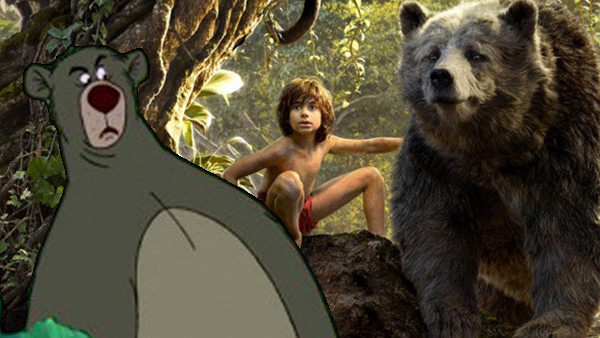
Disney sure are on a remake binge at the moment. They have at least fifteen movies in various stages of development right now riffing on previous animated classics, meaning we're now at the point where it's more sensible to say what won't be remade than what will next.
The viability of such a regurgitative model has been called into question ever since Tim Burton's Alice In Wonderland sparked this current trend (although it had already been sparked by 101 Dalmatians in the nineties): what do you do when you run out of things to remake? The likes of Frozen and Zootopia mean there's always going to be new stories to spin-off and sequelise, sure, but that's a bucket in a boat sinking into the quagmire of indistinguishable culture, surely?
But you know what? If they're all going to be as good as The Jungle Book, Disney can remake whatever the hell they want.
That's right, the star-studded live-action do-over of the 1967 adaptation of Rudyard Kipling's novel is a massive success. In fact, it's better than the original 1967 animation in just about every conceivable way.
No, seriously. That's the real genius of this current remake trend - it's not just about repetition, but expansion and improvement. Disney's back catalogue is far from untouchable (out of their fifty-five released films, at least half are middling-at-best) and going back to stories with untapped potential is a great way to provide unique, borderline original experiences. And that's exactly what Jon Favreau has done with his CG epic.
8. The Glaring Narrative Problems Are Fixed
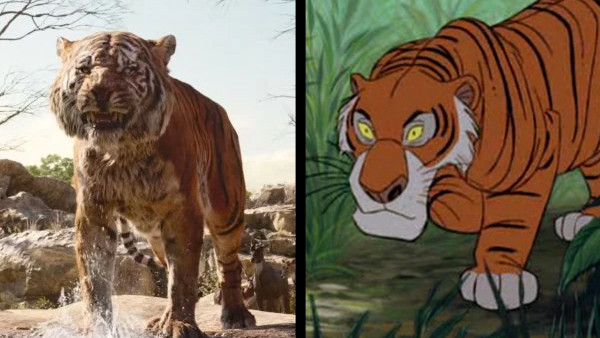
My biggest complaint with The Jungle Book cartoon is its story. The basic set-up is great, but the film never felt like more than an excuse to get to the new location/song. Disney has done episodic before - Bambi is one of my favourites - but what the successes have over this is an overarching purpose.
In that film, Mowgli goes from wolves to Kaa to elephants to Baloo to King Louie to Kaa to vultures to Shere Kahn on a whim, with nothing more random emotional pushes sending him on his way. Bagheera jumps in and out whenever he cares to (that's literally why he leaves his ward with a bear) and because the villanous tiger doesn't actually appear until halfway through (and there it's out of the blue), the threat propelling the plot feels underdeveloped.
Reordering a few events, adding in some shocking twists from the original Kipling book and ensuring that everything that happens in the jungle ties into Mowgli's character arc means Favreau's film feels like a fully formed experience and not just a string of unrelated set-pieces.
7. Mowgli Is A Stronger Character
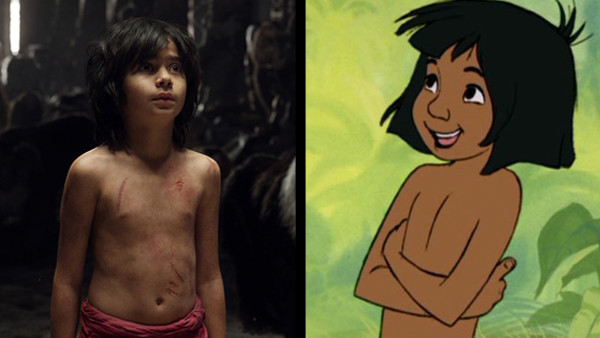
The Jungle Book may be all about the animals we meet, but it really hinges on its man cub hero, Mowgli. Even though he's feral (illusion shattered), by pure speciesism he's our eye into the world of the film and thus needs to be relatable yet believable without making too many objectionable mistakes.
You'd think this would be a real advantage point to the animation - there the filmmakers have much better control over how the child is presented and don't have to deal with a child actor. And yet, partly because of the era of Disney it came from, he's a little too blank, not quite lacking in personality as Alice (she of Wonderland), but a little too much out of the events.
Now here's where Jon Favreau knocks it out of the park. Neel Sethi is a find on a par with Daisy Ridley in Star Wars: The Force Awakens or Natalie Portman in Léon, balancing childish wonder and unearned maturity to be able to successfully to carry a major blockbuster without a crutch. As written Mowgli has more emotional range - struggling when leaving the Wolf Pack and at points actually, gasp, fearful - but it's down to Sethi (and the guiding hand of his adult co-stars) that sells it.
6. The Jungle Feels Like, Well, A Jungle
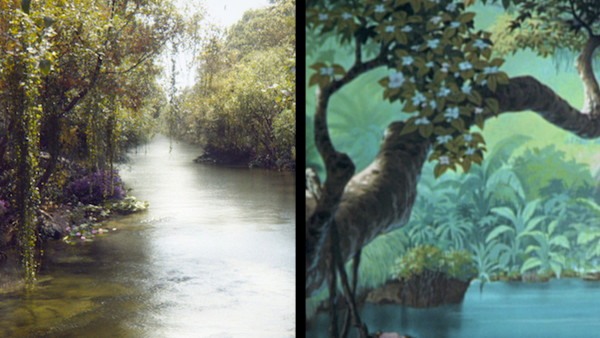
I don't usually like to spend ages harping on about how good the CGI of a new movie is; it's inevitably going to date, making any statement feel off in just a couple of years, and it's not like older classics are weakened by less jaw-dropping special effects anyway. But, f*ck me, does The Jungle Book look good.
Obviously you have all the various denizens of the world, but the landscape they live in is the real jaw-dropper. Neel Sethi acted most of the film on small, rudimentary sets (a few rocks and leaves here, some rain and mud there), with everything added in in CGI, and it looks phenomenal, more real than shooting in an actual jungle ever could.
From a design-standpoint it's also astounding. There's a development and growth to the various areas of the jungle here. The plains, Kaa's creepy tree, Baloo's paradise, Louie's dilapidated temple et al aren't just isolated locales, but all feel connected by real pathways, rivers and trees.
That's not to knock the animation in the original, which has some great establishing shots and solid backdrops, but you need The Lion King level animation to match the remake's emersion.
5. The Cast Is Phenomenal
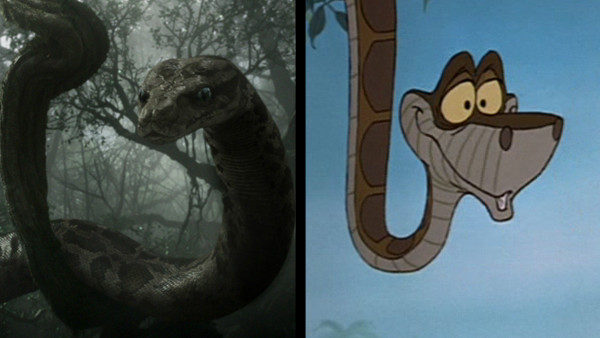
The vocal work in the 1967 film is solid. You have some of the best voice actors of the time - Phil Harris, Louis Prima, George Sanders - playing some of the most enduring icons in the Disney pantheon. So it's not that the remake is good where the original failed, just that it does it better.
Favreau's amassed a trailer-friendly collection of A-list stars, but they're not picked just for their weighty names. Every actor approaches their role as an original creation and, along with a bit more in-movie development, deliver unique, fully-rounded characters that don't just live in the shadow of those who came before: Bill Murray's Baloo is lackadaisical by choice; Christopher Walken's King Louie is a violent gangster, able to sell the orangutan's menace like the original never did; Scarlet Johansson's Kaa is slippery without a lisp.
There isn't really a weak link, but the highlights have to be Murray, Idris Elba as Shere Kahn (who couldn't be further from the gentile original) and, above all, Lupita Nyong'o's wolf mother Raksha, who deftly carries much of the film's animal-based emotional weight.
4. The Story Builds Towards Its Concluding Moral
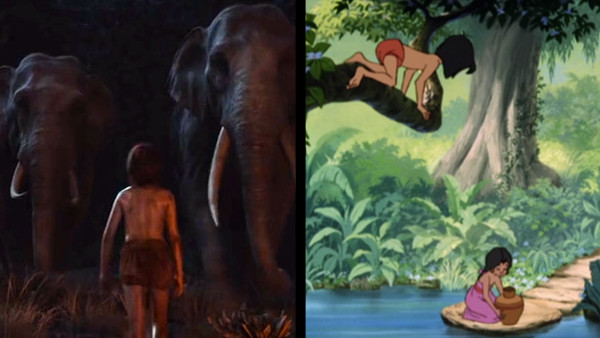
What's so striking about The Jungle Book remake is that it ends on a polar opposite note to the original; instead of giving in to human urges, Mowgli stays with the wolf pack, Baloo and Bagheera (at least for now - a sequel is already in development). While that seems incredibly reductive, revisionist for the sake of leaving the door open for more, it actually fits the film better than the original ending would have.
On a basic level it would have been a cop out. We already saw Mowgli visit the man village when stealing the fire to fight Shere Kahn and he had a severe apprehension to going any deeper, so to let his libido get in the way mere hours later would have felt forced.
But, beyond that, the entire movie was building towards something different, with themes centering on conformity, belonging and individual talents; for his first nine years Mowgli was told to be a wolf and stifle his human tendencies, but over the course of the movie he's taught (both explicitly by Baloo and through dire events) to not hide that part of himself.
The original only really dealt with the belonging aspect and, because the narrative was thinner, the impact it could have on the film's concluding moral was weaker. It was a kids animation, so no real harm there, but that doesn't hide that the 2016 take is superior here.
3. The Music
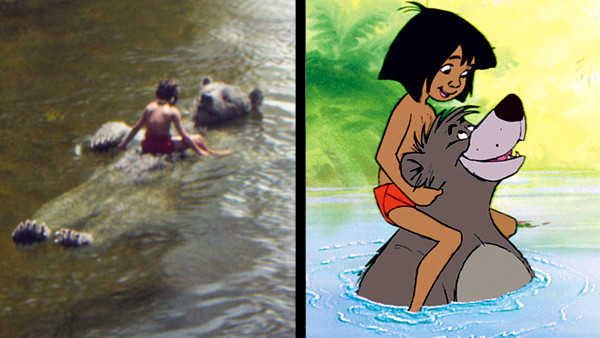
Woah, woah. Calm down. Don't set a Bengal tiger on me. The songs are far and away the most beloved part of the animation, and rightly so - they are the best thing in there. So, just to make it clear, I'm not here to discredit Bare Necessities or I Wanna Be Like You or any others you have a strong affinity with, but even accepting every song as a classic (and Colonel Hathi's March definitely isn't), the remake offers a better musical package.
The two best songs get a cover version in the film itself (and a third is over the closing credits), and while these versions aren't going to be as repeated as the originals, they fit better into the movie's world and narrative (and definitely don't feel like corporately-mandated distractions).
You then also have the rest of the score. In the original, all the orchestration is pretty generic, but here Favreau's brought in regular collaborator John Debney, who's made something that both honours the original and works by itself to increase the movie's sense of scale. Best of all though, you have that incomparable symphonic version of Bare Necessities. Wondorous!
2. The Balance Between Story And Animal Culture
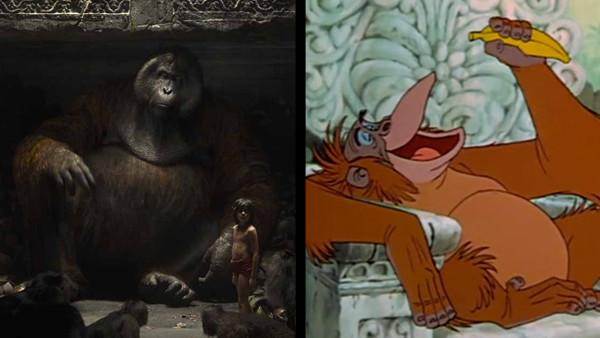
The Jungle Book is a very sixities movie. The songs are heavily influenced by the music of the time, of course (The Beatles were approached to play the vultures), but a lot of innate societal views and prejudices are also transferred across. I mean, do I even need to nod towards Louie? Of course, most Disney movies have traits of their time - from Lady & The Tramps siamese cat song through to whatever Home On The Range was trying to be - and there's plenty else beside that works, but even though there's quite a bit of anthropomorphisation going on here.
This is something Favreau corrects fully, not simply updating caricatures, but linking characterisation back into the culture of the jungle. So, yes, Louie is now a more primal primate, but elephants are also these revered creators instead of British troops and Baloo is more bear-like. Heck, on a more contextual level, there's talk of how cuckoos take advantage of other birds and the mystification of fire is ramped up.
What's important though is that the animals are treated as genuine creatures with species-accurate characteristics that remain consistent throughout; all this animal research is tied into their motivations and part in the plot. Kipling would be proud.
1. The Animation Is Probably Not As Good As You Remember
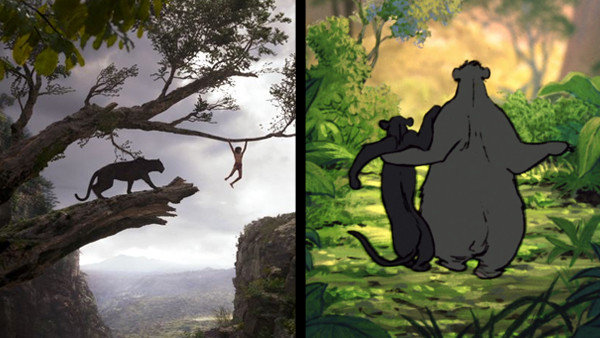
So far I've tried to keep everything about how good the remake is, but there's an unavoidable fact that needs to be addressed when comparing these two films, something that anyone who's rewatched the animation in preparation for the live-action version will have regrettably discovered; The Jungle Book isn't as good as you remember.
Oh, it's not a bad movie. It's just nothing special; a mid-range Disney film bolstered by excellent songs and some solid characterisation that unavoidable employs some cheap animation and narrative tricks. Let's put it this way - even for a kids films made in the sixties, to run for only 78 minutes and not have a narrative beyond "A to B by way of a tiger" is a bit weak, especially as Favreau has shown an impactful story isn't that hard to achieve.
As I said in the intro, this is one of the biggest endorsements of the remake enterprise, allowing ideas that had previously been only half-realised to get properly addressed. But that there are still elements of the 1967 version that work also means something else, something that may be The Jungle Book's biggest success; it improves on the original, but by nature of its different approach doesn't displace it, meaning fans of either version can be satisfied.
The last film Walt Disney worked on, The Jungle Book marked the end of an era for the animation studio, with the following two decades seeing low production rates and even lower quality all the way up to the Disney Renaissance in the early nineties. Here's hoping its remake does the opposite, heralding a new age for the company's live-action arm.
What did you think of The Jungle Book? Is it better than the original animation? Share your thoughts down in the comments.