8 Novels You Haven't Read That Became Iconic Films
 With few exceptions, novels are better than their film adaptations. All too often the movies eclipse their novels success to the point where few people even know (or remember) the movies were in fact based on novels to begin with. Of course, sometimes the success of the movie inspires people to read their source material, and that's how we often get those horrible movie ties-in books. However, I am the type of person who will try to read the source novel before seeing the movie version, or in the event I have already seen the movie version, I will make an effort to read the book eventually. Yet, of the books I'm about to list here, I've only read two, but will now make an effort to read them all.
8. Jaws - Jaws By Peter Benchley
 Peter Benchley's novel Jaws may have been a bestseller (it spent over 40 weeks on the New York Times bestsellers list and sold over 20 million copies) after being published in 1974, but ask a random person today about "Jaws" I wouldn't doubt that they'd say they've seen the movie, but haven't read the book. In fact, I bet many wouldn't even know it had been a novel. When you think about Jaws, you think about it's iconic movie poster and the ominous two-note title theme, and Roy Scheider saying "You're gonna need a bigger boat." The movie, naturally, focuses more on the shark, while the novel contains several subplots that didn't make it to the big screen. While the movie certainly deserves credit for it's impact on popular culture and sparking an interest in sharks and oceanography, it never would have happened had it not been for the novel. The movie also certainly made people fearful of the ocean, in a way I guess the novel didn't but, perhaps the novel should be read while listening to the score of the film. Still, if you're a sucker for character development and thrive on the insight of the characters that the big screen just won't give, this is probably a novel you'll want to read, but perhaps not at the beach.
7. Who Framed Roger Rabbit - Who Censored Roger Rabbit? By Gary K. Wolf
 Yes, Disney's Who Framed Roger Rabbit was based on a novel, but, the movie bears little resemblance to its source material. In the novel, Roger Rabbit is murdered early on and Eddie Valient hunts for his killer, with Jessica Rabbit and Baby Herman both suspects. But the cartoons featured in the novel are not Disney and Warner Brothers cartoons, but are instead primarily characters from comic strips who communicate by speech balloons, which facilitate the creation of the comic strips by means of photographing the characters as they speak. Incidentally, following the success of the Disney film, author Gary K. Wolf wrote two sequels, which retconned the first book as a mere dream and made Roger Rabbit's world more like that of the movie.
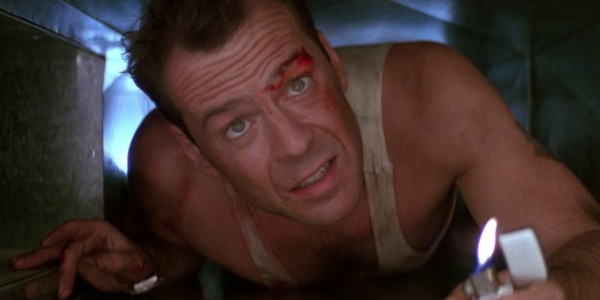
6. Die Hard - Nothing Lasts Forever By Roderick Thorp
The novel that became Die Hard. The movie introduced us to John McClane, but the main character of the novel is named Joseph Leland, who is older than his film character equivalent, and retired. He is not in Los Angeles to spend Christmas with his estranged wife and children, but to visit his adult daughter, an oil company executive. There are other similarities and differences, but it's probably best to read them on your own. The novel was re-released in December of last year, and I do plan to eventually read it.
5. Fast Times At Ridgemont High - Fast Times At Ridgmont High By Cameron Crowe
 Cameron Crowe was a 22-year-old freelance writer for Rolling Stone when he went undercover in a California high school and wrote a book based on his experiences. But, when you think of Fast Times at Ridgemont High, you think of Sean Pean's Jeff Spicoli, or Phoebe Cates at the pool... the movie came out a year after the book. The movie is apparently a faithful adaptation of the novel, but if you haven't read it, you likely won't get the chance to now. The book is now out of print, nor is it available as an ebook. Will it ever be re-released? It doesn't look good. The 30-year anniversaries of the book and film have both passed, and those would have been ideal times for a re-issue.
4. Field Of Dreams - Shoeless Joe By W. P. Kinsella
 Field of Dreams is perhaps one of the best baseball films there is. It also produced one of the most commonly misquoted movie lines "If you build it he will come." The key difference between the novel and the movie is that in the novel Ray Kinsella travels cross-country to meet J.D. Salinger. The character was changed to the fictional Terrance Mann (portrayed by James Earl Jones) due to a threat of legal action by Salinger. Which was probably a good thing, as James Earl Jones was fantastic in the movie.
3. Planet Of The Apes - La Planète Des Singes, By Pierre Boulle
 This French novel translates into English as Monkey Planet, or Planet of the Apes. Without this novel, the original Planet of the Apes film franchise would have never been, nor the reboots. Here's a novel that bears little resemblance to the film adaptation. While the protagonists of the novel come from modern-day Earth and end up on a planet where apes the intelligent life and humans are savage animals is the same, that is pretty much where the similarities end. The ape society in the novel is technologically advanced, and city they arrive in is virtually identical to what they'd seen on Earth. Since so much is different between the novel and film, it's hard to compare them, but since I read the novel, I've felt a true adaptation (which neither reboot is) would make a great film.
2. Psycho - Psycho By Robert Bloch
 Psycho was a novel? Yes, it was. Believe it or not. And the movie is apparently quite faithful to it, with some changes made by Alfred Hitchcock and Joseph Stefano, who wrote the screenplay. Is the iconic (and often parodied) shower scene in the novel? Yes, it is. Is it as memorable as the film version? Beats me, but I'm now really curious. There were sequels to the novel as well, which have nothing to do with the film sequels.
1. Sideways - Sideways By Rex Pickett
 Another novel you likely haven't read, but had a similar impact on popular culture because of the film, is Sideways. A novel about two friends, Miles and Jack, who visit wine country the week before Jack is to be married. Both the novel and the film have Miles disparage Merlot, while lauding Pinot Noir, and as a result, Pinot Noir sales rose, while Merlot sales dropped. The man who deserves the most credit for this impact on the wine industry (which generally resulted in the increasing the consumption of win) is not director Alexander Payne, but Rex Pickett. Despite the film's success and many awards, the novel was never a bestseller, and Pickett barely made any money off the book or the film rights. His experience with publisher ultimately led him to self-publish a sequel to Sideways, titled Vertical. A third installment of the adventures of Miles and Jack is currently being written and should be published next year. There are apparently no plans for the sequels to be adapted to the big screen, so if you loved the movie, and want to know what happens to Miles and Jack, (including things that didn't make it into the film) now's the time to start reading the books.