8 More Movie Sequels With Visual Effects Inexcusably Worse Than The Original
More money doesn't always equal more quality.

Movie sequels generally feel the need to be bigger and better than their predecessors, in every way imaginable. If a film is getting a sequel in the first place, it usually means that the original was a box-office success, which affords its followup more financial resources to splash the cash and make everything look as polished as possible.
Even without more money, it's not unreasonable to expect a sequel to at least look as good as the original. That first film has already done a lot of heavy lifting in terms of designing the characters and their world, which, in theory, should give the sequel a bit more polishing time in post-production.
And yet, for some odd reason, a lot of sequels end up looking shabbier than the original, and the visual effects department is often the worst offender.
Whether the filmmakers bit off more than they could chew, relied on computer-generated effects a bit too much, or simply ran out of time to make the whole movie look good, sequels really shouldn't look worse than the movies that came before them, but unfortunately... this lot did.
8. Along Came A Spider

In 1997, Morgan Freeman headlined Kiss The Girls, a thriller based on the Alex Cross series of novels. A moderate success, the film made around $60 million worldwide on a small $27 million budget, and while it wasn't a hit with critics, it did well enough overall to warrant a sequel, which arrived four years later.
Both of these movies are detective thrillers, and are quite small-scale as a result. There are small shootouts instead of huge action sequences, lots of walking and talking, and very few special effects-heavy shots. The effects that do appear in Kiss The Girls are solid, but Along Came A Spider opens with a CGI car accident that's so laughably bad, it'll make you wonder where its $60 million budget - more than double the first film's - went.
The vehicle doesn't just crash in a straightforward manner: it swerves and flips like something out of a cartoon, spinning about a million times before finally tumbling over the side of a bridge. It really does look like a shot pulled from a Burnout game, with all the graphical fidelity of an Xbox or PS2 cutscene.
Again, Along Came A Spider cost twice what Kiss The Girls did, and the effects in the latter are fine. How the hell four years and more money resulted in something that looks this cheap is anyone's guess. And for director Lee Tamahori, this isn't the only time he's completely dropped the ball in the special effects department...
7. Die Another Day

The sharp decline in quality found across the Pierce Brosnan era of Bond films was a huge disappointment considering that his first appearance - Goldeneye - is a stellar 007 outing. The mediocre duo of Tomorrow Never Dies and The World Is Not Enough followed, but nobody was prepared for just how bad Tamahori's Die Another Day would be - on pretty much all fronts.
The movie starts with a solid opening sequence but soon devolves into a cocktail of cringe-worthy dialogue and painfully bad special effects sequences, layered with so much bad cheese that you can almost smell it. The film's particularly rubbish highlight arrives after we're introduced to an ice palace (sigh), and finds Bond surfing across some massive waves, weaving in and around several huge blocks of ice in his path, before using one of them as a ramp to boost away and reach dry land.
And to be frank, it looks fake as balls. The green screen is annoyingly apparent in the close-up shots of Brosnan, and the wide shots clearly show a textureless, rag doll-like CGI figure. It's just impossible to buy the onscreen action, and scenes like this were what made the Bond series look utterly ridiculous when compared to the gritty realism of fellow spy Jason Bourne.
Brosnan's previous Bond films were much darker than Die Another Day, and so, their effects sequences were relatively "toned-down", and certainly much cleaner than this. It's no wonder Casino Royale served as a tonal reboot of the franchise.
6. Exorcist: The Beginning

Exorcist: The Beginning is a prequel to 1973's The Exorcist, but since it came out over 30 years later, you'd expect its effects to be a lot better than the original, or at least, not terrible. But that isn't the case.
While The Exorcist is a powerhouse of practical effects and makeup work, The Beginning, for some reason, opted to use a lot more CGI. This is like when Jurassic World all-but ditched the animatronic dinosaurs that were so realistic and terrifying in Steven Spielberg's original masterpiece: why fix what isn't broken? Sure, Jurassic World's CGI isn't bad, but it's hard to deny that animatronics would've made the film's dinos a lot scarier than they were.
Exorcist: The Beginning suffers from a similar problem. There are CG shots of possessed characters scuttling across walls that probably sounded awesome on paper, but in practice, the filmmakers either didn't have the money, the skill, or the time to make them look good. The worst offender, though, is the hyena attack scene, which looks so unconvincing that even director Renny Harlin regretted including it in the film.
The creatures themselves flop and move in such weird ways, and they move so fast that it's almost like the effects team didn't add enough frames to their animations. The production actually tried to use real hyenas for this scene initially, but found them impossible to train. Maybe use dogs next time then?
5. Escape From L.A.

John Carpenter made a name for himself with his superb practical effects work on movies like The Thing, so it was seriously confusing to see the CGI in 1996's Escape From L.A. fall hard on the other end of the spectrum.
Sequel to Escape From New York, Escape From L.A. came out 15 years later, with a budget that was around nine times larger. So, more CGI was always inevitable, especially after movies like Jurassic Park and Tron had showed what visual effects were capable of - in the right hands. But on Escape From L.A., those hands just weren't there. Maybe Carpenter isn't as skilled with a computer as he is with a makeup brush, but regardless, the movie's visual effects are dodgy, and the surfing scene is proof.
Starting with a shot of a car being swallowed up by some waves that everyone involved should be embarrassed about, the scene than shows Kurt Russell and Peter Fonda ridin' those waves, with both men trying their best to act like they're surfing, while actually being stuck against an amusingly obvious green screen background.
One of the biggest issues here is that Russell and Fonda are both balanced too well: they're not moving and shaking as much as they would be if they were actually surfing on the waves. And that's without mentioning some awful compositing, and the blocky, undetailed CGI water found in certain shots. Escape From L.A. is too campy for its own good, foolishly moving away from the straighter tone of the original, and this scene is the visual manifestation of that issue.
4. Freddy Vs. Jason

The proliferation of CGI throughout the 1990s and early 2000s meant that a lot of long-running franchises switched over to digital effects, even if they might have had more practical roots. It's almost like the filmmakers felt like they had to use the latest hot thing, and since CGI offers more flexibility in post-production, it's no surprise that digital started to take over. And the results were mixed.
We've already talked about The Exorcist, but other horror franchises like Alien, Friday The 13th, and Nightmare On Elm Street are good examples. Despite their flaws, Alien: Covenant, Prometheus, and even Alien Vs. Predator all look great - with Prometheus in particular proving a mesmerising CGI treat - but the same cannot be said for Freddy and Jason, who were handed a rough bag in their 2003 face-off movie.
There's some good practical effects work on occasion, yes, but the CGI is generally pants from start to end. There's a shot of a digital ghostly Freddy that looks ridiculous, a moment where Jason twists a man's head around that's more funny than scary, and then, the pièce de résistance of crap special effects: that weird caterpillar thing.
In the context of the scene, one of the human characters gets high and starts seeing some strange stuff, prompting this creature to crawl through a door and start smoking with him. It looks so terrible that it really has to be seen to be believed: the effect is poorly blended with the real environment surrounding it, and the render simply looks unfinished, with the creature almost stuttering as it moves.
When you compare this scene to the stomach-curling practical effects found in the early Friday The 13th and Nightmare On Elm Street movies, it really does make you question why the filmmakers chose to go so CGI-heavy.
3. Anaconda 3: Offspring

While the original Anaconda film (and its sequel, Hunt for the Blood Orchid) does feature some subpar CG effects at times, it also contains plenty of rather gruesome practical work, including scenes of people being swallowed whole by the titular snake.
These practical effects are important because you can clearly see the creature interacting with the actors, and on top of improving their performances by giving them something scarily real to act against, this sells the peril and terror of the situation more than a digital anaconda ever could.
What's more, the filmmakers knew that their CGI just wouldn't be up to scratch, and so, they took steps to mask it, like making these shots quick and their edits fast, or setting any CGI-heavy scenes at night. But by the time Anaconda 3: Offspring rolled around, everyone involved had just stopped caring.
Here, the actors are being chased around in broad daylight by what appears to be a giant glob of shiny pixels - or is that meant to be the anaconda? To be fair, the filmmakers were clearly aiming more for Sharknado than Jaws, but the main attraction still looks like absolute trash, and because the crew on the first two movies actually put some thought into how best to utilise their low budget, the lack of effort on display in Anaconda 3 is inexcusable.
2. Justice League

In a story that took on a life of its own and arguably became more popular than the film itself, the messy production of superhero team-up Justice League is now synonymous with a single word: moustache.
To be completely fair to the film's VFX team, they simply weren't given enough time to make the effect look good. Henry Cavill needed a moustache while shooting Mission Impossible Fallout, and Paramount wouldn't let him shave it off when he headed for Justice League's reshoots in the summer of 2017. That was around four months before the DC movie's release, giving the crew a very small window in which to digitally remove the actor's facial hair.
The blame here lies at the feet of Warner Bros' executives, whose indefensible and foolish decision to not delay the film to improve its effects, among other elements (they held its release date so they could earn financial bonuses) resulted in it becoming a laughing stock, with Cavill's moustache being more talked about than Justice League's story or its characters.
That choice ruined one of the few good things the DCEU had going for it: its visuals. Batman V Superman is not a good film, but it looks absolutely gorgeous, with Zack Snyder's keen eye for a powerful shot resulting in some of the most memorable movie images of the year. Man Of Steel also contained some stunning cinematography and effects work, getting the franchise off to a solid start.
The higher-ups at Warner Bros valued money over making a polished film, so fittingly, they lost money at the box-office, as well as giving the DCEU's reputation a further battering.
1. The Matrix Reloaded
The original Matrix movie was a groundbreaking sci-fi action flick, widely credited with making "bullet time" - aka super-cool slo-mo - a staple of a lot of Hollywood blockbusters.
This went hand-in-hand with its Oscar-winning visual effects, which is the one thing the movie is most famous for: whenever The Matrix comes up in conversation, a key talking point is always its cool, stylised, grimy dystopian look, as well as its inventive action sequences, achieved via an impeccable mix of practical stunt work, and unobtrusive digital enhancements.
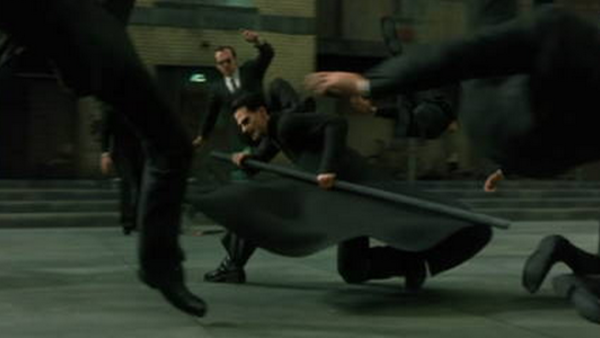
So the fact that that legacy has been tarnished with scenes like the Neo vs. multiple Agent Smiths fight in The Matrix Reloaded is a great shame.
It's just not very good at all, with the jarring WTF transitions between the real actors and the fake, floppy, weightless Keanu Reeves proving a major distraction, and with the insane amount of digital bodies cluttering the screen, the whole thing quickly devolves into a big black wave of incomprehensible visual noise. In fact, the CGI is quite spotty throughout both Matrix sequels, with the far cheaper original proving the best-looking of the three.
For a series whose visuals inspired an entire generation of filmmakers (and changed the way Hollywood approached action scenes), the poor CGI on display here is criminal. Of all the things to get wrong, this was not one of them.
-
Any other sequels with worse visual effects than their predecessors? Let us know in the comments section!