8 'Yeah, Science!' Moments In Film And TV
From 'Her' to 'The Hitchhiker's Guide', here are Hollywood's soppy love notes to science.

It is too often the case that I will sit here and whinge about the gross misrepresentation of science in cinema. It's obviously because I live a dessicated, funless existence and just like sh*tting on the things that other people enjoy.
But, be fair, science nerds can enjoy movies, sci-fi and life in general too, and there are quite often little bits of proper science in film and TV that make you go, "Oh, nice". These are exciting, we like these bits, and it is sometimes the thing that makes the difference between loving and hating the movie.
No film or tv show is going to be 100 percent scientifically perfect because, as much as I like to pitch a fit at inaccuracies, that would make them eye clawingly dull. Movies deal in a heightened reality and, whilst this can lead to some scientific, ahem, creativity, it can also sometime result in some properly exciting futurism.
Star Trek has famously predicted a lot of future tech, from mobile phones to 3D printers, and it often does this by taking existing scientific concepts, extrapolating, exaggerating and sexing them up until the look like sci-fi.
So, these movies may not be scientifically perfect (and thank god for that), but that makes us appreciate the little glimpses even more.
8. The Best Botanist On This Planet - The Martian

Yeah yeah, we get it. I love The Martian, you love The Martian, Neil deGrasse Tyson loves The Martian. We all love The Martian.
As well as being a great movie in general, the reason I can't shut up about it is that it's such a beautifully crafted love letter to science. There's a lot in there to make a science nerd go 'oooh': The rediscovery of Pathfinder (genuine chills), the gravity assist (if you ignore the fact that this basic of spaceflight had to be explained to the chief of NASA) and the hexadecimal alphabet Watney uses to communicate with Earth (they didn't have to do that, but they did, and I love it). The accuracy goes right down to the custom made sand created for the movie to look exactly like martian sand.
We could go on, but that's not the point.
The reason The Martian gets science fans in a tizz is its attitude to science. It's so refreshing to see a scientist sit down and figure stuff out, and not in the plot-device Sherlock Holmes way, but by a process of trial, error and repetition. He's even a botanist for god's sake - pretty sure that's not on Hollywood's approved list of cool science jobs.
There are no hero moments, no shortcuts and no miracles when it comes to The Martian and, as tragic as it sounds, that is very exciting.
7. Total Recall - Eternal Sunshine Of The Spotless Mind

Memory loss is one of those things that is so often depicted wrong in film and TV, that Eternal Sunshine's surprisingly subtle and relatively accurate depiction of how the brain forms memories makes a refreshing change.
Whilst we can't actually erase memories just yet, we are gaining a better understanding for how we form, retain and recall them, and it's a different picture to the "hard drive" model that used to be popular.
Eternal Sunshine's emotional themes are not just there to make compelling viewing, as it is thought that memories and emotions are almost inextricably linked. Memories are not so much little films to be replayed, but actual reconstructions of the thoughts and feelings that were felt when they were made.
The fact that Joel relives his memories as they are erased is also pretty in line with what we know about recall. It's thought that, when we remember things, our brains are actually reproducing the same neural signals that were experienced at the time, making you actually experience them again. Hypothetically, as these memories are uncovered in an erasing procedure, the brain could well experience them again - like the life flashing before the eyes before death
6. Genetics By Design - Gattaca

Much like Her, Gattaca grapples with an issue that our technological advancements may force us to grapple with one day.
Gene therapy is beginning to truly realise its potential at the moment, and soon we could be using it to treat a huge variety of ailments that we currently combat with pharmaceutical drugs. As anyone with half a brain knows, prevention is better than a cure, so it could be that we see gene modification coming into preventative medicine too, perhaps treating birth defects in utero, or screening and modifying parent's genes before fertilisation.
The thing is, is that this quickly leads you down the road of designer humans. I Gattaca, the majority of babies are conceived through IVF, and genetic screening ensures that only the genetically superior embryos get a chance at life. This creates not only a society of genetically perfect humans, but also a genetic underclass. Those conceived and born by natural means, such as the central character, Vincent, are restricted from all but the lowest jobs
The great thing is that Gattaca not only deals with the possibility of creating a whole new reason for humans to discriminate against one another, but also with the idea of genetic determinism. It explores the notion that our lives, capabilities and our characteristics are not completely dictated by our genes, and that sheer determination can work just as well - a nature/nurture debate that still rages on in the real world.
5. Ai Love - Her

Her was hailed as equal parts brilliant and bizarre when it dropped in 2013/14, and whilst it stands on it's own as a brilliant blend of sci-fi and rom-com (Sci-com? Rom-fi?), there's also plenty in there to tickle your techie tastebuds.
We're currently setting out on the path to create thinking, and even feeling, artificial intelligence and, as bonkers and even voyeuristic as "man falls in love with computer" sounds, it's an issue that we'll almost certainly have to deal with at some point.
Creating artificial minds with the ability to think and feel is not only technically difficult, but morally thorny. Once a computer can operate indistinguishably from our own minds, do they have the same rights? Is it ever right to turn them off? Why shouldn't someone fall in love with them? People meet other people online and fall in love, how is it, practically, any different?
Soul searching aside, something else that is particularly refreshing is the distinct lack of desire for world domination displayed by Samantha. The frankly tired "evil AI" trope gets a rest, and we get what is likely to be a much more accurate depiction of human-robot relations of the future.
4. The Swarm - Star Trek Beyond
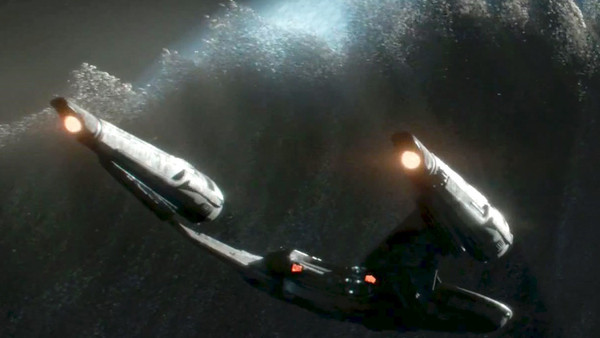
The scientific ups and downs of the new Star Trek offering have been roundly covered here, but one aspect of it gave me such good science tingles that it bears inclusion, and that's the swarm warfare.
The field of swarm robotics is a personal favourite, but also extremely significant for the future of technology. The move away from the idea that the most advanced and effective robotic systems have to be roughly human shaped, tottering around on two legs and fumbling fine motor movements, has opened up a number of interesting avenues. Non-scalable technology is out, swarms are in.
Swarm systems are versatile and scalable. Whether it's in the form of a legion of cleaner-bots scampering around your home, or, as in Star Trek, a terrifying, contorting battle fleet, their main strength is in their flexibility.
In warfare, a swarm is so difficult to combat because, like a swarm of wasps, the moment you swat one, there's another, angrier one to take its place. For this reason, the US military (amongst others) are already pouring resources into researching swarm systems.
Could we be witnessing another instance of Star Trek predicting the technology of the future? Only time will tell.
3. The Black Hole Science - Interstellar

Interstellar might go a bit doolally towards the end, but there's a reason why it was hailed for its scientific accuracy. Whilst there are obviously still healthy helpings of artistic licence to keep the plot turning over, the scientific concepts woven throughout it are firmly rooted in the realm of facts.
Relativity and time dilation play a major role in the plot, with one hour on the surface of Miller's planet lasting seven years back on Earth. It's the kind of dilation you expect that kind of dilation at the event horizon of a black hole, as relativity tells us that time will move slowly in the presence of a gravitational field.
Speaking of black holes, Gargantua is well known as the crowning glory of the movie. It has been hailed as one of the most scientifically accurate depictions of a black hole to date, with the accretion disk appearing to wrap over and around the black hole due to gravitational lensing.
Unfortunately, Nolan loses points here because the decision was made to make the black hole intentionally less accurate, by omitting a colour gradient caused by the Doppler effect, and the fact that a black hole with the spin capable of producing the time dilation effect in the movie would probably just be a psychedelic jumbled mess of distorted images. These were left out of the film as it was thought that people would find it too confusing - way to underestimate your audience there, Nolan, I want my jumbled mess of spacetime.
2. Space Is Massive - The Hitchhiker’s Guide To The Galaxy
The Hitchhiker's Guide to the Galaxy might not seem the obvious place to look for hard science but, beneath the gags about Pan Galactic Gargle Blasters and Joo Janta 200 Super-Chromatic Peril Sensitive Sunglasses, there is a specific underlying message that threads throughout the entire franchise, one that is often trampled on by other sci-fi, and it's right there in the Guide's introduction:
"Space is big. Really big. You just won’t believe how vastly hugely mindbogglingly big it is. I mean you may think it’s a long way down the road to the chemist’s, but that’s just peanuts to space."
Something that is always super irritating in sci-fi is the wild miscalculations of the scale of the universe. Whether it's a ship dodging through a packed-out asteroid field, or nipping between star systems or even sending and receiving instant communications over vast distances, filmmakers tend to forget that space is generally a whole lotta nuthin'.
Whilst the Hitchhiker's universe is teeming with life, ships, planets and small furry creatures from alpha centauri, it is constantly acknowledged that space is mainly a big, black void. The Total Perspective Vortex (featured in The Restaurant At The End Of The Universe) is even a device with the sole purpose of showing you how small you are in relation to the vastness of the universe.
Sure we still have people nipping around in hyperspace, it is much more practical for compelling storytelling I guess, it's nice to at least have it acknowledged.
1. Monty Python's Galaxy Song
Sticking with our classic British comedy theme to finish (because why wouldn't you?) Monty Python's Galaxy Song from The Meaning of Life is always a treat.
it's not sci-fi, it's not a blockbuster, it's a bunch of British blokes being as silly as they can because it makes them laugh, and yet this song would probably make a good classroom resource.
Okay maybe not, some of the figures have since been updated in the intervening years, and Eric Idle incorrectly uses the term "revolving" rather than "rotating" in order to rhyme with "evolving", but the speed of light is roughly correct, the galactic radius is right and Australian astrophysicist Bryan Gaensler has even said that the estimation for the thickness of the Milky Way, at 16,000 light years, is more accurate than the official figure of 6,000 light years that appears in textbooks.
Oh, and to make things even better, here's Stephen Hawking's rendition. See, science can be whimsical after all.
Are there any film or TV moments that made you say "niiice"? Let us know in the comments.
You could write for WhatCulture Science! Click here to find out how you could get paid to write about what you love.
If science gives you tingles in your brain bits, like us on Facebook or follow us on Twitter to stay up to date.