5 Things The Wolf Of Wall Street Celebrates (And Condemns) About America
The critics are divided as to whether Martin Scorsese's latest flick glamourises or condemns the life of its protagonist: maybe it's both?

5. Money

"Money doesn't just buy you a better life -- better food, better cars, better p*ssy -- it also makes you a better person. You can give generously to the church of your choice or the political party. You can save the f*cking spotted owl with money."Forget the cape and cowl: you can save the world with enough money. When Belfort is about to call it quits, he toots his own horn by talking about how he took in Kimmie, one of the senior brokers, when she was a single mother in debt. He reminisces about the time when she asked for a $5,000 advance and he generously gave her $25,000 instead. Kimmie breaks down in tears as she recollects on this (and on why money is so great). It is the means to saving someone, but instead of thankfully making enough money, Kimmie catches the greed bug from the Wolf. She becomes vain and spends $3,000 on Armani suits and Lord knows how much vacationing in the Hamptons and Bahamas. Kimmie becomes an example of what happens when the money changes from being a means to an end to being the end in itself. Once money becomes the very thing you love instead of the good you can do with it, you can be sure that no amount of the stuff will ever be enough. Which leads to our next point...
4. Success

"Money is the oxygen of capitalism and I wanna breathe more than any other human being alive." "You want to know what money sounds like? Visit a trading floor on Wall Street... I was hooked within seconds."When his back was against the wall, he couldn't stop even when he was at the top and had a chance to get out while he was ahead, when he didn't need to work another day in his life. The Wolf had his health, his wife, his kids, and - most importantly - his money. The only problem was leaving behind his addiction and it wasn't something he could go to rehab for. Success felt too good. It's not only a part of human nature: it's a part of American history. From the Declaration of Independence to Manifest Destiny to capitalism, we celebrate underdog success stories because they're cultural cornerstones of what makes America America. But what happens when you've tasted success? You taste higher levels of success, but once you reach the ceiling, do you stop? Nope. That's just not American. You keep going and you start overflowing...
3. Excess
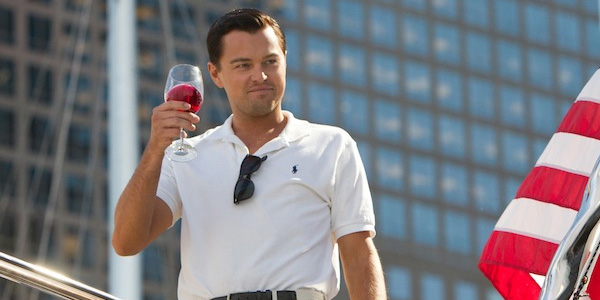
"The question is, 'was it legal?' Absolutely not. But we were making more money than we knew what to do with."The length and content of the film is enough to demonstrate our love of excess. Drugs, sex, and money are pop up as prevalent themes as we watch the film. Running at 3 hours, Martin Scorsese isn't shy about dedicating an hour of it to debauchery in order to pound it into our skulls that yes, this is what America wants. Right? Excess is what you think you want and need, but the risk is that in the rush of all the booze and sex, we may have overlooked the obvious question. Is this really what we want? Scorsese uses excess in the film by showing multiple sex and drug use scenes as filthy fun, but after a while, we become desensitized to it. Fun hits its expiration date and instead, all of the excess appears empty and hollow. What happened to the pursuit of...
2. Happiness

"It sucks... I'm so bored I want to kill myself."In America, it's not life, liberty, and happiness. It's the pursuit that matters. If you're not moving towards happiness in America, you're not moving at all and if you're not moving, you sure aren't living. Unfortunately, there's an end to every pursuit and if the pursuit doesn't kill you, then the boredom will. In the end, the Wolf lost his family, friends, company, and everything he ever worked for because he was never truly happy. However, the Wolf doesn't try to get his wife and kids back - to his credit, he doesn't go back to drugs and hookers, either, though. He goes back to his main addiction: money. In the end, he's back helping regular people like you and me get rich because that's when he was the happiest: pursuing money.
1. The American Dream

"It's a fugayzi, fugazhi, it's a wahzi, it's a woozie. It's fairy dust..."The biggest thing Americans sell to one another isn't a stock: it's the American Dream. It's universal, and it's tangible in the form of a college degree, a good salary, a house, a car, 2.5 kids and a golden retriever. It's the reason why Jordan Belfort still has a job at the end of the movie. When he's asking the audience to sell him the pen, he's really asking us and we're only too anxious to pitch him because there's a little seed of hope embedded in our minds that makes us believe we can be the one. We can be the one to sell him the pen and if we do, our fantasies and our dreams can and will come true. However, as evidenced in the life of the Wolf, it seems the brokers are just as hooked in as the buyers because once we're in the market, no one's getting out. We keep on investing and reinvesting in stocks, so our fairy dust can reach maximum profitability. The only difference between the American Dream and stocks is that the Dream pretty much sells itself:
"... Stratton Oakmont is America! Give me your tired and poor! The very moment you walk through that door and pledge your loyalty to this firm, you become part of a family, you become a Strattonite! It doesn't matter who you are, it doesn't matter where you're from! Whether your family came over on the Mayflower or on a f*cking inner tube from Haiti!"Like this article? What do you make of the Wolf of Wall Street? Let us know in the comments section below.