5 Things The Hobbit Films Are Getting Right (And Why It's Not Enough)
 Before I get into the article proper and in order to waylay immediate offense from a certain internet archetype, a disclaimer: it is entirely reasonable to consider Peter Jackson's Hobbit movies as "good films." It is, as it always is, a matter of opinion. My intent is not to communicate my opinions as fact; rather, I seek to point out a number of things I appreciated about "The Hobbit: An Unexpected Journey" (with additional points gathered from recent promotional material regarding "The Hobbit: The Desolation of Smaug") and then compare these positive aspects with an apt reciprocalexplaining, with my own opinionated bias, why the negative outweighs the positive. If you like, my bias is largely concerned with "adaptation," but some of the following points will also bring up other avenues of criticism.
5. The Casting
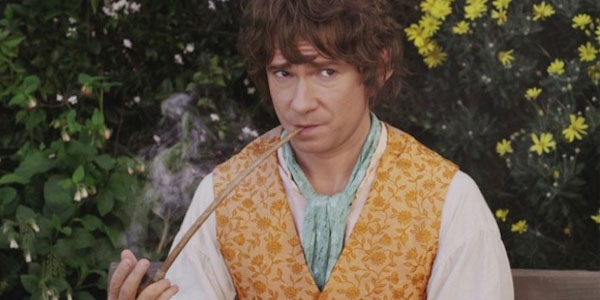 Martin Freeman is an utterly brilliant Bilbo Baggins. Richard Armitage (who has been a favourite of mine since BBC's "Robin Hood") has enough charisma and broiling fury to feed the five hundred, and the rest of the dwarf company was aptly and admirably cast. The fact that Peter Jackson managed to bring back Sir Ian McKellen, Hugo Weaving, Ian Holm, Elijah Wood, Christopher Lee, and Cate Blanchett (though I'll get into why the cameos of these final four were painfully unnecessary in a later point) is also an admirable casting success. (An honourary mention for great casting goes to bringing back Bret McKenzie as Figwit the elf). However, Peter Jackson also cast my all time least favourite actor in just about all of the remaining parts. The actor in question is so painfully lousy that he doesn't even have an IMDb page, even though he has a part in so many films. This actor shows up on screen in all of his films and manages to not only look and perform terribly, but also brings down the performances of many talented actors around him. Who is this cinematic travesty? Poor CGI.
4. The Dwarves
 Thorin's company is a great looking bunch of dwarves, and I'm not referring only to the ones with stubbly beards. The filmmakers developed some fantastic armour and costumes, with some of the articles and choices evoking thoughts of deep back-story and interesting characterization. Unfortunately, it is all wrong, and not only when lined up with available resources from the source materialit is wrong also, and perhaps most significantly, because it is completely and utterly unnecessary. I remember, in the genesis of this project, Peter Jackson saying something along the lines of "Tolkien didn't give the dwarves enough distinction and characterization, so we've made some choices." (Not an actual quote). He is half right. The dwarves weren't given much meat in the original novel, but they had been given exactly enough distinction. Balin wore a red hood. Fili and Kili wore blue hoods (and had blonde beards). Dwalin had a blue beard and a green hood. In fact, if we are honest, the dwarves were given precisely the same amount of characterization in the film as they were in the bookperhaps less. Film Bombur doesn't have a single line in the entirety of "An Unexpected Journey." Fili and Kili don't start a single campfire. Essentially, Peter Jackson and the rest of the filmmakers have no excuse, no reason: they simply butchered the source material. Nothing was gained, but a great deal was lost.
3. The Elves
 Rivendell is gorgeous. Everything about itits people, its buildings, its scenery, its history: it's a beautiful location and a fantastic set. I loved how I was introduced to new rooms and locations within Rivendell in "An Unexpected Journey." I appreciate how it was an exploration of a familiar placethis was why we were all excited, of course, when Peter Jackson agreed to produce and direct these new films. Onwards to Mirkwood: what we've seen so far from the trailers and photographic releases, the kingdom of Thranduil will rival Rivendell's aesthetic magnificence. The colours, the art, and the costumes seem pulchritudinous, a word which here means "beautiful" (I'm running out of synonyms); and not only that, but flush with the world we are already familiar withespecially in regards to costuming. I think the Greenwood will be a fantastically lovely place to visit. Alas. While the filmmakers' vision of Rivendell is undeniably exquisite, their interpretation of its *life* was completely and disappointingly incorrect. In the novel, the elves joke, they laugh, and they sing songs at the arrival of Thorin & Co. It's allliterally allfun and games for them. They do not view the dwarves with hostility (nor, of course, does Thorin consider the elves with any vehemence beyond an annoyance at being the butt of their jokes). This is, of course, all a matter of tone that I could also get into, but has been done beforeand the tone was all wrong, whereas the depiction of Rivendell involved a positive side. On the topic of Elvish joviality, why are the Wood-elves pursuing (open?) barrels of dwarves down the river when they should be getting absolutely hammered within their castle, drinking fine wine and experiencing one of Thranduil's legendary parties? Also why is Thorin asking for Thranduil's help? Why are the elves fighting orcs in Lake-town? I digressthis article isn't meant to document the bastardization of a beloved novel. I apologize.
2. Connection To The Lord Of The Rings
 I was overjoyed when Peter Jackson agreed to direct these films. His "The Lord of the Rings" trilogy has been one of my favourite film series of all time (despite, on occasion, displaying poor choices in adaptation, they remained, as a whole, fantastic and faithful-to-the-feel-of-the-novel-if-not-precisely-to-its-plot films), so I was keen on him bringing the story of "The Hobbit" to the silver screen. I loved that he brought back old actors, sets, and crewmaking the look of the world flush with the previous trilogy. However, he took a number of steps too far. Consider this: the sitcom "Friends" takes place in the same world (Earth) as the police drama "Luther," but the feel of the show is utterly and completely different. Perhaps you are saying, "Well, that's obvious: they are, after all, completely different shows." Well, there you have it. Some connection to "The Lord of the Rings" film trilogy is welcomeby all means set "The Hobbit" in the same visualized worldbut there is no need to extend this connection to the feel and tone of the story. Both "Luther" and "Friends" take place in a familiar world, and from that base they expand into their own territory. Alas, not only do "The Hobbit" films take place in the Middle Earth previously conceptualized by Peter Jackson and his team, they also strive to match the tone and feel of "The Lord of the Rings" film trilogy. To introduce this idea, we have a second prologue that bridges the gap between the two film trilogiesfeaturing entirely unnecessary cameos from Elijah Wood and a very tired, very old Ian Holm. To perpetuate this idea, we have a meeting of the White Council in Rivendellfeaturing entirely unnecessary cameos from Cate Blanchett and a very tired, very old Christopher Lee (whose remaining power and gravitas is completely stolen by a bored camera and a painful script). Azog the Lore-Defiler, xenophobic elves, xenophobic dwarves, extravagant action sequences with goblins, and extravagant action sequences with stone giants are all the spawn of this same idea.
1. Marketing
 The marketing team behind "The Hobbit" films has done a fantastic job. The video diaries, trailers, and images released for "An Unexpected Journey" and "The Desolation of Smaug" have been impressive enough to make even me, a source-material snob, excited for the upcoming films (though my excitement has been diminished exponentially by the recently released images of David Bowuh, Beorn). The interactive or social nature of a lot of the marketing material makes the research of these films a rewarding experience. Why isn't this enough? Well, for the simple reason that the films they advertise just aren't up to snuff, an expression which here means "are poor adaptations that produced only decent films, and are a squandered opportunity if one had high expectations, or any expectations at all." What things about the films do you look upon positively? Why isn't that enough for you; or is it?