5 Scientific Inaccuracies In Alfonso Cuaron's Gravity
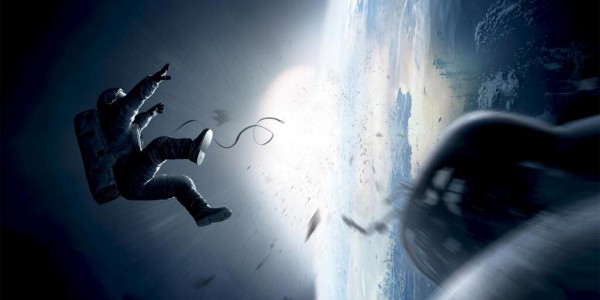 For the past 3 weeks, the space thriller survival film Gravity (written and directed by Alfonso Cuaron) has been the #1 movie in the States and around the world. The film's performance has surprised many critics and even the audiences who have found themselves enthralled by it, and it has set new records for a film released in October (typically considered a weak time of year for movie attendance). It is also the only movie since Avatar that deserves the extra money you will spend on 3D glasses. And you will see it in 3D (preferably in IMAX as well). Because no other film comes close to capturing that surreal feeling of floating above the Earth, what shuttle astronaut Jeff Hoffman has described as "the cosmic perspective." Of course, in Gravity that euphoria quickly turns into terror as disaster strikes and Bullock's character goes spinning off into the void with Clooney coming to the rescue in his Manned Manoeuvring Unit (MMU). Clooney, along with another astronaut played by Paul Sharma, spends most of the early moments of the film goofing around while Bullock works hard to install some new equipment on the Hubble Space Telescope. Clooney relates amusing anecdotes to the boys in Mission Control while cruising around in his MMU, using its jets of nitrogen to guide his movements, and generally exuding cool. A warning comes through that the Russians have shot down one of their own satellites, and due to a miscalculation, have created a possibly hazardous scattering of debris. Before Clooney, Bullock, and Sharma can return to the space shuttle, the satellite debris has impacted other satellites, causing a chain reaction and resulting in a monstrous wave of debris that is, of course, heading straight for our stalwart protagonists. Shortly after, the shuttle and the Hubble are being shredded and Bullock is tumbling into an endless starry backdrop. As a long-time NASA fan and science buff, I myself was extremely eager to see Gravity. It appeared that it could be that rare sci-fi film which deals with space in a completely realistic manner. In fact, I can think of only one other movie faithful to the realities of what a true-to-life space program would be like, Stanley Kubrick's epic 2001: A Space Odyssey (well, at least the first three-fourths of the film, before the Space Baby starts eating people's brains or whatever the heck is happening in 2001's psychedelic climax). Unfortunately, despite the fantastic 3D immersion of Gravity, despite the glorious cinematography and effects, despite wanting to weep whenever the astronauts glided above that big blue marble we call home, I very soon found myself thinking "Wait... that just doesn't make any..." and "What? Really? Are you kidding me?" followed by a few mutterings of "Well, it is just a movie..." and overall punctuated by a chorus of "Good God! Sandra Bullock, can you please stop hyperventilating?" Don't get me wrong: I thoroughly enjoyed Gravity. But some of the artistic license the filmmakers took with the science of outer space (and even of gravity itself!) did diminish my appreciation of the film. And as many astronauts along with sci-celebrity Neil Degrasse Tyson have done, I couldn't help but make note of a few of the most glaring scientific inaccuracies.
5. Hot Pants In Space
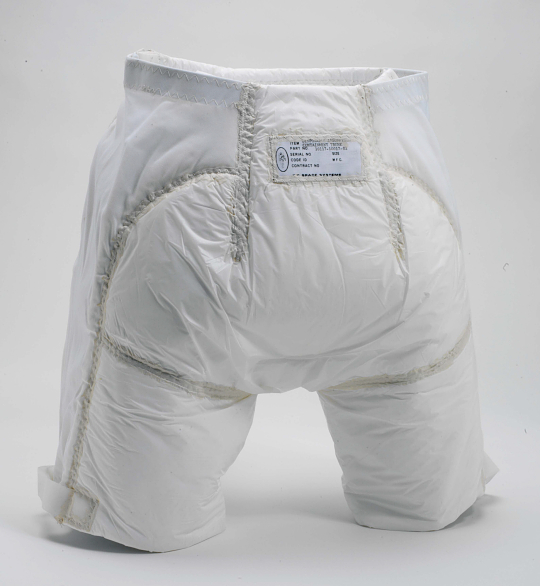
 Some of the "errors" of the film that experts have pointed out are not so much about a defying of the laws of physics as they are about improper protocols. Sandra Bullock's character is not a fully trained astronaut; she is a civilian consultant, a medical doctor. Some astronauts have wondered why she would be along on the mission in the first place, and have remarked that she definitely wouldn't be working on the Hubble by herself while the two other astronauts horse around. One former NASA contractor was nonplussed at the lack of professionalism exhibited by Bullock's character, by her tendency to panic. At the same time, the character's bare six months of training have given her the ability to pilot not only a Soyuz craft but also its Chinese equivalent. There are also many scenes in which Bullock and Clooney manage to grab some convenient handhold before being cast into the void by their inertia. But as several astronauts have pointed out, a typical space suit's gloves do not allow for such feats of dexterity. The gloves provide limited grip and would be at best equivalent to snow gloves and at worse similar to oven mitts. However, all of these distortions of the truth and breaks from official policy could be easily explained away by positing that the film takes place in an alternate reality, perhaps even a bit in the future, in which the space program has developed somewhat differently. In fact, the space shuttle used in the film is a fictional one, the Explorer, and its mission number is given as STS-157 when in reality the very last space shuttle mission was STS-135. Also, the Chinese space station in Gravity is quite an upgrade from its counterpart in real life. And the MMU (Manned Maneuvering Unit) which Clooney cruises around in is a piece of equipment used a few times in the '80s and retired shortly after the Challenger disaster. So, perhaps, Gravity takes place in a world with a kinder, happier space program, maybe one in which no space shuttle catastrophes ever occurred. A world in which civilian contractors are hastily trained and sent up to do menial labor while suave and playful astronauts gallivant like school children. And maybe they have enhanced space glove technology. But some things never change. It's likely that no matter which alternate reality you're visiting, you still have to deal with certain bodily functions, or as my friend Kid Jerry used to say to his dog: "it's time for poops and piddles." In one glorious moment of Gravity, Sandra Bullock has arrived at the International Space Station. After going through a quick decompression, she peels off her bulky space suit in a scene reminiscent of the opening shots of Jane Fonda in Barbarella or the final scene with Sigourney Weaver in Alien. And though Bullock's boyish hair cut in Gravity does nothing for me, those skimpy black hot pants certainly do. However, as many astronauts were quick to point out, Bullock's undergarments are a far cry from what is actually worn under their space suits. Astronauts wear a complex cooling garment under their suits, kind of like long underwear with a network of tubes. They also wear Disposable Absorption Containment Trunks, a.k.a. space diapers. Just in case it's time for poops and piddles.
4. I Just Happened To Be In The Neighborhood...
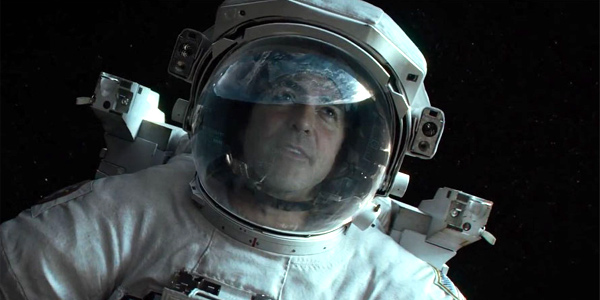 After the space shuttle and the Hubble Space Telescope get shredded, killing everyone except our two principals, hyperventilating Bullock and cool-as-a-cucumber Clooney use the Manned Maneuvering Unit (MMU) to gradually jet their way across the stunningly beautiful spacescape to the nearby International Space Station (ISS). Even if the crew has evacuated, Clooney informs Bullock, there will an extra Soyuz capsule they can pilot back to Earth. Unfortunately, the Soyuz has been damaged and is unable to make reentry. No problem, Clooney assures Bullock. "See that dot on the horizon," he essentially says. "That's the Chinese space station. No one's home, and their version of the Soyuz should be accessible and in working order. Just point this damaged Soyuz at that dot, fire the soft landing jets and allow the inertia to take you there." Meanwhile, as Bullock puts this last ditch plan into action, the wave of debris returns on another orbit and decimates the ISS. Astronaut Tom Jones (not the same as the hep '60s vocalist who helped redefine bare-chestedness) has noted that there's no way Bullock could have used the landing jets to traverse the distance between the two space stations, remarking that they would have just carried her into a higher orbit. And that brings up one major problem with both of these journeys that Gravity's astronauts make, the assumption that the Hubble, the ISS, and the Chinese space station are all on the same orbital plane (the same distance above the earth). In fact, there is about a 200 km (124 mi) difference between Hubble's orbital plane and ISS's orbital plane. The Hubble orbits at 370 km (230 mi) above the earth while the ISS is at 563 km (350 mi). So in addition to traveling what should be a fairly large distance from the Hubble to the ISS, Clooney should also have had to use his MMU's propulsion to take him and Bullock an additional 200 km (124 mi) higher above the earth. Besides the different orbital planes, there are also the different orbital paths of the Hubble and the two space stations. Think about it this way. First, the earth is a very large place. Try to think about just how big it is; contemplate the distance perhaps from the northern Sahara to the southern tip of Madagascar . Second, if you project outward 200 km (124 mi) from the sphere that is the earth, the result is a larger sphere with concomitantly larger distances from point to point. Now, imagine that the orbital path of a satellite such as the Hubble is a highway that stretches around this enlarged sphere. Do you think the ISS would travel on this same highway? Would it be on an adjacent highway? No, it would be on an entirely different highway, far far away. So, even if we forget about the notion of orbital planes, there is still a vast distance to traverse using only bursts of the nitrogen jets from the MMU. It would be like taking a brisk walk from a dusty highway in Zimbabwe to a sheep path in Pakistan, times roughly 3% to account for the larger "sphere" which results from being 200 km (124 mi) above the earth. Considering that Clooney was being conservative with the fuel in the MMU, he wouldn't be going at its top speed of 64 kmh (40 mph) and would likely be putting along at something closer to its normal speed of 5 kmh (3 mph). Even if we triple that speed, our hypothetical trip from an orbital path crossing Zimbabwe to one over Pakistan would take about 480 hours to complete, almost 3 weeks. And, well, the MMU has enough fuel to operate for about 6 hours.
3. The Take My Hand Trope Doesn't Work In Zero-G
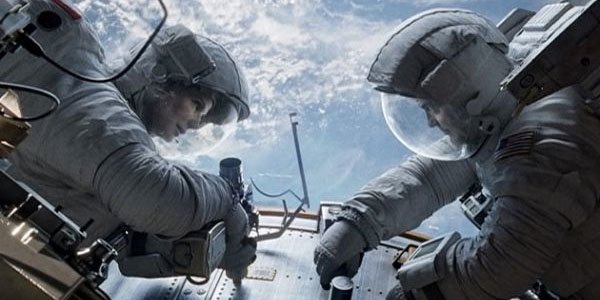 We've seen it in hundreds, perhaps thousands of movies. In fact, it seems as though it happens in every single movie. The hero or the hero's significant other or sometimes even the villain is about to fall to his or her death. Dangling helplessly by one hand, this person's only chance of rescue is to be pulled to safety by the person above, who is usually also using only one arm to effect this daring save. In many variations of this trope, the person below chooses to let go rather than pull their would-be rescuer down to a certain doom. Meanwhile, the person above grits his or her teeth and says, "Don't let go, damn you! Don't you dare let go!" Now observe the picture above and try to imagine how this situation would play out in a zero-g environment. In their approach to the International Space Station (ISS), Clooney and Bullock have missed the mark a bit and the only thing keeping them from floating away is the fact that Bullock's foot is wrapped in the parachute rigging which has deployed from the damaged Soyuz. She has also managed to catch the severed tether that had been keeping her connected to Clooney and is grasping it for dear life with her regulation NASA oven mitts, keeping Clooney from floating away. Now, at this point, with Bullock's inertial movement arrested by her becoming tangled in the rigging that dangles from the ISS and with Clooney's inertial movement likewise being stopped after Bullock grabs the tether, that should be the end of the suspenseful moment. Because there is no other force acting upon the astronauts, they are essentially at a complete standstill. There is no - I hate to say it - gravity to pull Clooney away. In fact, just a minor tug by Bullock on the tether would cause him to come drifting back towards her, problem solved. Then, they could leisurely "climb" their way along the rigging and to the ISS. And, yet, because this is Hollywood, because the Take My Hand cliché is considered almost a necessity for a thrilling movie, we are subjected to several minutes of Bullock pleading for Clooney not to let go as Clooney bravely insists it is the only way. He then sacrifices himself by unbuckling his tether and mysteriously drifting away, pulled apart from Bullock by one of the fundamental forces of the universe, movie tropes. I would have much preferred that the scene play out with Clooney letting go and then looking momentarily surprised when he doesn't float away. A boyish flush of embarrassment would cross his face as he says: "Whoops! I forgot we were in space. There's no gravity up here."
2. Tears Don't Fall In Space; They Don't Bubble Up And Float Away Either
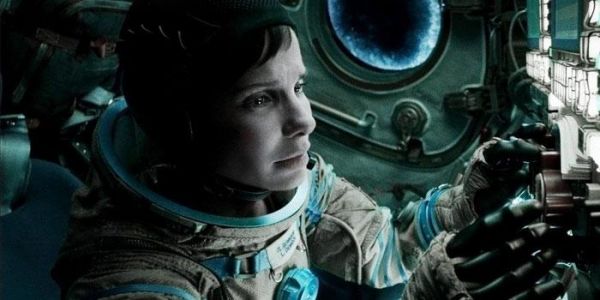 After Clooney has magically drifted away and after yet another landmark space structure, the International Space Station (ISS), gets shredded by the ravaging wave of satellite debris, Sandra Bullock's character has some moments of introspective despair. She's yet to figure out that she can use the soft landing jets to propel the damaged Soyuz to the Chinese space station (Clooney's ghost hasn't yet arrived to give her that bit of advice), so she is merely adrift in the Russian capsule. There is no contact with Mission Control, as the monstrous wave of debris has also wiped out communications satellites. "Half of North America just lost Facebook," Clooney's character says at one point in all seriousness. Bullock is completely alone. She does get to hear one last human voice as well as some barking dogs when what I presume is a shortwave radio picks up a transmission from a jovial Inuit fisherman. Shortly after, Bullock is on the verge of cutting off her oxygen and surrendering to the big sleep. A single tear forms at the corner of her eye, then bubbles into a sphere and floats off her face toward the camera. It is a great moment, cinematically and emotionally. Scientifically, however, it's far from accurate. In reality, if an astronaut's eye produces tears, the water tends to conglomerate around the eyeball, forming into a flubber-like glob of liquid. In 2011, astronaut Drew Feustel had some trouble during a spacewalk when a fleck of soap from the inside of his helmet got into his eye, causing him to tear up. The tears didn't turn into tiny little balls that bounced around inside his helmet. Again, if there's no force acting upon something in a zero-g environment, it's not going to go anywhere. The tears just built up into a blob around his eyeball until he was able to wipe them away with a space sponge. Super-cool Canadian astronaut Chris Hadfield, who made many interesting videos during his stay on the ISS (including a music video for his version of David Bowie's Space Oddity), answered this question about tears back in April of this year. Apparently, the writers of Gravity didn't get the memo.

1. The Theme From Jaws Should Have Played Every Time The Wave Of Satellite Debris Came Sweeping Around
 In other words, the wave of debris, the result of one Russian satellite exploding and causing a chain reaction that destroys other satellites and produces even more debris, is the Big Bad Monster of the movie. Clooney's character has even calculated how quickly the debris is orbiting the earth and sets a 90-minute timer to alert the astronauts to its arrival. The wave of debris devours the space shuttle, the Hubble, the International Space Station (ISS), and the Chinese space station, along with seemingly wiping out all communications satellites. I would like to think that Gravity could have put the astronauts into situations not quite so apocalyptic and had it be just as interesting. The idea of a survival film set in the void of space is certainly an intriguing one, and I don't think it required some monstrous force akin to the destabilization of the earth's core in Roland Emmerich's 2012 or the instantly freezing cold of Emmerich's The Day After Tomorrow. In other words, Gravity could have been a simple survival story without having the high-level destruction of an over-the-top disaster film. Overall, this wave of debris is the exploitation of artistic license which most tried my suspension of disbelief and tended to take me out of the film. First, if a satellite explodes in space, why would the debris all begin moving in one direction? Most likely, the debris would radiate in all directions. I suppose it's possible that the individual pieces of debris could be gravitationally attracted to one another, causing them to clump together in one heinous and vindictive wave of destruction. But, I suspect such an occurrence is much more implausible than not. Second, what really bothered me is the fact that - going back to the notion of orbital planes (the distance above the Earth - many communication satellites are in extremely high orbits, far far away from each other and even farther from low-Earth-orbit (LEO) structures such as the Hubble and the ISS.

I'm not sure what most of this chart means, but I do know that MEO (medium earth orbit) satellites, which include most GPS satellites as well as many communications satellites, are about 20 megameters (12,427 miles) above the earth. There are some communications satellites in low earth orbit, the Iridium network, but even these are over 650 km (403 mi) above sea level, still quite a stretch of distance from the Hubble orbiting at 370 km up (230 mi). And there are only about 70 satellites in the Iridium network.
For an explosion of one of them to cause a debris storm that wipes out another one would be like a telephone booth in France exploding and projecting debris to a phone booth in Cuba. Also, many of the MEO satellites are those used for Internet service as well as those used by NASA itself. So, a chain reaction involving LEO objects would have caused no outage of Facebook across North America, no inability to communicate with Mission Control.
Ultimately, space is big. Very big. Even if it were one of the MEO satellites that was destroyed by the Russians in Gravity, it would be virtually impossible for it to impact other satellites and cause a chain reaction. The other satellites would just be too damn far away. And for the debris from such an explosion to reach the Hubble would be an even larger leap in probability. Going back to our analogy about strolling from Zimbabwe to Pakistan, an MEO satellite explosion impinging upon the Hubble's integrity would be like throwing a rock from Pakistan and hoping to hit a target not just in Zimbabwe, but in a Zimbabwe that exists a whole other Earth away! Look at that picture above again. You could practically fit two entire Earths between LEO and MEO.
So the "antagonist" in Gravity, the giant shark which hunts our valiant astronauts down, following them across multiple orbital planes and orbital paths, is a huge implausibility. This villainous debris wave practically ruined the movie for me, sucking out the enjoyment. It was only later that I realized the entire movie is not about astronauts at all. It's actually an allegorical tale about the grieving process of a mother who has lost her child. Perhaps that's an article for another day.
Like this article? Let us know in the comments section below.