5 Movie Curses More Entertaining Than Their Movies
5. The Passion Of The Christ
 Its a well-known assertion that lightning never strikes twice. During the filming of The Passion of the Christ, both lead actor Jim Caviezel, and assistant Jan Michelini were struck by lightning (the latter was evidently struck twice. Michelini had previously received burns when his umbrella was hit by lightning. In this instance, however, the pair were dramatically struck during the filming of the sermon on the mound. Heres what Caviezel had to say about the incident: I was lit up like a Christmas tree! I was doing the Sermon on the Mount. I knew it was going to hit me about four seconds before it happened. I thought, "I'm going to get hit." And when it happened, I saw the extras grab the ground. What they saw was fire coming out the right and left side of my head. Illumination around the whole body. And during the shot they said, "Do you have it on camera?" What happened was Mel had said, "Action" and the cameras were panning to me and here is where this light just flashed. And by the time the cameras got to me, I hear Mel screaming out, "What the heck happened to his hair?" I looked like I went to see Don King's hair stylist. Five minutes after I got hit, , an assistant, walks over and says are you okay? And then he got hit. The difference was that they saw the bolt come down and hit Jan; they didn't see that when I was standing there. All I felt was this giant tremendous slap on my ears and a few seconds of a pink, red static infront of my eyes. As a fun little side note to that story, Michelini is credited in The Passion of the Christ as Jan 'Lightning Boy' Michelini. This was not, however, the only odd occurrence during the filming of the shot. Among miscellaneous mishaps is also the story of John Debneys battle with Satan while composing the music for the film. The computer system he was using for the composing evidently regularly froze on the image of Satan from the film. This was happening for months, evidently, crashing his computer and forcing him to reboot in order to resume work. Debney evidently reached the final straw four months into his work on the film: The computers froze for about the tenth time that day and it was about nine o'clock at night and so I got really mad, and I told Satan to manifest himself and I said, Let's go out into the parking lot and let's go. Satan did not appear, but the composer was evidently able to work better after that incident.
4. The Exorcist
 The Exorcist, likely the most shocking horror movie (or at least it was to audiences in 1973), did not bypass the crew in terms of horror, either. The accidents on set were numerous. The lead actress, Linda Blair, had her back injured on the set, when she was being thrashed on her bed. Ellen Burstyn, who played the possessed girls mother, also injured herself during the shoot when a piece of stunt equipment malfunctioned. She was meant to be pulled back by a harness, but the harness evidently pulled her too hard, causing her to land wrong. The subsequent screams can be seen on film, and are 100% genuine. According to the actress herself, there were up to nine deaths surrounding the production. Jack McGowen, one of the actors in the film whose character was killed by the possessed girl at the center of the story, died about a month before the film was released. The cause of death was evidently flu complication. Valsiliki Maliaros, who appeared in the film as well, also died weeks before the release date. Max von Sydows brother also died during the production, as did Linda Blairs grandfather. The deaths do not stop there a night watchman working on set also died, though the cause of death is not known. A man responsible for refrigeration of the set (the set was built to be very cold, to allow for the unpleasant atmosphere that is so palpable in the film) was also killed. The newborn baby of one of the cameramen died shortly after birth. A carpenter working on the film evidently lost a few fingers. A fire early on in the production cost the filmmakers six weeks, as the entire set burned down. The cause of the fire is not known to this day. To appease the fears of his crew, director Friedkin reportedly tried to commission an actual exorcism for the set. When that was denied, Reverend Thomas Bermingham came in to perform a blessing for the cast and the crew. The ceremony was repeated each time the crew changed location for shooting. In by far the most interesting story connected to the film, during the films premier in Rome, a storm had been building. As Joe Hyams, a prominent Hollywood columnist, recalls: The film was playing at the Metropolitan Theatre, just off this huge piazza in the heart of Rome which has these two twin Sixteenth Century churches with identical crosses on top. In Italy, of course, the film was an enormous success and I was standing outside the theatre watching the crowd go in, queuing in this rain and lightning, and loving it. And then in the middle of all this I heard some noise or commotion coming from the piazza, so I walk round and lightning had struck one of the crosses on top of those churches! That cross was probably four hundred years old, about seven or eight feet long-and it fell right in the middle of the piazza. It was only thanks to the bad weather that it didn't fall on nine Italians because that Piazza was usually very crowded. Well, as soon as the cross fell, the local policeman immediately took charge of the situation - but nobody went near to that cross. Now, I'm skeptical, but I start to think, 'This is getting crazy. OK there's a lightning storm and the lightning hit the cross. But there's been a lot of lightning in Rome over the past four hundred years, and this happens now when our movie is opening just down the street?' We left town about three days later, and even then that cross hadn't been moved from the spot where it fell. The authorities had taped the area off while they investigated what might have happened.
3. The Conqueror
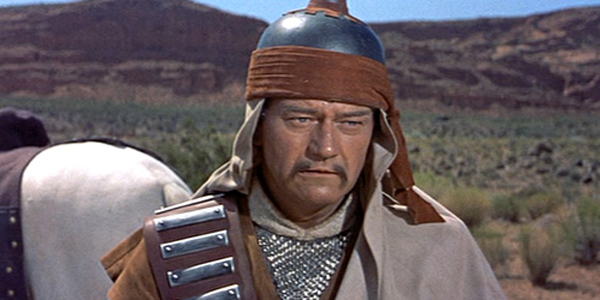 In 1956, Howard Hughes-produced The Conqueror, with John Wayne as Genghis Khan. You know, the mongol emperor. Hindsight being 20/20, we can see, of course, that casting the Duke, seen at the time as the quintessential cowboy, as an Asian historical figure may be a bad idea. However, such is Hollywood, that the biggest star gets to pick his parts. Unfortunately, bad casting and reviews (the film was included in the book The Fifty Worst Films Of All Time), were not the only curses on the production, as just a few years after the release, members of the cast and crew began dying of cancer, 91 of the 220 people involved developing cancer. Now, you might say, it's completely unreasonable to draw links between a widely derided biopic of a historical figure and cancer. It's not like they were shooting at the site of a nuclear explosion, right? ...Right? Actually, that's exactly what they were doing. The movie was shot around St. George, Utah, which just so happens to be downwind from Yucca Flats, Nevada, where 11 nuclear bombs were detonated roughly three years earlier. The shooting lasted 13 weeks, during which time the entire cast would have, without a doubt, absorbed significant enough radiation to pose a health risk. This was evidently not enough for Howard Hughes, however, who then went on to ship some 60 tons of dirt from the location back to Hollywood for reshoots. One could make the claim that the filmmakers must simply not have known about the radiation, given that the actual site of the tests was over a hundred miles away from the set. This, however, was patently untrue John Wayne reportedly even had a geiger counter on set! The producers and the crew definitely knew about the radiation, they were simply told by the government that it is not harmful. Pedro Armendariz killed himself after being diagnosed with cancer. Director Dick Powell died of cancer in 1963. Susan Hayward, John Wayne, and Agnes Moorehead all died of cancer in the 70s. Even members of John Wayne's family who visited on the set developped cancer in the coming years, though it was thankfully not terminal. Granted, this was the 50s, and people smoked heavily, but Dr. Robert Pendleton stated that With these numbers, this case could qualify as an epidemic. The connection between fallout radiation and cancer in individual cases has been practically impossible to prove conclusively. But in a group this size you'd expect only 30-some cancers to develop. With 91, I think the tie-in to their exposure on the set of The Conqueror would hold up in a court of law.
2. Atuk
 Atuk is one of the most plagued productions in Hollywoods history, seemingly systematically killing each actor attached to portray the role. The film itself is based on the 1963 novel The Incomparable Atuk by Mordecai Richler. The comedy centers around an Inuit hunter in the big city a thoroughly mundane concept, if anything. Strangely, however, every attempt to actually make the film resulted in the death of the actor meant to portray the title role. The first victim was John Belushi, who dies of a drug overdose in 1982. He evidently was enthusiastic about appearing in the film, but never got the chance. Belushis death is hardly suspicious on its own, as the man famously had a drug problem. This is far from the end of the story, however. Sam Kinison accepted the role in 1988. After filming a small portion of the film, Kinison requested changes to the script. This lead to lawsuits, and delays in filming. Shortly before the filming was set to resume, however, the actor was killed in a car crash. The man who recommended the script to both of the previous victims, Michael ODonoghue, died in 1994, just as the film was set to go into pre-production again with a new actor. This was John Candy, approached for the role in 1994. He evidently died of a heart attack reading the script. A few years later, the film was again being cast. The latest victim was Chris Farley. He idolized Belushi, and just like him, died of a drug overdose at the age of 33 which was, coincidentally, the age at which Belushi himself died. Farleys friend, Phil Hartman, who was being encouraged to take a co-starring role by Farley himself, died next year. The curse of Atuk happens to also align itself neatly with the similarly failed production of A Confederacy of Dunces each of the actors claimed by Atuk were also being considered for a part in an adaptation of the novel.
1. The Omen
 First of all, I want to be clear I love the Omen. The soundtrack by Jerry Goldsmith alone makes it a horror classic, and the film itself is certainly very suspenseful, guided by the masterful direction of Richard Donner. That being said, the accidents surrounding the film are arguably more ominous and more numerous than the ones seen in the film itself, making this one of my absolute favorite Hollywood legends. We begin with the near-misses. Gregory Peck, who played the lead in the film, on his flight from US to England, where much of the movie was shot, had his plane hit by lightning. The plane, thankfully, landed with no issues, and everyone onboard was fine. That alone is barely worth mentioning, except for the fact that executive producer Mace Neufelds plane was also struck by lightning on the same trip, but a different plane! I dont know about you, but Ive flown a lot, and my plane has never been hit by lightning. And the lightning coincidences dont stop there! Producer Harvey Bernhard was narrowly missed by a lightning bolt in Rome during the production. For those of you who have not seen the film, a priest is killed in the movie by a piece of debris loosed by bolt of lightning. We arent done with airplane mishaps, either. An airplane was chartered by the production team to shoot some b-unit footage. The company, however, offered the flight at half-price, if they would agree to move the flight to a later date. The airplane they were meant to be on crashed, killing everyone onboard. According to some reports, the aircraft also managed to hit a car on its way down, the passengers of which were the family of the ill-fated pilot. The nearly fatal accidents for members of the crew continued. Richard Donner himself was actually hit by a car, yet remarkably without serious injury. A restaurant where Neufield and Peck had dinner reservations which they didnt make was bombed by the IRA. There were also out-of-character animal attacks during the production. The Rottweilers which were featured prominently in the film turned on their trainers; and shortly after the crew left a zoo where they were filming, lions ripped apart a zookeeper who was evidently helping the crew just moments before. All of this pales in comparison to the cruel irony experienced by John Richardson, however, who was a special effect artist on the film. He created the famous decapitation effect in the film, where a backing up car looses a pain of glass, which flies out and cuts a characters head clean off, setting the fake head spinning in an almost darkly comical way. Tragically, almost a year after working on the film, he was involved in a car accident in the Netherlands, which decapitated the woman that was in the car with him. According to legend, when the special effects artist came to, he saw a sign to the town of Ommen, 66,6 km away. As a side note, during the filming of the terrible 2006 remake, days of footage were lost to camera malfunction. Despite the insistence of the support engineers that no such error exists, the remotely controlled camera kept displaying error 666. I guess the antichrist doesnt discriminate when it comes to films quality.