25 Greatest Film Musicals Of All Time
What follows is our definitive list of the twenty-five greatest movie musicals of all time, in descending order.
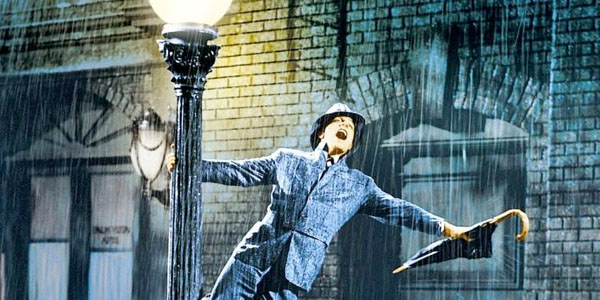 Much like the old nursery rhyme about the little girl who had a little curl right in the middle of her forehead, when a movie musical is good, it is very, very good. But when it is bad, it is horrid. Sgt. Pepper immediately springs to mind in the latter category, of course. There was also Kismet, which found itself unfortunately produced at the extreme tail-end of the Golden Age of the movie musical. South Pacific, Oklahoma! and Carousel were valiant efforts that tended to slack off midway through, and Godspell was the unwilling victim of poor direction. And though Jesus Christ Superstar retains its status as a cult hit, it wasn't difficult to scope out the problems in transferring the stage show to celluloid, plus let's not get started on the tragic messes that were A Little Night Music, Hello, Dolly!, Mame or A Chorus Line. In recent years, such transfers from Broadway to film have included musicals with varying degrees of success, among them Chicago, Nine, and The Phantom of the Opera. There have even been very good original efforts as of late, as in the case of Across the Universe and Moulin Rouge slightly before it, even with adapted music and lyrics. But whatever the era, the simple truth is that there's nothing like a good movie musical. Thus, what follows below is what hopes to be the definitive list of the twenty-five greatest movie musicals of all time, in descending order.
25. Calamity Jane (1953)
 Doris Day spent a good deal of her career trying desperately to shake her good-girl image, to virtually no avail. But she did manage to come close when she accepted the title role in Calamity Jane. Aided by a superb supporting cast headed by Howard Keel and Allyn Ann McLerie, Ms. Day proved an endless delight at all moments as the tomboyish heroine, whether being strung up in a theater shouting "Let me loose!", duetting with Mc Lerie on "A Woman's Touch," or ordering one of her beloved "sasparilley" cocktails at the bar. The delectable score by an uncredited David Buttolph and Howard Jackson didn't hurt either, along with touches by screenwriter James O'Hanlon.
24. Bugsy Malone (1974)
 Director Alan Parker created a novel concept with his movie musical featuring a group of children portraying adults in gangster-age Chicago in the 1920s, offering a score by Paul Williams and starring an unknown Scott Baio and Jodie Foster among others (plus a brilliant cameo performance by British theater veteran Bonnie Langford). There has never been a film like it before or since, and probably never will. And no one can ever forget Foster's brilliant turn as Tallulah, either when singing her nightclub solo at Fat Sam's Speakeasy or barking such commands as "Hey, Fizzy! Would ya cut the ivories and hit the shoe leather?"
23. Yentl (1983)
 By the early 1980s, it was clear that Barbra Streisand was very much her own force of nature; she needed no help from anyone whether performing in a rare concert appearance, acting on screen, writing a song or directing a film. But with Yentl, she was in full flood. Backed by the supporting turns of Mandy Patinkin (in an unfortunate non-singing role) and Amy Irving among others, she created a musical masterpiece adapted from the Isaac Bashevis Singer story, played originally and to tremendous acclaim by Tovah Feldshuh off-Broadway in New York. And Michel Legrand's impeccable score wasn't exactly a slouch, beautifully offsetting the screenplay by Streisand and Jack Rosenthal.
22. Hair (1979)
 "The Little Musical That Could," penned by the tireless combination of Gerome Ragni, James Rado and Galt MacDermot, finally found its way onto the silver screen after twelve years of endless trying. And while it may not have represented everything the show was about or what it was trying to convey during its years both off-Broadway and on, it remains a spectacular viewing experience that never fails to evoke tears of either sadness or joy with every frame of the picture.
21. Bells Are Ringing (1960)
 For all intents and purposes, Judy Holliday was the single greatest embodiment of the superstar since Judy Garland. Not merely an Oscar-winning actress, she proved a superb singer and dancer, and it was only natural for her to reprise the role of switchboard operator Ella Peterson that had won her such acclaim on the Broadway stage. Jule Styne's music and the lyrics of Betty Comden and Adolph Green caressed her and the other cast members (including Dean Martin and an outrageously funny Jean Stapleton) like a velvet glove, and the end result was theatrical ambrosia.
20. Fame (1980)
 It may have simply been a question of the right timing when this film emerged; legions of young people in and out of New York were longing for careers as entertainers or to attend performing arts high schools, and this film completely showed the highs and lows of a showbiz pursuit. And aside from the dynamite score by Michael Gore, who could possibly ever forget the image of Paul McCrane, sitting in the window frame of his apartment high above the Panasonic sign in Times Square, accompanying himself on guitar as he sings "Is It OK If I Call You Mine?"
19. Sweet Charity (1969)
 The Italian film Nights of Cabiria was perhaps the least likely candidate of all time to be transformed into a musical, even with the world-shattering performance of Giulietta Masina in 1957, but when the show took to Broadway in 1966 starring Gwen Verdon it was a total natural. And Shirley MacLaine brough a great deal of heat upon herself for endeavoring to emulate Verdon in the role of Charity Hope Valentine, the dance hall hostess fervently looking for love and only receiving heartbreak at every turn. But the film was an unequivocal winner, aided not only by Sammy Davis Jr's performance as Big Baddy on "Rhythm of Life," but by Bob Fosse's timeless and breathtaking choreography of "The Aloof," "The Heavyweight" and "The Big Finish," set against Cy Coleman's genius score.
18. Seven Brides for Seven Brothers (1954)
 The simple truth is, nobody gave a hope in hell to this film when it was proposed for the big screen. The idea of this most-beloved musical, with Howard Keel as Adam and Jane Powell as Millie, was almost dead before it got off the ground. But it was absolutely impossible not to love each and every frame, up to and unequivocally including Stanley Donen's direction and brilliant terpsichore by the likes of Matt Mattox (sometimes known in the dance world by those who stood behind him as he taught in class as Butt Buttox), Russ Tamblyn, Tommy Rall and Jacques D'Amboise. An early film appearance by Julie Newmar (then Newmeyer) didn't hurt either.
17. Oliver! (1968)
 By the late 1960s, the entire notion of the movie musical was all but forgotten save for a couple of notable recent examples. And though the Broadway show was a qualified hit when it premiered a few years earlier, Lionel Bart had been almost completely dismissed as a legitimate force in theatrical composition of music and lyrics (who, after all, would have stretched the word "where" over five syllables?). Nonetheless, this film proved not only a powerhouse when it emerged but managed to snag the Oscar for Best Picture. And why not? The "Who Will Buy?" sequence remains a feat of cinematic wizardry unto itself.
16. Bye Bye Birdie (1963)
 Where does one begin to describe the glory that was this particular movie musical? It wasn't just the very wise choice of allowing Dick Van Dyke to reprise his role as songwriter and failed chemist Albert Peterson. It wasn't just the selection of Ann-Margret to portray Kim McAfee, the girl kissed by an Elvis-ite character on Ed Sullivan's show. It wasn't even the queenious Paul Lynde, somehow completely believable in the role of a husband and father. It was every single bloody element, highlighted by the score of Lee Adams and Charles Strouse. And it will always remain timeless. Period.
15. All That Jazz (1979)
 Just when the world thought that Bob Fosse couldn't possibly top himself as a storyteller through dance and direction, he took the horrific story of his heart attack and transformed it into a glorious musical that not only won numerous Oscar nominations and other awards, but cemented himself as a legend for all time. There will never be anything, but anything, like the initial audition sequence or watching Leland Palmer, Ann Reinking and Erszebet Foldi making Joe Gideon's life pass before his eyes along with a bevy of fan-dancing vixens. The only thing that might have topped it would have been a musical number by Jessica Lange as the Angel of Death, but it would have been wholeheartedly unnecessary.
14. The King and I (1956)
 No matter how many women have portrayed the role of Anna Leonowens on Broadway or other stages, the simple fact remains that no one was ever born to play the King of Siam quite in the same way as Yul Brynner, and if he hadn't been chosen to play the role on screen it would have been an utter disgrace. Rita Moreno's shattering performance as Tuptim was no slouch either, nor was Carlos Rivera as Lun Tha. The score by Rodgers and Hammerstein was already a hit on every count, but with the film it became a cinematic masterpiece. And Marni Nixon's overdub of Deborah Kerr's vocals took it even further into the stratosphere.
13. Funny Girl (1968)
 When Barbra Streisand left the stage door for the very last time after her performance as Fanny Brice on Broadway, it was hardly a secret that she found herself literally the greatest star on the planet. Thus, it was absolutely unthinkable for anyone else to play the role on the screen (and win a qualified Oscar in a tie with Katharine Hepburn for The Lion in Winter). And while some might argue that the casting of Omar Sharif as Nicky Arnstein was a ghastly choice, the film will always remain one of the most delightful musicals of all time.
12. The Band Wagon (1953)
 Now, who could honestly argue with this? Not only was Vincente Minnelli fiercely in his element when he directed this picture, nor was Alan Jay Lerner's music perfectly offset by the lyrics of Betty Comden and Adolph Green, but to call the casting of Fred Astaire and Cyd Charisse merely "inspired" would be the understatement of the century. There has also never been anything like Astaire, Nanette Fabray and Jack Buchanan rendering "Triplets." And Oscar Levant's portrayal of Lester Marton was simply the icing on a very rich and gooey cake.
11. Victor Victoria (1982)
 Based on the 1933 European film Viktor und Viktoria, this film was very simply a dazzler on every count. Starring Julie Andrews as a woman pretending to be a man pretending to be a woman, with James Garner as her love interest (they'd clearly had practice during The Americanization of Emily) gangster King Marchand, Robert Preston as her flamboyant erstwhile manager Carol "Toddy" Todd, Alex Karras as Marchand's closeted bodyguard and Lesley-Ann Warren in a scene-stealing turn as mollish Norma Cassady, the movie remains as timeless a classic as the day it was first released. And Henry Mancini's sumptuous score only adds to the divinity.
10. Cabaret (1972)
 This film will remain in most Top Ten lists if only for the fact that it was the moment we all sat back and watched Liza Minnelli become a legend before our eyes. It really barely resembles the Broadway show, as much for jettisoning some of the best songs ("So What?" "Meeskite," "Why Should I Wake Up?" "Perfectly Marvelous" and "Don't Tell Mama" among others) as for introducing the homosexual undertone and all but omitting the role of Fraulein Kost, but to call it anything less than delectable would be a disgrace.
9. Mary Poppins (1964)
 This film came with a lot of controversy. First there was the fact that Julie Andrews was selected for the role because of Audrey Hepburn's portrayal of Eliza Doolittle, and the fact that Andrews copped the Oscar. Then there was Disney's option to include both live action and animation, set against a brilliant score by Irwin Kostal. And the argument that the casting of Andrews went completely against the grain of the book by PL Travers and should have been an older, less-conventional actress like Beatrice Lillie. But it remains as fresh a viewing experience to this day as when it was released nearly fifty years ago, and nobody doesn't have a favorite moment that stays with them for all the ages, be it "A Spoonful of Sugar," "Jolly Holiday," "Stay Awake," "Feed the Birds" or "Sister Suffragette" among myriad others.
8. A Star is Born (1954)
 The story of Norman Maine and Vicki Lester is age-old, first as done with Fredric March and Janet Gaynor in 1937, then forty years later with Barbra Streisand and Kris Kristofersson. But nothing has ever beaten the definitive version starring James Mason as the alcoholic Svengali and Judy Garland as his Trilby. All three hours of the film remain a sensational viewing experience, aided and abetted first and foremost by Garland's heaven-sent "Born in a Trunk" sequence, and it is truly shameful that she lost the Oscar that season to Grace Kelly in The Country Girl (even if the next day she was presented with a far greater trophy in the guise of newborn son Joey).
7. The Sound of Music (1965)
 It's truly regrettable that Mary Martin was never really granted the opportunity to shine as a leading lady of film, especially in the musical adaptations she portrayed so brilliantly on Broadway. But nobody could have possibly played Maria von Trapp quite so expertly as Julie Andrews, with Christopher Plummer equally resplendent as the Captain. From the very first moment, revolving in the wind atop the mountain and intoning, "The hills are alive with the sound of music..." it is pointedly clear that the audience in in for a never-ending thrill ride. There are also the marvelous supporting performances of Eleanor Parker, Richard Haydn, Charmia Carr, Peggy Wood and Angela Cartwright with which to contend.
6. West Side Story (1961)
 Stephen Sondheim once contended, "My entire success is based on lyrics I wrote for a big flop." He was referring to this show and the subsequent film. Naturally, nobody agrees. It may well be one of the most succulent viewing experiences ever to be had on the big screen. This tale of star-crossed lovers, based mostly on Romeo and Juliet, unquestionably deserved the 1961 Oscar for Best Picture besides awards for Rita Moreno as Anita and George Chakiris as Bernardo. There simply aren't enough adjectives to describe the glory that is this movie.
5. My Fair Lady (1964)
 Forget Audrey Hepburn as Eliza for a second here. Forget Rex Harrison as Professor Henry Higgins. Forget even Stanley Holloway as Eliza's father, Alfie. Just concentrate for a minute on the never-ending brilliance that was Sir Cecil Beaton's costume design, art direction and production direction, and you have in a nutshell exactly why this was one of the Top Five movie musicals of all time. There has and may very well never will be a moment as electric as when Eliza first emerges in THAT GOWN en route to the ball, or the genius that is the "Ascot Gavotte." No words. 'Nuff said. Oh, but well done, Lerner and Loewe. Fan-freakin'-tastic.
4. The Wizard of Oz (1939)
 It's so hard for so many to watch this movie and realize that it's really the only time we ever got to enjoy a more-or-less unspoiled Judy Garland, even though the studio-imposed pep pills and near-starvation diet were already beginning to take their toll on the goddess-to-be. But it will always remain timeless, as much for Garland's performance and delivery of "Over the Rainbow" as the supporting performances of Ray Bolger, Jack Haley, Bert Lahr, Frank Morgan, Margaret Hamilton, Charles Grapewin, Clara Blandick, Billie Burke and the Singer Midgets. The simple truth is that it's impossible not to love.
3. The Music Man (1962)
 Robert Preston (much like Angela Lansbury just a few years later) faced inevitable obstacles when he emerged on Broadway as a musical star; he was very simply a leading man for the movies and that was that. But nobody else on earth could have done such a miraculous job as Professor Harold Hill in Meredith Willson's masterpiece or become that great a stage star overnight. If anything remains a tragedy about the casting of the film, it was using Shirley Jones as Marian Paroo who, no matter how splendid, could have easily given way for Barbara Cook to become a movie star if it was in the cards. But supporting turns by Pert Kelton, Ronny Howard, Paul Ford, Hermione Gingold, Timmy Everett, Susan Luckey and the barbershop quartet the Buffalo Bills only add to the magic.
2. Singin' in the Rain (1952)
If you strip away all of the musical numbers of this film, headlined by Gene Kelly, Donald O'Connor and Debbie Reynolds, basically you're left with a ridiculous script about a failed attempt at making talking pictures. But that's exactly why it's the second-greatest movie musical of all time and still evokes a flood of tears besides copious laughter and delight. It's literally brilliant in spite of itself, and aided all the more by a genius dance turn by Cyd Charisse, not to mention Rita Moreno as Zelda Zanders.
1. South Park: Bigger, Longer and Uncut (1999)
 When this film was released, Sondheim actually sent a note to creators Trey Parker and Matt Stone, saying, "Congratulations. You have literally created the single greatest movie musical in cinematic history." To which Parker wrote back and said, "Thanks so much. You've written one or two pretty good ones yourself." Some may argue, but there's nary anyone who attended a screening of this film who can debate whether such songs as "Quiet Mountain Town," "Shut Your F*cking Face, Uncle Fucker," "Blame Canada," "Up There," "I Can Change," "I'm Super, Thanks for Asking," and "Tomorrow Night" aren't utterly impeccable. So, there you have it. The best of the best, in just one reviewer's opinion. Feel free to argue, if you can.