25 Definitively Best Movies EVER (According To Critics AND Fans)
15. Citizen Kane (1941)

Score: 92
For a long time, Citizen Kane was basically considered the greatest movie of all time, which is a stunning achievement by any rights, but for it to come from a first-time film-maker who also wrote, produced and starred in it is simply phenomenal. But then they don't make them like Orson Welles any more either.
Kane is everything you'd want to see from a truly great film: the story (based on the lives of William Randolph Hearst and Joseph Pulitzer - with the former characteristically reacting VERY badly to it) is compelling, Welles is mesmerising as Kane and everything from a technical point of view (particularly the cinematography) is brilliant.
Despite the fact that it was made more than 70 years ago, in the Trump age, it's still remarkably pertinent.
Rotten Tomatoes: 100 Audience: 90 IMDB: 84 Letterboxd: 86 Metascore: 100
14. All About Eve (1950)

Score: 92
In the same way that Hollywood proves its love for itself with the adulation for Sunset Boulevard, the critical adoration of Joseph L. Mankiewicz's All About Eve is very much about tinseltown unflinchingly holding up a mirror to itself. Curiously, it's often the grotesque and the tragic elements that the industry is most fascinated with - the idea of crushed dreams, discarded icons and people left behind or trampled on.
All About Eve is about all of that plus the immortal humanist fear of mortality and redundancy. It's about being replaced by someone keener, younger, more attractive and the cycical nature of that anxiety. It's essentially the same story as Toy Story, only with more malice on the part of the Buzz Lightyear-like replacement, more of an acerbic edge to the dark comedy and slightly more maturity. The story is remarkably compelling though and that's what makes it endure so long after its release.
Rotten Tomatoes: 100 Audience: 94 IMDB: 83 Letterboxd: 85 Metascore: 98
13. The Good, The Bad And The Ugly (1966)

Score: 92
Is this the most famous Western of all time? There is no Western genre without the image of Clint Eastwood in a poncho, scowling into the high noon sun with a cigar practically buried into the corner of his mouth.
Everything about The Good, The Bad And The Ugly is what fans will conjure up as the visual vernacular of the genre: that's how influential a piece it was and how beloved it became. The other films in Sergio Leone's trilogy are great too, of course, but this felt like the culmination, not only of a triumvirate of films but also of an entire wider body of work and it says a lot that Eastwood's career is so stories and yet this remains one of the most enduring images of the entire thing.
The visuals are stunning, the characters iconic and the swagger deeply, deeply intoxicating.
Rotten Tomatoes: 97 Audience: 97 IMDB: 89 Letterboxd: 88 Metascore: 90
12. Pulp Fiction (1994)

Score: 92
There are some who will tell you that Quentin Tarantino is not fit to stand shoulder-to-shoulder with the greatest directors of all time - that he's too much of a magpie and too much of a provocateur to really qualify. Such accusations miss the fact that the same could be said of Steven Spielberg or Alfred Hitchcock: great film-makers make you feel and they tend to know a thing or two about borrowing from other art.
And for anyone who doesn't believe in his ability as a story-teller, go and watch Jackie Brown, Reservoir Dogs and, in particular, Pulp Fiction and eat your words. The latter is an exhilarating exercise in character-building and story-telling, weaving an a-linear narrative that somehow makes heroes out of grotesques and monster and which single-handedly catapulted John Travolta back into the realms of cool. Plus, it made Samuel L Jackson the badass icon he's been known as since.
Rotten Tomatoes: 94 Audience: 96 IMDB: 89 Letterboxd: 88 Metascore: 94
11. Modern Times (1936)
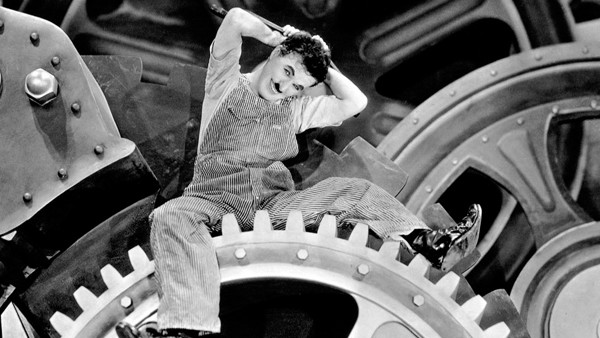
Score: 92
There's probably some temptation to believe that Charlie Chaplin's Modern Times makes this list because of its perceived historial importance (and that of Chaplin himself as a film icon), rather than based on pure merit. The fact that the film's Letterboxd and IMDB scores (two primarily driven by fans) are slightly lower than the others suggests further that there may be an element of that, but Modern Times is undoubtedly a cinematic great.
WIdely acknowledged as the best of Chaplin's career, Modern Times is often most-known for the insane sequence that sees Chaplin's Little Tramp riding cogs in a giant factory machine, but it's so much more than a single stunt. It's one of his most overly politically charged movies, it's funny and charming and it's inventive. In a time defined by technological over-reaching, it's also still entirely pertinent as an anxiety piece on modernism.
Rotten Tomatoes: 100 Audience: 95 IMDB: 85 Letterboxd: 85 Metascore: 96
10. Spirited Away (2001)

Score: 93
Spirited Away is arguably Studio Ghibli's most famous film, not least because it won an Oscar, but whether it's actually the studio's best is another matter and a serious point of contention. It's definitely up there and the Oscar recognition was definitely fitting as acknowledgement for the entire body of work, but some fans would say there were more fitting winners.
That said, though, Spirited Away is still among the most important animations ever released and it deserves praise for making the Ghibli catalogue more accessible to possible future fans. It's basically a collation of all of Miyazaki's key ideas too, which makes it even more of an access point - it takes in environmentalism, the power of imagination, a young vulnerable protagonist who finds strength and traditional Japanese mythology.
It's also dark, weird and hauntingly beautiful, which is why it unifies fans and critics in their praise.
Rotten Tomatoes: 97 Audience: 96 IMDB: 86 Letterboxd: 88 Metascore: 96
9. The Godfather: Part II (1974)

Score: 93
In what must go down as the biggest shock on this new form of ranking, The Godfather Part II is not classed the best of the trilogy. For some reason, the critics on Metacritic dragged it down slightly and Letterboxd fans seem to have railed a little against the popularity of the movie (it happens).
Whether you agree with it coming only 9th here, there's no denying that Al Pacino's portrait of Michael Corleone is a stunning achievement - matched only by Robert DeNiro playing the youthful version of his father as their stories run concurrently. And the film definitely stands as one of the single greatest sequels of all time: the story is more tense, the characters have evolved and everything feels like it's escalated.
Rotten Tomatoes: 97 Audience: 97 IMDB: 90 Letterboxd: 90 Metascore: 90
8. Singin' In The Rain (1952)

Score: 93
There may be more famous musicals out there, but there probably isn't a more famous single dance sequence in all of film history than the delightful, infectious street dance scene from Singin' In The Rain.
There are few films that endure to this level of popularity that are such an obvious counterpoint to the modern way of making films (La La Land aside, obviously). Gene Kelly's charming, breezy musical is another of Hollywood's favourite films about Hollywood, again turning a mirror on a darker side of the industry (though in no way as satirically as some of the others).
There is no venom here and while the musical elements tend to elevate it in memory, it's actually a tecnically brilliant, whip-smart romantic tale of personal triumph in the face of adveristy. And who doesn't love that?
Rotten Tomatoes: 100 Audience: 95 IMDB: 83 Letterboxd: 86 Metascore: 99
7. Schindler's List (1993)

Score: 93
Schindler's List isn't an easy film to watch and nor is it particularly easy to love as a story, but it is easily one of Steven Spielberg's best-made movies. To think that the king of entertaining blockbusters could make something this jarring compared to his "lighter" fare is even more impressive, but the director simply employs all of his astute film-making observations to a different, non-fantastical world and achieves brilliant results.
Liam Neeson is great as tortured industrialist Oskar Schindler and there's great, humanist support from Ben Kingsley, but the stand-out performance is from Voldemort-in-training Ralph Fiennes as Amon Goth, the terrifying, sadistic Nazi commandant of the work camp. His is the kind of performance that burrows itself under your nails and irritates and disgusts.
It's obviously an important movie in historical terms (which always appeals to critics), but if it weren't so well made and compelling it absolutely wouldn't be as cherished as it is.
Rotten Tomatoes: 97 Audience: 97 IMDB: 89 Letterboxd: 87 Metascore: 93
6. Casablanca (1942)

Score: 93
As already qualified, Michael Curtiz's Casablanca is one of those films that exists almost outside of the usual rankings of films, such is its universally accepted importance and quality. That can means it gets over-looked for flashier, newer films, but ignorance of this glorious war story is a major disservice.
Fans are less enthusiastic about it when compared to critics, but there's no question of the film's intoxicating blend of pathos, humour and smart writing. It's a less cynical film than would have been made in the decades following its release and it's a curious release to come out during World War II, but it's so eminently quotable (and impressively MISquotable) because of its enduring quality, which is underpinned massively by Humphrey Bogart's powerhouse performance.
Sure, it's a little saccarine in its romantic, but since when's that always a problem?
Rotten Tomatoes: 97 Audience: 95 IMDB: 85 Letterboxd: 86 Metascore: 100