20 Things You Probably Missed In Speed
Speed is a far smarter movie than it gets credit for.

1994's Speed is inarguably one of the most iconic, exciting, and impressively crafted action films of its era.
With the firm directorial hand of cinematographer-turned-filmmaker Jan de Bont, a killer acting trio in Keanu Reeves, Sandra Bullock, and Dennis Hopper, and an all-timer concept, Speed really does have it all.
Yet the efficiency of its bomb-on-bus premise might fool some into believing that Speed is a mere surface-level film, where what you see is exactly what you get.
But that's far from the truth - Speed is awash in blink-and-you'll-miss-it moments which show how deceptively smart it truly is, both as a piece of storytelling and a work of stunning technical filmmaking.
If you're much of an action fan, you've probably seen Speed innumerable times over the last near-30 years, but as this piece will confirm, there's still so much left to be uncovered.
By the end of this list, you should have a newfound appreciation for the mind-boggling effort that went into executing the high-octane action, while also delivering a satisfying story with memorable characters.
Above all else, you'll never quite watch Speed the same way again, and mostly for the better...
20. The Elevator Shaft In The Opening Titles Is A Miniature

Who can forget the movie's iconic opening titles, where we travel down a soon-to-be-tampered-with elevator shaft while Mark Mancina's pulse-racing musical score blares out?
Though you'd be forgiven for assuming that director Jan de Bont just... did it for real, by rigging up a camera and passing it down the elevator shaft, this actually wasn't the case at all.
The sequence was achieved with use of elaborate miniatures: de Bont had the production build a 35-foot miniature of the shaft, which was then laid horizontally as the camera dollied along it.
This is especially impressive considering that the shot ends with the camera dollying away from the shaft towards the maintenance entrance, which is presumably also part of the miniature.
De Bont is a huge fan of practical filmmaking wherever possible, so it certainly follows that he'd rather "go miniature" than resort to CGI if it wasn't possible to use a real elevator shaft.
19. The Bus Number Is "2525" (As In, 25 + 25 = 50)

This one's so simple it flies clean over the heads of most viewers. Though we see a lot of overhead glimpses of the Santa Monica bus' roof and general exterior, it's easy to miss that the bus bears the designation "2525."
As in, 25 + 25 = 50. As in, 50 miles per hour, the speed after which the bomb on the bus becomes armed. Get it?
Now, it's certainly possible that this was a mere coincidence, but it would indeed have to be quite the bout of luck considering the immaculate attention-to-detail employed by de Bont in basically every aspect of the film's production.
18. The Opening Sequence Was Filmed At "Nakatomi Plaza"

If the opening skyscraper in which the elevator is rigged to blow looks a little familiar to you, that's because it's the Fox Plaza, which at the time was the home of 20th Century Fox, the studio behind the film.
This wasn't the only film that the high-rise appeared in, though: it was most famously used as the Nakatomi Plaza in Die Hard, another film produced by Fox.
Keep your eyes peeled during Speed's opening sequence and you'll notice that the lobby and one of the building's floors are the same, architecturally-speaking, as the Nakatomi Plaza - because, of course, they were shot in the same skyscraper.
17. Jack's Watch Is Actually In Alarm Mode

After the first bus is blown up in the first act, hero Jack Traven (Keanu Reeves) speaks to bomber Howard Payne (Dennis Hopper) on a pay phone, who informs him of the second bus, and that he wants his $3.7 million by 11am.
Jack then looks at his watch which displays 8:05am, or so it seems.
Look a little closer, though, and you'll see that Jack's watch is actually set to alarm mode, presumably because nobody could be bothered to adjust the actual time of the watch, and "AL" looks a lot like "AM" to the fleeting observer anyway.
It's a classic "nobody will ever notice" mistake, but the Internet being the Internet, of course they did.
16. The Secret Meaning Of Jack's License Plate

Here's one for anyone that speaks Hindi, but will be totally lost on everybody else.
When Jack gets in his Ford Bronco and attempts to chase down the endangered bus, note that his license plate reads "646 TEZ."
Curiously, "tez" is also the Hindi word for "quick," or doing something with great speed, which in addition to being the movie's title is of course a perfect description of what Jack is doing in that very moment as he attempts to track the bus.
No word on why this rather left-field bit of wordplay made it into the film, but a cool find nonetheless.
15. The Bus Poster Foreshadows Payne's Motivations

Beyond the number of the bus being 2525, take a look at the fake poster for Santa Monica Bank on the back, which includes the slogan, "Money isn't everything (yeah, right)."
This clearly isn't random, and perfectly encapsulates Howard Payne's own motivations in a simple tagline.
Payne makes it clear later in the film that his only desired outcome from his terrorist attack is to be paid millions in cash money, and this poster accurately reflects that worldview.
For an added bit of fun, a different Santa Monica Bank ad appears on the back of the first bus that blows up, which reads, "Save the clams."
14. There Are Visible "Hidden" Cameras Throughout The Film

Jan de Bont has held his hands up and confessed that keen-eyed viewers will be able to spot many visible cameras hidden throughout the movie if they slow down or pause many of the film's shots.
For instance, in the intense sequence where Annie (Sandra Bullock) has to make an incredibly tight, uneasy right turn, watch as the bus slams into a police car and you'll be able to see a hidden camera attached to the side of the bus capturing the action.
According to the director, he ended up hiding cameras wherever he could - most often on other vehicles - to provide maximum coverage as they were sometimes only able to capture a single take of a hair-raising stunt.
Due to this, if you pay close attention you can frequently see cameramen visible, whether reflected in the bus' windows or not-so-subtly hidden amid the background chaos.
13. Jack Breaking The Bus Door Was Accidental

You'll probably remember that Jack actually breaks the glass door on the bus when he forcefully attempts to board it near the start of the movie, and as natural as this might seem, it was actually a total accident.
Reeves simply ended up hitting the glass too hard and in turn fractured it, but de Bont liked it enough that he ended up keeping it in the final film.
This does result in a few continuity errors throughout the rest of the movie, where the broken glass appears and re-appears due to some later scenes being shot prior to the accident.
Still, it's a cool moment that emphasises both Jack's desperation to get on the bus and also his general hot-headedness.
12. Why Payne Holds His Phone To His Left Ear

One of Howard Payne's more bizarre character quirks is his tendency to awkwardly hold his phone to his left ear with his right hand.
The reason for this is actually quite simple, but easily overlooked. We know that Payne lost a thumb on his left hand during his years on the bomb squad, and it's not much of a leap to assume that the accident also caused him to lose some of his hearing.
If he's holding the phone to his left ear, it's highly probable that he lost some if not all of his hearing in his right ear, and so being a right-handed person, naturally deferred to passing the phone over to his left ear.
This feels like something an acting lion like Hopper would've come up with by himself, but that's pure speculation.
11. The Meaning Of That "Really Big Pinto" Joke

Once Jack gets on the bus and Annie takes over driving, he asks her if she can handle the task, to which she replies, "Sure. It's like driving a really big Pinto."
This one-liner is basically lost on anyone who isn't a car enthusiast or was still a child when Speed came out.
Annie was actually referring to the Ford Pinto, which throughout its production run in the 1970s was infamous for a fuel-tank design which caused explosions during collisions and even led to major lawsuits.
Though Ford was ultimately cleared of any wrongdoing, the Pinto's reputation was irreparably tarnished, leaving it to be made fun of forever more in scenes such as this.
10. The Picture On Harry's Desk Is Of The Director's Wife
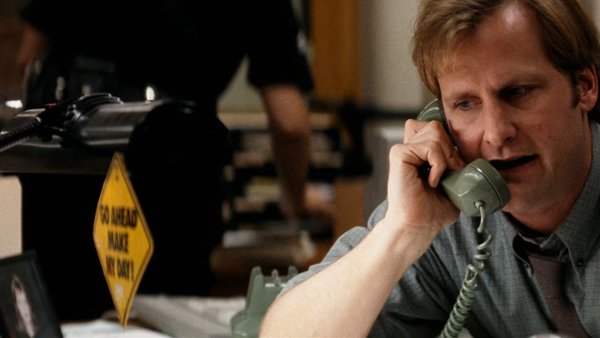
Here's a moment that, unless you follow the personal life of director Jan de Bont, you're admittedly never going to catch.
Mid-way through the movie when Harry (Jeff Daniels) is helping Jack with the bomb, we briefly glimpse a photo of a woman on Harry's desk, who is presumably his wife.
Except, the woman in question is in fact Trish Reeves, de Bont's own real-life wife.
Again, there's no real reason why anyone watching would know that, but it's pretty cute that de Bont paid tribute to his wife in the film in such a sly, subtle way.
9. There Are CGI Birds In One Shot

Without question the single most outlandish moment in the entire film involves Jack and Annie driving the bus over a gap in the freeway.
It's no secret that this was actually achieved on a completed freeway and the gap was then created digitally during post-production, but what you might've missed was the other sneaky VFX element in the scene.
As the bus approaches the gap, a flock of birds can be seen flying through it, which were also digital effects, inserted into the scene to help sell the fact that there really was a broken space in the freeway.
Considering the shot still holds up extremely well almost 30 years later, it's most certainly a job well done.
8. The Bus Footage Is Often Sped Up To Make It Look Faster

A film called Speed of course needs to depict full-throttle, balls-to-the-wall acceleration in a major way - though tell that to the sequel, Cruise Control - and so de Bont and his filmmaking team employed some deceptively simple editing tricks to do so.
The bus is frequently sped up throughout the film to make it seem like it's moving faster than was logistically possible during the shoot.
Every so often this is actually noticeable, perhaps most prominently just as the bus is approaching the freeway gap and the police escort begins to pull away.
Keep an eye on the people hanging off the back of the escort - they're moving in unnatural, jerky ways which make it clear they've been significantly sped up.
7. The Visible Tow Cables Pulling The Bus Towards The Plane

Keep your eyes peeled during the awesome climactic explosion where the evacuated bus collides with a freight plane, because all throughout the sequence you can see hints at how the jaw-dropping sequence was pulled off.
Basically, there are tow cables all over the floor during the scene, and this is because the only way to safely collide the two objects for real was to tow them towards one another with mechanical precision.
Despite the fact that the cables could've been painted out during post-production, it seemingly wasn't deemed noticeable enough to be worth the hassle.
Considering that 99.5% people have never even got close to noticing it, that's fair enough.
6. You Can See Payne's Police Uniform In The Background

This is a really good one. Throughout the film we keep cutting back to Payne as he monitors the situation from his criminal hideout, and in the second half of the film we capture a brief glimpse of what appears to be a police uniform on a mannequin behind him.
This is clearly foreshadowing the next phase of Payne's plan, that he will pose as a police officer to collect the ransom and, as it turns out, also kidnap Annie.
Speed may not be a particularly subtle film - and who would have it any other way? - but this is still a pretty neat wink at repeat viewers all the same.
5. It Features The Same Fake Courier Company As Die Hard

We've already explained how the bus-plane collision at the end was achieved, but this scene also contains the film's other amusing link to Die Hard.
The brand of the destroyed plane is "Pacific Courier Freight," which is a fake shipping company also featured in Die Hard, as appears on the side of the main vehicle used by the terrorists.
This is likely the result of two things: firstly, de Bont was himself the cinematographer of Die Hard, and production designer Jackson De Govia also worked on both films.
Naturally, this has prompted some to theorise that the two films exist within the same shared universe, a fact exacerbated by Die Hard with a Vengeance featuring another similarly-monikered vehicle for "Atlantic Courier."

4. Payne Secretly Quotes A Tom Lehrer Song

When Payne reveals to Jack that he's kidnapped Annie and fitted her with an explosive vest, he quizzically quips to Jack, "Be prepared, that's the Boy Scouts' marching song."
Younger viewers in particular might've reasonably assumed that Payne was directly quoting a mantra from the Boy Scouts, but he's actually secretly quoting something else entirely.
Payne's in fact quoting the 1953 Tom Lehrer song "Be Prepared," which begins with the very same lyric, "Be prepared, that's the Boy Scouts' marching song."
The meaning in this context is more or less the same - that Payne had a back-up plan - but the fact that he's slyly referencing a 1950s song rather than a generic Boy Scout refrain is a very era-specific reference relevant to Payne's approximate age.
3. Payne's Nametag Has His Character's Original Name, Fisk

Look closely at Payne's uniform near the end of the film and you might notice that his nametag reads "Fisk."
It's totally understandable that Payne would go by an alias when attempting to recover the ransom money, though curiously enough, his character's original scripted name was indeed Howard Fisk.
It isn't known why the name was changed and whether the nametag is a cute reference to the change or simply due to the nametag having already been created by the prop department before the change.
Considering this is quite possibly supposed to be Payne's own police uniform, it's perhaps more likely that the nametag simply wasn't changed to read "Payne" and the filmmakers knew audiences would just assume that Fisk was an alias. Either way, it works.
2. The Train Is Actually A Bus At The End

Speed's spectacular - if slightly tacked on - ending sees Jack and Annie bracing for dear life as their hijacked subway train derails at street level, though ends up leaving them miraculously unharmed.
The moment the train derails and crashes atop Hollywood Boulevard, we're not actually looking at a train but in fact a bus that's been dressed up to look like one.
Though miniatures were used for portions of the scene, any time the train is practically moving along the street, it's really a disguised bus. If you look closely at the wheels, you'll see that they're actually tyres.
1. The Visible Camera Track In The End Credits

In addition to all the cameras and crew members visible throughout the film, a particularly glaring error is noticeable during the end credits - in fact, it might be the most ridiculous of the lot.
As de Bont pans out to survey the carnage of the train derailment, look to the left of the screen and you'll be able to make out what's blatantly a camera dolly track on the floor, with presumably a crew member standing beside it.
It's a little mystifying, then, that the final sequence doesn't feature any major dolly shots, though this may simply have been another case of de Bont only having one attempt to capture the derailment stunt and not wanting to miss a thing.