15 Blunders That Ruined J.J Abrams' Star Trek And Destroyed The Franchise
Star Trek was more than just catchphrases, warp spreed and firing phasers...
 Star Trek turned 46 this month and the legacy of the show has grown to include 11 movies and a further 4 television series'. After the Original Series got canceled in 1969 after only three seasons, the show became extremely popular in syndication. In 1979 Star Trek The Motion Picture was released to capitalize on the success of Star Wars. Even though the film was a financial success, it failed to impress critics but the subsequent sequel by Nicholas Meyer with Star Trek II: The Wrath Of Khan showed audiences that Star Trek could be a success in the cinema as well as on TV. The show's popularity peaked with Star Trek The Next Generation, Deep Space Nine and Voyager with all shows lasting seven seasons. The follow-up prequel series Enterprise was deemed a failure and the show got canceled after only four seasons, sadly just as the show's quality was starting to pick up. Combined with Star Trek: Nemesis bombing at the box office, the Star Trek franchise was put to bed, suffering from a severe case of overkill. After a break of 4 years, JJ Abrams gave the world a new Star Trek, and not just a new Star Trek but also a new set of actors playing Kirk, Spock and the rest of the iconic original crew. Gone was the techonbable, morality tales about what makes us human and canon. In its place we got ACTION, cheesy nostalgic one liners and a wafer thin plot, in other words, a movie for the modern casual audience. Star Trek had fallen into the trap of only pleasing its core group of Star Trek fans, even though that audience was huge, Paramount wanted to bring in the casual audience movie-goer who doesn't want to see a film with a heavy plot, references to science and belonging to a franchise that is considered very nerdy. So Abrams, being a life long fan of Star Wars, Star Warsified Star Trek and engaged the casual audience like no other Star Trek film had done before. It made $350 million at the box office and critics loved it. Anticipation is high for the sequel, Star Trek Into Darkness that is set for release next year. But stuck in the whirlwind of hype that surrounded J.J Abrams' Star Trek was a core set of old school Star Trek fans who objected to the liberties Abrams took with the universe they had invested so much time, love and money into for most of their lives. They didn't like the dumbing down, the odd looking Enterprise, nonsensical science and the rubbish plot. It is easy to ignore them and say that they are just butthurt Star Trek nerds who would never be happy unless they saw William Shatner put on the Starfleet uniform again and take his place in the captain's chair, but that is a lazy and dismissive response to some very valid points. There are a lot of flaws with Star Trek and the biggest being that the franchise has been pushed into a more generic action fare and gone (possibly forever) is all the things that made Star Trek unique. Star Trek was more than just catchphrases, warp spreed and firing phasers, it was character driven story telling that had a human heart and no matter how fantastical the setting, you could always relate it to something much more closer to home. That is why these fans wait to see if Star Trek Into Darkness has more of what made pre-Abrams Star Trek so engaging for them or have they been pushed aside for the casual audience member and his/her box office ticket. So in hope that Star Trek Into Darkness is a much more worthy movie for the Star Trek franchise now that the writers have not got to deal with the difficult, rebooting first movie, here are 15 blunders that ruined JJ Abrams 2009 Star Trek movie and possibly the franchise forever.
15. Supernova Nonsense
 The events in Abrams' Star Trek all stem from a supernova that destroyed Romulus, killing Nero's family in the process. Tragic but an avoidable disaster if common sense was used. Why was Romulus not evacuated when it was discovered that the Hobus star is about to go nova? Even as a simple precaution it would have probably been a good idea, it's not like the Romulans don't have enough ships to do it. According to the official prequel comic ''Countdown,'' the Romulans refused to believe that Romulus was in danger and rejected Spock's plan to use Red Matter to create an artificial black hole to absorb the supernova. Could they not check to see if the Hobus star was really a threat? We can examine light from a star now and work out if it is reaching the end of its life, so you would expect the Romulans to be able to perform a simple scan to evaluate the danger. Instead it is left to Nero, Spock and the Enterprise to make the Red Matter and try to save Romulus. Like I said, this was all in the prequel comic that gave the origin story of why Nero was so angry and obsessed with Spock. Unfortunately the story is by Roberto Orci & Alex Kurtzman who also wrote the movie so that is why none of the science or plot in general makes much sense. Also, the Hobus star is 500 light years away from Romulus so that means it takes light 500 years to travel that distance. We also know that nothing natural can go faster than the speed of light so it would mean that the Romulans have at least 500 years to evacuate the planet. But somehow the supernova managed to break that law of nature and destroy Romulus quite quickly. For a series that has always tried to keep its science believable, this was too much science-nonsense to allow Orci & Kurtzman a free pass. You lose all the audience members who have a basic understanding of science when they have to stop and ask ''how exactly does a supernova threaten a galaxy?'' like Spock said it did, in the same way Kirk had to stop and ask ''What does God need with a starship?''
14. Emo Nero, Let It Go!
 Nero ranted to Pike in Star Trek that the Federation didn't help Romulus when they knew of its impending doom. But we already know from the Countdown comic that Spock helped to make the Red Matter, Geordi LaForge constructed the Jellyfish starship that Spock used to deliver the Red Matter and the Enterprise took Nero to Vulcan when his own ship was under attack. As far as I know, the Enterprise, LaForge and Spock are all members of the Federation, therefore the Federation did try to help. They did a lot more than his own government did, shouldn't he be more angry with them? The Federation can only do so much but they went out of their way to help while the Romulan Senate pretended nothing was wrong. So instead of hatin' on everybody, Nero should take a deep breath and realise who really let him down, he had 25 years to work all of this out so there is no excuse. And why is he torturing Pike to get the subspace frequencies for Starfleet's border protection grids? Considering he's from the future and those codes are 150 years old, he should have them in his ship's computer, we've seen this a number of times in Star Trek. Also, Nero states he wants to destroy every planet in the Federation, that's over 1000 planets so he better get a move on. Another thing is that Nero waited 25 years for Spock to appear so that he could teach him a lesson by making him watch Vulcan be destroyed. I've been annoyed in the past and can understand that somethings do take a long time to get over, especially losing your wife and child to a nonsensical supernova explosion. But why did Nero not use this time to warn the Romulans in the past that the Hobus star goes nova and destroys Romulus? If you are going to refer me to the deleted scene where Nero is captured by the Klingons and taken to the prison planet Rura Penthe as an explanation for how he spent the 25 year wait, then that raises even more questions. In Star Trek VI: The Undiscovered Country, we learned that Rura Penthe is surrounded by a shield that prevents beaming, so how did Nero get off the planet? Was Nero's ship in orbit all that time? Did the Klingons not want to tear it apart and examine the advanced technology from the future? And why did they wait 25 years to start interrogating Nero? So many questions and so many no answers!
13. Fancy a Beer...In Space?
 This one has been said a few times so I'll try and not go over too much ground that has already been covered but it is a major blunder and has to be pointed out. Having rewatched the film only yesterday, I still can't understand the decision to make the Engine Room look like a steamship boiler room. The Engine Room on a starship may have ''engine'' in the name but it's not an ''engine'' like we have today. It is the room where the warp core is kept and looked after. The warp core is a a sleek, self contained piece of technology that is controlled by various computer terminals, in the same way everything on the Bridge is. Therefore, god knows what all the valves, silos and water filtration systems were for? Not only did it fail to give the ship a key space that has been part of every Star Trek incarnation since the Original Series, it also was another distraction that made no logical sense. I understand that when it came to brainstorming ideas for the Engine Room, some bright spark must have said ''steamships in space'' and away they went, but what is the point of making the Bridge look like a Steve Jobs wet dream and then juxtapose that with an Engine Room that belongs on the Titanic? Fingers crossed they fix this!
12. Rebel Without A Point
 One of the most annoying sequences in the film is young Kirk driving over a cliff in the car. It appears that after Kirk's father was killed, his mother shacked up in Iowa with a scumbag who eventually became his stepfather. To hammer home the fact that he has a rebellious streak that may be down to his less than ideal home situation, young Kirk steals his step dads 1965 Corvette and takes it on a joyride over a cliff. The reason this scene is annoying is mainly down to two things. The first is the blatant Nokia advertising thanks to the large logo on the in-car telephone. Product placements in movies are nothing new but this one sticks out like a sore thumb. In the same way you would not expect to see ''Lockheed Martin'' on the side of the Prometheus or a Coke machine in Braveheart, you don't expect to see branded products in the Star Trek universe where we know society has moved on from Capitalism. It wasn't the only example of product placement, with Budweiser making an appearance in the scene where Uhura appears to show us that she is a binge drinker by ordering 5 drinks all for herself. There have been other product placements in Star Trek movies before, most notably for Apple and Yellow Pages in Star Trek IV: The Voyage Home, but in that film the crew had traveled back to the 1980's so it was a good contrast to the world they had come from, so you can understand and forgive. In J.J Abrams' Star Trek, it was just another slap in the face to show the new Star Trek is not beyond being a sparking billboard for big companies to advertise. It's hard to get absorbed in a new positive future if you are being reminded of the same overly commercialized world that you live in. The second reason this scene is annoying is due to the Beastie Boys track Sabotage that Kirk decides is the best musical accompaniment for his joyride. Just like Nokia, this also sticks out like a sore thumb. Not only because you wonder why a child in the 23rd century would choose to listen to the Beastie Boys but much like the rest of this scene, when did it seem like a good idea to include it. Some have speculated that it might be a little nod to Shatner's infamous ability to mispronounce ''Sabotage'' as ''Sabotaaage'' but I doubt that is what the writers intended. The main priority was to show us that Kirk as a child was a cocky rebel who could steel a car and drive it over a cliff while listening to rebellious hip-hop, but what sounded good to Abrams, Orci and Kurtzman around the dinner table, had many people rolling their eyes in the cinema. And Iowa is pretty much a flat farming state with no deep canyons so the writers explanation that the huge hole in the ground is in fact a quarry of some kind, just highlights how much thought the writers put into the little details that make a quality script.
11. Pointless Destiny!
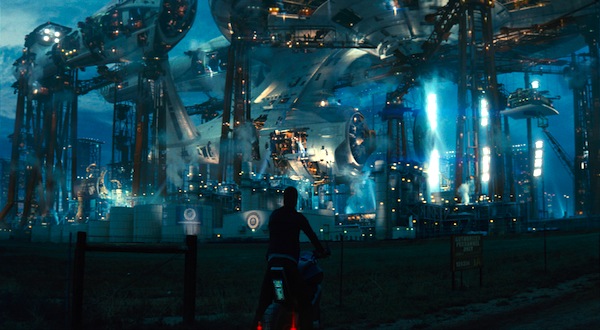 During the initial attack on the Kelvin, apart from it giving us a dramatic but ultimately unnecessary birth of James T. Kirk in space, why didn't Nero just destroy the Kelvin instead of letting it be rammed into his ship. He had no problem wiping out the far more advanced ships that confronted him around Vulcan so why did this one ship cause him so many problems. Not only did he risk a very up-close-and-personal warp core explosion but he also let all the escape pods get away. Don't get me wrong, this is probably one of the best scenes in the film but again it gets ruined by incoherent planning and eagerness to be dramatic and epic when restraint can get your villain over far more effectively. Look at the way Khan is introduced in Star Trek II, Commander Kruge in Star Trek III and even V'ger in The Motion Picture. Khan had very threatening reveal in Star Trek II with the way he slowly removed his head dress and then put the eels into the ears of Chekov and Captain Terrell. Commander Kruge got the Genesis information he wanted in Star Trek III and destroyed the ship that brought him the stolen intel and in The Motion Picture, V'ger wiped out three Klingon battle cruisers with very little effort. The point is that all these antagonists are far more memorable than Nero and each one was introduced to us with enough menace to show us that they are not to be underestimated.
 Nero on the other hand had to stab the Captain of the Kelvin, cripple the Kelvin and inadvertently be responsible for the death of Kirk's father. Kirk had no reason to be born in the midst of this battle, it's not like that it affected the story in any major way. Nero had many reasons to be hated with blowing up Vulcan being the primary one so also being the reason why Kirk grew up without his father was unnecessary. It was just trying to be epic for the sake of being epic, it didn't enhance Kirk or Nero in anyway, it didn't link the two characters in a unique way so it just made the whole exercise pointless. It also made you scratch your head in the climax when Nero appears to know that he killed Kirk's father during that confrontation with the Kelvin, how does he know Kirk's father was on the Kelvin? And if the purpose of this scene was so that Kirk could recognize the ''lightning storm in space'' that was the signature of Nero's ship, then you have to ask why would Kirk remember a detail like that and link it to Nero? It's not like that electrical disturbances are rare in space. And Captain Pike already told us that he was an officer on the Kelvin during the attack, so does it not make more sense that he would make the link to Nero? Weaving characters destiny's together to give a film more substance than it has, does not work. If anything it is now a cliche to employ storylines like this. One of the weakest points about Tim Burtons's Batman was the decision to have Joker kill Bruce's parents and link him to Batman, you watch that now and you wish that element was not there because it's been done so many times. To see it in Star Trek had me shaking my head, we know Kirk was born in Iowa, why couldn't they just leave it like that? Another dumb destiny moment is Kirk looking up at the Enterprise that is being built conveniently in a cornfield in Iowa that is within driving distance. Again it's Abrams, Orci & Kurtzman tieing everyting together, all relationships have to be linked by fate. CLICHE!
10. Kobayashi Moron Test
 The Kobayashi Maru Scenario is a Starfleet test for cadets who are being tracked for command. You are put in charge of a ship that has to rescue the civilian freighter Kobayashi Maru that is stuck in the Neutral Zone. When you go to its aid, you are confronted by three Klingon Battlecruisers and that is where the 'no win' part of the test kicks in. It is impossible to rescue the Kobayashi Maru, fight the Klingons and escape from the Neutral Zone, you have to choose what you think is the best course of action and your command ability is evaluated. Kirk famously stated in The Wrath Of Khan that he was the only cadet to ever beat the no win scenario. He reprogrammed the simulation so that it was possible to rescue the Kobayashi Maru and he got a commendation for original thinking. Some fans at the time objected to Kirk cheating but Wrath Of Khan director Nicholas Meyer said ''it revealed an aspect of Kirk's character and that the film, or Kirk, shouldn't be restricted by "television mentality." In other words, Kirk as a character isn't diminished by the fact that he cheated, if anything it showed why Kirk is such a good starship captain due to the fact that he cant accept that there is such a thing as the no win scenario. No matter what he has to do, he will find a way to solve a problem. So fast forward to Abrams' Star Trek and it was a foregone conclusion that the film will include this famous piece of Star Trek lore. But instead of making it a pivitol moment that you will remember, the scene was written like it belongs in a crap teen comedy. Kirk reprograms the test and proceeds to act like a complete cocky jerk during the examination. He makes it clear that he's not taking the test seriously and is even allowed to eat an apple. I know some people think that the apple is a nod to Wrath Of Khan and the scene where Kirk is eating an apple but this conjecture was shot down by Abrams on the DVD commentary, so it is another example of Orci & Kurtzman nonsense. Why would he be allowed to take an apple into the test? Why is he making it obvious that he has done something behind the scenes? The point is that you reprogrammed it so that you could pass the test, but instead it appears the only reason Kirk went to all that trouble was so that he could annoy the Starfleet brass that was examining him. Nothing in this scene shows us why Kirk would make a great captain, he demonstrates no leadership qualities and it's a wasted scene.
 We also find out that for some reason, Spock is the one who programed the Kobayashi Maru test. He might simply have input the data into a computer and made sure it runs ok, but it's another example of Orci & Kurtzman trying to link everything together in the same way Kirk's birth was linked to Nero. Spock didn't have to have anything to do with the test, the whole scene was written as a build up to Kirk and Spock's initial confrontation in the cadet hall when Kirk is receiving a stern talking to for his actions in reprogramming the simulation. Why was Kirk receiving a dressing down in front of all the cadets? Surely things like this are normally dealt with in private but not in Abrams Star Trek, Kirk and Spock have to have a verbal bitch fight in front of the whole school? The Kobayashi Maru test was a great opportunity to show the audience a glimpse of why Kirk belongs in command of the Enterprise. It would have made the audience root for him to be promoted and when he eventually does take command, it would have been far more believable. Instead, Kirk comes across as someone you wouldn't want anywhere near your ship and is not the Kirk that the crew would choose to trust their life with. And before you start telling me that it's a more rebellious Kirk because Nero changed the timeline, then you have been fooled into making excuses for poor script writing. Kirk is a character that is a TV and film icon, diluting him into a cookie-cutter jock does him a disservice in the same way if someone decided to reboot Colombo as a wise cracking, teen detective who loves blowing things up and having sex with witnesses, just because he has a glass eye does not make him Colombo. That is why this Kirk is not the Kirk that was so popular and unless Orci & Kurtzman make some drastic changes in the sequel, Chis Pine's Kirk will forever be overshadowed by Shatner.
9. HA HA HA...He's Got Big Hands!
 Humour in Star Trek as a franchise has always been hit or miss. You have some great examples like the bickering between Spock & McCoy, Kirk shouting ''double dumbass on you'' at a taxi driver in The Voyage Home, but you also have cringe worthy moments like Mr Scott banging his head in Star Trek V: The Final Frontier. No matter how rubbish the comedy was sometimes, it still had charm which is more than you can say about the 2009 Star Trek. Not all of the comedy was bad in the film, it had some good moments like Kirk being bemused (just like us) when he saw Spock and Uhura kissing in the Transporter Room but the majority of the humour was what you would expect to see in a Michael Bay Transformers movie, which is not surprising as two of those films were also written by Orci and Kurtzman. You had ''hilarious'' moments like Kirk's hands becoming huge after he was injected by McCoy so that he looked sick and therefore could be smuggled on board the Enterprise as a patient of McCoy. But all Kirk had to do was pretend to be sick and let McCoy talk him onto the ship. The injection made no difference and was only in the script so that Kirk could run around with big hands, hilarious! The other rib tickler was Scotty being transported into water and pumped around the beer factory Engine Room. How funny it was to see him pass through the pipes and fall out of the conveniently placed hatch. Side splitting. But that was nothing compared to the the surprise introduction of Mr Scott's Ewok sidekick, Keenser. This turd with eyes looks like a permanent fix in Star Trek now with Deep Roy, the actor who played it stating that he believes Keenser will be in Star Trek Into Darkness. As welcome as Jar Jar Binks, Keenser is there to keep the young audience members amused but annoy and distract everyone else. Comedy sidekicks like this rarely work and Keenser is no exception. It appears his skill is climbing on things with Scotty shouting at him to ''GET DOWN!''...hilarious.
8. The Mining Drill
 It is perfectly feasible that in the future you will still have to drill the ground to extract minerals and ore that you need. I can even go with the idea of the drill being lowered through the atmosphere rather than have it constructed at the mining site. And I understand that the drill is simply in the film for cinematic purposes because in pre-Abrams' Star Trek, the Federation and the Romulans would fire a controlled phaser beam from their ship, rather than go to the trouble of lowering a drill that does essentially the same thing. But I can't understand how a drill is disrupting communications and transporters. It's described as a ''high energy pulse device'' but it's just a mining drill so how and why would it be causing disruption to transporters and communications on board the Enterprise? They could have said that Nero was disrupting communications and it would have made much more sense, but the writers focus was on making the pointless mining drill a bigger threat than it was. The drill also had and obvious flaw in that a single phaser blast to the chain area would send the thing crashing to the planet surface, but that was saved for Spock to do during his ACTION sequence in the climax. If only he had thought to do that around Vulcan and billions of lives would have been saved. Before I'm attacked for not getting it, I know this is the brand new ACTION Trek and that the writers and the majority of the casual audience are not bothered with small details like how can a drill cause so much disruption to the Enterprise systems because as long as the next ACTION scene is not disrupted, the drill can disrupt as much logic in the script as it wants. It's primary purpose was for it to enable the skydive and fight scene on the drill. But if you ignore the small details, it just highlights how ill-thought out some of these scenes are and act as a block to you being absorbed into the film, a problem that ruined Prometheus.
7. Chekov
 I had no problem with the way Anton Yelchin played Chekov, it was always going to be a difficult role to do with the risk that the comedy Russian accent could quickly turn all your hard work into a farce. But overall, Yelchin did the best job he could and after Karl Urban's McCoy, he was one of the best decisions made by the casting director. However, no matter how much hard work he put into playing Chekov, Yelchin could not escape the destructive power of Abrams, Orci & Kurtzman. In this rebooted Abrams universe, for some reason Chekov the navigator is also the ship's transporter expert. So much so that when Kirk and Sulu are hugging and falling to their death, it is only Chekov who can save them. Even gravity slows down its effects so that Chekov has enough time to run from the Bridge to the Transporter room. When Chekov gets to the transporter room, rather than tell the transporter to automatically lock on to any falling humans it can find and beam them on board, he decides to manually lock on to Kirk and Sulu. Why cant he automatically lock on like we have seen been done a million times before on Star Trek? Later, Chekov the transporter expert has to beam Spock, his mother and father and some other Vulcans on board the Enterprise before Vulcan is destroyed. However, mid-transport Spock's mother Amanda is killed when the ground beneath her collapses and she falls to her death. I'm sure you will agree that this is very sad, especially for Spock but if I was Spock, I would have immediately demanded to know how was it possible for Amanda to die if she was in the process of being beamed. We know from 46 years of Star Trek that when a person is caught in a transporter beam, their molecules are broken down to be reconstructed in the transporter room and as soon as you get a lock and begin transporting, that person is safely stored in the transporter buffer. So how exactly did Amanda die by falling to her death? She had already begun being beamed so she should have materialized in the transporter room with everyone else.
 Also, how did Chekov know that it was Amanda who had died? He shouts ''I'm losing her!'' but how would he know who he was losing? The transporter doesn't individually label each person it's locked on to. Besides, Chekov has already demonstrated that he is ace at beaming people who are falling so why doesn't he do his thing and beam her up? It may sound like I'm nitpicking but things like the transporter have been explained to death how they work and people know its limitations. The Transporter in this rebooted timeline has been tweaked for no reason and it just sucks. One other Chekov moment that seemed really forced is when he has to make the ship wide announcement, just before the Enterprise reaches Vulcan. Firstly, why would Chekov be making the announcement? Ship wide messages that explain the mission are normally relayed by the commanding officer, so why is it suddenly Chekov's job? This scene was written just to shoehorn in the joke about Chekov mispronouncing his "V's", he cant say ''Victor Victor' to log into the computer because he says ''Wictor Wictor'' instead. Why is he logging into the ships computer to make an announcement in the first place? No one has ever had to log in to make an announcement! If the computer cant understand him, what hope is there for the rest of the crew?
6. The Enterprise
 This was one of the big things Star Trek fans were waiting to see when the reboot was announced. What would the new Enterprise look like? How close will it be to the one seen in the Original series? What we got was a cross between the original Enterprise and the movie version that was first seen in Star Trek: The Motion Picture. In principle, there is nothing wrong with combining those two designs, they are both classics in their own right and beautiful to look at. But rather than an outpouring of joy and excitement, the first pictures of the new Enterprise brought out a very mixed to negative response. The general shape of the new ship was ok but it was hard to focus on anything other than the over-sized warp nacelles. Having been described as looking like huge hairdryers, rather than complimenting the rest of the design, they stick out like balls on a dog as they sit on their strangely curved pylons, looking totally out of proportion.
 The design of the Enterprise is something that you have to get absolutely right. The original design by Matt Jeffries is considered a classic and way ahead of its time, every Enterprise that has followed has been embraced with open arms by Star Trek fans with the refitted movie version and the Enterprise-D from The Next Generation being the most popular. It's sad to see that designer Ryan Church dropped the ball with this redesigned Enterprise and forgot that shape and proportion are what makes an object attractive to look at, sticking lights all over the place does not make the ship look cool. After the original hoo-haa that erupted when the first preview picture of the new Enterprise were released, Ryan Church tried to defend his design;
Im not going to get involved in the mud slinging, here, but needed to assure you guys and gals: weve built you a fine ship. To clarify: theres a slight optical illusion occurring here, consequence of the camera angle. For Rick and others who worry the nacelles dont have a clear line of sight over the disc they, in fact, do. We were hardly working in a vacuum. I raided ILM reference photos like a madman. We were deferential to inviolates of Star Trek design vocabulary. Additionally, the profile here isnt 100% representative, because, as youve noticed, the Bussards are dimmed. The true profile of the nacelles may or may not be revealed here, and thats all Ill say.Unfortunately, when we finally saw the Enterprise on screen, it didn't make any difference, it still looked odd. The point Church makes about camera angles is very true. To make a ship like the Enterprise look good, you have to know the angles it doesn't look good and avoid them, Abrams made the huge mistake of not framing the Enterprise from the correct angles. Where you should have felt an overwhelming sense of awe when you saw the Enterprise, it just always looked a bit strange. And when it was on screen, it was too brief for you to appreciate anything about the new design. From Star Trek: The Motion Picture to Star Trek: First Contact, the Enterprise has benefited from slow fly-by shots, it establishes the Enterprise as another character. But apart from the sequence where the Enterprise is maneuvering through the debris field around Vulcan, Abrams failed to realise the importance of giving the Enterprise a proper reveal and enough screen time.
5. Spock & Uhura
 To quote Allo Allo ''What-a-mistaka-to-maka!'' Uncomfortable as watching two relatives kiss at Christmas, this was Orci & Kutzman trying to throw a curve ball and shock the audience. We all know Uhura has been promoted from a ground breaking character that broke racial grounds to become one of the first black characters in a mainstream TV series to SEX GODDESS. So therefore in order to make that transition complete, she has to get off with someone. Not a random bloke because that would make her look easy (that's saved for Kirk) Uhura has to be in a proper relationship and Orci & Kurtzman picked Spock as the lucky guy. But like most things in this film, it feels out of place and inorganic. And lets not forget how she bullied her way on to the Enterprise, if she hadn't reminded Spock that ''on multiple occasions'' she demonstrated ''exceptional aural sensitivity,'' she would have been serving on the Farragut (facepalm) Spock has already been diluted down to a parody in this rebooted universe and the whole no emotion thing has been put on the back burner because you cant expect the modern casual movie goer to empathise with an alien that conveys no emotion. So Quinto mostly ignores everything Leonard Nimoy established about Spock and smirks, kisses and rages his way through Abrams Star Trek. Yes Nimoy-Spock did get emotional occasionally but it was rare, Quinto-Spock went through a range of emotions in one film which begs the question of whether the writers understood the Spock character beyond that he says ''Live long and prosper?" Combined with Quinto's acting and bad writing, Spock as a character has been crippled. Anything that made Spock unusual and unique but charming in his own way is gone. In his place we have a Star Trek icon that has been broken down and recreated an another Hollywood, cookie-cutter action hero that we have seen a million times before. And what does every cookie-cutter hero need? A love interest. But Uhura might not stick around for too long, Vulcans only mate every seven years but that's probably been forgotten about as well.
 As I'm on the subject of Spock and his emotions, when Kirk and Spock are fighting on the bridge, why is no one trying to stop them? The bridge crew and security stand around like kids in a playground watching Spock punch Kirk repeatedly in the face. Even when Spock is chocking Kirk and clearly trying to kill him, they all stand there looking at each other. You even see security standing there with their Phasers out but they must only be for show because at no point to they think to use them and stun Spock who looks hell bent on killing Kirk. It's lucky Spock's father decided to take a trip to the bridge and had the intelligence to stop the fight by shouting ''SPOCK!'' It's just more Orci & Kurtzman silliness that should have been ironed out in the script meetings, that's assuming that they actually had script meetings.
4. What Are You Doing??
 Anybody have any idea about the logic behind Spock ordering Kirk to be stranded on Delta Vega? Why did he not just throw him in the brig? Never in the history of Star Trek has a prisoner been jettisoned to fend for himself on a barren planet. What would Spock have done if Kirk had died? If Kirk had died, Spock would have been up for a Court Martial in the same way Shatner-Kirk was in the Original Series episode "Court Martial." In that episode, Kirk is put on trial for causing the death of a crew member who was jettisoned accidentally during an ion storm. What Spock did in this movie is worse, it's deliberate. Orci & Kurtzman do this in most of their films, they have the next big action set piece planed and they write it into the script even if the reasoning for it is bizarre or quite frankly shit. On Delta Vega we get to meet Nimoy-Spock who has also been stranded there by Nero so that he can watch Vulcan be destroyed. During the flashback scene, Spock has a great close-up view of Vulcan being consumed by the black hole, a view that you would only get if you was on a moon around Vulcan. But it's been established that Vulcan has no moon so where exactly is Delta Vega? And considering the weather pattern on Delta Vega, it's lucky Spock managed to see his home world being destroyed at all because with all that snow, there must have been a lot of cloud cover.
3. Red Matter
 A plot device is an object or character in a story whose sole purpose is to advance the plot of the story, or alternatively to overcome some difficulty in the plot. In Star Trek, that was the deadly Red Matter. It was the space equivalent of a Swiss Army knife, it did everything you needed to at any given moment, it's just a shame that Orci & Kurtzman couldn't be bothered to give it a proper name. A small drop of the substance creates an artificial black hole that consumes everything around it. No mention of what happens to the black hole after it has finished doing what you want it to do, it's lucky it didn't devourer Vulcan's brand new moon, Delta Vega. But the fun with Red Matter doesn't stop there, it also acts as a time travel device, you can fly through the black hole it creates and journey to the past because in Orci & Kurtzman's universe, that is what black holes do. However, make sure you pick the right time to fly through the black hole, if you try doing that at the climax of a movie, the black hole wont send you hurtling through time, instead it will destroy your ship. It's hard to take things like Red Matter seriously, even in science fiction if you don't set its rules and limitations clearly. You can't just make it do whatever conveniently fits into your script, it then move away from being a mysterious substance to be feared and becomes nothing more than a lazy plot device. And if one small drop of red Matter creates a black hole big enough to consume a planet, then the amount used at the end of the film should have made a HUGE black hole. But no, it was just big enough to destroy Nero's ship so we can all relax.
2. Mr Scott and Transwarp Beaming
 Mr Scott says that he accidentally killed Admiral Archer's pet beagle trying out his new idea of Transwarp beaming. Lets set aside the fact that Admiral Archer, from Star Trek Enterprise, would be almost 150 years old by now, the idea of Transwarp beaming is another device that was created to overcome the problem of getting Kirk and Mr Scott onto the Enterprise. A normal transporter beams a person from point A to point B and we have always been lead to believe that it has a limited range. But in Abrams universe, it is now possible to beam you from planet to planet and even on a ship that is traveling at warp speed. Transwarp beaming onto a ship at warp has never been mentioned in Star Trek before because it's a dumb idea. How would you get a transporter lock? What if the ship has it's shields up? what if the transporter beam is disrupted on it's long journey? How does a transporter beam travel faster than light? The consequence of abandoning Kirk on Delta Vega to fight CGI monsters is that you have to figure out a way to get him back onto the Enterprise. And Orci & Kurtzman's ingenious idea was to invent Transwarp beaming, a lazy and quick way to overcome an unnecessary self made hurdle in the script. Also, why did the Enterprise's Intruder Alert not go off when Kirk and Scotty beamed onto the ship?
1. Kirk's Promotion
 Another wacky element in Abrams' Star Trek is the way Kirk is promoted from Cadet to Captain. Instead of making a believable transition up the ranks, Kirk is promoted every time he walks out of a turbo lift and it just makes him look unworthy for the position and in turn damages the character. After being bollocked for being on the Enterprise, 5 mins later he is promoted to first officer. And by the end of the film he makes the big jump straight into the captain's chair. I'm sure all the other officers who follow the rules and work hard would love Kirk to be fast tracked like this. It also shows that promotion in Starfleet is random depending on how your ranking officer feels that moment. I'm surprised that they didn't just make Kirk an Admiral for saving Earth, why stop at Captain? In any case, it's not bad going for a cadet that was being reprimanded for cheating during the Kobayashi Maru test and not given a position on any star ship. Well done Kirk. So there we have it, it's hard to see how Star Trek will go back to its glory days of being a genuine, intelligent science fiction show. Now that the masses have put their money behind ACTION Trek, it will be hard for Paramount to ignore the dollar signs and make quality science fiction drama again. But let's see what Star Trek Into Darkness brings us next year and if it's any better due to having less rebooting pressure on it's head, Orci & Kurtzman might surprise us and make a decent film but judging by their track record, yes their films make money but the quality is not there. And every beloved franchise they get involved with, they ruin and sadly Star Trek might be the latest in that line. Star Trek Into Darkness opens May 17, 2013.