13 Planet Of The Apes Facts That Will Blow Your Mind

Some damned dirty facts to sink your teeth into.

Planet of the Apes - a franchise that has been going on for so long it seems to pre-date the dawn of evolution itself. A lot of fans were first introduced to the series sometime during the 1960s/70s cycle, and chances are it will have not only scared the living hell out of them, but left them with a lifelong love of the story. As the films rolled on, the main component became the spectre of the H-bomb, the instrument that many believed would sound humanity's death knell back in those days - there was a bomb-worshipping cult of mutated humans under New York City and Charlton Heston, the ostensible hero, set off a thermonuclear device with his dying breath to blow the Earth to smithereens. Sure, some of the goddamned dirty apes were scary too, but they were as much victims as antagonists - hallucinations caused by the mutant telepaths made them believe their gorilla comrades were being tortured. Not dissimilar from the Terminator franchise that followed in the 80s and 90s, the continuing storyline began to evolve into a circular loop in time that allowed the apes to create their own past. Some love the science-fiction and time travel components, some see the enduring appeal in the subtle commentary on an uprising slave class. Of course, when the original story was 're-imagined' by Tim Burton and his team at the turn of the millennium, it was no longer focused on our earthbound future and became something else entirely. Add the reboot of the last few years into the mix - and its return to terra firma) and all of a sudden we've got a story that looks at the impending morality of genetic exploitation. Such is the wonder of pulp and science fiction, that it can mean so many different things to so many different people, all while adapting to fit the preoccupations of the day. The evolution of a franchise that's both beloved (by the fan culture) and derided (by cinematic sophisticates), and where the rise of simian intelligence was once denoted by the twitch of a latex rubber chimp nose, but has since expanded to CGI images of ape insurrection across the Golden Gate Bridge, still has much to teach us.

13. It All Came From The French Book Monkey Planet
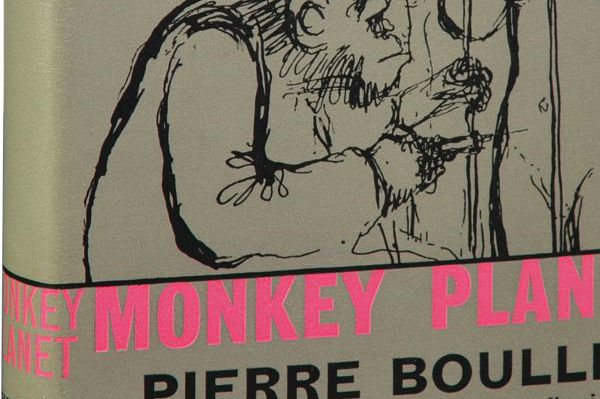
It wasn't always about our own planet, and there wasn't always a half-buried Statue of Liberty waiting to reveal the fate of the human race. But the original novel was still inspired by man's inhumanity to man. In Pierre Boulle's La Planete Des Singes (1963), often inelegantly translated as Monkey Planet, the action takes place on Soror: a sister planet to our earth, it is, nonetheless, an alien planet distantly related to that in Burton's Planet of the Apes (2001). But the topsy-turvy evolution offers Boulle the opportunity to comment on man's inhumanity to man; for example, when the sophisticated apes that subjugate the brutal humans ensure a child is fed, whereas her own kind would let her starve. And Boulle knew about inhumanity: held in a forced labour camp by the Japanese in WWII, his experiences inspired the novel that became classic war film The Bridge On The River Kwai (1957). His novel, rather than pulp sci-fi, is a literary satire on humanity and its arbitrary place in the scheme of things. Cornelius, the amiable chimp archaeologist of the early films, was originally a skilled neurosurgeon in the novel, and commented on how fortunate he was to have human 'animals' as vivisection subjects: "Man's brain, like the rest of his anatomy, is the one that bears the closest resemblance to ours." It echoes Charles Darwin's observation, in The Descent Or Origin Of Man, that, "every chief fissure or fold in the brain of man has its analogy in that of the orang". By the end of Boulle's story, the evolutionary tilt of Soror has been exported to our earth. The human hero Ulysse - after Ulysses in The Odyssey - returns 700 years after his departure (due to travelling "at the speed of light minus epsilon") to find a gorilla in military uniform waiting to greet him at Paris's Orly Airport. It finds its echo in Burton's similarly extraterrestrial film, when Mark Wahlberg's astronaut finds the Lincoln Memorial replaced by a simian statue, and is leapt on by gorilla police - a nightmarish pulp climax to an otherwise staid movie.

12. The Movies Took Everything From It... Except The Story
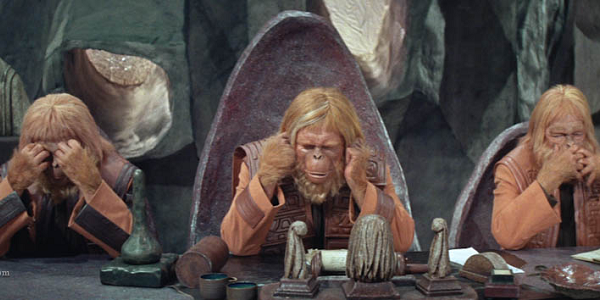
Boulle's Soror is a very different world to 20th-Century Fox's Planet of the Apes of either the 60s/70s or the 2010s. His orang-utans and chimps are urban sophisticates, while the gorillas are more proletarian, and they live in modern cities filled with skyscrapers. The only concession to their jungle origins are the climbing bars by which they cross the street. But little aspects of his novel still found echoes in the movie franchise: the brain surgery experiments of Planet of the Apes (1968); in Escape From The Planet of the Apes (1971), Dr Zira shows her intelligence under human military observation by making a staircase from building blocks to reach her food - the same test she puts to Ulysse in the novel; in the same movie, the reactionary Dr Hasslein realises the threat posed by Zira and her partner Cornelius: "If they can transmit that distinguishing characteristic to their progeny, all apes will eventually have the ability to speak." It's another inversion of the novel, where the apes fear Ulysse and and feral girl Nova giving birth to a human baby. A more direct reference to the book comes in the chimp couple's recollection of how ape folklore tells of the rise of their species, of how "they performed all the menial tasks that humans insist on having done for them but won't do themselves". In Boulle, they confide similarly to Ulysse of how archaeological research indicates humans once ruled their planet; in Conquest of the Planet of the Apes (1972) the ape slave rebellion they spoke of comes to pass - echoed by the insurrection of the vivisected in Rise of the Planet of the Apes (2011).

11. It Took A Twilight Zone Writer To Adapt It
When producer Arthur P. Jacobs acquired La Planete Des Singes as a literary property, he commissioned Rod Serling, the host and sometime screenwriter of the classic Twilight Zone TV series (1959-63) to adapt it into a screenplay. So began a process of turning a piece of often whimsical satire into harder-edged Hollywood fare. Budgetary restrictions led Serling and later co-writer Michael Wilson (Lawrence of Arabia, 1962) to ingeniously exchange Boulle's modern city for the primitive Ape City, based on the Catalan architecture of Gaudi. Most of all, Serling brought his own urgent style of pulp philosophy. Take a look at the first season of The Twilight Zone, particularly a story called 'I Shot An Arrow Into The Air'. In it, a small crew of astronauts crash-lands in a desert on an unknown planet. One of them, Corey, is untrustworthy and murderous, killing two of his comrades. After murdering his captain, he clambers up a sandy ridge - to find he's in Reno, Nevada: "Oh my dear God€ We never left earth. That's why nobody tracked us€ we just crashed back into it." Anyone familiar with the classicPlanet of the Apes ending will find a chilly echo here.

10. It Revolutionised Prosthetic Makeup
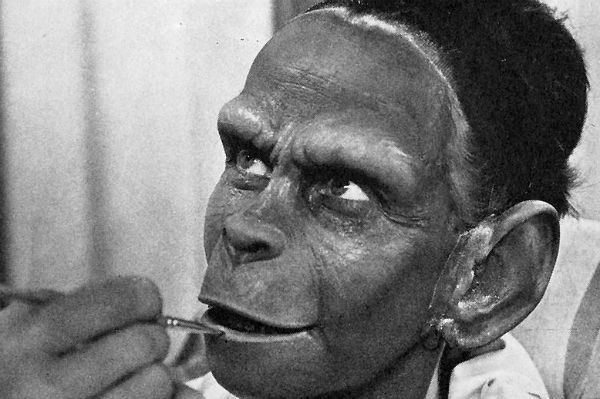
Arguably the contributor who truly made the original film possible was the makeup artist. John Chambers first made up veteran actor Edward G. Robinson as Dr Zaius - the manipulative, authoritarian orang-utan (played in the film by Maurice Evans), the most emblematic of the original ape characters - in a missing-link style, half-ape and half-human. But as it became clear that he could create expressive simian masks with moveable latex, Chambers achieved what at first seemed impossible in those pre-CGI days. The makeup for ape crowd scenes was often cheaper and quicker, but Roddy McDowall (Cornelius/Caesar), who stayed for most of the series, was always able to project through the rubber. John Chambers was a TV horror and science-fiction veteran who did some great work for The Outer Limits, The Munsters, The Invaders, Star Trek and Night Gallery. He always claimed not to be responsible for the photo of the legendary/mythical Bigfoot that surfaced in 1967, but readers are urged to compare it to his creatures on Lost In Space.

9. There Was An Entire Subspecies Of Mutant Humans
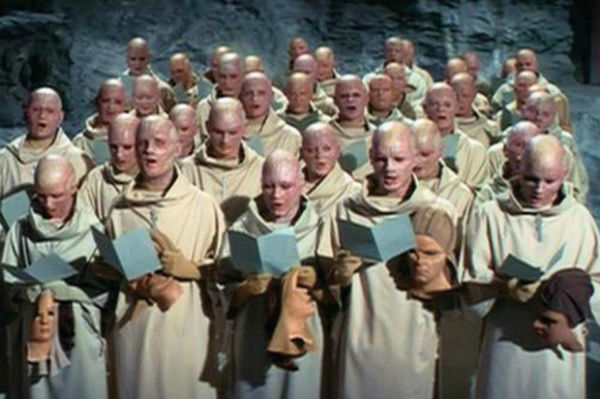
For all Pierre Boulle's satirical observations, his Planete Des Singes is not a product of the Cold War. But the American pulp SF tradition was already dealing with the theme of nuclear annihilation in the 1950s, albeit in the metaphorical shape of prehistoric beasties awakened from centuries-long slumber by the atom bomb, or radioactive mutated animals; by the next decade, movies like Fail Safe and Dr Strangelove (both 1964) posited that if mankind stockpiles those world-destructive weapons, we're eventually going to use them. The same shadow fell over Colonel Taylor (Heston) in the first movie: "You maniacs! You blew it up!" he hollers despairingly at the ruin of the Statue of Liberty. "Damn you all to hell!" It all becomes suddenly clear: it was The Bomb that put the evolutionary process into reverse. This is taken further in Beneath the Planet of the Apes (1970) by the irradiated, scarred, human mutants who worship The Bomb and sing 'All Things Bright And Beautiful' to it. Their god is the doomsday weapon that a dying Taylor activates, destroying the planet - but political conservative Chuck Heston wasn't making an antiwar statement by insisting on the scene, he just wanted out of the series.

8. It Dealt With Human Rights

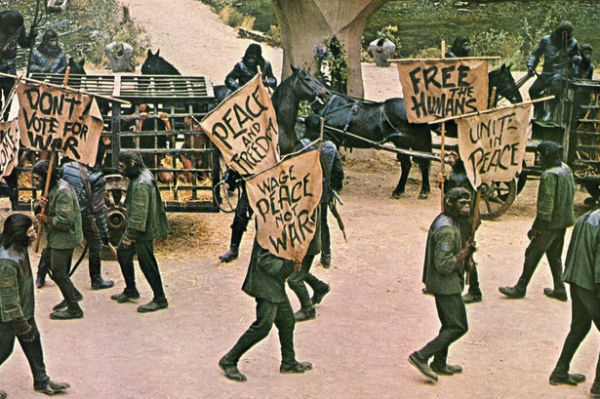
It's symptomatic of its time that, when Pierre Boulle was invited to write his own screenplay for the second film in the series, he included a Vietnam-style draft calling up gorillas, chimps and orangs alike: 'THE SACRED DUTY OF THE YOUNG IS TO FIGHT' reads a recruitment poster, resisted by radical chimpanzees. Boulle was living in Paris at the time of the May 1968 student riots, and can't have failed to be aware of the era's radicalism. His screenplay, which wasn't overly cinematic, was never produced but the peacenik ape image survived into Beneath The€ with the chimps who carry placards reading 'FREE THE HUMANS!' and 'UNITE IN PEACE!', in defiance of gorilla General Ursus's campaign to invade the Forbidden Zone. It all looks very hokey now, but in the late 60s/early 70s, student antiwar protests were a life-and-death issue.

7. There Was Originally Plans For Interspecies Breeding

There was a kinkily bestial overtone to Boulle's description of Ulysee Merou's relationship with the chimp Zira in his novel: "the sentiment that came to life between us had no name on Earth or any other region of the Cosmos." It was obviously difficult to mirror that transgressive frisson onscreen, and Kim Hunter's Zira winces, "But you're so damned ugly!" as Taylor gives her an affectionate full-on kiss. Before Burton's re-imagining debuted in 2001, there was conjecture that the monkey love might go further but, despite Helena Bonham-Carter's strangely cutesy ape-femme makeup, it was only a rumour. But Beneath The€ did come close to breaking the species boundaries, as screenwriter Paul Dehn - who created the ingeniously pragmatic concepts for the first three sequels - described: "I wanted a more optimistic end€ than the destruction of Earth by the Doomsday Bomb, but my own end, the birth of a child half-human and half-monkey, proved intractable in terms of makeup, and anyway it was thought that Man-Ape miscegenation might lose us our G certificate." Indeed. The idea was quietly abandoned but a shot of the makeup test survives.

6. Cornelius And Zire Were There Own Great-Grandparents

When Paul Dehn took over as screenwriter for the POTA sequels, he inherited 'Hasslein's theory of time' from Rod Serling. The concept expanded in ESCAPE, when the energy released by the Alpha-Omega Bomb propelled Cornelius and Zira in the opposite direction along the same warp. And so the original Apes cycle, at the halfway point, became the saga of how a loop in time allowed a reverse-evolutionary future to subvert the present. As the President recognised in SF writer Jerry Pournelle's novelisation of ESCAPE, the arrival of Caesar's parents and the threat it posed was a paradox: "If they didn't come here to be their own great-great grandparents, they couldn't exist at all." Thus evolution, like time, has become curved or circular, circumnavigating its own linear development.

5. It Became A Commentary Of The American Race Riots
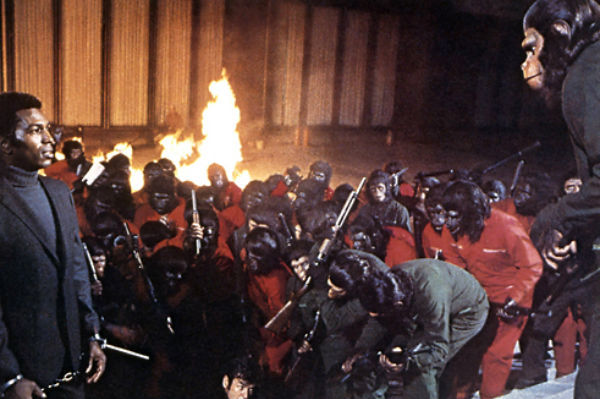
With Cornelius and Zira's son, Caesar, brought into the equation, we got to see how Colonel Taylor's "crazy upside-down world" got started. But in Conquest of the Planet of the Apes (1972), we also switched our sympathies from the persecuted humans of the early films to the oppressed and enslaved simians. This time it was the human race that held the whip hand, and the ever-younger POTA audience in the 70s was happy to cheer every time an actor in a latex monkey mask rose up and killed a human in uniform. The whole thing may have looked cheesy - declining budgets meant Conquest exhibited the modest production values of the average 60s/70s TV science-fiction show - but just reflect for a moment on how subversive the concept was. Critics were queasy about the civil rights allegory. The Village Voice noted how the latest series entry had been "transformed into a simple-minded metaphor for racial conflict in America€ there is enough here to make even a redneck cheer at the association of apes and blacks, however human those apes might be€" By the time it got to the riot scenes, the film was still a riot of fun for everyone who ever fantasised about giving society/humanity the finger. The only disappointment comes in its re-cut closing moments, when it abandons its hairy belligerence in favour of a kinder, gentler Caesar, seemingly bridging the gap with the final entry in the original cycle - a 'kids' movie', as ordered by Fox. It may be a vain hope, but it would be interesting to see a 'director's cut' which let Caesar's bloody uprising go all the way to its crazed conclusion

4. Battle For The Planet Of The Apes Was A Kids Film
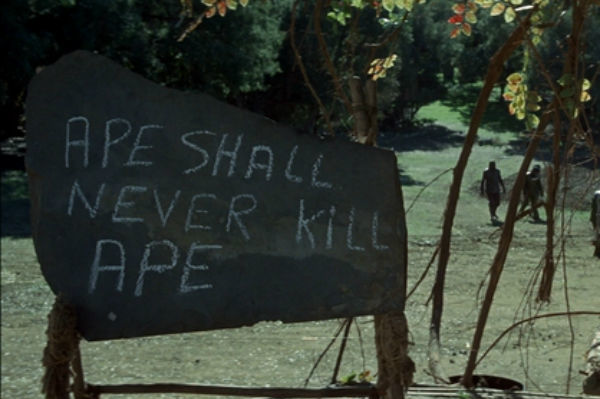
The final episode in the original cycle, Battle for the Planet of the Apes (1973), was disappointingly lacklustre. Chiefly serving as a bridge between the earlier and later films, it lost much of its impetus when a subplot about the first 'nuclear pope' (distant ancestor of Mendez XXVI from Beneath) was excised, as was Paul Dehn's original climax, where an increasingly pacifistic Caesar was killed by a warlike ape council. Instead, the rewritten script was turned into an anodyne children's film, only interesting for a scene where Caesar finds videotape of his parents warning about the planet's later destruction, and a cameo by legendary director John Huston as the orang-utan Lawgiver referred to in the first two films. As an emblem of how the rebooted films have revitalised a seemingly arcane concept, Dawn of the Planet of the Apes (2014) turns the pedestrian ape-human war of Battle into a looming CGI apocalypse. In 1973, the $1.8m budget had necessitated close-ups and quick cuts to give the illusion of a sizeable mutant army in the brief, anti-climactic battle scene. Other parallels include Gary Oldman as Dreyfus, leader of the San Francisco epidemic survivors, who echoes the old Caesar's adversary, ex-police chief Kolp; Caesar's basic tenet of "Ape shall never kill ape" is put to the test against Koba the bonobo, as it was against General Aldo in the earlier film - and audience identification with a CGI monkey is evoked by video footage of Caesar's early life with his trainer.

3. There Was A TV Show In The 70s

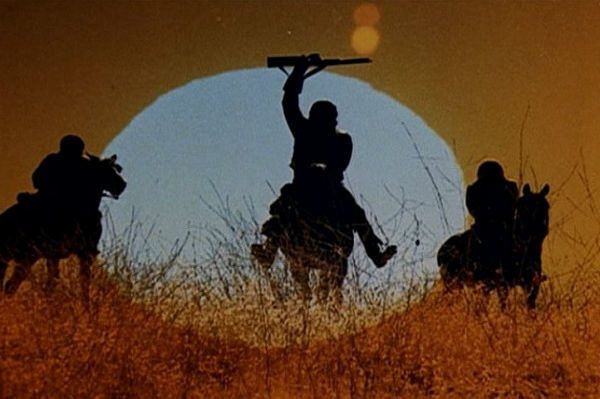
For several decades before the release of Dawn Of..., the only footnote to Battle was the TV series that supplanted the expired film franchise. Debuting in October 1974, the Planet Of The Apes TV series attracted a whole generation of kids with its menacing theme music (reminiscent of Jerry Goldsmith's score for the first film) and its image of a gorilla hunter holding a rifle aloft. But the audience just as quickly fell away again. While its premise was familiar and enticing enough - astronauts Virdon and Burke are time-warped to a future earth 900 years before the first film, where humans are at the bottom of a feudal society and have not yet devolved to the animal state - its individual stories were lacking in imagination. Like the similarly stunted Incredible Hulk, it was another variation on the formats for The Fugitive or Kung Fu, where the characters keep running from town to town without much narrative development. Despite Roddy McDowall reprising his chimp act, the show was cancelled after 13 episodes and is referenced by the Pulp song 'Bad Cover Version', which compares an old girlfriend to pop-culture disappointments 'like Planet Of The Apes on TV'.

2. Oliver Stone Nearly Remade The Series In The 90s

Prior to Tim Burton's visually elaborate/narratively bland Planet of the Apes (2001), the first remake suggestion came, surprisingly, from Oliver Stone (as mooted producer) in the early 1990s: "What if time was not linear but circular," he expanded on Paul Dehn's temporal sleight-of-hand, "and there was no difference between the past and the future€ and what if there were discovered cryogenically frozen Vedic Apes who held the secret numeric codes to the Bible that foretold the end of civilisation?" As elaborate conspiracy theories go, it takes some beating. Stone described the original POTA cycle as "awful", but it didn't stop him enlisting Terry Hayes, co-screenwriter of Mad Max 2 (1981), to develop a screenplay. 20th-Century Fox chairman Peter Chernin called it "one of the best scripts I ever read," but it's hard to see why. It starts with a grotesque if confusing concept: babies are being stillborn from 'old age'; a scientific researcher into mitochondrial DNA adjusts his own to somehow transport him to the dawn of evolution, where the syndrome is rooted. In a primitive world folkloric allusions come thick and fast - Aragorn from The Lord Of The Rings and Ma-Gog from The Old Testament are participants. But the carefully-drawn ape society of POTA is entirely absent, and even Zira ('Dr Zora') is a butchering gorilla (not chimp) surgeon. Unsurprisingly, the screenplay never got close to production.

1. Fox Tried To Remake It With The Writer Of Batman
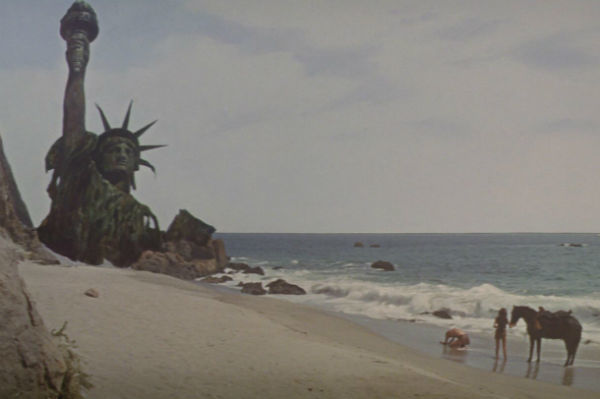
Fox had Batman (1989) writer Sam Hamm take another shot at the POTA screenplay. He took Hayes' idea of prematurely aged babies and made it the subject of an exploratory space mission manned by a crew resembling the 1968 film's Taylor, Landon, Dodge and Stewart. Ape society is better drawn, with elements of both Boulle's more technological world and the classic film. There's even an ending which combines both of those seminal works: "€Our old friend the Statue of Liberty, standing watch on her island pedestal€ she's undergone radical plastic surgery€ her once-proud porcelain features have been crudely chiselled into the grotesque likeness of a great grinning ape." But many of the other elements were hit-and-miss: an action sequence resembling the flying monkeys scene in The Wizard of Oz (1939); 'Lord' Zaius controlling his society via access to ape TV, with very dated references to 80s/90s movies. Once again, it didn't fly - although the intriguing disasters that might have resulted from Hamm's or Hayes' scripts would have been more interesting than the classically allusive but dry piece William Broyles, Jr. fashioned for Burton.


Contributor
Contributor

Writer/editor/ghost-writer transfixed by crime, cinema and the serrated edges of popular culture. Those similarly afflicted are invited to make contact.