13 Movies That Have Little Hope For Humanity
We're all doomed.

Reading the news is a routinely miserable experience these days, and it's easy to believe that things really are getting worse.
As such, movies can serve as a wonderful escape from real-world horror, highlighting the very best of humanity and letting you temporarily forget the void that inevitably awaits you.
And then there are films that go in the entirely opposite direction, leaning into all the hopelessness and painting a disturbing picture of how utterly screwed humanity is as a species.
This can extend from the mere fact we're all going to die to the cold, hard truth that humans will turn on each other as best suits their interests.
These films, some of them oddly comforting in their bold-faced admission of humanity's penchant for self-annihilation, should be your go-tos if you want to feed your misery and see a damn good movie at the same time...
13. The Mist

Stephen King's novella The Mist wasn't exactly all sunshine and rainbows, but Frank Darabont opted to make his 2007 movie adaptation an alien invasion movie of an uncommonly grim order.
At its core this is an achingly human film about how fragile society is, and how quickly people would turn on one another in an intense crisis scenario.
As terrifying as the Lovecraftian monsters are, it's the people - especially Maria Gay Harden's tyrannical religious zealot Mrs. Carmody - who prove the most horrifying.
How It Ends: Protagonist David (Thomas Jane) find his wife dead, and shortly thereafter drives past a gigantic, tentacled monster several hundred feet in height.
This prompts David and his fellow survivors to give up, committing to a suicide pact which sees David shoot the three adults along with his own young son.
David doesn't have a bullet left for himself, so he walks out into the mist waiting to be devoured, only for a military tank to roll through the mist, revealing that if they'd waited just a few minutes longer, they'd see that the alien invasion was being successfully repelled.
It's an ending so critical of human fatalism and our own self-destructive tendencies you might not know whether to laugh or cry, honestly.
12. No Country For Old Men

Like several of the Coen brothers' movies, their Best Picture-winning masterpiece is a coldly nihilistic film about the inherent lack of meaning in the world, and how humans are basically destined to live and die while still questioning what it all amounts to.
This is embodied primarily through the character of Ed Tom Bell (Tommy Lee Jones), an ageing sheriff who is helpless to stop Anton Chigurh's (Javier Bardem) ruthless, murderous rampage across Texas.
Main characters die without much fanfare, the antagonist wins in the end and while the last "hero" standing survives, he's left utterly spiritually defeated.
How It Ends: A retired Bell talks to his wife about a series of recurring dreams involving his father, nodding towards the inevitability of his own death and his absolute inability to do anything to affect the ultra-violent new world around him. Lovely.
11. We Need To Talk About Kevin

Lynne Ramsay's searing drama about a mother, Eva (Tilda Swinton), coming to terms with her son committing a high school massacre is a brilliant yet infuriating two-fingers-up to other, lesser films which attempt to analyse horrifying crimes through the lens of basic pop-psychology.
This is a movie that presents a few possible explanations for Kevin's (Ezra Miller) ultra-violent act, but never clings to one and ultimately leaves Eva, Kevin and the audience themselves in the lurch. There is no quick-fix rationalising his act, only shock and sadness left behind.
It's a depressing primer for discussing the human condition as a whole, really. Awful things will happen, and despite humanity's attempts to put them in an easily explainable box, reality isn't quite so simple.
How It Ends: After it's revealed that Kevin also killed his father (John C. Reilly) and sister, the final scene sees Eva confronting her son in prison one last time. She asks him why he did it, and he simply replies that he used to think he knew, but isn't sure anymore.
In one of the all-time most depressing endings to a movie, a despondent, broken Eva hugs Kevin and leaves. There's no closure or semblance of hope. Grim.
10. Night Of The Living Dead

Night of the Living Dead was the first major zombie movie, and also the first to present itself as a socio-political allegory.
There are numerous popular interpretations of the movie - perhaps most prominently that it's a critique of America's involvement in the Vietnam War - but the prevailing tenor is an extraordinarily depressing one where hope is in extremely short supply.
Though zombie movies these days - and even George A. Romero's own subsequent entries into the Living Dead franchise - tend to skew a little sillier and more hopeful, from first minute to last this film is ugly and brutal, with little hope in sight.
How It Ends: Nothing in this film is more depressing than its finale, where hero and sole survivor Ben (Duane Jones) is shot dead by a gang of rednecks who mistake him for a zombie.
The racial implications, especially with the movie releasing so soon after the assassinations of Malcolm X and Martin Luther King Jr., is undeniable. And on a broader level, it just cements what might be humanity's greatest and most disturbing fear of all: itself.
9. Requiem For A Dream

Darren Aronofsky's masterful, unflinching addiction drama is an ingeniously constructed movie that lures audiences in with flashy, MTV-style visuals, which lull the viewer into a false sense of security about what kind of movie this is.
At first it might seem like Harry (Jared Leto) and Tyrone (Marlon Wayans) will make a fat living as drug dealers, giving Harry enough money to fund his girlfriend Marion's (Jennifer Connelly) dress shop, while Harry's mother Sara (Ellen Burstyn) will fulfil her dream to appear on television. But this is no such movie.
The "fall" sequence in the movie's third act is a hopeless descent as the four central characters pay the price for their addictions, not just to narcotics but also lifestyles and dreams.
There is no redemption here, just ruined lives and an unfathomably depressing depiction of humanity's most tragically desperate instincts.
How It Ends: Harry ends up with his arm amputated after injecting junky heroin into it, Tyrone is jailed as he goes through intense withdrawal, Marion performs degrading sexual acts for drug money and Sara is left a shadow of her former self by electroshock therapy. Yup.
8. Happiness

Todd Solondz's extremely controversial 1998 black comedy may be a heightened, satirical look at the seedy underbelly of "prosperous" suburban life, but it's really only as funny as it is because Solondz's observations are so authentic and weirdly empathetic.
This is a "comedy" where Jon Lovitz commits suicide after being romantically rejected, Philip Seymour Hoffman plays a sad sack who gets off making obscene phone calls to women, and to top it all off, Dylan Baker gives an incredible performance as Bill Maplewood, a psychiatrist who drugs and rapes his son's schoolfriend. When Bill's son learns of this fact and asks if he'd ever rape him, he gives the nauseating response, "I'd jerk off instead."
That's to say nothing of the sheer, unrelenting misery inflicted upon the movie's other characters, who typically fail in love and finding satisfaction in their lives. Solondz seems to argue that the pursuit of happiness is a futile exercise in an uncaring world.
How It Ends: Bill's son Billy's (Rufus Read) numerous attempts throughout the film to make himself ejaculate climax (sorry) with him successfully masturbating to a topless sunbather. Naturally, his dog licks up the seminal deposit and he proudly announces the emission to the rest of his family.
At least someone ended up happy, at least for a moment, right?
7. Melancholia

Lars von Trier is an indisputable master of miserable cinema, though Melancholia is his only movie to date that actually dares to commit to the sheer hopelessness of global annihilation.
Aptly, this movie about Earth being threatened by an incoming rogue planet is the second entry into von Trier's so-called "Depression trilogy."
That sci-fi set-up belies an otherwise grounded, bleak drama about a woman, Justine (Kirsten Dunst), battling crippling depression on the eve of her wedding, and the various forlorn figures in her life.
This is a film where just about everyone is sad about something, be it a result of mental illness, personal and professional failings, or the simple fact that Earth's destruction is approaching.
How It Ends: Justine calmly sits down with her sister Claire (Charlotte Gainsbourg) and Claire's son as the world is destroyed by the planet's approach. There's no hint of salvation or possibility of survival, which basically reflects the human condition: you can flail around about the fact you're going to die or just accept it. Either way, the end result is the same.
Unsurprisingly, Melancholia was written during one of von Trier's intense depressive episodes. As hopeless as the movie is, it does at least have a cathartic, oddly calming quality to it.
6. Funny Games
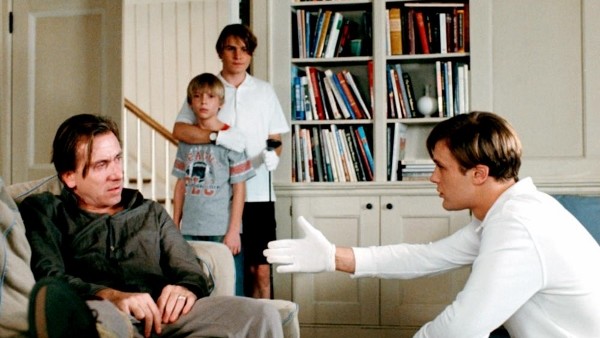
You can take your pick here with either Michael Haneke's 1997 Austrian original, or the 2007 Hollywood remake that he himself directed. The end result is the same: senseless torture and murder for no apparent reason, with Haneke expressing a unique disdain for the audience for even bothering to watch it.
Intended as Haneke's criticism of violence in the media, he reportedly wanted to make an ultra-violent and unpleasant film that was otherwise "pointless". To this end, one of the assailants routinely breaks the fourth wall, hinting that he's aware he's in a movie, and ultimately taking a sneering view of the audience themselves.
There's no hope for the movie's characters, both victims and villains, and apparently not for viewers, who by finding entertainment in murder, are pretty twisted themselves.
How It Ends: The entire family is killed, culminating with the mother (played by Naomi Watts in the remake) being casually thrown overboard from a boat. The self-aware killer then coldly stares at the audience, as if to mock their expectation that the "hero" would find a way out of her predicament and avenge her fallen family.
But no, Haneke denies this and is basically laughing at the viewer for even considering that it might happen.
5. The Road

Post-apocalyptic movies are generally no picnic, and John Hillcoat's adaptation of Cormac McCarthy's devastating survival drama is one of the bleakest ever made.
The Road focuses on a man (Viggo Mortensen) and his young son (Kodi Smit-McPhee) as they traverse a world ravaged by a non-specific extinction event. They eke out a hopeless life scavenging what they can while attempting to avoid other hostile survivors.
As anyone who's read a McCarthy novel knows, the guy has a pretty low view of humanity on a global scale, and The Road is no exception.
Though the movie omits arguably the ugliest part of the book - where the man and boy stumble upon a baby being roasted on a spit - it's still an intensely depressing look at how humans would deal with one another if society as we know it crumbled.
How It Ends: The man dies, leaving his son on his own. The boy is approached by a family who insist they're "good guys", though the movie keeps it ambiguous as to whether they can really be trusted.
If you truly believe this family wanted to help the boy, then you can argue it does possess a small glimmer of hope, but let's be honest, they probably killed and ate the boy 10 minutes after the movie ended.
And even if not, in a world governed by so much selfish violence, are "good" people really going to last long anyway?
4. Synecdoche, New York

Charlie Kaufman's mind-boggling dark comedic drama follows a theatre director, Caden Cotard (a brilliant Phillip Seymour Hoffman), as he faces a major existential crisis in the middle of prepping an insanely ambitious play.
Caden's life begins to unravel as his romantic relationships routinely break down alongside his body, which is afflicted by a crippling, non-specific ailment.
Add on top of this the realism of Caden's play blurring the line between reality and fiction, and eventually he disappears, quite literally, into his work.
How It Ends: An aged Caden speaks with one of the actresses in his play, and as he expresses a desire to do something other than the play, the play's new director issues him one final command through an earpiece: die.
The film speaks plainly about the collective human fear of mortality through some painful yet poetic dialogue, presenting little hope for the individual ability to transcend death.
However, like Melancholia, there's also an unexpectedly comforting quality to its straight-faced bleakness.
3. First Reformed
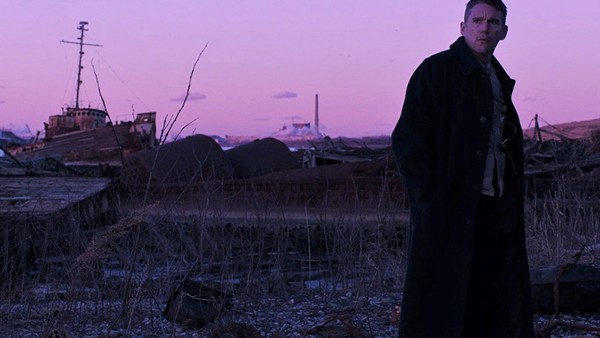
Paul Schrader's scintillating drama might be 2018's feel-bad movie to beat, an almost unbearably solemn film about an alcoholic, ailing Protestant minister, Ernst Toller (Ethan Hawke), who finds himself at an existential crossroads.
Enrst is struggling to cope with the death of his soldier son, while also dealing with his centuries-old church being propped up by the financial support of a morally dubious megachurch, and the suicide of a young environmental activist, Michael (Philip Ettinger), he was counselling.
Unshakably affected by Michael's persuasive argument that climate change is an inevitable, irreversible result of human greed, Ernst clings to the cause as he suspects he may be suffering from stomach cancer. Eventually, he plots to wear Michael's unused suicide vest to blow the church to smithereens.
A powerful political statement about conservatism, or merely the act of a desperate, possibly dying man pressed to find a worthy cause to cling to? Either way, it paints a horrible picture of present humanity and the world we're leaving future humans to inherit.
How It Ends: The ambiguous final scene sees Ernst remove the suicide vest after Michael's wife, Mary (Amanda Seyfried), shows up at the church. He then wraps himself in barbed wire and prepares to commit suicide by drinking bleach, but Mary runs into the room and the two passionately kiss as the film ends.
It's been fiercely debated as to whether or not this moment actually happened or it's merely a death dream in Ernst's head. Either way, the big picture result is basically unchanged: big business will send the Earth to an early grave, because people are trash and even the most dedicated individuals are powerless to stop it.
2. Under The Skin

One of the most singularly evocative sci-fi movies ever made, Under the Skin follows an alien (Scarlett Johansson) who arrives in Glasgow of all places, assumes a human identity and begins feasting on the locals.
Arguably the best thing about this movie is how it unfolds from the alien's perspective, observing her fascination with human society, and how strange everything we do would seem to an outside entity.
Though not everyone the alien meets is a bad person, pretty much every significant interaction she has in the movie has an unpleasant result for someone: either her human meal or, eventually, herself.
How It Ends: In the forest, the alien is attacked by a logger who attempts to rape her, during which her humanoid skin is pulled back to reveal a sleek, black figure underneath.
The man, clearly horrified at what he's seeing, douses her in flames and sets her on fire. The end.
Whatever way you look at this movie, it's not a good look for humanity. We're either horny buggers easily lured to our doom by a siren, or we'll murder anything we perceive as different. Yikes.
1. A Serious Man

The Coen brothers are at it again with this fascinatingly nihilistic drama about a man, Larry Gopnick (an incredible Michael Stuhlbarg), having a crisis of faith after his personal and professional lives go up in smoke.
Gopnick, a Jew, turns to a series of rabbis for answers throughout the film, none of whom provide satisfactory answers for why God appears to be punishing him.
While not necessarily a direct railing against organised religion, the film does appear to mock the feckless human need to ascribe meaning to a seemingly meaningless universe, where an avalanche of awful things can and do happen to good people.
How It Ends: After wrestling with the dilemma for most of the movie, Larry decides to accept a bribe in order to change the grade of a student's paper.
Almost immediately after this, as if caused by God himself, Larry receives a grim phone call from the doctor implying he's got some very bleak news, while a huge tornado approaches his son's school, the outcome of which is left unknown.
It's a masterpiece of a dark comedy that considers the notions of good and evil, why we choose to do things and how ultimately, the universe lacks the logical through-line many of us assume it has.
What do you make of these insanely bleak movies? Got any more to add? Shout them out in the comments!