10 Terrible Movies That Were Absolutely Bursting With Cliches
 Full-disclosure: When I sat down to write this article, I wasn't as sure of its premise as I thought I'd be, so I began by defining the two pivotal terms. "Cliche" was easy. It's objective and based on empirical evidence. "Terrible" is much more subjective and open to discussion. On more than one occasion, several people have tried to convince me Citizen Kane is actually terrible. And, depending on your mood, Plan 9 from Outer Space might be a more rewarding watch than The Maltese Falcon. This brings me to my point: Every once in a while a terrible movie is great fun to watch. In light of this, I've tried to treat the notion of a "terrible" movie as empirically as possible. The result, I hope, is a collection of films that are a joy to watch despite being tremendously flawed and cliched. Some of them are entertaining because they're successful, others work accidentally because they are not. Be sure to leave your favorite "terrible" movies in the comments if you feel I've left any out.
10. Speed (1994)
 Speed is the epitome of the enjoyable "terrible" movie. It's a "Murphy's Law" action flick that grabs you by the shirt with every mishap, however cliche. The dialogue is cheesy, outcomes predictable, and even the always intense Dennis Hopper seems a little silly as he navigates the familiar plot points. The movie opens amidst police sirens when an unmarked cop car carrying our hero buddy-cops comes flying over the camera, having just gotten air on a hill. Why this was included in what one might presume to be a serious action movie after having already be parodied nearly a decade earlier in Ferris Bueller's Day Off is certainly perplexing. As the cold open continues, we are introduced to yet another familiar scenario: Hostages in an elevator dangling precariously over certain death. Of course, they barely manage to save all those trapped and the last woman out, slowed by her paralyzing fear, loses a shoe as the falling elevator catches it. Sphew! That was close. The scene ends as our stock villain makes a narrow escape. You probably can't help but chuckle as he takes the time to stop in the doorway and let out one last, cliche maniacal laugh. This gives me an idea: Has anybody out there made a video on youTube yet called, "Dennis Hopper laughing in Speed"? After an unspecified amount of time, we find our now decorated hero (Keanu Reeves) in a coffee shop. Enter one of my favorite stock characters of all time: The one we're manipulated into liking in mere seconds just so he can be killed off immediately. The Simpsons parodied this trope in their ongoing McBain series: His partner is two-days away from retirement, a daughter about to graduate college, and - as soon as the catch the bad guy - he and his wife are going to sail around the world in a boat called "The Live-4-Ever." All of this is divulged just before a hitman shoots, misses McBain, and kills the partner instead. "This time, it's personal." Speed continues with its "anything that can go wrong will go wrong" plot as Keanu boards a bus that must stay above 50mph, otherwise triggering a bomb attached to the undercarriage. Setting the scene on public transportation allows for a slew of characters including two "Oh crap" archetypes whose only purpose is to provide cheap exposition and cue the audience in to how intense the action on the screen is. One of them even fills the role of the fish-out-of-water tourist. How's that for efficiency? Other cliches include the ever-popular 90's sassy and strong female lead, with a tacked on love-story sub-plot for good measure, objects that defy the laws of physics for the sake of plot, ticking time-bombs, phone-tapping, cat and mouse scenarios, exploring hero and villain as facets of the same person, lots of explosions whenever possible and an even bigger "this time it's personal" death, raising the stakes right at the movie's midpoint. Oh, yeah. And maniacal laughter.
9. Manhattan (1979)
 The terribleness of this film is more than debatable: It sits with a comfortably "fresh" rating of 98% on Rotten Tomatoes, Roger Ebert awarded it 3.5/4 stars, and I myself - a longtime fan of Woody Allen's - enjoy the movie immensely. So why include it on the list? For starters, the director himself thinks it's terrible. After it was completed, Allen asked United Artists not to release it, offering instead to make a movie for free. In Woody Allen: A Documentary, he recalls thinking to himself, "At this point in my life, if this is the best I can do, they shouldn't give me money to make movies." The other reason is that despite how beautiful New York City looks in black & white with the 2.35:1 aspect ratio and the often hilarious dialogue, this movie is ripe with Romantic Comedy cliche. This may be because Woody Allen himself reinvented the Romantic Comedy just two years earlier with Annie Hall, arguably paving the way for the next forty years of "guy meets girl" movies. They're all here: A twice divorced leading man (Allen, obviously) whose ex-wife is writing a confessional about their marriage. Since their divorce, she has come out of the closet, is now living her new partner, and has custody over their son. His best friend is going through a tough time in his marriage and has begun seeing another woman named Mary (Allen regular Diane Keaton). Classically, the relationship between Allen and Mary begins with distaste before blossoming into a romance. The romantic entanglement creates the familiar love-triangle as two best friends fight over the same woman. Add to the mix Tracy, the 17-year-old high school student Allen's protagonist is seeing at the beginning of the film. He constantly reminds her she can't get too serious because of their difference in age and urges her to go to London and study acting. When things become serious with Mary, breaks it off much to her dismay. After all of his relationships fall apart, he has the cliche realization that what he was looking for had been right in front of him the whole time: Tracy. The movie ends with Allen running out of his apartment, through the streets of New York in a cliche last-minute-sprint. Predictably, he arrives at the lobby of Tracy's apartment just as she's about to leave for London and confesses his love for hear by asking her to stay behind. Is it predictable? Certainly. Is it worth 96 minutes of your time? Without a doubt.
8. Angus (1995)
 An overweight science geek. A beautiful blonde-haired, blue-eyed cheerleader. A beautiful blonde-haired, blue-eyed Quarterback. Patrick Read Johnson's Angus just about has it all from the quirky best friend (think Ducky in Sixteen-Candles) up to and including a make-over montage. Angus is a 14-year-old high school student who is applying to a magnet school to avoid the constant humiliation he suffers. Football and Science come pretty easy to him, but Quarterback Rick Sanford (James Van Der Beek) has two things he doesn't: Looks and Melissa LeFevre. At him, he receives a great deal of love and support from his mother and grandfather but still spends most of his time fixated on those two things that seem forever out of his reach. And that makes a lot of sense. True to the high-school outsider canon, Rick seems to live to make Angus' life miserable through the following cliches: Rick engages in classic bully-behavior from stuffing kids in lockers to running Angus' underwear up the flagpole. He must have just seen Carrie because the plot moves forward as he ensures Angus is voted Winter Ball King by rigging the election in hopes to embarrass him in front of the whole school. The film is as cheesy as any that explores the dichotomous relationship between the nerds and the popular kids and hits all the "right" notes with it's time-stamp of a soundtrack (Green Day, Weezer, Goo Goo Dolls...). And you almost can't see the cliche twist where Melissa, during their first real conversation just prior to their dance as King and Queen, confesses her fear of having everyone watching as they dance. Hey. Beautiful, popular people can be insecure, too. Why else would Rick act out and torment others like he does? It's this realization that prompts Angus to give the ever cliche third-act redemption speech on the topic of "What is normal?" after suffering what seems like certain humiliation from Rick. Oddly enough, the moral of the film hits "hero and villain as facets of the same person" mark closer than one would be inclined to think.
7. Batman & Robin (1997)
 Joel Schumacher's second Batman movie is practically supercharged with cliches. There is the narrow-minded mentor vs. the hot-headed learner dynamic between Batman and Robin. This is combined with a love triangle between the two involving Poison Ivy, who is played by the movie's saving grace, Uma Thurman. It is Arnold Schwarzenegger's Mr. Freeze that, for all the wrong reasons, provides the films best laughs as a perpetual one-liner machine including, "Hey, Batman. What killed the dinosaurs? The Ice Age!" The biggest shame of this movie is that it's best actor, Uma Thurman, was given so little to work with aside from puns worse than Schwarzenegger's and a cliched, single-note back story that takes its cues from Selina Kyle in Tim Burton's Batman Returns: A lowly assistant who learns too much regarding her boss' psychotic plans to expand his wealth and therefore must die. The boss never quite sees the deed through, resulting in an unfulfilling attempted murder that provides our villain with new-found powers. Freeze's backstory is not any more original as it includes the typical troubled past and another science experiment gone wrong. He has since moved from a profession in the sciences to one as a jewel thief. The plot shifts to explain it is diamonds that provide his suit with the energy to keep him cold. This theoretically links to his motivation of stealing enough diamonds to create a super-freeze ray and cover the whole world in ice. If it doesn't make sense, don't worry: It's all explained vaguely enough to keep you from caring too much. Just chalk it up to many of his elaborate death traps, of which he provides more than his share. Because if writers ever had the villain just kill the hero when he has the chance, movies would be over before they start. The film also tries to incorporate Bane, but falls victim to the "too many villains" cliche. Perhaps most frustrating for fans of the original comics, the writers have swapped out Bane's well-known intelligence and fit the character into the "Dumb Meathead" mold to provide a thoughtless henchman for Poison Ivy. As always, Batman movie veteran Michael Gough brings his reliable best to the role of Alfred as he fulfills another movie cliche: The Old Man On His Death Bed. Unfortunately, these rare human moments are buried under studio pressures to make the film more "Toyetic."
6. Jingle all the Way (1996) Speaking of "toyetic" Schwarzenegger movies from the mid 90's, why not Jingle all the Way? Since it's a Christmas movie, the cliches should almost spell themselves out, but let's take a closer look: Like most "good" Christmas movies, Jingle all the Way is a essentially a reworking of the Scrooge story: A heartless businessman, through a series of events, comes to understand the true meaning of Christmas. In this instance, the meaning of Christmas is that a parent can make up for years of emotional neglect by buying the right toy. And for anyone wondering, they did in fact make actual Turbo-Man dolls. Why wouldn't they? In 1995, the major success of Toy Story truly opened the flood-gates for movies about fictional toys that served the dual purpose of acting as a 90-minute commercial for a real-life product. As a true child of the 90's, I had everything from a Buzz Lightyear to a small collection of toys from 1998's Small Soldiers. Schwarzenegger's Howard Langston is disingenuous and business-minded. If you made him a lawyer instead of a mattress salesman, you'd have Jim Carrey in Liar, Liar. Come to think of it, if you switch Christmas for a birthday and switch the climax from parade to an airport, you'd almost have the same heart-warming movie. Even the mother characters are interchangeable as they merely serve to express concern over the distance between the father and son and a subplot involving a creepy suitor looking to fill the space caused by the biological father's emotional absence. The suitor, Ted, is Jingle all the Way's saving grace and the one thing that really makes this movie worth watching (in a positive way, at least). Played by the reliably fantastic Phil Hartman, Ted adopts the "Superdad" facade, but Hartman hints at something sinister hiding beneath the surface compared to Liar, Liar's oafish (still entertaining) Cary Elwes. True to form, Hartman steals every scene and leaves his stamp of quality on an otherwise unintentionally hilarious film. Aside from the stock characters (a psychotic mailman, an overly authoritative police officer, a reindeer, etc.) and over-used plot-points, the film has its pratfalls in all the right places, a chase scene involving a grown man and a small child in a playground, another small child giving the villain the classic crotch-shot, plenty of close-call saves, and mistletoe used for misanthropic sexual advances. And in the end, the hero is carried away on the shoulders of the crowd while the supporting cast looks on and smiles. Why not?
5. Miami Connection (1987)
 People love movies about drugs and criminals. Goodfellas, Boogie Nights, Traffic, Blow...Even the Godfather had heroin in it. Also consider Boardwalk Empire or any other narrative centered around the Mafia during prohibition. This cliche is so wide-spread that Mendoza, the super-villain in The Simpsons' fictional McBain films, is a drug smuggler. What makes Miami Connection a most perfect embodiment of this cliche, it's that the drug lords also happen to be motorcyclist ninjas who are confronted throughout the film by good ninjas who just so happen to be members of a ninja themed rock band named Dragon Sound. Why they stopped short of adding skateboards, we'll never know. The central drama (I think) centers around a girl caught between her evil brother with ties to the ninja motorcyclist and her boyfriend, the ninja-bassist. But that's not all, each ninja-musician shares a troubled past that provides them the motivation to do good in the world. One of the more interesting features of the movie is that the alleged star, Y.K. Kim, seems to play second fiddle to the actual drama of the film, coming in only to show off his martial arts skill. The explanation for this is probably quite simple: He just can't act. He was, however, a contributor to the story (if you can call it that) and financed a lot of the film himself. His role of producer almost even bankrupted him as the film was almost never released. Over a decade later, the film finally saw wide-release and, thanks to high-speed internet, can now be streamed instantly on Netflix.
4. Warriors of Virtue (1997)
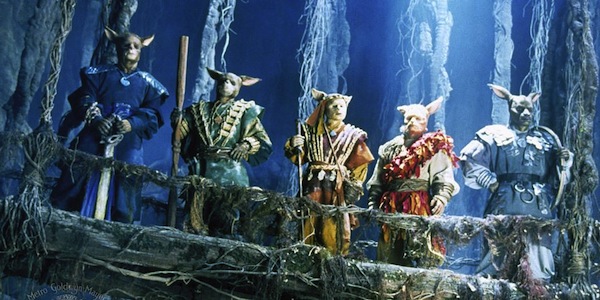 That title for the film refers to a race of humanoid kangaroos that inhabit a fantasy world and know martial arts for some reason, but the main character is a young outcast water boy who is sidelined by a leg-brace. Of all of the cliches in Warriors of Virtue the most fun is the tense, final play of the football game and worthy climax to any sports movie. It's complete with near tackles, the most triumphant of music, and individual victory cheers of all the important characters. All these components are augmented by slow-motion. Did I mention this is in the first ten minutes of the film? Really. It's almost as though the director took the end of another movie and put it at the beginning of this one. Let's back-track a little bit. Our main character's home life leaves much to be desired. Similar to the pre-teen protagonist of 1993's Last Action Hero, his mother is a single parent who's too consumed with her work to notice the social challenges her outsider child faces everyday. Thankfully, and again in similar fashion to Last Action Hero, the kid has found an adult to look up to in his specialized interest. In Last Action Hero, it was the old projectionist at a forgotten movie theater. Here, young Ryan finds confidence in a chef who behaves in his kitchen the way a ninja does at a dojo. After the exhibition of his karate-cooking (Seriously, at the very least watch the cooking scene), he explains to Ryan the virtues of being a master in nothing specific with echoes of Obi-Wan explaining The Force to Luke. Other cliches include: "The Bait and Switch" (cue Admiral Ackbar: "It's a Trap!"), An everyday object that is actually a magical portal, a chronic injury that is magically cured somehow, good guys dressed in white, bad guys dressed in black, and dead parents and/or troubled past. The movie also includes an exceptionally talented warrior who has vowed never to fight again as a result of his (again) troubled past. This plot element is so trite even Trey Parkers' Orgazmo, released the same year as Warriors of Virtue, lampoons this cliche ("Dad. I don't think I'm gonna do Hamster Style anymore...") Oh, and someone actually utters the phrase, "Houston, we have a problem."
3. The Room (2003)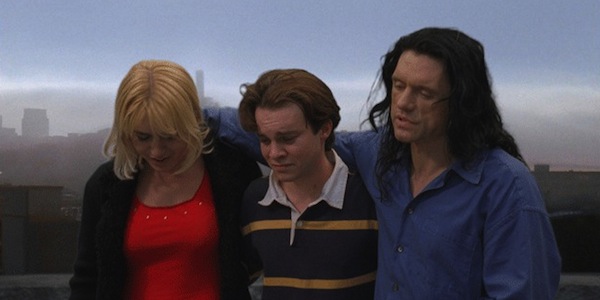 I've seen writer, director, producer, and star of this film Tommy Weisau compare it to Citizen Kane. I've also seen Citizen Kane. And Citizen Kane this is not. Perhaps the one thing this movie has in connection with Citizen Kane is that you must see it to believe it. Like a few other films on this list, this movie comes from someone who, in a traditional sense, should not be making movies. Personally, I don't necessarily agree with that philosophy, because if Tommy Wiseau were never allowed to make movies, we'd never have The Room, a movie that - in its own weird way - has contributed to the discussion of "film as art." So what if that's because this is terrible? It dares to ask the question, "What if we used every plot cliche ever imagined to explain a broken relationship?" Lisa doesn't love Johnny anymore, presumably because he didn't get his promotion, he got drunk last light, and he hit her (don't worry, he didn't). Lisa is compulsive in her deceit, even lying about being pregnant, which she explains she did, "to make it more interesting." Well, thanks for trying, Lisa. She even has an affair with Johnny's best friend Mark. The love triangle erupts into a fight during the middle of a party. And to the viewers dismay, none of this makes it anymore interesting, either. There's a young teen named Denny, a name for a young character that has to be its own cliche by now. Denny has gotten himself into trouble: He owes money to the wrong people. I'll insert a paragraph break to give to time to see if you can figure out where this is going. If you said "Drug Dealers," congratulations: You've been paying attention. This conflict again erupts in a fight, this time atop a roof that is clearly a stage with a city-scape designed over a green-screen. How does this relate to the plot between Tommy and Lisa? I'm not too sure and apparently neither was Wiseau because it's dropped almost immediately. Other cliches involve a character throwing an object in a mirror, a parent with cancer, a sex scene shot with curtains around the bed (even this millennium), phone-tapping, a sex scene on a staircase, a man is threatened by being dangled over the side of a building, and wonderful cliched dialogue such as: "You are tearing me apart, Lisa!", "This will be our secret," and the double-header, "I treat you like a princess and you stab me in the back." Hopefully none of this discourages you from seeing it. Otherwise, I'm afraid you won't believe me.
2. The Dark Knight Trilogy (2004 - 2012)
 Given the stature, popularity, and even watchability of this trilogy, this claim might strike you has hard to defend, but from the initial training montage in Batman Begins to the ticking time-bomb climax of The Dark Knight Rises, this franchise is completely ripe with cliches. Even within itself. The narrative structure of the trilogy as a whole mirrors the classic structure of a three act play: The Rise, The Fall, The Redemption. If this seems vaguely familiar, this is also the structure for the Star Wars Trilogy (A New Hope, The Empire Strikes Back, Return of the Jedi). This three-act structure is well known by screenwriters as common practice in single movies and is most obvious in the narrative of The Dark Knight rises in which the first act concerns Bruce Wayne's reemergence as The Batman only to fall at the hands of Bane during the first act turning point, which lands him on his back for nearly the entirety of the second act. There are a few cliches that run a string throughout the films. One common thread is the bad guy who disposes of his own henchmen just to show how malicious he is. Including The Joker's exciting bank robbery in which the help drops like flies and Bane telling his henchmen to "follow" Gordon down the sewer. This trait even echoes each of the previous Batman films such as when Jack Nicholson's Joker kills Bob, his right-hand man, out of frustration, The Penguin shoots a henchman for asking if drowning babies is "a little much," Two-Face showers a helicopter pilot with bullets after discovering The Bat survived what should have been a fatal crash, or Mr. Freeze, who froze a henchman for interrupting his wedding video. Smaller specifics from the last franchise permeate Nolan's trilogy: Ledger screaming "Hit me!" seems almost of the stand-off between Nicholson and the Batplane. Even looking outside Gotham's city lines, we find cliches abound in Nolan's universe: Bad guys who mumble on far too long about their ideals, master plans, and overly elaborate death traps, Dream sequences induced by drugs or extreme physical conditions, friends who leave only to come back and save our hero, car chases, a plot-twist in which a good guy was really a villain all along. In fact, Ra's and his daughter pretty much have the same reveal. And even Scarecrow was peddling drugs for the mob. An examination of the love story between Bruce Wayne and Selina Kyle speaks to the charismatic and lovable thief that wins the heart of the wealthy socialite. For other examples of this, see Aladdin. The inclusion of a love-story at all in a such a setting could alone be argued as trite. Further more, each third act of all three films involves a ticking time-bomb of sorts: In The Dark Knight and The Dark Knight Rises, the time-bomb is quite literal. But in Batman Begins, time equals the ever-decreasing distance between the train and the main water hub located directly underneath Wayne Towers. This climax sequence of Batman Begins brings to light another cliche that we'd previously found in Speed: The "Oh Crap" character, whose only real purpose is to provide cheap exposition that cues the audience in to the gravity of the situation. In Batman Begins, Nolan intercuts scenes with this character, who is monitoring the growing pressure in the sewers from inside Wayne Tower. While Batman is in his final showdown with Ra's Al Ghul, Nolan continues to cut back to this character to emphasize the effect of the microwave emitter on the water pressure, even though the plan had already been described in detail by Commissioner Gordon and again by Ra's. We encounter this cheap exposition again in an even more cliche dressing when Harvey Dent is transported in a S.W.A.T. truck. As Joker engages his assault, Nolan cuts back to the S.W.A.T. officer in the passenger seat who offers such classic "Oh Crap" cliches as, "I didn't sign up for this!" And, to add the cherry to the top, each film explores the notion that good guys and villains are really facets of the same person (see: Speed).
1. Bride Of The Monster (1955)
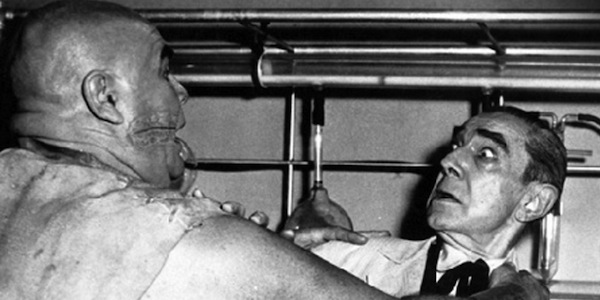
Anyone familiar with Ed Wood's movies knows he filled out the plot by seemingly compiling every cliche under the sun. Originally titled Bride of the Atom, the film aimed to cash in on the nuclear-age sci-fi trend (cliche) of the mid 1950's. As with all Ed Wood films, the results are...breathtaking? The plot follows Dr. Eric Vornoff and his monstrous assistant Lobo through his attempts to create an army of atomic supermen vis-a-vis his experiments with nuclear energy. I hope we're all familiar with Mary Shelley's Frankenstein and the cliched relationship between a stock mad-scientist and his disfigured laboratory assistant doesn't need highlighting, but incase it does... Don't worry. Ed Wood didn't forget to include the old, secluded mansion that serves as his lair and laboratory. The twist here is that it's guarded by a giant octopus, the film's monster. So therefore it must be surrounded by a moat. Right? Because otherwise people could just walk around the...oh, forget it. After a string of suspicious deaths (stop me if you've heard this before...), Journalist (of course) Janet Lawton goes to investigate (why wouldn't she?) and gets captured by Dr. Vornoff. Of course. Troubled by her disappearance, her boyfriend, police lieutenant, and real life son of the producer (the cliches even boil over into the casting!) begins the search for her while she suffers at the hands of Vornoff in his lab. Eventually Lobo becomes enthralled by Lawton (Beauty and the Beast) and sets her free. The lab, dressed with every trite object in the sci-fi book, is eventually burned to the ground in the cliche fire, and after the predictable under-water climax, the film ends with prototypical big explosion. And of course I can't stress "big" enough...Like, mushroom cloud big.