10 Teen Movies That Are Smarter Than You Think
Ditch the popcorn and put on your thinking cap; these teen movies have something to teach you.

Sitting at the intersection between comedy and romance, the teen movie is a staple subgenre that has remained popular ever since John Hughes made it a cinematic mainstay in the 1980s. But not all teen movies have John Cusack on the lawn with a boombox or Judd Nelson thrusting his fist in the air to Simple Minds.
The '90s and 2000s saw a boom that produced as many all-time classics as flops, before the streamers opened the floodgates in the 2010s, oversaturating the market with low-budget, poorly written, no-star efforts that have made it difficult to sort the queen bees from the wannabes. And for a genre that was never taken seriously to begin with, this has been a major blow.
Nonetheless, amid the ever-increasing barrage of fluff and nonsense of the past few decades, there are a handful of teen movies that set themselves apart. Yes, they tread the high school corridors, but they do it while developing elevated humour, meaning, and intelligence behind their apparently inconsequential facades. After all, 10 Things is a Shakespeare play in high school duds; Easy A combines classic literature with a wry reverence for its generic forebears; and Bottoms offers a meta take on the teen genre as a whole.
While the following ten films may appear to the untrained eye to be just like any other teen movie, they're way smarter than you might think.
10. Booksmart (2019)

Maybe it shouldn't come as a surprise that a film with "smart" in its title is more intelligent than the average teen comedy, and yet the meaning of "book smart" is someone who is well read but pretty dumb out in the real world.
And that is kinda who Booksmart’s protagonists, Molly and Amy (Beanie Feldstein and Kaitlyn Dever), are. The high schoolers are reaching graduation having never gone in for the parties, sex, and juvenile chaos their classmates thrive on, and feel they’ve missed out. Thus, they embark on a time-honoured escapade through various drug-and-drink-fuelled parties and awkward romantic situations with their contemporaries.
While this all sounds familiar to anyone who was alive and watching in the 2000s, Booksmart manages to take the Superbad template and make it relevant for a generation concerned with inclusivity and diversity, conforming to some of the Jonah Hill film's tropes and flipping others on their head. It manages to walk the tightrope of being genuine and relevant while going all-out on the physical comedy and giving a platform for the girls to be just as gross and sex obsessed as their male counterparts. And the all-female writing team manages to give this a feminist throughline that feels empowering, built around the idea of authentic personal discovery.
9. The Perks of Being a Wallflower (2012)

After moving into the big franchise movie space and losing touch with whatever used to keep them grounded, Ezra Miller has gone off the rails, and yet they started out their career turning in consistently funny, weighty, and considered performances that brought the films they were in to life. The Perks of Being a Wallflower is a prime example of this, which puts Miller, Emma Watson, and Logan Lerman through the wringer in high school.
Charlie (Lerman) lands hard in his freshman year, suffering all the usual struggles on top of an untreated bout of PTSD, and it’s only thanks to his new friends - seniors Patrick (Miller) and Sam (Watson) - that he makes it through. Patrick is a hellraiser who flunks his classes, while Sam manages to balance academic success and partying, catching Charlie’s eye in the process. And when their wider group’s tangle of hormones and relationships is picked apart, their friendships are tested.
So far, so ordinary. And yet, Wallflower was adapted from Stephen Chbosky’s beloved novel of the same name (by Chbosky himself!), and packs the literary one-two punch most teen cinema is missing. The coming-of-age story steps out of the high school movie comfort zone and tackles suicide, PTSD, and abuse, with the signs of Charlie’s mental health issues deftly embedded in more surface concerns like sexuality, so that when the devastating third act hits, we’re kicking ourselves at not having put it together.
But that doesn’t mean it doesn’t have a happy ending.
8. Easy A (2010)

Will Gluck’s Easy A gave an already 22-year-old Emma Stone one of her last outings in the teen genre, starring as Olive Penderghast, whose mistaken promiscuous reputation in her high school leads her to accept her salacious fate rather than reject it.
Cashing in on the appearance of sleeping around, Olive gives hopeless virgins and closeted homosexuals the social props and cover they desperately seek in exchange for money and gift vouchers. She embraces her image and even affixes a scarlet letter A to her outfits to pwn her critics irl. But this causes unforeseen issues in her real relationships and leaves her wishing for more.
First and foremost, the film is inspired by, and in conversation with, Nathaniel Hawthorne’s classic historical novel The Scarlet Letter, but at the same time, Easy A manages to reference and subvert the John Hughes films that created the modern teen movie template. The intertextuality is not just implicit but explicitly signposted in a scene where Olive namedrops movies like Say Anything, Sixteen Candles, and Can’t Buy Me Love, leaving no doubt as to Easy A's influences, but making its differences to those films - especially the fact of its empowered, independent female lead - clear in the process.
7. Eighth Grade (2018)

Bo Burnham’s directorial debut Eighth Grade is one of the few teen movies that actually makes an effort to portray the genuine teen experience. We follow Kayla (Elsie Fisher) into her final week of middle school, where she struggles with anxiety, isolation, and the pressures of an increasingly digital social life.
Kayla faces acne, panic attacks, an overbearing but well-meaning single father, and the discomfort of quasi-romantic moments with boys head-on, and lives to tell the tale. While the film is laugh-out-loud funny at times, and as cringingly awkward as the likes of American Pie could ever be, it manages all this via something that looks an awful lot like real life.
That’s because Burnham built Eighth Grade out of his own experiences in high school, and hired Elsie Fisher precisely because a) she was an unknown, b) she was the age her character is meant to be, and c) she looked like a real kid, not an airbrushed product of the pageant scene or Disney TV star. And it works. The material feels familiar from our own lives and from teen movies, shaping a new aesthetic for the genre, challenging the very real and multi-pronged issues of social media, social pressure, sexuality, and consent - all while delivering the laughs and emotional moments we expect.
6. Heathers (1988)
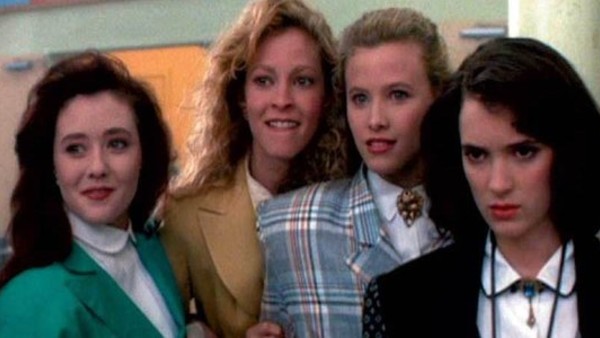
The high school clique is a staple of the teen movie, proving difficult to enter, devastating to leave, and tapping into the exclusionary social structures most people grew up with. Michael Lehmann’s Heathers is built out of this, putting Veronica Sawyer (Winona Ryder) in with Westerburg High’s most exclusive clique, the Heathers (Duke, McNamara, and Chandler), whose only goal in life is to look good and make life hell for everyone they don’t find hot.
But behind the handbags and Peter Pan collars, a darker narrative emerges when Veronica befriends trenchcoat-wearing, motorbike-riding bad-boy Jason "JD" Dean. Fed up of the systemic ostracization practiced by the popular kids, the pair embarks on a campaign of extreme subversion. Once JD has been unleashed, though, the bodies start piling up, and Veronica has three options: join him, stop him, or die.
Today, Heathers might be read as a school shooter film, but what screenwriter Daniel Waters was tapping into at the time was a culture and class war between the social and material haves and have-nots. The picture satirises the high school clique in deadly fashion, and while JD seems to come out as the bad guy, the final scene of the movie, in which Veronica confronts Heather Duke (Shannen Doherty), points us back towards its real target.
5. Clueless (1995)

One of the defining teen movies of the '90s, Amy Heckerling’s Clueless features a whole host of then-up-and-coming stars, including Alicia Silverstone, Paul Rudd, Brittany Murphy, and Breckin Meyer. And it is the very opposite of what its title suggests.
Cher Horowitz (Silverstone) is the ditzy, popular, and well-meaning rich kid the film’s title refers to, who makes it her mission in life to look good, live well, and play matchmaker across her high school. She renegotiates her poor grades, sets teachers up on dates, shops ‘til she drops, and falls for her stepbrother Josh (Rudd).
Clueless is all tongue in cheek, a satire of the very culture it represents, showing the excesses and idiocies of the affluent, Hollywood-adjacent types for whom the tribulations of life are largely inconsequential. But it’s also a loose adaptation of Jane Austen's Emma, jettisoning the Surrey setting, the period aesthetic, and the 19th-century English diction in exchange for SoCal everything. And it well and truly does the job, adapting the book for modern audiences while launching a biting critique that lambasts Austen’s uncritical fascinations with status, matchmaking, and high society.
4. Mean Girls (2004)

Mark Waters and Tina Fey’s Mean Girls is to the 2000s what Clueless was to the '90s, simultaneously capturing and creating the zeitgeist while serving up an infinitely quotable teen comedy.
Back before Lindsay Lohan went off the rails, she was Cady Heron, the newcomer at North Shore High School, whose childhood of home-schooling in Africa leaves her woefully underprepared for her new life as a US teen. North Shore is all but run by the Plastics, a trio of mean girls led by queen bee Regina George (Rachel McAdams) that allow Cady into their ranks - a position that gives her the opportunity to report back to her outcast friends on all the nasty things they get up to, while quietly undermining them.
Though this obviously pays homage to Heathers, Mean Girls is very much its own thing.
Loosely based around ideas extracted from Rosalind Wiseman’s self-help book Queen Bees and Wannabes, Fey’s whip-smart writing deconstructs the power relations and sociology of the high school experience. Yes, it’s funny as hell, but it also provides a unique commentary on our high school experiences, showing how the cliques, conformity, posturing, hierarchy, and exclusionary practices bridge the gap between the natural and human worlds, and how we may not be as evolved as we think.
3. Election (1999)

Cited by Quentin Tarantino as his favourite film of 1999 (sorry, Phantom Menace!), Election centres around the low-stakes, high-energy election for student government president at George Washington Carver High School.
Wide-eyed, scheming know-it-all Tracy Flick (Reese Witherspoon) is the frontrunner for the position, and, having had absolutely enough of her, history teacher Jim McAllister (Matthew Broderick) regrettably involves himself in sabotaging her chances and furthering the prospects of rival candidate Paul Metzler (Chris Klein). Needless to say, this doesn’t exactly go to plan, and after a film spent trading verbal, emotional, and social blows with Tracy, Jim’s election-rigging antics are outed, and he loses more than just his job in the process.
Election adapts Tom Perrotta's already accomplished novel and injects it with a major dose of the kind of sardonic magic that writer-director Alexander Payne has come to be known and revered for. The surface level of the film feels pure high school, but beneath that, there is a sharp commentary on US politics. And the message? The most odious, devious, and unsuitable candidate for office will inevitably be the one who goes farthest…
2. 10 Things I Hate About You (1999)

The teen movie makers of the '90s and 2000s had an almost unhealthy obsession with the Bard, cranking out an unholy number of pictures based on Shakespeare’s plays. The films that resulted from this period weren’t exactly created equal, but there is a certain standard of quality to most of them, and an especially high bar set by 10 Things I Hate About You.
The breakthrough picture for Julia Stiles, Heath Ledger, and Joseph Gordon-Levitt, the film touches down in Padua High, Seattle, where new student Cameron James (Gordon-Levitt) acclimatises to his new surroundings and promptly falls head over heels for Bianca Stratford (Larisa Oleynik). There’s only one problem: Bianca isn’t allowed to date until her arty, feminist, men-hating older sister Kat (Stiles) does. Thus, Cameron pays bad boy Patrick Verona (Ledger) to lure Kat onto the dating scene. And, of course, things don’t quite go as planned.
Based on The Taming of the Shrew, 10 Things strikes the perfect balance between its source material and its contemporary subject matter, integrating the nuances of Shakespearean romance into the '90s high school setting. All its characters have their own agenda, and the loops and twists in their relationships feel authentic while being elevated above the usual teen fare, trampling and sending up the standard tropes in equal measure.
1. Bottoms (2023)
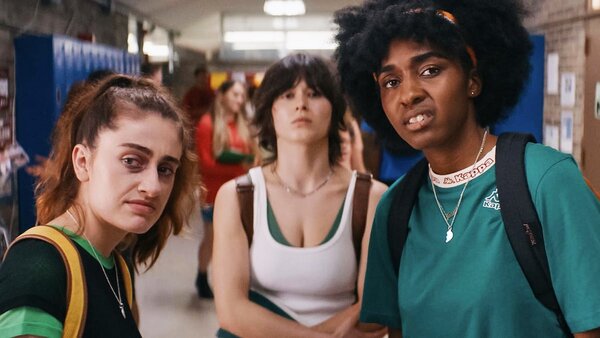
Emma Seligman’s Bottoms is the teen movie we didn’t know we needed, until we did. It’s an absurdist satire on the very concept of teen movies, paying homage to the entire canon, from in-the-know films like Heathers, Election, and Easy A, to the more bare-faced, straightforward teen movies like She's All That and Bring It On, and it’s better than all of them.
Deeply unpopular best pals PJ and Josie (Rachel Sennott and Ayo Edebiri) occupy a precarious social position at the football-obsessed Rockbridge Falls High, compounded by their lowly status as virgins. Seeking the approval and romantic reciprocation of the cheerleaders, the pair lean into their suddenly (and mistakenly) acquired bad girl images and form a fight club, widening the gender gap between their contemporaries.
Bottoms expands, exaggerates, and subverts an array of typical teen narrative tropes, including the sexy car wash, the prank, and the virgin pact, as well as more meta-level tropes like, for example, the cast playing way below their age range, calling attention to the fact that teen movies often cast people in their 20s as high schoolers.
Though the film amplifies and examines the stereotypes used in teen movies, it maintains its own fiction throughout. This isn’t Not Another Teen Movie or Scary Movie, and it is not winking down the camera lens and stepping outside the frame of its own fiction. The world is fully occupied by Bottoms' characters; it’s just that that world, as in most teen comedies, doesn’t make sense.