10 Ridiculous Ways You Won't Believe Films Accomplished Shots
What's the point in being a director unless you're willing to destroy an entire ecosystem?
Moviemaking is a tough business. For a director, the process of translating a dream script from fantasy to reality can sometimes prove near on impossible - the imagination of a filmmaker is unlimited, though, not bound by reason, logic or any of the things that stop the sky from turning red or prevent our pets from becoming jazz musicians. A movie production is a physical thing, bound by budgetary constraints and the limitations of the artists on-board.
What great ideas filmmakers have in their head aren't always achievable in real life. But for some directors, 'no' isn't any kind of reasonable answer. Failure simply isn't an option for such brave souls. They'll break their back and the backs of their colleagues if they have to, or - if they're particularly daring - go to extreme, costly lengths and hope the investors don't notice.
Presented here is a list of 10 directors and the shots they achieved by just saying "screw it, we'll do it anyway."
10. D.W. Griffith Rebuilt A Piece Of The Babylonian Empire For Intolerance (1916)
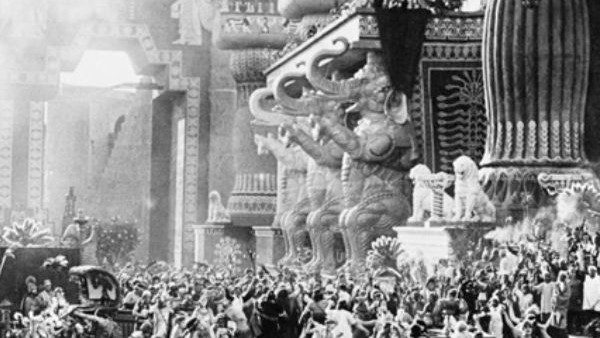
Back in the 1910s, or 'the olden days', as it's better known, there was no CGI for cinema to fall back on. Filmmakers at the time had to make do with what they had: models and wonky-looking special effects that probably didn't convince anyone even then. The director could either get the shot they needed in-camera, or just not get it at all. It could mean building what they needed for real - for something like a familial drama, you could get a domestic abode built inside one of LA's many available studio spaces, no problem.
Clearly, this same logic wouldn't extend to historical epics that required a reconstruction of enormous antediluvian cities. Except it evidently did. For his 1916 epic silent movie Intolerance's most famous shot, director D.W. Griffith requested, nay, ordered that a section of ancient Babylon be rebuilt on the corner of Sunset Boulevard and Hollywood Boulevard in LA. For this four-part epic, a life-size set was deemed necessary to appropriately depict The Great Wall of Babylon - measuring 100 feet high, and packed with extras working on princely wages, this shot alone took $200,000 out of the film's estimated $2.5 million budget.
The set was so humongous that the LA fire department considered it a fire hazard, and demanded it be taken down; only Griffith had run out of money at this point, and couldn't afford to demolish it. So it just stood there. For four years.
9. Stanley Kubrick Built A Set In A Ferris Wheel For 2001: A Space Odyssey (1968)

Stanley Kubrick didn't do things by halves. This was the man who spent years of painstaking research on his passion-project Napoleon movie, only to then abandon said project and work just as painstakingly on 1975's Barry Lyndon instead. This is the man who rebuilt Vietnam at the site of an old London gas works, who spent over a year shooting Eyes Wide Shut (a total of 400 days, holding the world record for the longest continuous shooting period) just to get it right.
So when Stanley Kubrick set a movie in space, you can only imagine his disappointment when he was reminded that man had yet to reach the moon, rendering him unable to go up there and film it himself. Instead, Kubrick had to make do with boring old Earth for the production of 2001: A Space Odyssey, and, for a scene set aboard spacecraft Discovery One, Kubrick had to resort to funfair technology to get the shot he wanted.
For the scene in which Keir Dullea's pilot, Dave Bowman, jogs along the circular hub of the ship, in which the floor is a never-ending track bolstered by in-built gravity flooring, Kubrick had the set built into a rotating Ferris wheel, at a cost of $750,000.
The result is a stunningly simple visual effect, though it's better not to think about the fact that Kubrick was essentially filming his actor jogging around a giant hamster wheel.
8. Danny Boyle Destroyed An Ecosystem For The Beach (2000)
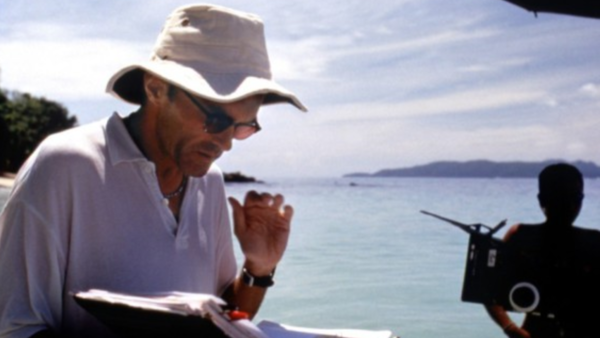
Before Leonardo DiCaprio became a coke-snorting stockbroker for The Wolf of Wall Street, and before Danny Boyle became some kind of national saint for directing the baffling opening ceremony of the 2012 London Olympics, the two collaborated to adapt Alex Garland's bestselling novel, The Beach, for the big screen. And while the resulting film, which could be aptly described as your uncle trying to teach you all about the backpacking scene of the late 90s, didn't go down too well with critics, there was a more important matter: that of the film's production 'landscaping' (read: bulldozing) over the natural beauty of Thailand's Phi Phi Lay island.
To more accurately match the filmmakers' idea of what the titular beach would look like, Maya Bay, The Beach's principal location, reportedly became a "forlorn scene of ugly bamboo fences and dead native plants" after the crew removed unsightly local flora and planted alien plants and palms in their place.
The complex ecosystem then later fell apart, and wasn't restored to its original state until the 2004 tsunami came and put it all back together. And that was after years of legal battles and claims of illegal "rearranging" on the part of the production team. But hey, The Beach! It was worth it, right? Nah.
7. Akira Kurosawa Shot Real Arrows At Toshiro Mifune For Throne Of Blood (1957)
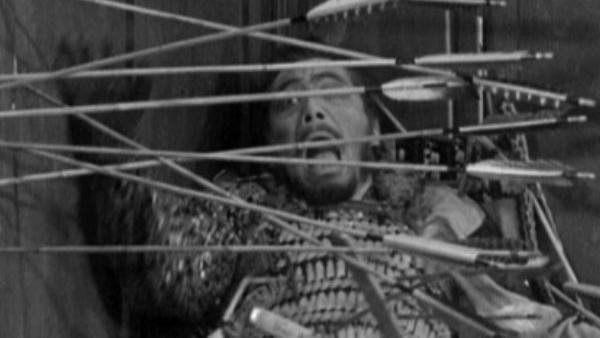
Akira Kurosawa is responsible for some unforgettable death scenes, like the killing of Kyuzo by the recently-invented musket in Seven Samurai, or the geyser of blood-spurting end of Hanbei in Sanjuro. Perhaps most unforgettable of all, however, is the death of Washizu (Toshiro Mifune) in Kurosawa's adaptation of Macbeth, Throne of Blood: having killed his lord and arranged the murder of his best friend, Washizu finds his newly acquired castle besieged by an avenging army of samurai. Fearful, and tired of his rule, Washizu's men turn on him and decide to offer his body up to the enemy.
To do this, they have to kill him first, so Washizu's troops take the practical approach and fire a barrage of arrows his way. And with Mifune clearly on-camera apparently dodging these flying kill-sticks for some unnervingly long takes, it looks almost real. That would be because it is - doing away with all this special effects or camera trickery nonsense, Kurosawa had choreographed archers shoot real waves of arrows at Mifune, requiring the actor to hit specific marks and hope to hell one of the bowmen wasn't having an 'off day'.
If Mifune looks appropriately frightened for his life in this final scene, then he probably is.
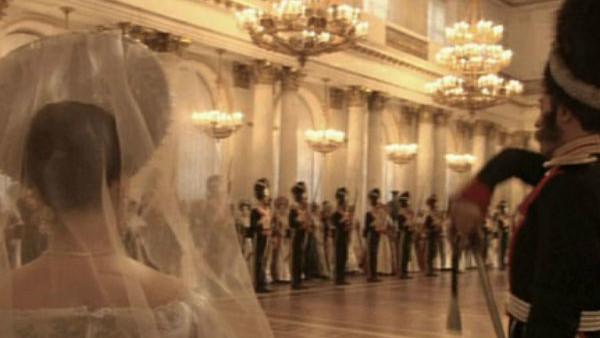
6. Alexander Sokurov Shot The Entirety Of Russian Ark (2002) In A Single 96-Minute Tracking Shot
The single-take movie has apparently been done before - Alfred Hitchcock, for example, was doing it as far back as 1948. But take a closer look at Hitchcock's Rope - actually broken down into ten shots with wily Hitch masking the cuts with sneaky editing, Rope is a masterful film made by a director clever enough to avoid forcing a cameraman to film for 80 minutes straight, and wise enough to gather that an uninterrupted take would be a logistical nightmare (if Jimmy Stewart had put a foot wrong two minutes before the end, it would've been back to square one).
For all his psychological torture and human/bovine comparisons, even Hitchcock wasn't that cruel. We can assume that Russian Ark director Alexander Sokurov, however, is - for his historical drama, Sokurov filmed for 96 minutes non-stop. And this wasn't some static theatre piece, either - Russian Ark was shot in Saint Petersburg's massive Winter Palace, a Steadicam weaving around the building, requiring a heavily orchestrated and minutely prepared cast and crew to follow every step to the detail.
It involved 33 separate rooms of the museum, plus a cast of over 2,000 actors, and it's a wonder DoP and Steadicam operator Tilman Buttner hasn't already received the Hero of the Russian Federation medal for making it through alive.
5. John McTiernan Dropped Alan Rickman 70 Ft. For Die Hard (1988)

Alan Rickman didn't take a feature film role until he was already comfortably into his 40s, and it instantly made him a star. He'd play Die Hard's uber-villain Hans Gruber with such aplomb that it'd set him up for life, seeing him build a healthy career on dastardly villainy and all-round nastiness; but it came at a price.
In a scene towards the end of John McTiernan's Die Hard, Gruber, confronted by Bruce Willis' John McClane after McLane has mercilessly slaughtered all of Gruber's men, is forced out onto the ledge of the multi-storey Nakatomi Plaza building. McClane then drops Gruber out of the building, allowing a misunderstood German terrorist to fall to his horrible death. And Rickman did this for real. Obviously not entirely - Rickman is still with us after all.
The actor's fall was broken by an air bag and, in reality, the distinctly concrete-floor-looking background was achieved through green screen; Rickman wasn't really falling out of Nakatomi Plaza. But he may as well have been: the actor really did get dropped a total of around 70 feet (or 40 feet, according to Rickman himself - accounts vary of how big his balls really are), hence why he looks so convincingly full of fear and regret as he's falling.
What we see here is the first take, meaning McTiernan didn't have to put Rickman through this ordeal more than once... but you can bet that he did.
4. Ron Howard Flew His Cast Into Real Zero G For Apollo 13 (1995)
If you want to know how difficult it is to recreate a zero gravity environment for film, just give Alfonso Cuaron a call. Once he's done screaming in terror over flashbacks of what must've been one of the most tortuous shoots ever embarked upon, he'll tell you that Gravity took years of pre- and post-production, the use and even invention of cutting edge technologies, and hours of laborious shooting to incredibly specific instructions. Why do you think there aren't more movies set in space?
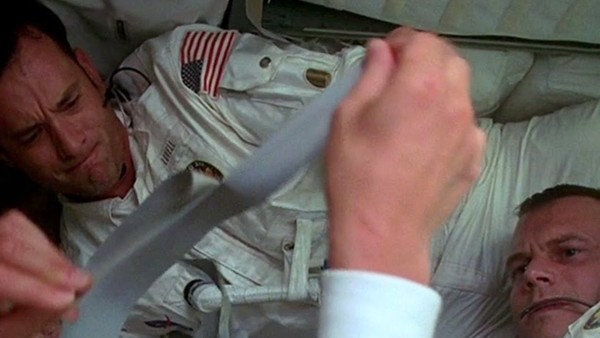
For Apollo 13, Ron Howard took one look at the logistical worries of doin' a reconstruction of space on Earth and declared that ain't nobody got time for that. And so, rather than shooting Tom Hanks, Bill Paxton and Kevin Bacon into orbit, thus endangering the lives of Hollywood's most wholesome trio, Howard instead sent his boys on a trip in a Boeing KC-135, a reduced gravity aircraft - also known as the 'Vomit Comet' - that recreates the sensation of zero gravity.
By flying high then plummeting suddenly back to Earth, the Vomit Comet offers a 25-second window in which its passengers really are drifting in zero gravity. Howard simply set up his camera inside the aircraft and set Hanks and co. to 'float'.
3. Michael Curtiz Craftily Utilised 'Little People' Extras For Casablanca (1942)

The use of forced perspective in movies is, as well as surprisingly effective if used correctly, often absolutely hilarious when seen up close. Think Ian McKellen stomping around a tiny house like a giant in The Fellowship of the Ring, or Jim Carrey getting reduced to child-size for Eternal Sunshine of the Spotless Mind. These are examples of forced perspective done right, but perhaps the most (in)famous application of the technique in cinema still resides in Casablanca, shamelessly exploiting as it does a set of 'little people' to stand in for extras, only ones that are very far away.
As Casablanca was made during WWII, more pressing matters - like not getting bombed - meant the crew couldn't film the picture's final scene at a real airport after dark. Instead, director Michael Curtiz took the shoot indoors, onto a sound stage, where he'd built a small cardboard cutout plane and placed a set of small people portraying the take-off crew. So next time you're watching this classic, take a look at Humphrey Bogart in the closing minutes, appreciate his final exchange with Ingrid Bergman, then allow yourself to recognise that stood behind Bogart were a pair of tiny extras hired just to confuse the audience into assuming there was a greater distance between the camera and the back of the studio.
2. Michael Cimino Spent 24 Hours And $200,000 On Kris Kristofferson Cracking A Whip For Heaven's Gate (1980)
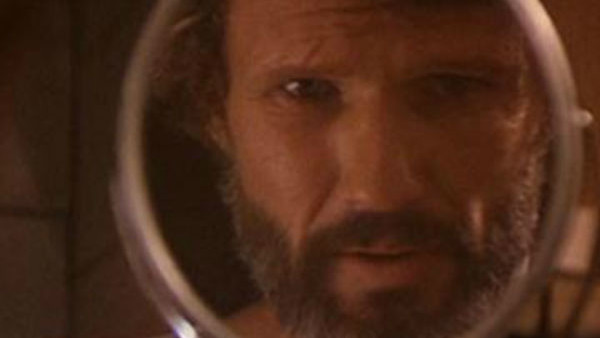
This one isn't so much a mind-blowing shot - in fact, the image of Kris Kristofferson cracking a whip in Michael Cimino's Heaven's Gate is plain and unremarkable. It has no impact on the plot, and is nothing but a stylistic flourish that you could, essentially, take or leave. But it's the lengths to which Cimino went to get the shot that's extraordinary.
On production of Heaven's Gate, a film which has come to represent ultimate excess in Hollywood moviemaking, the notoriously perfectionist director reportedly filmed a minimum of 32 takes for each shot. It's been said that Cimino was trying to top Francis Ford Coppola's own one-million-feet-of-footage style of excess on Apocalypse Now (p.s. mission accomplished: Cimino got to 1.3 million feet of film, totalling some 220 hours), so would rack up the number of takes on-set.
Of course, it becomes a bit of a problem when said film is costing approximately $200,000 per day and the director is spending whole days on single shots, like that of lead actor Kristofferson drunkenly cracking a bullwhip in a hotel room. The film went over-budget, flopped at the box office, bankrupted a studio, ruined Cimino's career and practically killed the western. But hey, at least now the critics like it, right?
1. Christopher Nolan Pimped A Jet With A Camera For Interstellar
If you're Christopher Nolan, then you've got to have a significant amount of leverage in the movie business right now. You're probably the biggest 'name' director of today, adored by beard-stroking intellectuals as much as you are by comic book nerds and less pretentious cineastes.
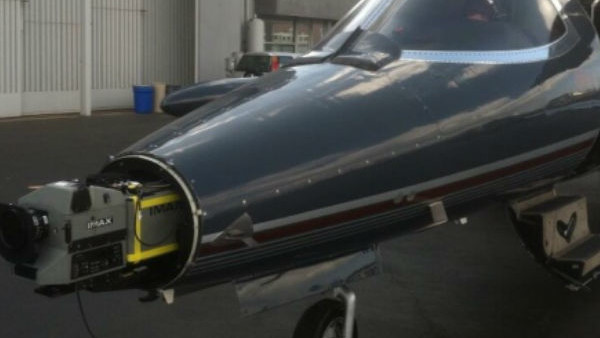
So, if you've got one of the most iconic blockbusters of the age (Inception) and, that rarest of beasts, a critically acclaimed comic book movie trilogy (The Dark Knight saga) under your belt, you best believe an IMAX camera will be built into the nose of a learjet when you ask for it.
For Nolan's Insterstellar, he got exactly that. Known for his distate of CGI special effects, Nolan built as many practical sets as possible and the IMAX shots from the learjet helped the film become one of the more visually striking of 2014.