10 Reasons Why The World's End Is Secretly The Best Of The Cornetto Trilogy

Yeah, you heard. Now how's that for a slice of fried gold?

The Cornetto Trilogy: Shaun of the Dead, Hot Fuzz and The World's End €“ surely the greatest geek-friendly series of British comedy films ever to tear through cinema. A decade-spanning, unstoppable torrent of big laughs, unforgettable quotes and ambitious set pieces, recently completed with last year's arrival of The World's End, a sci-fi adventure in which five childhood friends reunite to attempt a fabled pub crawl in their hometown. A pub crawl which, in true Simon Pegg/Edgar Wright fashion, is interrupted by an invasion of alien robots. Each film in the cult trilogy, connected by writer/director Edgar Wright, best-mate leads Simon Pegg and Nick Frost and a gaggle of recurring jokes, is hilarious in its own right - with zombie-ridden debut and riotous quote-factory Shaun of the Dead most commonly regarded as the standout classic of the series. But what if €“ blasphemous as it may sound €“ Shaun isn't actually the best of the three? What about latecomer The World's End? Can a case be made that €“ in terms of pure quality of writing, direction and performance €“ part three (the oft-most derided instalment of any trilogy) is secretly a better film than its predecessors? Here are ten points which may well prove that to be so...

10. Directorial Flair

Edgar Wright is a filmmaker who was born masterful and whose confidence behind the camera has only snowballed since. Just take a look at his very early short film Dead Right, included on the Hot Fuzz DVD extras, to see how early on his unrivalled eye for visual, kinetic ingenuity strove to leap above and beyond the call of duty. It almost goes without saying that some of the most frequently lauded aspects of Spaced and Shaun of the Dead are the ingenious, fluid elements of Wright's direction, but The World's End sees the comedy maestro at the peak of his abilities, easing off on the recognisable 'woosh' cuts that gave accent to Shaun and Fuzz. This is post-Hollywood, Scott Pilgrim Wright. This is Marvel Studios Wright. The first real master-stroke comes during the film's celebrated men's room showdown €“ the first encounter our inebriated heroes have with the robotic forces of the invading network. Without a slither of strain, Wright deftly realises an inventive, five-way fight scene wherein his travelling camera breezes in and out of the separate one-on-ones in a rolling, edge-of-your seat set-piece to rival the likes of Avengers Assemble's explosive denouement. Many a Brit director would be content with such a sequence, but Wright insists on outdoing himself with a later punch-up in one of Gary King's beloved pubs, during which the anti-hero strives to keep his pint glass filled to the brim with beer in an ambitious balancing act that Buster Keaton would be proud of. The World's End is a British comedy wrapped in Hollywood flair (which, given its genre cinema leanings, is wholly appropriate). What it retains in themic and comedic kinship with its Cornetto predecessors, it gloriously dusts off in terms of slick, unfaltering visual style.

9. Soundtrack

One of The World's End's secret weapons is nostalgia €“ unsurprising given the nature of the premise €“ and in no aspect of the finished product is this more rewarding to the viewer than in its excellent soundtrack. Wheeling out a host of forgotten gems from the early '90s Britpop movement €“ including Teenage Fanclub, Suede and The Soup Dragons €“ alongside some better known hits from the likes of Pulp and The Stone Roses, the film's choice of soundtrack underscores the plight of fallen idol Gary King, a hero of the heyday he refuses to loosen his grip on. What's more, who could sit through such a wealth of bygone classics and not themselves fancy a pint afterwards? While Shaun and Fuzz each have a superb choice of fitting pop to prop them up, The World's End outdoes them yet again with its constant onslaught of rousing, rocking numbers (there's even room for some early Kylie Minogue in the only place where you'd expect to hear her). And in true Cornetto fashion, each song lyrically compliments what is happening on screen at the time. Pegg and Wright leave no stone unturned.

8. Gary King

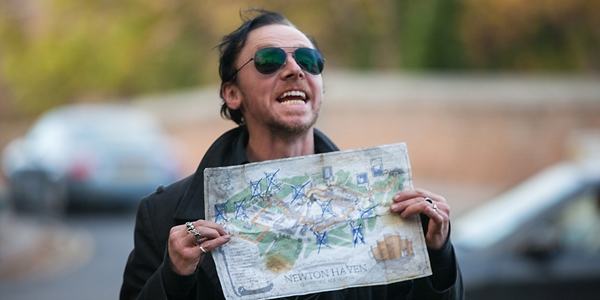
Central character and virtual antagonist Gary King remains the most divisive element of The World's End, though it's really the actor behind the character that's the source of the derision. It's hardly unusual for a film from within the notoriously self-deprecating genre of British comedy to centre around an unlikeable lead, and were it anyone other than traditionally-matey Simon Pegg in the role, it's likely the character would have been slightly more readily accepted. Either way, it's difficult to deny that King is one of the most complex and layered characters Pegg has ever played, and unquestionably so among his Cornetto trilogy-triplets. The man is introduced as an irritating twerp €“ the bane of his former school friends, each of whom follow him to Newton Haven with extreme reluctance. Throughout the course of the crawl, the layers of the character are gradually peeled away very much against his wishes until the root of his perpetual standoffishness is eventually revealed €“ the pub crawl was the all-too-early high point of King's life and he masks depression, alcoholism and drug abuse by trying to relive it. It's masterful writing, and while King's journey from unfocused loser to unlikely hero echoes that of Shaun, the former is (forgive me) little more than Pegg playing himself. King is a true creation, more complex, more troubled and with lines like "A man of your legendary prowess drinking ****ing rain" and "Why don't you get back in your rocket and **** off back to Legoland," funnier than the characters that paved the way for him.

7. Chemistry

Another initially jarring departure from the well-established Cornetto dynamic was the bold decision to all but remove the Simon Pegg/Nick Frost bromance, at least until the very end. Instead, Pegg and Wright up their number of leads from two to five and yet again rise effortlessly to any challenge that may have cropped up in doing so. Shaun of the Dead €“ and to a lesser extent Hot Fuzz €“ focused on an ensemble of characters, but in each case the majority were partly sidelined in favour of the celebrated pair. This time round, everyone gets to play. Gary King and Frost's Andy Knightley give each other a wide berth for the bulk of the film so that the entire group of crawlers €“ the 'Five Musketeers' €“ can spar with one another and develop and demonstrate their varied set of kinks and idiosyncrasies. The dialogue comes thick, fast and funny, and the sense that this lot have known each other since childhood is reinforced throughout as the group move through waves of mistrust, disappointment and hearty nostalgia in quick succession. It's not just Pegg and Frost who get the best lines, either. Between Paddy Considine's Steven Prince adolescently pining over best mate Oliver's (Martin Freeman) sister Sam (Rosamund Pike) and Eddie Marsan's mawkish turn as pushover Peter Page, everybody is invited to be laugh-out-loud funny. The 'old-mates' chemistry is so believable that you'll wish you were invited to crawl the Golden Mile, even after things turn nasty.

6. Social Commentary

Those who fancy themselves ready to tackle the genre of science fiction had better not do so without heeding the importance of social subtext, and thankfully Simon Pegg and Edgar Wright know this. Formerly content to exorcise their geek-cult demons by way of splattering heads and car chases, The World's End throws a bit more cultural context in to the mix, as is to be expected with the Ray Bradbury/John Wyndham territory of 'Social Science Fiction.' Their stance on the overall iffiness of a man in his forties refusing to grow out of his teens notwithstanding, The World's End begins with some appropriately middle-aged grumbling on the monopolisation of British pub culture and the loss of character inherent in such a corporate pursuit ("Starbucking," as Steven Prince puts it). The revealing shot of the second pub's interior being identical to the first makes for a delectable sight gag in that respect, while the townspeople €“ ultimately revealed to be hive-minded robots €“ underline this conviction in their monotonous, huddled behaviour and quiet, cautious scrutiny of the newcomers to the town. However, the film then takes a bold move towards the final act as it starts to question whether 'Starbucking' is such a bad thing after all. It is revealed that the network wish to conglomerate every planet in the galaxy €“ akin to an intergalactic coffee empire €“ and work to make each planet's people the best they can be. As Wright himself remarks in The World's End's making of feature, was the old coffee really ever that good in the first place? Whatever view one may take to this outlook, it has to be said that such ideals and societal inclinations are yet again above and beyond the duties of a comedy film, and while Shaun and Fuzz make their nods toward the dispositions of society, neither comes close to the unwavering undercurrent present in The World's End.

5. The Last Act

The last act of a film is ultimately what leaves a taste in the mouths of its audience, and filmmakers would obviously like that taste to be closer to creamy, minty Cornetto than warm, stale lager. In this case, Pegg and Wright present us with far and away the funniest continual sequence of events and one-liners they've ever dished up. Hot on the heels of The World's End's (and the entire trilogy's) most dramatic scene €“ in which Gary and Andy alone make it to the titular pub and Gary's desperation is quantified via the reveal of a recent suicide attempt €“ the tone then u-turns completely as Gary and Andy then unwillingly descend into the bowels of the pub and are confronted with the bright, booming leader of the Network (voiced by trilogy veteran Bill Nighy). What follows is hilarious to no end. By now severely drunk after successfully necking eleven of his twelve pints, Gary stands atop a table and raucously defends humanity the only way he knows how €“ by shouting, swearing and refusing to take criticism. It's clear as day Pegg and Wright had a ball writing this scene, as each line rhetorically outdoes the last and matches Shaun's "He's never liked me and now he wants to shoot my mum" in terms of sheer, cry-laughing hilarity. From the aforementioned "Legoland" remark, through "To err is human, so... err..." to Steven Prince's eleventh hour arrival, nothing is less than fried gold. It's the gut-wrenchingly riotous conclusion to a decade of spellbinding British filmmaking and should have comedy writers the world over sitting up in envy. Richard Curtis certainly has his work cut out.

4. A Cult Classic Already

Let's be honest, this is a film about an alien invasion during a pub crawl €“ it had the 'lad' market tapped from the word go. But like Shaun of the Dead and Hot Fuzz, The World's End is surely destined for repeatable, cult-classic status. It boasts the repeat-viewing, blink-and-you'll-miss-it layers familiar to the rest of the trilogy (the fact that the name of each pub on the crawl foreshadows what happens to our heroes within being the tip of the iceberg) and many of its best lines are already doing the rounds on social media and in pub banter. There are even, predictably enough, a number of drinking games related to the film surfacing on all corners of the web (drink responsibly). Like the seductive siren bots in the Mermaid's school disco, The World's End lures you in with its promise of a good time. Beyond being the untrustworthy, self-centred antihero of the film, Gary King is inviting us as the audience to share in his good time and certainly the pre-robot invasion portions of the film feel just like a good night out with old friends, as the initially reluctant musketeers grow to enjoy their evening through funny stories of old times, good music and shots. It's the perfect film to gather your mates for, a trait which in time will prove to be the fuel for its longevity.

3. Honouring The Past

The World's End concludes a tonal thread that began not with 2004's Shaun of the Dead, but with Spaced - the 1999 sitcom that first drew the talents of Simon Pegg, Nick Frost and Edgar Wright together. Each film in the ensuing trilogy strove to include as many actors from the acclaimed TV series as possible, and the final entry concludes the trend, finally adding a cameo from Mark Heap, who played eccentric artist Brian. In fact, the only key actor from Spaced to not have appeared in the Cornetto trilogy is Katy Carmichael (Twist). In the realms of the trilogy itself, Pegg and Wright have made sure that every actor who had appeared in both Shaun of the Dead and Hot Fuzz (Martin Freeman, Bill Nighy and Rafe Spall among the many) also features in The World's End, which fully brings home the idea that though these three films are unconnected with regards to characters and narratives, they are very much parts of a greater whole and each individually recognisable as a relative to the others. Even the premise of The World's End brings the trilogy together somewhat, being as it is an amalgam of the previous films: our characters arrive in a small town wherein strange local behaviour seems commonplace (Fuzz), and decide that €“ in spite of the mounting terror €“ going to the pub is still the best plan (Shaun). The Network robots themselves are also something of a cross between the zombies of Shaun and the Neighbourhood Watch Alliance of Fuzz.

2. A New Direction

A common misconception about the Cornetto trilogy is that it's little more than a series of parodies of other genre films. Though references to such films are rife throughout Shaun and Fuzz (reenacting sequences from films as diverse ass The Omen, Night of the Living Dead and Lethal Weapon), this has never been the case €“ each film is its own beast, and at the most can be called an homage to its respective genre. This time round, it's quite clear that Pegg and Wright have grown weary of this erroneous reputation, and the end result reinforces this in spades. The World's End tones down the genre references considerably. There are few, if any, direct riffs on past sci-fi movies and more so than either of the films that went before, it stands firmly on its own two feet €“ not afraid to mark itself out as a wholly original outing for the Cornetto team. The essential 'trilogy' jokes are there €“ the fence jump, the fruit machine and the Cornetto itself €“ but while the premise may feel a little familiar, that is far more down to the notion that many sci-fi plots have been done to death in the hundred-plus years since the genre's inception. The "Starbucking" plight of the corporate Network is actually quite a novel idea, when applying the spin that the Network is an ambitious, intergalactic chain with an outlook akin to a coffee giant or franchise pub company, and Gary King is a protagonist not plucked from any existing work - which sets him apart from Shaun and Nicholas Angel who with a few alterations could well be Tim from Spaced and Murtaugh from Lethal Weapon respectively.

1. A Worthy End

The World's End depicts the end in more ways than the obvious. Early in the film, when attempting to recruit his old friends for the pub crawl, Gary remarks "It's about closure. It's about, why should something like getting old affect something as important of friendship?" This line sums up more than Gary King's immature disposition, it sums up the entire trilogy. King very much embodies the trilogy itself €“ he is immature yet still funny, geeky yet still stylish and obsessed with reliving japes from years ago. While the rest of the cast is made up of now highly esteemed British actors €“ Sherlock and The Hobbit's Martin Freeman, award-winning director, Shane Meadows collaborator Paddy Considine, and even Nick Frost, who had no acting experience prior to working on Spaced, has since gone on to bigger things, it's still endearingly immature. As the trilogy is very much the passion project of Wright and Pegg, it is only fitting that Pegg play the one member of the group who doesn't want things to change and is reticent to change himself. The World's End is the worthiest of endings imaginable for the superb trilogy, an ending alluded to by the Cornetto wrapper that flutters in the wind in the film's epilogue €“ devoid of ice cream, unattainable and then spirited away into the ether. Ultimately, Gary King learns to move on to a degree €“ he is still reliving the Golden Mile but has overcome his alcohol addiction. Such is the outlook of the writers €“ they may go on to deliver greater, more serious work (Wright is on the cusp of adding a chapter the phenomenally successful Marvel Cinematic Universe and Pegg is a prominent fixture in the rebooted Star Trek franchise), but they will never really lose that disposition for unadulterated, geeky humour and love for cult cinema.

Contributor

26 year old novelist and film nerd from London. Currently working on his third novel and dreaming up more list-based film articles to flood WhatCulture with.