10 Movies Where The Hero Was Dead All Along
So heroic, and so dead.

In our cinematic present it's fair to say that the "they were dead all along" plot twist is totally and utterly played out.
Only the cleverest of movies can get away with such a thoroughly overdone "surprise," because in 2021 audiences are just too savvy to the conceit of a dead protagonist walking around as if they're alive.
But cinema is nevertheless littered with memorable examples of heroes who, for one reason or another, were actually dead or living out their final dying breaths for most of the movie.
In some cases the movie itself is the dying dream of a mortally wounded person, or perhaps their consciousness has been somehow preserved after they've been declared physically, clinically dead, or maybe they're just a straight-up ghost doing their thing the whole time.
Whatever the explanation, these 10 movies featured central, heroic characters who were goners as soon as the movie started.
More often than not, what remained was their quest to complete unfinished business, finish an existential odyssey and, if they were lucky, ascend to a higher plane of existence...
10. Jacob's Ladder

Jacob's Ladder opens with the titular protagonist (Tim Robbins) serving in the Vietnam War, where during a sudden attack he's stabbed with a bayonet by an enemy combatant.
After this, Jacob wakes up on the New York City subway apparently several years later.
For the rest of the movie Jacob encounters a series of increasingly unsettling, demonic visions, seeming to suggest he's suffering the effects of PTSD since returning from war.
But it's ultimately revealed that Jacob never actually made it back from Vietnam, and the movie's events have in fact been his brain making sense of everything that's happened to him as he expires.
As it turns out, Jacob was stabbed to death by one of his own teammates after their squad was dosed with an experimental drug called The Ladder, causing them to violently turn on one another.
The final scene cuts back to Vietnam where Jacob lies dead in a medical tent, though in his final moments he at least seems to have found some fleeting sense of peace regarding his young son's (Macaulay Culkin) death, a vision of whom leads him into a bright light as he dies.
9. Source Code

Duncan Jones' Source Code is one of the smartest original sci-fi movies of the last decade, following Captain Colter Stevens (Jake Gyllenaal) as he repeatedly enters a computer simulation of a train bombing to try and track down the culprit.
Yet it's revealed later in the film that Stevens was effectively killed in action two months prior in Afghanistan, and the U.S. Army has kept his brain artificially "alive" on life support, hooking him up to neural sensors which allow him to enter the simulation.
Though Stevens sees himself as an able-bodied man, this is actually just a manifestation his mind created in order to cope with the situation, while in actual fact little of his physical body still remains.
An unsurprisingly angry Stevens then asks Captain Goodwin (Vera Farmiga) to terminate his life support once he completes his mission, but of course, the film instead ends with Stevens hijacking some poor guy's body in a parallel dimension instead. Yikes.
8. The Others

Alejandro Amenábar's The Others is presented as a pretty typical - albeit terrifically crafted - haunted house story, with mother Grace (Nicole Kidman) and her two children living in a remote country house which appears to be occupied by malevolent supernatural forces.
But the film's big reveal is that Grace and her children were actually the dead ones the entire time, after a bereaved, despairing Grace smothered her kids to death with a pillow and then committed suicide.
And in an added, devilishly subversive twist, the "others" are actually the new, living occupants of the house.
On reflection it's certainly a stretch to call Grace a hero once we know the full extent of her actions, far away from the initial suggestion that she was a fiercely protective mother hell-bent on keeping her children safe from the ghosts inhabiting their home.
7. Last Christmas

Paul Feig's seasonal schmaltz-fest Last Christmas follows Kate (Emilia Clarke), a downtrodden retail worker whose life is turned around after a chance encounter with a handsome, charming stranger, Tom (Henry Golding).
Yet Tom is ultimately a bit too perfect to the point that it's suspicious, which nevertheless does little to quell the shock factor of the film's big twist, that Tom has actually been dead the entire time.
More to the point, Tom was killed the year prior in a traffic accident and Kate, who was herself deathly ill at this time, received his heart via a transplant. And so, the film is a quite literal adaptation of the Wham! classic "Last Christmas."
And so, Kate has been seeing either a hallucination of Tom or his spirit, depending on your perspective, with the film sensibly never confirming his presence one way or another.
As much as rom-coms rarely feature true heroes, and as completely insane as the film's twist is, Tom's tragic death nevertheless gave life to another person, and that's definitely heroic.
6. Stay
Marc Forster's 2005 psychological thriller Stay opens with the sight of protagonist Henry (Ryan Gosling) sat on the Brooklyn Bridge next to a flaming car, with no further context immediately given.
The movie has a slippery, dreamlike logic to it both narratively and visually, as Dr. Sam Foster (Ewan McGregor) tries to talk a suicidal despondent Henry out of killing himself.
But the film ends with the reveal that the increasingly surreal events featuring Henry, Sam, and Sam's girlfriend Lila (Naomi Watts) are actually Henry's dying dream as he bleeds out from the aftermath of the aforementioned car accident on the Brooklyn Bridge.
The various characters he encounters throughout the film are actually those who witnessed the crash, with Sam and Lila attempting to save his life following the accident. Sadly, Henry dies in the film's final moments.
As much as Stay received wildly polarised reviews from critics upon release, it has won itself a cult following in more recent years due to its David Lynch-inspired style.
5. Carnival Of Souls

Released literally decades before most of these movies, Carnival of Souls is often credited with originating the "dead all along" trope, with the film's very first scene depicting a car accident which sends Mary Henry (Candace Hilligoss) and her pals plunging off a bridge into the river below.
Inexplicably, Mary seemingly escapes her watery grave and returns to shore while the police are dragging the lake searching for bodies.
It's important to remember, of course, that this film was released in 1962 - almost 40 years before the big twist became a cliche in its own right, and so audiences were willing to accept what they were seeing on face value.
Throughout the film Mary finds herself increasingly haunted by troubling visions, especially a ghoulish man (played by director Herk Harvey) and a pavilion which she seems unavoidably drawn to.
Mary's journey ends with her meeting her own ghoulish self at the pavilion, being chased by an army of ghouls, and finally collapsing on the beach.
In the final scene, it's revealed that the corpses of Mary and her friends have been discovered inside their car in the river - she was dead the whole time.
4. Safe Haven

Not all movies with dead heroes are any good at all, but this 2013 Nicholas Sparks adaptation makes such bizarre use of the "dead all along" twist that it really begs to be seen.
Safe Haven is a pretty typical Sparks romantic drama for the most part, focused on a troubled woman, Katie (Julianne Hough), who crosses paths with a dreamy widower, Alex (Josh Duhamel), leading to a steamy love affair.
But their romance wouldn't be complete without an extra piece of the puzzle - the approval of Alex's dead wife Carly. But how does the movie achieve this, you ask?
By giving Katie a friend, Jo (Cobie Smulders), who in the film's twist ending is actually revealed to be the ghost of Carly, and was effectively trying to bring Alex and Katie together over the course of the movie, even leaving Alex an encouraging letter to give to Katie before she died.
It's completely insane, and yet within the film's own twisted logic, Carly basically ensures the cute couple get their happy - if demented - ending.
3. Point Blank
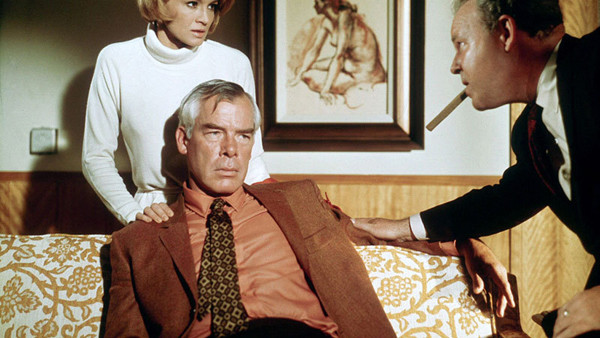
John Boorman's 1967 crime classic Point Blank revolves around anti-hero protagonist Walker (Lee Marvin), who in the film's opening sequence is betrayed in the middle of a heist, left for dead and deprived of his $93,000 share of the loot at the hands of his partner Reese (John Vernon).
But Walker appears to recover and spends the rest of the film on a roaring rampage of revenge.
That's if you ignore the popular fan theory that Walker actually died from his injuries in the opening scene, and the rest of the story was nothing more than the desperate, vengeance-fuelled dream of a dying man. It would certainly explain the film's radically non-linear storytelling.
But a fan theory is one thing and certainly wouldn't merit inclusion on this list by itself, if not for the fact that Boorman himself has since confirmed the theory to be completely true.
Suddenly the film's surreal aesthetic makes all the more sense - we're witnessing Walker's synapses firing off wildly as he shuffles off his mortal coil.
2. The Sixth Sense

It may not be the earliest instance of this trope, but M. Night Shyamalan's The Sixth Sense is unquestionably the most famous film to feature a protagonist who was dead the entire time - and prompted a host of inferior thrillers to rehash the same twist in the years that followed.
Our hero is Malcolm Crowe (Bruce Willis), a child psychologist who is shot and wounded by a former patient (Donnie Wahlberg) in one of the film's establishing scenes.
But Malcolm seemingly makes a full recovery, with the story picking up the next year as he works with Cole Sear (Haley Joel Osment), a young boy who can see dead people.
Jaws are collectively dropped at the end of the movie, then, when it's revealed that Malcolm himself was in fact dead the entire time, having died from that initial gunshot wound.
Thankfully with Cole's help Malcolm is able to deliver some parting words to his wife Anna (Olivia Williams) and "move on," his business complete.
1. Pale Rider

Clint Eastwood's legendary 1975 western Pale Rider sees Eastwood playing a character known only as The Preacher, a shadowy gunslinger who helps protect a prospecting town from a mining tycoon, and whose precise identity is kept intentionally vague.
The film's biblically-inclined title of course suggests right off the bat that the Preacher might well be the personification of Death, per a famous bible quote: "And I looked, and behold a pale horse: and his name that sat upon him was Death and Hell followed with him."
There are more overt hints throughout that the Preacher isn't quite of this world - namely Marshal Stockburn (John Russell) literally referring to him as "dead" at one point - and Eastwood himself eventually confirmed the theories in an interview, that the Preacher is indeed "an out-and-out ghost."
Audiences are ultimately still free to believe whatever they want given that the film itself doesn't explicitly out the Preacher as a ghost, but Eastwood himself has certainly made his filmmaking intention clear.