10 Movies Actually Improved By Studio Interference
Because sometimes directors just need saving from themselves...

The meddling studio executive is one of Hollywood's biggest and most delightfully propagated tropes. The vision of a grey faceless suit telling an innovative filmmaker to compromise on their project is an image seared into the minds of many film fans whose favourite directors have been forced to unwillingly relent control to money men.
Cinematic history is littered with examples of studio executives forcing unneeded mass edits, making insane casting choices and even changing the entire plot of a films to create an absolute tonal mess (Suicide Squad anyone?). Even some of the greatest filmmakers of all-time are seemingly not immune to Hollywood's unyielding hand.
However, despite their overwhelmingly negative reputation, there are some examples of executives coming to the rescue of doomed productions and gently persuading filmmakers to reconsider their overly maverick style.
Whether it be preventing ridiculously long cuts, bizarre tonal decisions, or ill-judged endings, there is certainly a case to be made for a little bit of well-intentioned meddling every now and again.
So, if you've ever wondered why Ben Stiller berates the audience during the end credits of DodgeBall: A True Underdog Story, or why we never got to watch an incomprehensible 4-hour-long cut of Easy Rider, now is your chance to find out.
10. DodgeBall: A True Underdog Story

Despite being one of the most underrated sports parody films of all-time, 2004's DodgeBall: A True Underdog Story has become more well known for its retrospectively unfortunate Lance Armstrong cameo than its man versus corporate machine message.
However, the story behind its original ending is a classic example of well-intentioned meddling that ultimately created a better film. Initially, Vince Vaughn's team of losers reached the final, but were ultimately defeated and forced to leave the competition with nothing. However, after poor test screening responses, studio executives convinced director Rawson Marshall Thurber to allow the good guys to prevail.
In the ending of the released version of the film, after triumphing over Goodman in a sudden-death final, the team are awarded a treasure chest. The chest is amusingly marked 'deus ex machina' and conveniently contains enough cash for LaFleur to purchase a controlling stake in Globo Gym.
This change also led to a hilarious post-credit scene in which a now morbidly overweight Goodman appears, laments the simplistic ending, and tells the audience - "the problem with American cinema is it can't handle any complexity".
9. Monty Python's Life Of Brian

Usually in the case of studio interference, it is what executives force filmmakers to do that results in changes to a project. However, in the case of Monty Python's 1979 Life Of Brian, it was production company EMI Film's inaction that led to a massive change of course for this future cult-classic.
In making the film, the comedy troupe had set out to create a biblical satire which revolved around a man named Brian who, after being born in the next-door stable, was accidentally mistaken for the Messiah.
Unfortunately, due to the film's potentially controversial themes, and under the weight of considerable pressure, EMI pulled their funding only 3 days before filming was due to begin.
Thankfully for the Pythons, long-term fan and former member of The Beatles George Harrison became the film's unlikely hero when he stepped forward to provide financial backing through his newly-founded production company, HandMade Films.
This change in production company allowed the Pythons ultimate creative control over their envisaged story without any resistance or censorship from studio executives.
This proved to be a successful decision as, despite being banned by 39 local authorities in the UK, the film went on to become an enormous box-office success and is still widely regarded as one of the greatest comedies ever made.
8. Easy Rider

Despite being one of the most beloved road-trip films of all-time, the production behind 1969's counter-culture classic, Easy Rider, was troubled to say the least. There are almost countless behind-the-scenes stories regarding the bizarre on-set antics of the film's director, co-writer and star Dennis Hopper.
Whether it was his incessant drinking, confrontational personality or ever-present drug-induced paranoia, the entire filming process was reportedly an arduous task from start to finish.
However, the filming issues pale in comparison to Hopper's year-long shambles of an editing process. After watching Stanley Kubrick's 2001: A Space Odyssey, Hopper began to experiment with using flash-forwards as a narrative device and ended up with a cut almost 4 hours-long.
Unsurprisingly, the studio behind the film were unimpressed with Hoppers efforts and, after sending him on a trip to New Mexico, brought in Henry Jaglom to re-cut the entire film to a more modest 95 minutes.
Upon his return, Hopper was initially hostile towards Jaglom's cut alleging that his vision had been "turned into a TV show". He would later acquiesce and go on to receive the First Film Award at the 1969 Cannes Film festival leaving Jaglom with only an 'editing consultant' credit for his efforts.
7. Good Will Hunting

After starting life as a 40-page play written by Matt Damon for a class at Harvard University, Good Will Hunting became a huge success upon its release in 1997 and launched the careers of both Damon and his childhood best friend and co-writer Ben Affleck.
However, if it wasn't for the intervention of studio executives during pre-production, the plot and cast of the film would have been virtually unrecognisable.
Damon had originally intended for the film to be an action thriller in which a similarly brilliantly-minded Will Hunting would be attempting to evade capture by the government with a minor a sub-plot between Hunting and a therapist. After reading the script, Rob Reiner of Castle Rock Entertainment encouraged Damon to pursue this therapist-patient relationship in favour of the film's action aspects.
There was also the added issue of the film's casting as studio executives favoured Brad Pitt and Leonardo DiCaprio instead of Damon and Affleck. This led to Castle Rock giving the pair 30 days to find another buyer or face losing their rights to the project.
After numerous rejections, Affleck passed the script to his Mallrats co-star Kevin Smith who delivered it to then-head of Mirimax Harvey Weinstein who immediately bought the film rights from Castle Rock.
This move allowed Damon and Affleck to star in the film's lead roles and eventually led them to winning the 1998 Academy Award for Best Original Screenplay.
6. Alien

Ridley Scott's 1979 seminal science-fiction horror Alien is widely regarded to be one of the bleakest stories ever conceived and launched the career of its relatively unknown star, Sigourney Weaver, into the stratosphere.
However, without the intervention of studio executives, the film would have had ended on a much more horrifying and franchise-destroying note.
In Scott's original ending, after escaping the self-destructing Nostromo, instead of sending the Xenomorph out of the airlock its death, Weaver's Ellen Ripley would have had her head ripped off. The alien would deliver the final log entry in the voice of the ship's previously deceased captain, Tom Skerrit's Dallas.
According to Scott, after explaining his vision to executives at 20th Century Fox over the phone, a representative from the studio appeared on set within 14 hours and threatened to fire him on the spot unless he agreed to a more sequel-friendly ending.
Although Scott's ending may have been slightly more realistic and in keeping with the film's brutal tone, Fox's decision has proved to be fortuitous. Especially for Weaver who has gone on to reprise her role 4 more times and become one of the most iconic female heroines ever to grace the big screen.
5. Donnie Darko
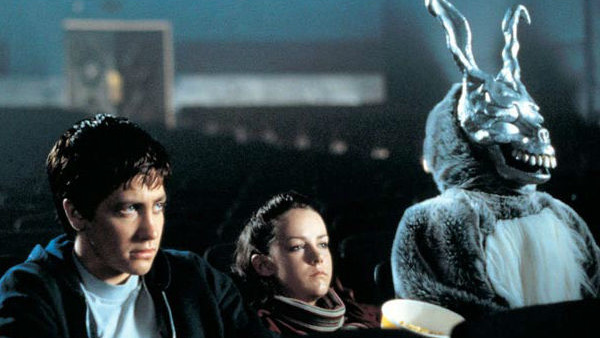
Despite its initially poor box office performance, 2001's Donnie Darko has become one of the 2000's most enduring cult-classics and is widely remembered for both its mind-bending plot and extraordinarily creepy rabbit-human-hybrid.
However, without the intervention of executives at Newmarket Films the film's fate could have been very different.
During the original editing process, director Richard Kelly was required to keep the film's run-time below 2 hours and to keep the film's time travel elements simple enough for audiences to understand. Kelly agreed to the studio's demands and released the 113-minute long theatrical cut.
Normally in these case it is impossible to know what would have happened had Kelly decided to fight for his original vision. However, due to the film's cult status, Kelly was approached to release his version as a director's cut in 2004.
Following the film's re-release, audiences and critics alike soon realised why the studio had imposed certain conditions on the original release.
The new version featured 20-minutes of deleted scenes and further explanation of the film's more supernatural elements, something many fans felt removed much of the original's ambiguity. Kelly also revised the soundtrack, changing the position of the film's most iconic song - Echo & the Bunnymen's The Killing Moon - which proved equally unpopular.
4. Dredd

Following its release in 2012, Pete Travis' film adaptation of the iconic 2000 AD comic book character Judge Dredd became an instant hit with audiences and critics alike and, despite its lukewarm commercial performance, is now widely considered to be a cult classic.
However, at one point during post-production the future of the entire film looked to be hanging in the balance.
Rumours began to surface in October 2011, when multiple media outlets began reporting that, as a result of creative differences, Travis had been removed from the editing process entirely and replaced by the film's writer/producer Alex Garland.
At the time, despite this seemingly massive change, Travis and Garland released a joint statement claiming the entire project was an "unorthodox collaboration" and the latter would not be seeking a co-director credit.
This would later be challenged by the film's star Karl Urban who, in a 2018 interview regarding a potential sequel, directly credited Garland for the film's success. He also explained that Dredd should be Garland's directorial debut instead of 2014's Ex-Machina.
Ultimately, due to the film's lasting success, the studio's decision has appears to have paid off and although there is currently no official word on Dredd 2, given Urban's continued enthusiasm, it looks like more of a case of when, rather than if, it happens.
3. Toy Story

Pixar's journey to creating their 1995's feature film debut Toy Story is well known for its financial struggles. However, these difficulties pale in comparison to the ridiculous levels of studio interference from Disney who managed to both almost ruin and then save the film during its production.
In exchange for their financial support, director John Lasseter and his team were required to give frequent presentations to then-chairman of Walt Disney Studios Jeffery Katzenberg.
During these meetings, Katzenberg would reportedly lobby for Lasseter and team to add more "edginess" to the film's lead characters, so it would appeal to a more adult audience.
The result was something that Lasseter would later describe as "a story filled with the most unhappy, mean characters that I've ever seen". Upon showing Disney the film's first half in late 1993, the studio shutdown production in an event dubbed 'The Black Friday Incident'.
Thankfully for Pixar, the studio finally relented control and allowed Lasseter to achieve his creative vision. Katzenberg also allowed the project to be filed under the wing of Walt Disney Feature Animation which enabled Pixar to consult directly with Disney's animation veterans.
Production would later re-start in February 1994 and the final film was recieved with enormous critical and commercial success, launching Pixar's decades-long domination of the animation industry.
2. Get Out

Jordan Peele's 2017 directorial debut Get Out succeeded with combining cutting social satire with a classical horror twist to create a thoroughly unsettling and thought-provoking piece of filmmaking. However, despite the almost continuously disturbing themes running throughout the film, Peele's final horrifying twist proved to much for test audiences and studio executives alike.
Following Daniel Kaluuya's Chris escaping from the sadistic body-snatching Armitage family, Peele initially envisaged him being arrested after attempting to strangle his psychotic ex-girlfriend Rose. The film would then end with Chris behind bars telling his friend Rod that he'd stopped the family and everything was fine.
During the film's production, after consultations with executives and a series of high-profile incidents of police brutality, Peele decided to tone down his ending and only lead the audience to believe Chris was about to face arrest before being rescued by Rod instead.
In interviews following the film's release Peele has discussed the alternate ending at length and concluded that it ultimately led to a better end product. He was later proved correct when the finished film went on to receive 4 nominations at the 2018 Academy Awards, with Peele winning the Best Original Screenplay accolade.
1. American History X

The story of director Tony Kaye and lead actor Edward Norton's on-set disputes during the filming of 1998's neo-Nazi crime thriller American History X have become something of a Hollywood legend. However, the true extent of these disagreements, that followed the pair all the way to the cutting room, are often overlooked.
Following the completion of filming, Kaye took over a year to deliver his first 90-minute-long cut which executives at New Line swiftly rejected for being far too short. His second attempt proved to be just as unsuccessful leading the studio to totally lock Kaye out of the editing process.
They instead allowed Norton, with the assistance of editor Jerry Greenberg, to produce the final 40-minute longer theatrical cut, which Kaye alleges existed purely to increase Norton's own screen time.
As a result of losing creative control, Kaye attempted to disown the film and his bizarre actions have since become iconic in their own right. Whether it was attempting to legally change his name to 'Humpty Dumpty', or attending a meeting of studio executives accompanied by a priest, a rabbi and a Tibetan monk, his efforts were impressive to say the least.
Unfortunately for Kaye, these efforts were not appreciated by Hollywood who effectively blacklisted him from ever working again. It wasn't until 2006 that he would resurface with his documentary, Lake of Fire.
The finished film on the other hand was received with much critical acclaim and Norton was rewarded with both an Academy Award nomination for Best Actor and an enormous career boost for the hand he played in saving the film from almost certain failure.