10 Most Infuriating Seth MacFarlane Habits

It's funny because you've seen it 500 times!
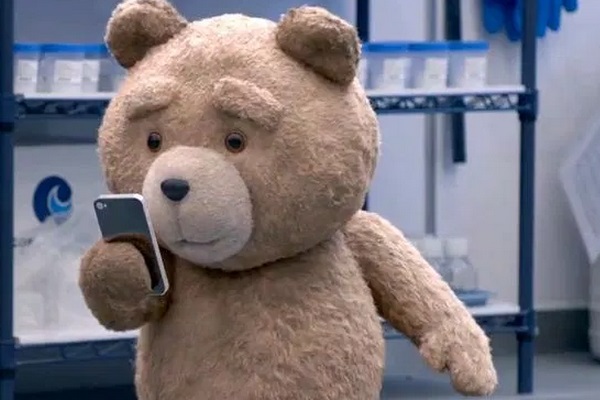
Ted 2 came out last Friday and Family Guy and American Dad are also still on the air, so the age of Seth MacFarlane comedy continues, somehow. There's comfort in the familiar, one supposes. If you like MacFarlane comedies, boy, are you in luck. Family Guy has completed 249 episodes, American Dad has 190, The Cleveland Show managed 88 and the YouTube series Seth MacFarlane's Cavalcade of Cartoon Comedy is 50 1-2 minute episodes. Ted 2 is his third film, following Ted and A Million Ways To Die In The West. All told, that's roughly 12,000 minutes - 200 hours - five solid work weeks - of Seth MacFarlane you can start watching any time you want. If that sounds like fun for you, hey, by all means... When Family Guy blazed onto TV in early 1999, it was fairly fresh, despite the early (and persistent) claims that the then-24-year-old MacFarlane was stealing from The Simpsons. Yes, he never quite stopped borrowing from the successful granddaddy of all modern animated TV comedies, but he found a few fresh gimmicks all his own. And once he found them, he held onto them like a meth addict who found The One Ring in his cereal box. It's now 2015, and he shows no signs of letting go of even one. It's simplifying things a bit to lay every aspect of a MacFarlane project at MacFarlane's feet, of course. Television series have many writers and directors, as well as some input from actors and producers. Still, MacFarlane is a big enough name that the buck always stops with him. And then that buck turns into a painfully long digression about George Washington pooping.

10. Non Sequiturs

https://www.youtube.com/watch?v=JKRu-xH58E8 MacFarlane's story ideas are sometimes interesting and sometimes not. But hecertainly never seems that interested in them. Non sequitur-based comedy is the norm for MacFarlane projects, from Family Guy on down. A Million Ways To Die In The West at least maintains some sense of theme by making most of the non sequiturs about how hard Western life can be. MacFarlane's animated shows are about seventeen minutes of plot held together by five minutes of cutaways, with nothing more profound tying the digressions together than "I like lots of old movies and TV shows." The Ted films follow the same general model. But even when the shows themselves aren't digressing, the characters are. Ted can't maintain interest in his own legal personhood long enough to avoid a legalese-shouting contest with his lifelong "Thunder Buddy" John or getting hung up on how his lawyer, by some sheer coincidence, has the name "Sam L. Jackson." Often, these non sequiturs aren't as funny as something a little less improv would've been. Ted's claim that Samuel L. Jackson is "the black guy in every movie ever" might've had more bite if his own movie didn't have several black guys, most prominently Morgan Freeman.

9. Introducing Little Monsters

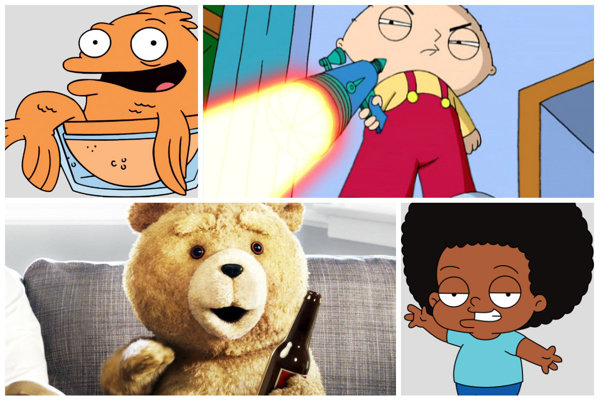
Family Guy's Stewie, American Dad's Klaus, The Cleveland Show's Rallo and Ted's Ted are all basically undersized sadists whose behavior would be outright horrifying if they weren't so small that we can't help but register them as underdogs. Some of that behavior is pretty horrifying anyway. There's a sadistic cast to MacFarlane's humor in general, and Stewie Griffin-like characters represent a perfect outlet for it: as vicious as Stewie wants to be, the laws of sitcom status-quo preservation and the fact that he's, you know, a baby generally prevent him from killing his mother and going on an orgy of destruction. Klaus may want to bring back the master race, but he's just a fish. But there's only so much that size can excuse. MacFarlane is so taken with the idea of tiny sadists that he doesn't see anything wrong with, say, Ted becoming a father in Ted 2, even though he casually laughs at others' pain (including John's) and wrecks a hundred samples at the local sperm bank.

8. Pop-Culture References Evvverywhere

https://www.youtube.com/watch?v=FNF_g9Uz3tA Seth MacFarlane has a positive pop culture addiction. Even A Million Ways to Die in the West, constrained from referencing present-day movies and TV shows, still featured Django of Django Unchained and Doc Brown of the Back To The Future series. Family Guy, The Cleveland Show, American Dad and the Ted movies can rarely go seven minutes without referencing a celebrity, motion picture, song, or TV series (or, very occasionally, a book) in the dialogue or one of those cutaway gags. Cavalcade of Cartoon Comedy was largely pop culture jokes spiced with occasional observational humor, without any bothersome characters to get in the way. Ted 2 checks all the required boxes: Frozen, Lord Of The Rings, Fifty Shades Of Grey, and a TV theme - Law and Order, in this case.

7. "What The Hell?"

https://www.youtube.com/watch?v=f5dBkrQ7nsc You may not notice this for a while, or until someone points it out, but MacFarlane has a serious affection for the intensifier "Hell," and particularly for the statement "What the Hell," with or without any clarifier. (At least Stewie changes it up a little with "What the deuce," but still.) This qualifies as a deliberate running gag in Family Guy, but it's a dialogue affectation MacFarlane is fond of elsewhere, too... and like most things he does over and over and over again, he seems to think it qualifies as humor on its own merits, regardless of context. It is mildly interesting that MacFarlane should feel this way about one of the mildest swears to be found in pop culture. Perhaps that has to do with his obvious love of older TV and movies, which used the intensifier often, as the relatively tight standards of the day meant it was all they had.

6. Some EXTREME Humor

When pop culture fails, there's always poop culture. MacFarlane is notable for taking bathroom humor further than ever before (an extended scene of four characters projectile vomiting just has to be seen to be believed) and he certainly believes there are no taboos in comedy. In one of Ted 2's too-rare funny bits, Ted and John call out suggestions for improv comedy reporters that include 9/11, Charlie Hebdo, Bill Cosby and Ferguson, standing in for MacFarlane's desire to rant against the establishment. The thing is, somewhere around the 100th episode of Family Guy, MacFarlane became the establishment, and today's comedians are only too happy to rant about Cosby, Ferguson, Hebdo and 9/11. Some of them are gifted enough to do that with an insight that can make the seemingly tasteless tasteful. MacFarlane isn't one of those guys.

5. The Same Damn Family

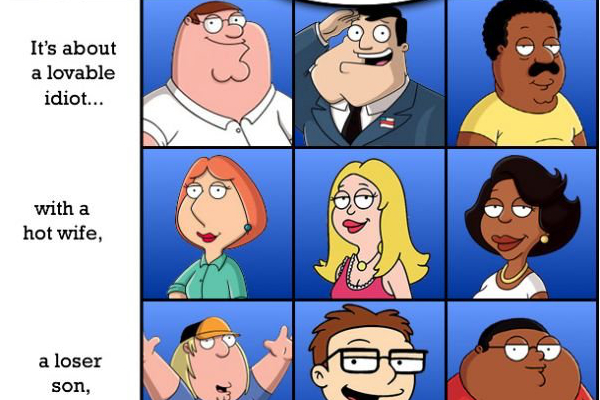
The Seth MacFarlane family is generally made up of these elements: a big, dumb dad, a sexy mom (or at least as sexy as the animation will allow), a loser son and a resentful daughter, along with a few oddball hangers-on. This is the Griffins of Family Guy, the Smiths of American Dad and the Browns of the Cleveland Show. And it's the family the MacFarlane movies lean toward: the "Thunder Buddies" always seem to date women that are certainly pretty enough - but apparently not smart enough - to do better. Even Albert of A Million Ways to Die in the West, the closest MacFarlane protagonist to a real hero, gets his girl more through pity than bravery. MacFarlane has admitted that over the years his male-dominated, sometimes male-exclusive staff has struggled to write women and especially teenage girls, so it's not too surprising that this is their go-to move.

4. The Relentless Mashups

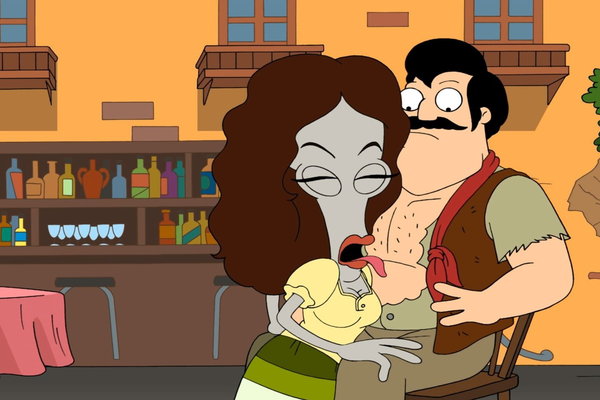
MacFarlane never met a genre he didn't like, and he generally sees no problem with combining them all. Outside of his straight-up Western parody, his stories exist in a sort of plastic reality that's not quite your life and mine and not quite fantasy/science fiction, either. In the MacFarlaneverse, you're equally likely to meet Patrick Stewart, Captain Picard, Stan Smith's boss as played by Patrick Stewart, or just a narrator. This desire to have it all works against him when he's trying to be serious. Ted 2 mixes its gutter-minded comedy with long, earnest speeches, as if being extra serious will make up for all the raunch. The movie dares to compare Ted's struggle with the struggle for same-sex marriage, which would've been tacky even if it had anticipated the Supreme Court decision made the day of the film's release. No one really comes to a MacFarlane project to see a serious courtroom drama, and trying to be one, even for a few moments, is like watching Jim Carrey trying to do Shakespeare.

3. Using Oddball Things That Aren't Supposed To Talk
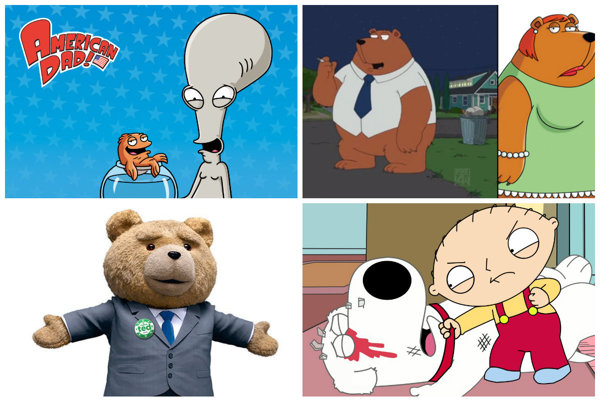
Stewie the baby. Brian the dog. Klaus the fish. Roger the alien. Tim the Bear. Arianna the Bear. Ted the teddy bear. The pattern is pretty hard to miss, and that's excluding all the one-off gags where things start talking just for a minute or two to deliver one quick, jokey exchange. There's no way to predict who will be able to hear any of the Talking Things: Brian seems to have made himself heard from day one, but Stewie's insults, initially at least, went right over Lois' head. No wonder Ted 2 treats Ted as if he's the representative of a minority: in the MacFarlaneverse, he is. "Talking Things That Have No Business Talking" are far better represented than actual gays, though Stewie at least is both.

2. Seth MacFarlane's Voice Is Literally Everywhere

https://www.youtube.com/watch?v=HGOzjdcNtw8 Peter Griffin. Brian Griffin. Stewie Griffin. Glenn Quagmire. Stan Smith. Roger. Greg Corbin. Tim the Bear. Tom Tucker. Carter Pewterschmidt. Alex Stark. Ted. This isn't the full list of Seth MacFarlane roles, just the ongoing or movie roles he's made his own. He'll use himself many times for his throwaway pop culture references or bit players, too. As voice actors go, MacFarlane does have a decent range, but he's kidding himself if he doesn't think monopolizing this much of the total spoken word-count of his programs doesn't give them a certain accent. Most irritating, though, is the pacing of most of his dialogue: slow and meandering, convinced that you'll start laughing not at the joke, but at how long it takes him to get to any sort of joke. Which leads nicely to...

1. It's All VERY Hit Or Miss

https://www.youtube.com/watch?v=zHXi8h8H2VA There are a few really great MacFarlane episodes in a year: even the rest of them aren't what you'd call humorless. Some jokes really, really miss, but in most episodes, a few of them hit, and as long as that's true and it's comfortable viewing, isn't that good enough? No, it's not. There are lots of series and movies where the good jokes are better and the bad jokes are way better, but more importantly, the joke delivery system is much faster and more efficient. Seth MacFarlane's most profitable idea is that there's as much comedy to be mined from awkward pauses as there is from actual jokes, that a traditional gag is actually more efficient when it's dragged out. In the clip above, the basic joke - "Peter is on ecstasy" - is extended for a full minute when fifteen seconds would've easily been enough. It's a very Eastern idea, and it can only provide so much actual entertainment value in a Western culture, but at this point we lap it up regardless because it's just a Seth MacFarlane thing. Without his MacFarlanisms, he wouldn't be his familiar, comfortable, unchallenging sort of entertainer, and you'd probably have to think a little harder about what you wanted to watch on Sunday nights.

Contributor
Contributor

T Campbell has written quite a few online comics series and selected work for Marvel, Archie and Tokyopop. His longest-running works are Fans, Penny and Aggie-- and his current project with co-writer Phil Kahn, Guilded Age.