10 Horror Movie Monster Designs Everyone Hated
These horror movie monster designs just weren't it.

Horror movies will often live or die on the strength of their central monster design. It's tough to come up with a truly unique creature these days, but if there's something neat for audiences to latch onto, that's usually good enough.
To the same token, though, a creature design that falls short of the mark can end up leaving audiences unintentionally amused, to the extent that it ends up sinking the entire movie.
While not all of the following 10 horror movies were entirely undone by their janky monsters, they were all certainly compromised by disappointing designs that didn't come up to snuff. From a certain entity that reminded us way too much of a particular legendary heavy metal band, to a redesign of a classic horror villain that just wasn't it, and the misguided decision to ditch practical SFX in favour of VFX, these critters and beasties were largely reviled by general audiences.
And so, it absolutely pays for filmmakers to workshop the hell out of their creatures, to spend the extra money getting it right and ensure that audiences are suitably creeped out, rather than reacting the entirely wrong way.
10. Bughuul - Sinister

It's a credit to the unnerving atmosphere of Scott Derrickson's Sinister that it can overcome the fact that its Babylonian god antagonist, Bughuul, looks almost exactly like one of Slipknot's lead guitarists, Mick Thomson.
The long, greasy hair and distorted facial features just scream "metalhead," and to make this even tougher to take seriously, Bughuul shows up decked out in a spiffy suit from the neck down.
Buhuul's rather silly design is oft-cited as Sinister's big, glaring flaw because the build-up to his reveal is so brilliantly disturbing by comparison. This is perhaps best exemplified by the film's horrifying ending, which is swiftly undermined by a last-second final jump scare as Bughuul leaps into frame, which is probably more likely to rouse laughter from viewers than genuine terror.
This is absolutely a classic case of a horror movie that should've shown its villainous entity as little as possible.
9. Chucky - Child's Play (2019)
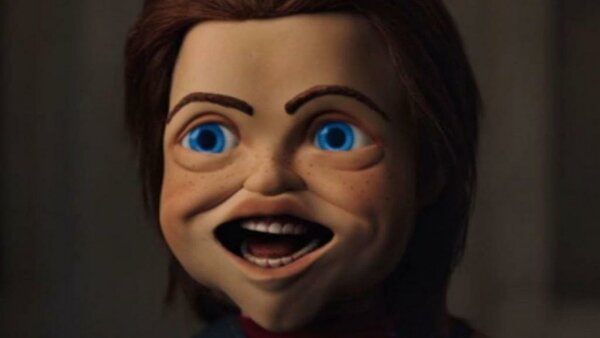
Though 2019's Child's Play reboot was decently received by critics and performed well at the box office, it's telling that the film has also been quickly forgotten.
Its lack of wider cultural impact can be largely attributed to the fact that the redesign of killer doll Chucky (Mark Hamill), was, to be kind, godawful. While the original Chucky is wholly believable as an adorable doll that kids would naturally gravitate towards, the new version is so hideously uncanny that it's basically impossible to accept that any child would become attached to it.
The eyes, mouth, and general proportions of the body all feel completely "off," and so when the O.G. Chucky returned in 2021's TV series, it truly felt like a much-needed palette cleanser.
Though Mark Hamill does a commendable enough job trying to live up to Brad Dourif's inimitable voice work in the main series, there's just no beating that original Chucky design. The 2019 version is nightmarish in all the wrong ways.
8. Darkseekers - I Am Legend

I Am Legend is one of the more memorable post-apocalyptic horrors of the last 20 years, largely due to Will Smith's searing performance as virologist Robert Neville. A virus has killed 90% of the world's population, seemingly transforming everyone except the "lucky" immune into Darkseekers - vampiric cannibal mutants who hunt the remaining humans.
While the original plan was to have dancers portray the rabid humanoid creatures, director Francis Lawrence viewed screen tests and felt that they weren't sufficiently menacing, opting instead to have the horde be realised through CGI. And aside from its clunker of a theatrical ending, this is by far the most derided aspect of I Am Legend - the VFX renders have a loose, floaty quality to them that doesn't ground the Darkseekers as humanoids.
The facial close-ups of the creatures also fall way short of the mark, as is especially important in the film's climax, where both Neville and the audience are supposed to recognise the Darkseekers' humanity.
Clearly, using flesh-and-blood actors would've been the right way to go here. Even if it meant that the Darkseekers were slightly less intense, we would've all bought them as actual living things rather than digital abominations.
7. Rawhead Rex - Rawhead Rex

1986's fantasy horror flick Rawhead Rex is based on a rather terrific Clive Barker short story, which initially envisioned the titular ancient monster as a nine-foot tall humanoid that basically resembles a penis.
When it came to translating this idea to the screen, the filmmakers opted to deviate from Barker's phallic visage, instead conceiving Rawhead as a more generic guy-in-suit monster, much to the author's disappointment.
The final design of Rawhead looks like a garden variety beastie/orc you could find in any number of horror or fantasy films - the lifeless eyes alone ensuring a fundamental disconnect with the audience.
This looked dated even at the time of its release, and given that the picture basically lived or died on the strength of its central creature design, it ensured Rawhead Rex largely lives on as a cheeseball curio. It is, however, absolutely a story that should be remade with a more source-faithful design. A24, get on it.
6. The Lipstick-Face Demon - Insidious

Much like Sinister, Insidious is such a well-crafted studio horror flick that it's able to succeed despite how ultimately comical its central antagonist looks.
Insidious' focal monster is the Lipstick-Face Demon (Joseph Bishara), who is the textbook definition of an entity best doled out in the smallest doses possible. Now, to be fair, the creature's initial appearance, where it shows up behind Josh Lambert (Patrick Wilson) totally out of nowhere for a split second, is brilliantly effective. However, the wheels firmly come off once we get a more prolonged look at it later on, as Josh ventures into the realm known as the Further to save his son Dalton (Ty Simpkins).
Here, we see the Lipstick-Face Demon in his full "glory", confirming just how much of a daft Darth Maul knock-off he is. Daft Maul, even? The demon looks less like a terrifying evil force than a relatively committed carnival employee, in turn undermining so much of the hard work leading up to this point.
5. He Who Walks Behind the Rows - Children of the Corn (2020)
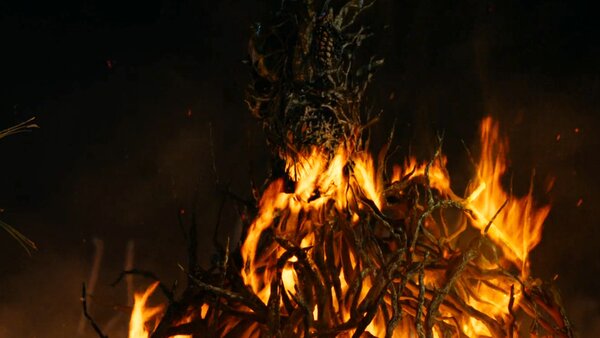
The primary antagonist of the Children of the Corn franchise is He Who Walks Behind the Rows - a demonic deity that builds a cult of children to ritualistically murder the local adults.
In Stephen King's original short story and the initial 1984 movie adaptation, the entity isn't ever fully glimpsed, though 2020's adaptation boldly decided to show what the creature looks like. And, well, it probably would've been better if they didn't bother.
He Who Walks Behind the Rows - or simply "He Who Walks," as he's called in this iteration - basically just looks like a cursed version of Groot from Guardians of the Galaxy.
A seriously goofy-looking Corn Giant whose presence is made even more laughable by some seriously wonky VFX, it goes without saying that a lower-budget adaptation such as this should've definitely opted for a subtler, less-is-more approach to its iconic antagonist.
On the other hand, the risible design is pretty much the only memorable thing about the movie - a third Children of the Corn adaptation that few were asking for.
4. Pooh & Tigger - Winnie-the-Pooh: Blood & Honey

Expectations weren't exactly high for Winnie-the-Pooh: Blood and Honey, which is a shameless cash-in on the fact that Winnie-the-Pooh entered the public domain in 2022. Even so, a slasher movie featuring Pooh and Piglet carving up unsuspecting saps could've been fun with the right execution, but it's painfully clear throughout that a $100,000 budget wasn't enough to get the job done.
Above all else, Blood and Honey needed creative kills and gnarly creature designs for Pooh and Piglet. But the filmmakers basically just settled for slapping some generic rubber masks on the actors portraying the killers and calling it a day.
There's no expressiveness to their faces, and as a result, it's never even remotely convincing that we're looking at feral, monstrous iterations of the beloved characters. Instead, it's simply two blokes wearing terrible masks.
To the filmmakers' credit, they did however seriously step things up for last year's sequel, which armed with a $500,000 budget, clearly spent way more money on bespoke makeup for the villains.
3. Sarah - Cobweb

Cobweb is actually a solidly creepy horror romp up until its less-assured third act, where young Peter (Woody Norman) finally comes face to face with his "sister" Sarah, who claims she was abandoned within the walls of the family home by their parents (Lizzy Caplan and Anthony Starr).
When Sarah is finally revealed on-screen, though, she's shown to be a spider-like humanoid creature with large eyes. The film's evidently tight budget couldn't fully realise this vision, and so Sarah is depicted here as an uncanny-in-a-bad-way VFX calamity.
The cartoonish texturing of her face looks more like a TikTok filter than something you'd expect to see in a Hollywood movie, and the fact that Sarah is generally concealed in darkness is a surely blatant attempt to cover for the iffy CGI.
A subtler approach with practical makeup was probably the right way to go, and if that wasn't achievable either, then maybe don't even bother showing her face at all?
2. The Grimcutty - Grimcutty
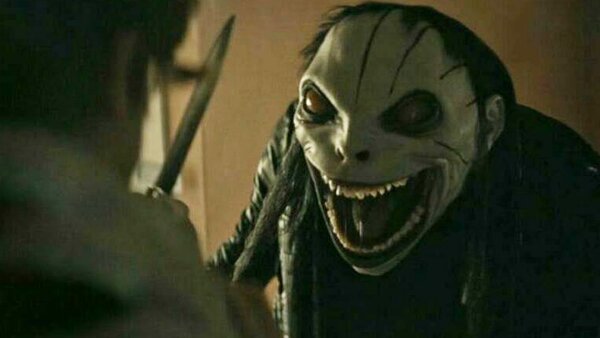
2022's low-budget horror Grimcutty certainly had potential, revolving as it does around an Internet meme that comes to life and starts killing people, even accepting how absurdly monikered the creature is. However, despite some solid build-up, it all collapses once we get a good, sustained look at the entity, whose bulbous, red-eyed CGI face and elongated limbs are tough not to laugh at.
The design has a profound whiff of an AI mockup that somehow made its way into the final release, but it only gets worse from there. It doesn't help that many horror fans online compared Grimcutty's proportions to Gru from the Despicable Me franchise, and once you've got that in your head, it's basically impossible to take this thing seriously at all.
Again, the movie has effectively tense moments, but the actual creature design itself is such a colossal letdown from which the rest of the film is unable to recover.
1. The Wolf Man - Wolf Man (2025)
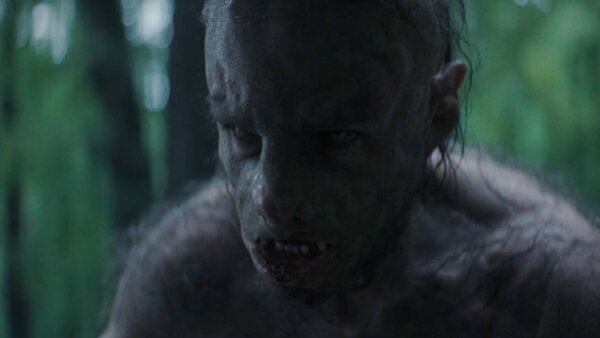
One of the most common criticisms of Leigh Whannell's new Wolf Man movie is that it almost feels like it's embarrassed to be an adaptation of Universal's iconic creature. Above all else, the film opts for a decidedly more scaled-back, pared-down depiction of the title character, who definitely skews more into man than wolf.
The traditional hairy Wolf Man design is ditched for a more modest, infected humanoid form. While, in theory, this might give Whannell and lead actor Christopher Abbott more opportunity to explore the humanity of the character, that isn't really what happens.
Wolf Man was produced on a relatively svelte $25 million budget - especially compared to the $150 million 2010 movie - and while the commitment to practical effects is laudable, this unfortunately has nothing on the standard bearer for the genre, Rick Baker's sublime, Oscar-winning work on An American Werewolf in London.
Though Universal spoiled the creature's final design shortly before release in a panicked attempt to stoke more interest in the film, the fact that Wolf Man still underperformed at the box office is the ultimate indication of how unfussed folks were about the look.