10 Highly Questionable Actions Committed By Batman
 People tend to like their superhero morality neat and tidy. Just look at all the vicious, sometimes spurnedsoundingdebates that have sprung up following the release of Man of Steel, with its already infamous "One of us dies!" ending. One of the strengths of Batman has arguably always been his slightly controversial status within the superhero cannon. This is a guy who carried a firearm for a year of his history, before DC company policy outlawed it; this is a guy who fights injustice but looks like a monster; this is not a God like superhero, but an ordinary mortal who decides to take the law into his own hands. Should we be surprised his moral compass is a bit more complicated than that of Superman? There's an inherent contradiction in the character of Batman, a contradiction that stretches back to the fact that he's a man who has trained all his life to become the ultimate warrior, and yet refuses to take a life. Maybe it's crazy. Maybe it's noble. Maybe it's both. All of which is a long winded way of saying that Batman's history is full of "questionable" moral choices and actions. Here's ten that jump to mind.
10. Leaving Ra's Al Ghul On A Crashing Train In Batman Begins
 "I won't kill you...but I don't have to save you." One of the most controversial moments of Christopher Nolan's Batman trilogy relied, as Nolan himself has pointed out, on a "technicality": Batman had already established his "no kill" credentials -- in stark contrast to those of his mentor, Ra's al Ghul, who preached "doing what was necessary", including wiping out hundreds of civilians if push came to shove -- but when Ra's found himself on a careening, out of control monorail train, Batman left him on said train with nothing but the above wisecrack. The scene inspired (and continues to inspire) a seemingly endless number of online debates. Was Bruce Wayne technically responsible for murdering Ra's? The act was certainly more than justifiable -- after all, Ra's was a terrorist cult leader who was planning to reduce an entire city to madness with a hallucinagenic weapon, and didn't seem to show any signs of rehabilitating any time soon -- but did it conflict with Batman's own moral stance? Ra's had put himself on that train to begin with (considering the speed at which the train was traveling, was it possible Ra's had basically intended this as a kamikaze mission to begin with?), but could Batman have rescued him, pulled him to safety? What is perhaps most interesting about this little moment is the fact that it was clearly a conscious choice. David Goyer's original first draft script had Batman and Ra's al Ghul battling hand to hand on top of the speeding monorail train; Ra's put Batman in a headlock, Batman used his cape to escape at the last minute, and Ra's was sent to a screaming death -- still a little morally ambiguous, perhaps, but much less ambiguous than how the scene plays out in the final film, where Batman has clearly incapacitated Ra's and still leaves him on the train to fend for himself. Why muddy the waters morally? Perhaps it's to show a rookie Batman -- in his first real case -- making a misstep, one that he quite pointedly corrects in the next film; when Batman throws the Joker off a construction tower at the end of The Dark Knight, the scene is underscored with the same music as when Ra's meets his fate...but this time, Batman catches the Joker with a grappling hook, and pulls him to safety. This is one of those fan debates that will probably never be settled...and it is one that, ironically enough, in answered within the films themselves. When Marion Cotillard's nutty, wild eyed version of Talia confronts Bruce Wayne in The Dark Knight Rises, there's no cutesy wisecrack or tidy moral technicality to get him off the hook. In her eyes, as she tells Bruce, he "murdered" her father. Maybe she's right. And speaking of Talia...
9. Sleeping With Talia al Ghul
 ...was a really bad decision. In every version of the Batman mythos, ever. Look Bruce, I get it -- it was the '70s, during your "bare chested love God" phase. You were a playboy on the make, and along comes the daughter of a powerful warlord with aims similar to your own (well, up to a point...), and she's as skilled in combat as you are, and she looks like that...and she's got the hots for you. And when Talia was the Dennis O'Neil creation -- a (frankly) somewhat shallow male fantasy, torn between her love for both Batman and his arch nemesis, her father, but mostly there to throw herself at Bruce Wayne every chance she got -- having sex with her, even siring a child with her, was somewhat excusable. But then came Grant Morrison. And sleeping with Talia al Ghul suddenly became the worst one night stand any man has ever had in the history of sex.
 Under Morrison's pen, Talia was (rather logically, it must be said) transformed from a kind of idealized Bond-girl romance for the Bat into a psychologically twisted woman, almost shorn of human feeling, so convinced that Batman will rule the world by her side that when he rejects her crazy offer, something snaps. No longer does Talia and Batman's union result in a secret child put up for adoption; now their son, Damian, is a highly skilled half pint assassin, and the battle for his soul will literally lead to armed conflict, one that has in the last six months or so nearly reduced Gotham to rubble in the pages of Batman Incorporated. So...yeah. Maybe you should've payed slightly closer attention in sex ed class, Bruce, and used protection. And on the subject of sex...
8. Dating Vicki Vale
 ...was maybe not the smartest move Bruce could've made. Bruce Wayne's romantic relationships have never been terribly mature -- this is a guy who can barely connect with the web of associates who form his "family", much less with a mature, responsible woman -- and most of his romances with "normal women" (Silver St. Cloud, Linda Paige, Julie Madison) end bittersweetly at best and tragically at worst. But at least none of those women were actively trying to figure out what Bruce Wayne does with his nights. At least when Superman was romancing the reporter trying to suss out his secret identity, they were already working together (and she was apparently blind enough to not be able to see past his glasses); Bruce Wayne purposefully seeks out the reporter who would give her left arm to be able to splash Batman's secret identity all over the front page of the Gotham Gazette, and then ends up shocked (in Gerry Conway and Gene Colan's quite underrated Detective Comics run) when she tries to do just that. Special idiocy props to Bruce for not making this mistake once, but twice, the second time with reporter Vesper Fairchild, who was also researching Batman's secret identity. Vicki got off lucky, though; Vesper ended up getting killed because of her relationship with Wayne.
7. Founding (and Funding) Batman Incorporated
 Secret identities are a funny thing. Anyone who spends more than ten seconds actually thinking about superhero comics realizes they're fairly ridiculous; there's really no way for us to buy that nobody would realize Clark Kent is Superman, but it's a fantasy world, it's a genre trope, and we forgive it. It helps that the issue usually isn't brought right out in the open; most superhero stories just avoid putting their main character and his superhero alter ego in the same place at the same time, making the whole device easier to swallow. Not Grant Morrison. During his tenure as (arguably) the biggest name writer over at DC of the modern age, Morrison has made a habit -- maybe even a fetish -- of not ignoring the most ridiculous aspects of DC's stable of characters but embracing them, milking them for all they're worth. On his ongoing Batman opus in particular, Morrison has been quite concentrated in seeking out the less well remembered/more "embarrassing" parts of Batman's storied history, dusting them off and parading them out. At the very least you have to admire his chutzpah; and sometimes you end up with legitimately great stories (Batman has a son!). Sometimes, though...sometimes Bruce Wayne decides to announce that he's publicly funding a global organization called Batman Incorporated:
 Batman, who has always walked a precarious line between hero and vigilante, whose relationship with the power structure in Gotham -- particularly the police -- is by necessity strained, who arrives back in Gotham as a one man instrument of justice...Batman has decided to (more or less) fund a corporate Batman franchise. This idea is so insane it almost comes around from being stupid to being awesome. Almost. Thematically, there's some obvious juice to be wrung here: if, as Morrison says, the first rule of Batman is "Batman is never alone", the ultimate expression of that idea has to be a team of international allies. But that's the thing: Batman already has a team of international allies. They're called the Justice League, and Batman historically hasn't had much problem calling them up. (Grant, you know this. You've written some of the most acclaimed Justice League comics of the modern age.) What does Batman, who historically has been reticent to allow others to join his team, get from this? A band of well meaning crime fighters who now have huge targets on their backs. (More on that in a second...) What does Bruce Wayne get out of this? Possibly the lamest explanation for not being Batman anyone could've possibly conceived. "Uh, no dude, I'm not Batman, I, uh...I just fund him. Yeah! And in fact, I'm going to fund a global franchise of him!" As if it wasn't already obvious enough that the guy with three surrogate sons who are the same approximate age as Nightwing, Red Robin and Robin, who has the means and funding to be a super equipped crime fighter, who is built like a brick wall -- as if it wasn't already obvious enough that guy might be a prime suspect for Batman, Bruce just painted a target on his back. DC writers have had to jump through all sorts of Herculean hoops to justify people not knowing that Bruce is Batman; it's gotten to the point where the only sensible explanation is that everyone in Gotham has sustained some massive brain trauma. The worst part of this whole questionable decision? Batman, who has always felt human life was so sacred, who had been understandably reticent to bring new allies into the fold and put them in harm's way following the death of Jason Todd -- that guy has now established a whole order of Batmen who will be targeted twice as viciously because they wear his symbol. If you're so concerned about fighting crime across the globe, Bruce, why not just secretly fund some upstart crime fighters? Putting them under the banner of Batman Inc. has (as the ongoing series has proved, with its high body count) become almost a death sentence.
6. Leaving KGBeast To Die
 The '80s were a scary and tumultuous time for Batman. Robin died at the hands of the Joker, Mr. Mom played him in a movie, and in the 1988 story arc "Ten Nights of the Beast", Batman ran up against undoubtedly his greatest foe (aside from The Joker, Two-Face, Catwoman, Ra's al Ghul, The Penguin, The Riddler, Black Mask, Bane, Mr. Freeze...): KGBeast, a.k.a. Anatoli Knyazev, a cybernetically enhanced KGB assassin who dressed like a refugee from a bondage gear shop. KGBeast was, in true '80s action movie fashion, an "unstoppable killing machine", leaving such a ludicrously large number of corpses that he probably qualifies, in just four issues (!), as a mass murderer on the scale of the Joker. This dude was so "hardcore" he literally cut off his own hand to escape from Batman. Clearly the final confrontation between these two would be a titanic physical clash... ...or Batman could outsmart the Beast, locking him down in the Gotham sewers, where he would gradually starve to death:
 Batman, the superhero most noted for his incredibly strict "no killing" rule, left KGBeast to die a slow, agonizing death by starvation. Justifiable? Well, maybe; again, let's remember the ludicrous body count the Beast left behind him. But especially in a universe where Batman refuses to kill the Joker because "it would bring me down to his level", it seems like sort of a cop out to have a man whose whole life and career have stood in opposition to deadly force be faced with a literal "killing machine"...and then solve the issues by just killing the dude. The moment was controversial enough that writer Marv Wolfman later retconned it, having Batman state that he alerted the Gotham police as to the Beast's whereabouts, several days after he had collapsed from fatigue...which still seems like kind of a dick move. Killing the villain? Not cool. Possibly putting him into a coma? Aces! But then Batman has a history of making these kinds of questionable calls...
5. (Nearly) Breaking The Joker's Neck In The Dark Knight Returns
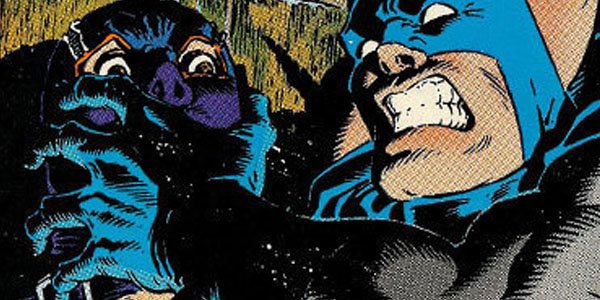
 It's one of the longest running debates in the Batman comics, and in comics in general, brought up in Christopher Nolan's film The Dark Knight, in Death in the Family, in No Man's Land, and most recently (and rather wearyingly) in Scott Snyder's Death of the Family story arc -- why doesn't Batman just kill the Joker? The most often stated excuse is the old "he's not worth it" standby (honestly, the real reason Batman doesn't kill the Joker is that the Joker's a great character, and good for sales). When writing his legendary 1986 opus The Dark Knight Returns, about the latter days of Batman's career, Frank Miller decided to bring the issue to a head. Here an older Bruce Wayne, faced with the reemergence of the Joker, and the murder at his hands by hundreds of innocent children at a carnival, vows to end the madness once and for all... ...but he can't do it. He can't, in the end, bring himself to kill the Joker. But, y'know, twisting his neck almost to the point of breaking? That's totally kosher:
 One of the important ideas imbedded within Dark Knight Returns is that Batman is more than a man, almost bigger than conventional morality. Is a man taking up vigilante justice right or wrong? How does one reconcile the positive effects of Batman's reemergence (a drop in street crime, inspiring good people like Carrie Kelly to work for justice) with its negative effects (the reemergence of old foes like the Joker and Two-Face)? It often seems as though Miller is making Batman and his effects purposefully ambiguous, and that is perhaps no more effective anywhere than here. Batman *technically* doesn't break his "one rule", but as in Batman Begins, it might be argued that he slides by on a technicality -- if Joker survives, he'll basically be dead anyway, and in spite of the Joker being an insane mass murderer one has to imagine there will be a public outcry over Batman's mistreatment of him. (The fact that Joker manages to twist his neck that extra little bit, just to frame Batman for his murder, is the final twist of the knife.) Batman himself doesn't look terribly pleased by what he's done; the conflicting feelings coursing through him -- the terrible feeling that he really should've killed the Joker, the equally terrible knowledge that he can't -- is perhaps an apt metaphor for the conflicted feelings of the readers themselves.
4. Making Jean Paul Valley Batman
 Bane had broken the Batman. It was a shocking moment for readers, and for Bruce Wayne himself; the Batman, previously indestructible, brought to his knees by a hulking brute. Recovery would take time, might even be impossible; in the meantime, Gotham City needed a Batman, and Bruce would have to appoint one, at best to be a temporary fill in, at worst to be a successor. And to fill the role, Bruce Wayne chose -- ...Jean-Paul Valley? Wait, who? Yes kids, believe it or not, there was a time (read: the early '90s) before "big events" became the rage in comics when a lot of people were honest-to-God convinced that there was a brand new tough as nails Batman in town, and he went by the name of Jean-Paul Valley. Valley was a college student who learned that his father had been an assassin named Azrael, a sort of sleeper agent working for the Order of St. Dumas; their martial arts style, "the System", had been planted in Valley's brain, to be unleashed shockingly and without warning when the time came. Valley met Bruce Wayne in the "Sword of Azrael" miniseries a few years before the Knightfall story arc, and Bruce had been helping the young man come to terms with his new status as a super assassin from hell. So what better way to help Jean Paul Valley cope with these stunning revelations than suddenly, and without warning, thrusting him into the role of Gotham's protector? No wonder Jean Paul cracked under the strain. Jean Paul's ascension to the throne of the Bat clearly had more to do with thematic notions than character consistency. It's remembered now as the storyline about Bane breaking the Bat, but most people forget what Knightfall was really supposed to be about. By the '90s, violent characters were the norm in superhero comics, and Batman's "no kill" rule seemed almost passé; the writers on the Batman titles wanted to give the readers what they wanted -- a "tougher, meaner" Batman -- and show them why that was actually a terrible idea. The problem was they had to do this at the expense of logic. If Bruce was going to disappear, why not ask Dick Grayson to fill in as Batman? (Bruce tossed out some pablum about how Dick was "his own man", which didn't even make sense to the other characters in the comic.) Hell, Bruce would've been better off asking Alfred to put on the batsuit. Anyone but Jean Paul, who predictably began cracking under the strain almost immediately, monologuing endlessly about "The System", going on a massive ego trip, becoming unnesscarily brutal with criminals and allowing the villain Anarky to die a brutal, painful death. Valley, who was a major fixture of the Batman titles throughout the Knightfall story arc, has more or less disappeared since the early '90s. Maybe the writers are as embarrassed by his time in the cape as Bruce is.
3. Criminal Negligence
 Everyone loves to bring up the fact that Batman "killed" during his first year in the comics -- as though because Batman occasionally killed during his first appearances, before he has acquired an origin story or most of his recognizable character traits or even managed to become anything much more than a visually striking Shadow rip off, it justifies Batman killing in any version of the character from that point onward. Historical context is also important to consider here: in the late '30s/early '40s, when these stories were first being written, comic book morality was a lot simpler -- heroes were good, villains were bad, and any crook who bit the dust absolutely, positively, 100% deserved that death, because they were unrepentant slime. Even then, Batman's intentionally lethal activities really weren't all that numerous: he melted down two silver bullets to kill a pair of vampires, he machine gunned a truck carrying Hugo Strange's "monster men" with the admonition "Much as I hate to take a human life, I'm afraid this time it's necessary!"...we were a long ways from the "one rule" Batman of 1940 onward, but still, it's not like Batman was Elliot Ness or Dick Tracy, gleefully firing tommy guns at bolting crooks. No, in his early years, it's not so much that Batman was openly homicidal as that he was...a little negligent about the safety of criminals he tangles with. Batman pretty much just let his first "super villain", Dr. Death, go up in a terrible fire with his laboratory (although Death ultimately turned out not to be dead...), and if we go back to Batman's first appearance, in The Case of the Chemical Syndicate, there's an infamous moment where Batman punches a crook, and the villain stumbles backwards and falls to his death into a vat of acid (pictured above). What's unsettling isn't so much the death itself -- I'm not sure we can blame Batman for uppercutting a proven murderer holding a firearm, and the dude dies thanks to a trip over a railing that leads him to fall in a vat of goo, which is almost a gag out of a Looney Tunes cartoon -- as Batman's reaction to it. "A fitting end for his kind!" he rasps to the man he's just saved; Batman may not have had outright murderous intent in his early appearances, but if a few crooks got flattened as collateral damage? Eh -- part of the job. The Batman of later years had no love for criminals, but as a result of the murder of his parents, he would come to see all human life as precious, and the waste of it tragic; this early Batman was a much more shadowy, ambiguous figure, with a similarly ambiguous morality to boot. And while we're on the subject of an early years Batman dispensing lethal justice...
2. Blowing Up Axis Chemical In Batman (1989)
 It's one of those fanboy debates that will never end -- just how big an act of blasphemy was it for Batman to kill in Tim Burton's films? Most fans tend to focus their ire on Batman Returns' infamously silly "bomb down the pants" scene, but probably the most flagrant bit of disregard for human life in the Burton films comes in 1989's Batman, when Batman sends the Batmobile into Axis Chemical for the specific purpose of blowing it up...and presumably, everyone inside with it. This isn't just an issue of collateral damage, of Batman going into battle and possibly racking up a few casualties in the thick of it. Joker has publicly announced his plan to lead a murderous parade through the streets of Gotham City, and Batman's response is to go blow up his factory/home base, with the clear intention of killing him. (When Joker flies by in his helicopter and yells "Missed me!", Batman's annoyed stoicism reads primarily as, "Damnit! I thought all those bombs would do the trick!"). Putting aside the questionable morals of this whole act (fair enough, Batman in Burton's films is more like the '39 Batman who carried guns and sometimes killed crooks, and those Joker thugs are necessary casualties in the fight to save the city), this bit of pyrotechnics just seems unnessecary. Presumably Batman has known for a good, long while now that Axis Chemicals was Joker's hideout, since after all, he was the guy who cracked the Joker's poisonous code a half hour ago in screen time. Why not get that information to the police, and have them raid the joint? (Sam Hamm's first draft script for the film actually included a beat where Gordon and his men are about to raid the plant when it blows, but this was cut, presumably as part of the Burton/Schumacher film's co-ordinated effort to make Gordon into a complete moron.) Heck, why doesn't Batman himself just raid the plant a whole heck of a lot earlier?? Waiting for your arch nemesis to make a big public announcement as the signal to, y'know, knock over his joint doesn't seem like the smartest big of strategic thinking in Batman's history.
1. Inducting Dick Grayson As Robin
 Robin is in many respects a fabulous character -- giving Batman a junior partner and moral conscience to bounce dialogue off of, allowing the caped crusader to lighten up a little, putting Bruce Wayne into the new and sometimes uncomfortable role of father figure -- but at its core, it might argued there's something...problematic about the idea of Bruce Wayne inviting a young boy to join him on his quest for justice. I'm not talking about Jason Todd here, the Robin who was most famously killed in the line of duty; letting Jason wear the costume was certainly a dubious decision, but it's one that the source material itself has basically spent 30 some years second guessing. No, I'm going right back to the very first (and in many people's opinion best) Robin, Dick Grayson, a great character with a fantastic origin story: a young trapeze artist whose parents are killed by protection racket gangsters, Dick Grayson is basically kidnapped by Batman before child services or a psychiatrist can talk to him, and within five panels is being inducted, almost by blood oath, into Batman's holy war on crime -- wait, WHAT?!
 The problem with Robin has never really been the character himself: once Robin's there, it's fine -- the story can progress, and the reader gets a lot of valuable character interaction/insight from him. But making it plausible that Bruce Wayne would actually be kosher with dressing up a little boy with no crime fighting experience in the brightest costume possible and having him run towards men with machine guns has proven damn near impossible. Hell, even when the writers of the Batman comics introduced the idea that Bruce Wayne adopts Dick Grayson -- to make the father/son connection that much more literal, and also to try to offset the slightly weird "Batman and Robin sitting in a tree" undertones -- it still made little sense: billionaire Bruce Wayne has been a near recluse, has almost completely cut off his personal life to devote himself to becoming the Dark Knight detective, can barely have normal relationships with people, is trying to hide this tremendous secret...and he suddenly decides he wants to be a foster father?? The whole scenario is so weird that when Frank Miller after-birthed his misbegotten Batman opus All-Star Batman & Robin -- where "The Goddamned Batman" is a near psychopath more concerned with causing property damage than actually, y'know, combating injustice -- he pretty much just recreated the above scene (albeit with more police cars getting blown up, courtesy of a grinning, cackling Batman) to prove just how craaaaaaaazy Bruce Wayne is:
 Miller got criticized a lot (and rightly so) for the overall nuttiness of All Star, but on a certain level, all he was doing was honestly illustrating just how insane Batman's whole "kidnap a traumatized boy and draft him into a war on crime" scheme has always been. Honestly, when you start to think about it, it's a little surprising a "Jason Todd" situation didn't happen a whole hell of a lot sooner.