10 Famous Film Settings You Won't Believe Were Faked
 They say seeing is believingwhich is probably the other side of the "sucker born every minute" coin. Can we really trust our eyes after thousands of years of Jesus magic, peyote, Escher doodles, and Wachowski Brothers films? The Wachowski Brothers aren't even brothers. BOOM! One's a sister. Mind blown? It shouldn't be. Fact is, seeing is seeing and not very much more, which is probably the reason we evolved four other senses"if it walks like a duck AND quacks like a duck"see how it works? But while quintangulation was particularly important to our ancestors' survival, the comforts of modern life are such that we'll gladly subdue, numb, and warp our senses for a psychological kick, an old favourite being the suspension of disbelief that occurs within the cinema house as we play pretend: that Matt Damon's a spy! That Matt Damon's a math's whiz! That Matt Damon'sthe rest of his oeuvre momentarily escapes me. The point is we don't rationally confuse films and reality, or even biopics and reality beyond the age of twenty-four, but we play along because our emotions have no idea that Tom Hanks laid down his life to save Matt Damon?! The humanity! Emotions playing Buffy to our rationality's Watcher. So, with all of this topsy-turvy emotional chicanery going on, we don't bat an eyelid when someone paints a few pyramids on a glass slide in Mexico, passes off a 7-11 in Los Feliz as The Louvre, or lands on the moon on Stage H, Shepperton Studios (eh, conspiracy theorists?). But, far from the seductive glow of the silver screen, when some dork gives you a dose of reality, it can be rather interesting. And guess whatI'm that dork! Click "next' below to kick things off...
10. The Dollars Trilogy
 Rather than ask for clarifications about things which struck me as odd, as a small child, I'd often travel along in a state of pique, puzzling over apparent synergies between reality and cartoonish possibility. Suffice to say that I was driven close to conniptions by the tale I heard of my family waiting for a lounge sweet to be delivered, "sweet" meaning lolly, or candy. From the context it was discussed in, I imagined this thing as a giant strawberry éclair or mint leaf or liquorice bullet big enough to sit on. I pictured myself perched on soft nougat or foamy marshmallow, watching TV, and casually eating my seat. It was incredible. I was five. When it turned out to be a lounge suite, I was devastated. In a similar vein, my dad was often talking about spaghetti Westerns. I figured I'd love these things. Pasta and cowboys! A match made in heaven. Alas, I never seemed to chance upon one, flicking around the teev, and in fact it was quite a while later (like, a quarter of a century) before I learned that the term referred to films in the genre made by Italians, most notably the works of Sergio Leone, meaning that many of the most famous Westerns weren't filmed in the west at all. The seminal westerns comprised by the Dollars Trilogy, for instance, A Fistful of Dollars, For A Few Dollars More, and The Good, the Bad and the Ugly, was filmed in central Italy, and northern and southern Spain. The only "west" was in the script.
9. American Psycho
 Due to some particularly detailed acts of torture, Bret Easton Ellis' American Psycho created such a furore at its time of release that one publishing house dumped it entirely, and Ellis received death threats. Given that all manner of vile things happen in novels, it was perhaps testament to the vivacitythe unrelenting realismof the author's prose that so riled its opponents. Some ten years later, my own copy was sold in shrink wrap! But for those of us who could distinguish between actual torture and bleak satire, the story's pleasures derived from the immense detail pouring from its narrator's stream of consciousness, one of Patrick Bateman's central obsessions being placewhat was lavish, where was hip, where one could be invisible, and where one went to be seen. Accordingly, the many faces of New York City depict Bateman's playgrounds, from the innocuous (restaurants, beach houses, and nightclubs) to the malign (back alleys, stairwells, and even a torture chamber in Hell's Kitchen), the late Eighties ambiance of the town portrayed convincingly enough to create the sense of a period documentan even more impressive feat when you learn that it was filmed ten years later in Toronto.
8. Gladiator
 Director Ridley Scott, is known as much for his wildly divergent subject matter as for his meticulous attention to place and atmosphereto making the scenery as much a part of a scene as the props and actors. From the tech-noir of Blade Runner, to the stark planet so fatefully visited in Alien, no corners are cut in fleshing out the environments his characters' find themselves in. In fact, they pulsate with such life that they seem to drive the key protagonists' actions, from the languor of the southern U.S. states in Thelma and Louise to the harrowing menace of Mogadishu's streets in Black Hawk Down. His swords and sandals epic, Gladiator, set during the height of the Roman Empire, follows its hero, Maximus, from his betrayal in the forests of Germania, to his return to the fold in The Coliseumthe violent heart of Rome. The frigid gloom of Germania's dark forest, however, was in fact a wood in Surrey, England, just twenty miles south-west of London. And the pulsating streets of Rome were a combination of Maltese locations and the magic of CGI.
7. Inglourious Basterds
 Though Tarantino films are renowned for being completely bonkers, you might expect dollars and sense to have prevailed when it came to putting one together. Upon examination, however, at least one of them seems to be just as whimsically loose with reality as its plot. Of course I speak of the alternate history romp, Inglorious Basterds, which opens upon a charming French farmhouse, the setting of our first encounter with the nefarious Colonel Landa, and actually a charming German farmhouse. The exterior of Shoshanna's Parisian cinema, Le Gamaar, was a set built at the appropriately named Babelsberg Studios near Berlin. The interiorthe setting of the film's infernal climaxwas actually constructed in a disused cement factory, the only place capable of standing such abuse! Hitler's office, in which Private Butz recounts his terrifying brush with The Basterds, was filmed in Germany sure enough, but ironically, within the Clay Headquarters Compound of the U.S. military, a former Luftwaffe command centre taken over as the U.S. command, post-war. Back to Paris (but not really), the cafe Zoller invites Shoshanna to, Chez Maurice, is in Berlina real cafe, and not only famous in its own right, but quite emphatically anti-Nazi by name: Cafe Einstein.
6. The Wolverine
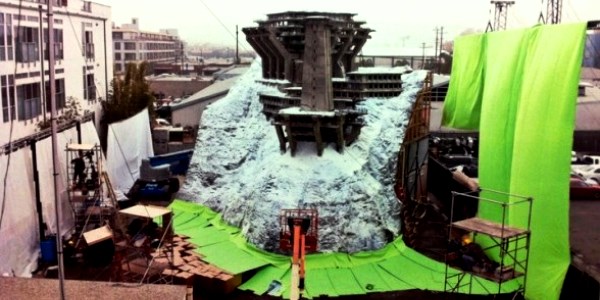
 The way I imagine it went down was that when they asked Hugh Jackman to make a Wolverine film set in Japan, he replied, 'On one condition, mate: we film 'er in Sydney, ay?' For those unfamiliar with Australian geography, the state of New South Wales is a giant slab of forest which, two hundred years ago, presumably reminded an Englishman of South Wales. Oh, and Sydney's its capital. Oh, and Fox owns Studios is in Sydney, which is why Sydney is also a variety of Star Wars planets, West Egg, and Metropolis. And most recently, the Yukon and Tokyo. And to think it began as a penal colony! In The Wolverine, Nagasaki is in Botany Bay, and the alpine region of Canada is the Blue Mountains. The Yukon town of Faro is the hick town of Picton. We zip back to a defunct bar in the city centre to represent the Yukon night life. The brawl in the Japanese gardens actually took place in the Chinese Garden of Friendship, Darling Harbour. The Tokyo chase occurs in the suburb of Paramatta. And the final showdown in Yashida's mountain complex was actually built in a carpark near Sydney Olympic Park, the heart of the 2000 summer games.
5. Robocop
 Is there a more identifiable symbol of Motor City than RoboCop? (Don't say "urban decay.") Keeping it above the belt, Cyber-Murphy has become so closely linked to hope and resurgence in the troubled town that a fan push has led to a 10 foot tall bronze statue of Robo being created, to be unveiled within a year or so. The fact is, the mean streets of a dystopian Detroit play such a significant role in providing the bleak, utilitarian stomping grounds for the corrupt OmniCorp that it's quite a mind-tweak to learn that filming took place in Dallas, Texas. The famous Reunion Towerthink a giant phallic symbol covered in lights (take that, RoboCop statue!)is even visible at times. And the towering OmniCorp building is actually the City Hall, with matte paintings used to heighten the building to the film's ninety-five storeys. Interestingly, after shooting President Kennedy (or being made a patsy if you prefer, eh conspiracy theorists?), Lee Harvey Oswald was temporarily gaoled in the former City Hall, the setting for RoboCop's own political crisis. And one can't help wondering how differently the world might have turned out if old squeaky had been there to shoot Oswald in the peen. Maybe Tarantino could shed some light on it ...
4. Scarface
 Brian De Palma's three hour opus about the life of the upwardly mobile purveyor of disco enhancing substances, Tony Montana, is notable for its alternating focus between the blinding sunshine and lurid architecture of Miami, and the lush Bolivian compound of Montana's supplier, Alejandro Sosa. The distance between the two locations makes the trust Sosa places in Montana, not to mention the latter's own charismatic persuasiveness, all the more remarkable, so it's rather a shock to learn that much of the movie, including Montana's bid for freedom from Cuba, was shot in California. Both Tony's and Sosa's compounds, for instance, can be found in Santa Barbara! The distance between settings is often integral to films' plots, and one of the key ways in which we participate in cinematic narratives is by inputting our sense of the vastness of the world into the ostensible gaps we're told to observe. That being said, from a production standpoint, the closer they are the better.
3. King Kong
 Peter Jackson's remake of the Thirties' fantasy epic was further testament, after The Lord of the Rings, to the unlimited potential that CGI had to create from the ground up, or merely augment, a given environmentin this case, New York of the era, and the mysterious Skull Island, located somewhere in the vicinity of Indonesia. Astonishingly, every shot was composed on the Land of the Long White Cloud, mostly around the city of Wellington. While Lord of the Rings proudly showcased the dramatic New Zealand landscape as a stand-in for Middle Earth, Kong concealed it entirely, convincingly contorting time and space to create the hyper-real metropolis and tropical island evolution forgot. The real-world exteriors used, such as Wellington's Opera House, show once again how likely we are to be influenced by the information we're given on-screen; to conclude that a distinct piece of architecture, or landscaping, or public art is characteristic of a certain place, as opposed to belonging to the collection of things a filmmaker has accumulated to create the sense of place. More than just a quality fantasy epic in its own right, King Kong represents the state of the art in visual effects, and adds to Jackson's reputation as a visionary special effects pioneer. Given that his fascination with the potential of film to transport us to other locations developed in early childhood, it seems especially fitting that he was able to fashion such an epic in his own backyard.
2. New York, New York
 Scorsese! De Niro! Minnelli! New York! ... Los Angeles! No doubt after the success of Mean Streets and Taxi Driver, Scorsese could have filmed the story of a couple of misfit nightclub performers in his home town if he'd wanted to. Demonstrating the kind of bold stylistic decision-making that has characterised his career, however, the choice to shoot on the West Coast was born of the fact that the film was intended as an homage to the classic musicals of Old Hollywood, such as Top Hat and Singin' in the Rain, which were made in studios and didn't attempt to simulate reality absolutely, but rather to strike a middle ground between a clearly fabricated set and the nitty-gritty of an actual location. In other words, Scorsese intended New York, New York to resemble a somewhat contrived version of NYC, and in fact made use of a studio which breathed life into the period he referenced, including the musicals of Judy Garland, whose dressing room was used by her daughter, Minnelli (De Niro being relegated to Greta Garbo's!) Partly due to its lavish production costs, the film wasn't profitable, and received a lukewarm reception from critics, but perhaps only because Scorsese's creativity was at least a decade ahead of its time. From the Nineties onwards, audiences were ready to interpret apparent aesthetic incongruities as creative decisions, and appreciate them on their merits as pastiche or homage. This "education" was initiated by pioneers like Scorsese, who continually mixed up their bread and butter pieces with radical creative flair.
1. Full Metal Jacket
 Another film based in two very distinct locations offers perhaps the quintessential geographical switcheroo. Kubrick's Full Metal Jacket is split down the middle, with the brutality and isolation of the U.S. Marine training facility located on Parris Island, South Carolina, being followed by the catharsis and nihilism that Vietnam propagated as a theatre of war. It's a testament to Kubrick's reputation as a consummately particular filmmaker that I was stunned to learn that the whole shebang had been filmed in Cambridgeshire, about fifty miles north of London, England. It simply didn't seem possible. After a while I could rationalise that the Parris Island scenes were do-ableand were in fact British military facilitiesbut how had Kubrick created a war-torn Asian country on London's rural-urban fringe? Well, as is a common theme with the most unlikely of real-world settings, the location scout in this case discovered a gas works that was scheduled to be demolished. Modern day location scouts must have all manner of feelers out, primed to tell them the instant something is about to be flattened, because they're a filmmaker's dreamcheap and utterly disposable. Over three months, vast amounts of ecologically-correct vegetation was added, and buildings pocked, scorched, blown-up and knocked down in order to simulate "a world of shit." I didn't doubt it for a second.