10 Famous Directors Who Completely Changed Style For One Movie
And now for something completely different.

Most directors have their own unique fingerprint. Their films reflect their own unique artistic sensibilities and creative visions. And over the course of a career, it's easy to see certain patterns form in their work, whether it be a repeated visual aesthetic or the inclusion of very specific types of characters.
Some auteurs are able to sustain long and fruitful careers without ever diverging from their self-created molds. Woody Allen has been making the same kinds of movies for the better part of four decades. Same goes for Martin Scorsese. And we all pretty much know what to expect from a Quentin Tarantino movie by now.
This can naturally lead to pigeonholing, and sets up unreasonable audience expectations that can suffocate a filmmaker. After all, just because you do one thing very well, that doesn't mean you can't try something else.
And that's why even the most steadfast auteurs have to occasionally shun expectations, throw caution to the wind, and deviate from their normal directorial habits for a bit. Even if it's just for a single film.
The results aren't always pretty. But at least they were willing to try something different.
10. Guy Ritchie - Swept Away

We all know what a Guy Ritchie production looks like by now: Extended music videos full of jump cuts, lens filters, and more gratuitous shootouts than a John Woo film. Ritchie broke out as the flashy director behind Snatch and Lock, Stock, and Two Smoking Barrels.
Those two films were the byproduct of a new, ultra-violent era of crime noir ushered in by Quentin Tarantino, and Ritchie was one of the few truly effective copycats of that style.
So it was more than a little baffling when Ritchie released Swept Away, a deserted island rom-com adrift in misplaced sentimentality and by-the-numbers storytelling. The film, which starred then-wife Madonna, replaces Ritchie's signature snappy banter and slick black comedy with rote dialogue and one of the most unlikable characters to ever be stranded on a beach.
Swept Away is as straight-ahead as love stories come, and there's nary a high-speed action sequence in sight. It's more Nicholas Sparks than Quentin Tarantino.
9. Tim Burton - Planet Of The Apes

Bringing in a director with such a singular vision to direct a mainstream Hollywood remake is rarely a good idea, especially if you force said director to stay within the confines of the average action-adventure template. That's essentially what happened when Tim Burton was hired 2001's reimagining of Planet of the Apes.
There's not much whimsy be found in the film, nor is there much soul. And no matter what you think of the director's limited scope, those two things are typically front-and-center in any Burton film.
Aesthetically, he brings a bit of his requisite goth-meets-pop art stylishness, though it's mostly reserved for little details rather than an overarching backdrop.
Really, the whole thing plays out like a by-the-numbers summer blockbuster, and the end product certainly doesn't call to mind the auteur behind Edward Scissorhands and Beetlejuice. (The lack of Danny Elfman in the background doesn't help, either.)
8. David Fincher - The Curious Case Of Benjamin Button

The worlds David Fincher presents in his films are typically cold, dark, and littered with rebellious ideology. It doesn't matter if the story involves home invasions, an FBI manhunt, or the creation of Facebook, it's going to be presented using the same bleak palette.
The sole exception to that rule is The Curious Case of Benjamin Button, a romantic fantasy drama that goes out of its way to prove that Fincher is capable of giving his audience something that loosely resembles hope for humanity.
A melancholy fable about a man who ages in reverse, Benjamin Button stands outside the rest of David Fincher's filmography by embracing the kind of dewy-eyed sentimentality that you aren't going to find in other Fincher/Pitt collaborations like Se7en or Fight Club.
The visuals are warm, the story is heartening, and the characters lack that proud sense of immorality that tends to worm its way into most portrayals in the Fincher canon.
7. The Coen Brothers - Intolerable Cruelty

Despite their knack for genre-hopping, Coen Brothers movies feature three elements above all else: caper motifs, exceptionally quirky characters, and jet black comedy. Intolerable Cruelty has very little of that.
The average viewer could pick a Coen production out of a lineup pretty easily, without getting past the first few scenes. Likewise, you can tell Intolerable Cruelty is the odd man out in their filmography after the crafty opening credit sequence gives way to a fairly standard issue battle of the sexes story.
Sure, the characters -- particularly George Clooney's smarmy divorce attorney -- engage some of that famous, well-timed Coen banter, but aside from a few aesthetic idiosyncrasies, you'd hardly recognize that they were behind the lens.
This all makes the film perhaps the Coens' most forgettable. The story is derivative, the cinematography is bland, and most of the characters were painted using the broadest of strokes. It's one very small step away from featuring Kate Hudson and Matthew McConaughey. That's how lightweight this rom-com is.
6. Oliver Stone - World Trade Center

Oliver Stone is no stranger to politically-minded thrillers with a basis in real world events, so at first glance, making a movie about the September 11th terrorist attacks seems right up his alley.
But unlike JFK or Nixon, movies that tackle the seedier elements of human nature while intertwining several threads of disparate conspiracy theories, World Trade Center plays more like a vague and oddly respectful tribute. It would be difficult to even point out what Stone's ideology on the matter is.
It's almost like he was too afraid to make any real statement about the tragedy, so instead he settles on making a toned-down disaster movie. This movie could have been about anyone trapped under any ol' building's debris, as there's not much in the film that's tethered to the specific emotions of this attack.
Which is fine. The movie still offers a few moments of genuine tension and anxiety, though it feels a bit like a cheap cash-in given the title and Stone's history with political dramas.
5. George Lucas - American Graffiti

Space: It's the final frontier of George Lucas' career, and the only thing most people will remember him for 50 years from now.
Granted, Lucas offers up a relatively small sample size for such a famous director, but considering that his only other work in the director's chair is THX 1138 and four Star Wars films, American Graffiti certainly qualifies as a significant outlier.
This film hints at an alternate reality where Lucas never pursued science-fiction, and instead focused his talents on coming-of-age dramedies. It's the only thing in his filmography that obviously culls from his own real life experiences, centering on the rock and roll culture of the baby boomer generation.
The production values are slight, with an almost documentary aesthetic that belies the outrageous special effects obsession he gained later in his career. But despite its modest style, American Graffiti became a huge box office smash and afforded Lucas the money and clout needed to make his dream project, a space opera about a farmhand who goes on to become a Jedi Master.
4. Wes Craven - Music Of The Heart

It's impossible to look at the poster for Music of the Heart - which is so warm and inoffensive it should have its own line of candles at Bed Bath & Beyond - and imagine the man responsible for bringing Freddy Krueger into the world could possibly have anything to do with this movie.
Unless...is it possible Meryl Streep, Angela Bassett, and Gloria Estefan were actually being hunted down by a warped madman who turns his victim's hearts into shockingly tuneful music boxes?
No. Not so much. It turns out the only shocker about Music of the Heart is just how sterile and stately Craven's drama ends up being. Sandwiched between two Scream sequels, it's weird to consider that this was actually something of a dream project for Craven, who only agreed to sign on for Scream 3 if he was able to direct Music of the Heart.
Music of the Heart proved - at least to Craven himself - that this director was capable of releasing a movie that didn't feature a single dismemberment or throat slashing. Heck, it even scored Meryl Streep another Oscar nomination.
3. David Lynch - Straight Story

A PG-rated movie from David Lynch. Yes, that really happened.
Known primarily as a purveyor of all things surreal and depraved, most people know David Lynch for his work on the unfortunately short-lived supernatural crime serial Twin Peaks, or for grim psychological dramas like Blue Velvet and Mulholland Drive.
There's absolutely nothing "straightforward" or "not creepy" about Lynch's storytelling and presentation, and yet, for one brief moment in 1999, the world was gifted this decidedly conventional film about an old man riding his lawnmower from Iowa to Wisconsin to repair his relationship with his estranged brother.
Lynch somehow crafted a quintessential American road movie, one that even kids were allowed to watch. Straight Story - with an appropriate nod to its orthodox narrative right in the title - is still quirky, but it's a far cry from The Elephant Man or Eraserhead.
Interestingly enough, the director considers this his most experimental film to date, which further proves that David Lynch is unlike any person who has ever existed. In reality or fiction.
2. Alfred Hitchcock - Mr. And Mrs. Smith
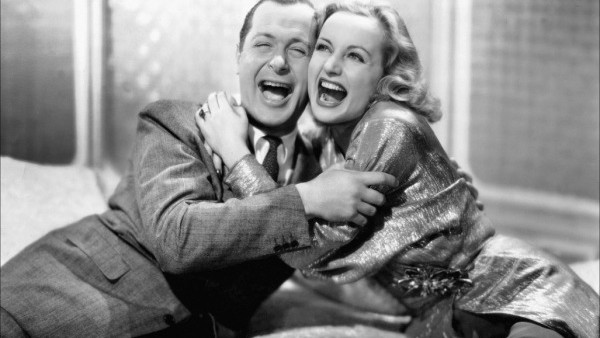
Alfred Hitchcock, the "Master of Suspense", remains one of the most influential directors of all time. Over the span of fifty-plus feature films, Hitchcock solidified himself as a persistent innovator, artist, and auteur. As unique as each of his films turned out to be, Hitchcock certainly wasn't afraid to return to certain themes and stylistic choices over and over again.
From The Man Who Knew Too Much to Rear Window to The Birds, nearly every Hitchcock film contained mystery, suspense, death, and characters who were in way over their heads.
And then there's Mr. and Mrs. Smith, an outright screwball comedy that severely departs from his typical style. There's not a single dead body in the whole affair and nary a hint of genuine terror.
Granted, Hitchcock did break out of his usual genre on more than one occasion - for instance, The Trouble With Harry is technically a comedy, as well - but those other films at least retain many of what we now consider classic Hitchcock-ian tropes.
1. Francis Ford Coppola - Jack

If you thought pairing the director of The Godfather with the actor from Mrs. Doubtfire would cause an eruption in the space time continuum and blow up the world from within, you were probably a little underwhelmed with the final result.
Jack is a coming-of-age comedy with a twist: The titular boy, played by Robin Williams with all the subtlety of a brick to the face, suffers from Werner syndrome, which causes him to age four times faster than normal. The film is essentially a two-hour long excuse for Williams to indulge every manic, childish whimsy he was forced to leave out of Mork & Mindy.
Coppola, the man behind such violent and harrowing fare as Apocalypse Now and Patton, had occasionally ventured into other genres with great success - most famously The Outsiders and Rumble Fish, a pair of teen dramas based on S.E. Hinton novels - but he remained an auteur even when he stepped out of his usual territory.
That's not the case with Jack, which borrows everything but the heart and soul from Big, resulting in a pretty tepid comedy.