10 Edgy Properties No Film Producer Dared To Touch
Yet.
 They said it could never be made! The film they didnt want you to see! Old-time movie-poster hyperbole played up the outrage to the point where, to quote exploitation moviemaker Russ Meyer, you were getting more sizzle than steak. But then there were the books that were supposedly unfilmable: unreliable stories told by amoral narrators; surreal or bizarrely structured narratives that wouldnt translate to a linear script; transgressive acts which, while just about tolerable on the page, didnt bear thinking about onscreen. The way that films mainstream, art-house or B-movies got around it was to offer an approximation of the text that watered down its wildest excesses. Both Bret Easton Elliss 1990 novel AMERICAN PSYCHO and Mary Harrons 2000 screen version are red-clawed satires of vicious capitalist misanthropy, but the child murder, cannibalism and evisceration of a hooker understandably didnt make it into the movie. William S. Burroughs 1959 THE NAKED LUNCH was long considered unfilmable because of its nauseatingly surreal imagery and fractured, non-linear narrative; Cronenberg solved it in his 1991 film by marrying the books science fiction-like elements to biographical details of author Burroughs own seedy early life. Even the Marquis de Sade got housetrained: whereas his most extreme books are so chock-full of sexual violence that theyve been widely available in English for less than 30 years, most film adaptations are fairly tame Euro-gothic (though Pasolinis SALO: THE 120 DAYS OF SODOM was banned in many countries for its art-house atrocities). We live in a culture where almost anything (except for, say, the overt racism of early film epic THE BIRTH OF A NATION) is considered viable for viewing consumption. All the more remarkable, then, that a handful of hard-edged stragglers still resist transfer to the screen...
10. To The White Sea
 Joel and Ethan Coen wrote a second-draft screenplay of novelist/poet/alcoholic James Dickeys narrative of surviving the war in the Pacific. While their scripts were original up to the point of remaking THE LADYKILLERS (2004) and adapting Cormac McCarthy (see below), their first adaptation was intended to be Dickeys savage epic that echoed the misanthropy of his earlier DELIVERANCE (where, as Jim Goad points out in The Redneck Manifesto, the author repaid the mountain men who, in real life, saved him from drowning by depicting their brethren as hillbilly rapists). The part of Sgt Muldrow, the tail gunner shot down over Tokyo in the 1945 fire bombings, was won by Brad Pitt. Opening with the characters introductory monologue from the novel, the Coens reduced the sparse dialogue from an earlier version of the script (by David Webb Peoples and Janet Peoples, screenwriters of TWELVE MONKEYS, 1995) to zero for most of the rest of the film. Muldrow was to walk determinedly, silently home through Asia to the Bering Straits killing with cold, desperate deliberation throughout to keep himself alive. Shooting was scheduled to being in 1998, until the Coens realised the studio was not going to raise the $80 million budget (a record for them). As Joel said, dont set a movie in Tokyo during the firebombing unless you have lots of money to pay for it... was the lesson we took away from that. Not even the presence of a major Hollywood star could assuage the accountants feeling that they were taking a major risk with a near-silent epic of existential violence. Pitt offered more box office-bait than Martin Sheen had when he signed up to replace Harvey Keitel in APOCALYPSE NOW (1979) but Muldrows focused ruthlessness recalled the final terminations spree of Sheen as Capt Willard, most of which was cut from the final print for making his character unsympathetic and remains unrestored, even in the Redux print. (Pitt later showed loyalty to the Coens by camping it up and getting comically killed in BURN AFTER READING.) Gunner Pitt finally makes it to the end of the war in FURY (2014).
9. Blood Meridian
 Mark Pellegrino as the Judge, in James Francos 30-minute show-reel for his abandoned version of BLOOD MERIDIAN. When Cormac McCarthys epic novel BLOOD MERIDIAN (or, THE EVENING REDNESS IN THE WEST) saw publication in 1985, it epitomised the generic hybrid gothic western. So well-drawn was its gruesome yet mystical Wild West panorama that it drew comparison with darkly obsessive American writers from Edgar Allan Poe to Flannery OConnor, as well as to Melvilles Moby Dick. The story of the kid, a drifter in the mid-19th century whose every step from outlaw gang to army renegades to Native American massacres is shadowed by the sinister Judge Holden, who may possibly be an earthly demon. It was also inherently cinematic, inviting allusions to the violent outlaw West of Sam Peckinpah in THE WILD BUNCH (1969) and BRING ME THE HEAD OF ALFREDO GARCIA (1974), his contemporary tale of revenge and obsession. At the same time, BLOOD MERIDIAN was seen as impossible to film, its poetically described violence eclipsing the slow-mo squibs of action movies with acts of cruelty, the Comanche tribe outdoing even the white man by murdering a wedding train and sodomising the corpses too extreme to maintain sympathy with the amoral characters. Of course, this was before some of McCarthys more extreme novels (ALL THE PRETTY HORSES, 2000, aside) had been brought successfully to the cinema screen: John Hillcoat focused on Viggo Mortensen as the anguished father in the apocalyptic THE ROAD (2006); the Coens eschewed their quirky humour (as they had in their screenplay for TO THE WHITE SEA) to depict the murderous avarice of NO COUNTRY FOR OLD MEN (2007). It was Tommy Lee Jones, lead actor in the latter and a personal friend of Cormac McCarthy, who first obtained an option on BLOOD MERIDIAN; it expired after a draft screenplay which maintained the poetic savagery but only contained about a third of the book. Screenwriter William Monahan, Oscar winner for THE DEPARTED (2006), had a crack at it too, before the option rights came around to indie actor/director James Franco. Francos 30-minute screen test for his mooted cast, based on a crucial section of the book, can now be found online at Vice Magazine. In some ways BLOOD seems un-filmable, hes admitted self-defeatingly. His terse prose utilises vocabulary only found in the crannies of annals of the Old West and the specialised spheres of working men. Francos footage is faithful in that sense, as reverential of his literary source as his adaptation of Faulkners AS I LAY DYING (2013). But it contains only a little of McCarthys sense of overhanging violence: the Glanton gang, holed up in the hills, barely resemble men bloodied and diminished by Apache attack though theres a tense moment when they find the skinned corpse of one of their number. Maybe this was why the producer pulled the rope, and a film of BLOOD MERIDIAN remains only a fond hope though its hard to imagine any director besides Hillcoat or Paul Thomas Anderson who could pull it off. Franco compensated by filming an earlier (1973) McCarthy novel, CHILD OF GOD, also once considered unfilmable. With Scott Haze in the title role of feral backwoodsman Lester Ballard, the brooding indie film explores the lower depths of necrophilia and sex murder as Ballard becomes ever more estranged from society.
 In 2014, it was a subject that lent itself well to a grungy, low-budget rendition; but the epic scale of BLOOD MERIDIAN is going to require producers with balls and money.
8. The Room
 When I read Hubert Selby Jr.s LAST EXIT TO BROOKLYN as a kid, it seemed like the ultimate unfilmable novel: vivid descriptions of a hooker named Tralala getting gang-raped and violated; straight guys having sex with transvestites; vicious tenement wives calling to a baby on a balcony to make him fall. That it made it to cinemas in a colourful late 1980s adaptation is a testament to changing times as well as to how a book will highlight details that a movie can pass over. Selby, a moral and compassionate man compelled to wallow in the human undercurrents hed experienced, also came later to the screen via his REQUIEM FOR A DREAM: a searing account of addictions in a junkie and his mother, Darren Aronoskys 1998 film version indicting the American Dream and the chemicals that fuel it. (They ought to show it in schools, film writer Billy Chainsaw told Selbys editor, Ken Hollings. Kids would never touch the stuff.) But it was in the decade between LAST EXIT and REQUIEM that Selby wrote his edgiest pieces. THE DEMON, which preceded REQUIEM in the mid-1970s, placed the reader in the head of a successful businessman obsessed with casual sex as a form of blasphemy, finally escalating to the point of murder. If it was brought to the screen it might play like a manic version of Steve McQueens/Michael Fassbenders SHAME (2012), but with no casual opt-outs for the main character. But it was THE ROOM, which preceded it in 1971, which shocked even its own author. I mean, it is really a disturbing book, Jesus Christ! he later emphasised. I didnt read it for 12 years after I wrote it... The late rock poet Lou Reed, himself influenced by Selbys documentary realism, said THE ROOM put him in a place he didnt want to be with a character he couldnt get away from. Its not hard to see what he meant. The unnamed narrator is in a police cell for a crime he claims he didnt commit; he veers between moral self-righteousness, as he imagines himself a fighter against police corruption, and sick, sadistic fantasy when he fantasises about the torture and rape of a woman he knows. Both extremes exist in the same characters consciousness, making him all too recognisably human. If they ever filmed this one itd be so claustrophobically fetid that itd make LAST EXIT and REQUIEM, both controversial in their time, look like primetime family viewing.
 Tralala (Jennifer Jason Leigh) before her gang rape in Uli Edels film of LAST EXIT TO BROOKLYN (1989).
7. Killing For Company
 As far as moral transgression goes, its hard for any fictional character to plumb the authentic depths reached by Dennis Nilsen in the late 1970s/early 1980s. Convicted of six murders but implicated in an admitted 15, the civil servant and former policeman was brought to book when rotting human flesh was found in the drains of his north London flat in 1983. As might be expected of a man who claimed to have strangled his gay lovers so that theyd never leave him, Nilsen was a strange mass of contradictions. Thoughtful and articulate but alienated and lacking self-control, he became the subject of sympathetic biographer Brian Masters acclaimed 1985 psychological study, KILLING FOR COMPANY. A feature film adaptation was always a tricky proposition even though, as far back as 1993, the producer who held the option at the time assured this writer it would be going ahead, oh, any day now. Twenty-two years on, its not hard to see that a biopic on a necrophiliac Masters was inclined to believe Nilsens assertion that he never had sex with the corpses, others were not so sure may have been a hard sell. Add to this an exploitation movie based on the case COLD LIGHT OF DAY (1989), shot in the West Country by one Fhiona-Louise in which the killers name was changed, possibly to avoid copyright action by Masters. Seen retrospectively, this rather drab and depressing piece (which played in prints running anywhere from 30 to 75 minutes) does at leave give rotting flesh to that hoary old phrase the banality of evil. It also leaves an unwarranted impression that such a subject is always low-budget or underground fare. It neednt have been that way. In the late 1980s, not long after the books publication, I saw a one-handed fringe theatre version of KILLING FOR COMPANY at the Hen & Chickens theatre in north London. The actor who played Nilsen was brilliant in his lonely, psychopathic neediness, drawing you into the clammy killing grounds of his apartments. (Sadly, an internet search has upturned neither any background material nor the actors name.) Featuring recreations of the notorious amateur cine film where Des did himself up in blue mascara as a corpse, it climaxed with his strangulation of an unseen victim via headphones cord as the prog-rock album Tubular Bells played. The forced intimacy of a fringe theatre, though, is more of a shared experience than a cinema or video screen. To date, the nearest anyone has come to a film adaptation of KILLING FOR COMPANY is an 11-minute 2013 short dramatising the second of Nilsens known murders. Shot on an ultra-low budget, it plays as a rough hint of what might have been rather than as a trailer of any future project.
 Jamie Langlands as Nilsen, in the truncated short film based on KILLING FOR COMPANY (2013).
6. The Family
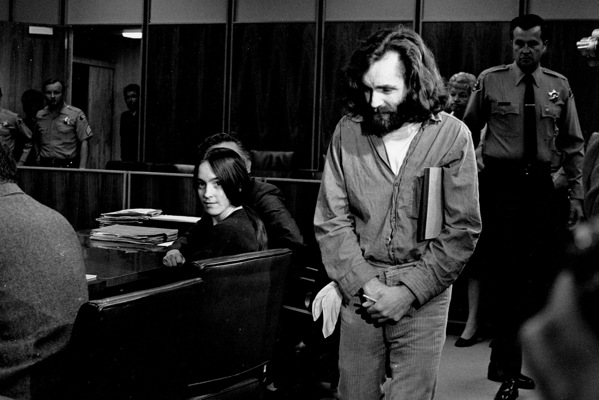
 Ed Sanders 1971 study of the dark countercultural phenomenon known as the Manson Family is often thought to be the definitive book on the subject. Lacking the self-interested viewpoint of prosecuting attorney Vincent Bugliosi, whose HELTER SKELTER spawned the 1970s TV miniseries of that title, Sanders was himself a mover in the hippie era: an underground poet and member of New York anarcho-folk rock band the Fugs. His own anti-establishment credentials allowed him to get closer to the frayed edges of the hippie scene, some of whose acolytes were acid-addled enough to be indoctrinated by Charlie Manson. The outcome of it all was the Tate-LaBianca murders of August 1969 (whose victims included filmmaker Roman Polanskis wife and unborn son), its motives hidden beneath layers of psychedelic mysticism, myth and plain old BS. The rationale for so much bloodshed ranges from apocalyptic visions of a race war (Charlie was not so much a hippie as an acid fascist) to the pettier motive of revenge on a record producer who failed to turn Mansons acid-folk songs into hits. Considering the power of Charlies supposedly magical charisma (he wasnt even present for five of the seven murders, when the Family was said to do his bidding), it seemed appropriate to get a genuine movie star on board for the film of Sanders book. In 2000, Johnny Depp earned a little unwanted publicity when he requested a visit to Charlie at Corcoran State Prison, where the former head of the Family (these days an online environmental activist, apparently) is serving out his life sentence. Its not known if his request was ever actually granted, but THE FAMILY never went ahead once Depp left the project. As of late 2014, the latest option on the book was taken by independent production company Roxwell Films. If it does actually go forward this time, their intended screenwriter is Guinevere Turner, who adapted AMERICAN PSYCHO for Mary Harron. Part of the longterm problem in bringing THE FAMILY to the screen appears to be the perception that it belongs at the other end of the market. HELTER SKELTER has been filmed as a TV miniseries twice, three decades apart, while low-budget exploitation director Jim Van Bebbers psychedelic gorefest THE MANSON FAMILY (2003) borrowed factual elements from THE FAMILY, HELTER SKELTER and just about every published work on Mansons murderous little clan. First begun in 1989 under the title CHARLIES FAMILY, the no-budget movie took a full 14 years to complete. (As Van Bebber told me many years ago, the process was talking so long that the actor playing lead murderer Tex Watson was losing his hair.) At moments the films lack of resources can make it look jaw-droppingly inept; at other junctures, its down-and-dirty grindhouse ethos and deeply disturbing gore lend it a chill that a Hollywood picture probably couldnt match.
 Jamie Langlands as Nilsen, in the truncated short film based on KILLING FOR COMPANY (2013).
5. Lords Of Chaos
 In the 1990s, the black metal movement briefly meant something more than just screaming guitars and growled vocals. LORDS OF CHAOS was the title of a 1998 book on the phenomenon by Michael Moynihan of US neo-folk band Blood Axis and Norwegian rock journalist Didrik Soderlind, which drew much of its inspiration from the latters homeland. It was in the Oslo black metal scene that a competitive sense of how to become the most authentically evil Satanist took hold. Burnings of medieval stave churches briefly became a phenomenon, reputedly encouraged by Euronymous, vocalist of the band Mayhem and proprietor of black metal record label Deathlike Silence; tragicomically, a bandmate who called himself Dead decided he truly didnt belong to this world and blew his head off with a shotgun. After the August 1992 murder of a gay man in a park, the band Emperors drummer, Faust, was charged with the crime which seemed of a tone with his neo-Nazi leanings. But it was the 1993 arrest of Count Grishnackh who recorded under the name Burzum and had renamed himself after an orc in THE LORD OF THE RINGS that took the madness to its peak. For Grishnackh (or Kristian Vikernes, to cite his rather ironic given name) had repeatedly stabbed his former friend Euronymous to death and was allegedly found in possession of 150lbs of dynamite. Michael Moynihan imbued his telling of these events in LORDS OF CHAOS with a mythic significance, seeing the so-called Black Metal Circles acts as a revolt against European liberalism and a return to pagan instinct. Part of the 1990s US apocalypse culture, the young writer/musician personified an occultist/radical rightwing axis; as his onetime mentor, musical experimentalist and provocateur Boyd Rice, had found a personal hero in Manson, so Moynihan tended to lionise Vikernes as a man of action. Its a disputable stance as rumours about the Grishnackh-Euronymous spat have suggested more mundane causes, but it lent the book (published by underground hipsters Feral House) an undeniable power. It may have been this inherent controversy that attracted Tokyo filmmaker Sion Sono director of the TOKYO TRIBES manga adaptation and disturbing art film STRANGE CIRCUS to the project, or pretty boy TWILIGHT vampire Jackson Rathbone to audition for the part of Vikernes. It may also have been similar factors that doomed it outright. As on the trailer poster above, LORDS OF CHAOS was expected to see its premiere in 2010. There may have been many obstacles (including finance), but one likely factor was opposition from an unexpected quarter: Varg Vikernes (the ambient metal artist formerly known as Grishnackh, his adopted forename the Norwegian for wolf) had been released from prison in late 2009, after serving 15 years of his maximum 21-year sentence. Moving ever further to the right, the Odinist (worshipper of the Norse gods) is a long-time racial separatist and white supremacist. Despite Moynihans sympathy for his resurgent atavism, Vikernes damned his book as an inaccurate cash-in. (He was even more disgruntled by the interview in my friend Gavin Baddeleys satanic rock study Lucifer Rising, conducted when he was on bail for burning churches: I dont want to use words like Mordor because it could be dismissed as a joke, hes quoted as saying of his LORD OF THE RINGS influence, sensing hes on the verge of sending himself up.) In 2013 Vikernes and his wife, long domiciled in rural France, were arrested for a suspected terrorist plot but released when it was confirmed that the firearms they held were licensed. Hes out there, hes armed and hes p*ssed off it sounds like a cheesy tagline on a movie poster, but it just so happens to be true.
 Twilight co-star Jackson Rathbone was pencilled in to play orc-loving black metallist/killer Count Grishnackh (thats the Count on the right).
4. In The Realms Of The Unreal
 Jessica Yus remarkable documentary, IN THE REALMS OF THE UNREAL: THE MYSTERY OF HENRY DARGER (2004) is as close as were ever likely to get to a film of the staggeringly obsessive work that provides its main title. In 1973, the titular Darger, a janitor at a Chicago hospital, died. On removing his body and his small number of personal effects from his shabby apartment, it was discovered how this private and withdrawn man possibly autistic, though also troubled by the secret homosexuality that remained criminalised through most of his 82 years had spent much of his life. IN THE REALMS OF THE UNREAL or, to give it its full title, The Story of the Vivian Girls, in What is Known as the Realms of the Unreal, of the Glandeco-Angelinian War Storm, Caused by the Child Slave Rebellion is a vivid phantasmagoria realised in almost as much detail as THE LORD OF THE RINGS, albeit the work of an alienated and fragile psyche. This strange cosmology posits the seven young Vivian sisters as the tragic heroines battling interplanetary tyrants who impose child slavery. Running to over 15,000 pages (and followed by a 10,000-page sequel, Crazy House, which, as the title suggests, really does tip over into insanity at times). The texts hybrid of Lewis Carroll-like fantasy and pulp sci-fi was complemented by painstakingly realised illustrations that combined Dargers own embellishments with found images and pictures traced from commercial publications. The effect veers from startling whimsy to bloody horror: as if pictures from a late Victorian childrens book had suddenly transformed into collage of a medieval hell, with the innocent young girl heroines (some of whom had penises, indicative of the authors sexual confusion) bound, tortured and slaughtered like the martyrs of the Catholic religion he was raised in. In Ms Yus documentary narrative, some of the illustrations come to life in animated sequences. It seems to be the nearest well ever come to a cinematic adaptation of this singularly obsessive epic though a possible Darger influence can be detected in some of the more extreme anime, where a childlike wondrousness and horror exist side by side. Its hard to believe that censorious Twitter types wouldnt go into apoplexy over unexpurgated cinematic Darger, as the mans inner visions make his feelings so easy to misinterpret. His obsession with the newspaper story of a murdered little girl is disturbing on the face of it but then his stated wish to form a Childrens Protective Society with his only friend seems to have been sincere, a sentiment inculcated by a difficult early life and his own institutionalisation as a child.
3. Geek Love
 The geek, in the American carnival tradition, is not physically deformed but a debased human being, maddened and made feral by his circumstances. In the hand-to-mouth showmans world of the carny, if a guy had fallen off his bottom rung then, for the price of some straw to sleep in and a bottle of whisky a day to drink, hed to all extents and purposes become a wild man: snarling and growling at onlookers; maybe biting the head off a hapless chicken that had been thrown his way. The geek in GEEK LOVE, the cult 1989 novel by boxing journalist and devotee of bizarre Americana Katherine Dunn, is Lil Binewski a fallen member of Boston society who created her niche in the carny world via chicken slaughter. Lil is enterprising and wants to create her own familial stable of performers, abusing her body with pesticides, drugs and radiation to ensure she gives birth to deformed kids. In this sense, Ms Dunn was being politically correct in calling her title characters geeks instead of freaks. For Lils offspring includes Arturo the Aqua Boy, who crawls along without limbs a fictional counterpart of Prince Randian, the Human Torso of Tod Brownings classic 1932 exploitation movie FREAKS. Similarly, Lils children include Electra and Iphigenia, sexually promiscuous Siamese twins who recall the (presumably much more chaste) Daisy and Violet Hilton, British twins who performed a tap-dancing routine with Bob Hope prior to appearing in Brownings film. The main reason FREAKS banned in Britain for 30 years and not much seen till a brief spate of showing on Channel 4 in the 1980s holds up today is its strange mix of grotesquerie and sentimentality. We may baulk at the freakshow mentality that exploited authentically disabled people and squirm at the revenge sequence that shows them as near-monsters crawling through the mud. But theres a poetic moralism at work in their decency and loyalty towards each other. Its the able-bodied characters a predatory trapeze artist and her strongman lover who are the real monsters. Katherine Dunn was far from unaware of the controversial legacy of Brownings film when she wrote GEEK LOVE. Several decades removed from the era of the carny freakshow (already eliciting moral disgust and in decline by the 1930s), hers was a more surrealistic and darkly cynical view of the world in which natures anomalies made the best of it by putting themselves on display. It embraced some science-fiction elements, in that some of the offspring had telekinetic or telepathic powers; yet it was very much a literary work in its vividly florid (and occasionally sick-making) construction. Little wonder perhaps that David Lynch, the great American surrealist, should briefly be spoken of as director of a film adaptation. His art-house debut, ERASERHEAD (1977), possessed its own personal poetry of deformity, while his first mainstream film, THE ELEPHANT MAN (1980), featured a sequence set in a Belgian freakshow that owed much to Brownings FREAKS. That Lynch never directed GEEK LOVE may also be a testament to his personal vision; its unlikely he would have taken the short cuts of animation or CGI (still in its infancy back then), and itd take a particularly brave producer to encourage him to dis-anchor himself from normality and engage with the 100% grotesque. It was animation that suggested a route into Dunns phantamasgorical world, as Henry Selick, director of TIM BURTONS THE NIGHTMARE BEFORE CHRISTMAS (1993) and JAMES AND THE GIANT PEACH (1996), explained: I talked to Tim Burton about producing it as an animated film, but honouring the book, hardcore. Warner Bros took out an option, but again, the Selick/Burton version never got made. The animation director recently opined itd have been impossible to make the film at any time over the last 20 years, for both technical and content reasons but now believes it might happen. As do the Wachowskis, directors of THE MATRIX trilogy (1999-2003) and erotic neo-noir BOUND (1996). It is a diabolically insightful and exquisitely rendered examination of the transformational power and pathology of familial love, says Lana Wachowski, the filmmaker now equally famous for transforming her own gender. We do have a dream of adapting it; we would love to work with Tim Burton. Once again, fellow filmmakers fantasise about unleashing Burtons sublime visual sense with their dream project. Warners are said to hold a perpetual option on GEEK LOVE, but whether it actually happens depends on a modern audiences ability to embrace what was once low-budget exploitation material up at the glossier end of the spectrum.
 A carnival barker promotes the geek show in Nightmare Alley (1947).
2. Lord Horror
 I hate it. I absolutely hate it! The programme was late-nineties BBC TV series CLIVE BARKERS A-Z OF HORROR. The interviewee was sometime TV presenter and latter-day producer Muriel Gray, who at one time was also an aspiring horror novelist. Its the kind of thing a kid who shoots down his school reads while hes polishing his guns... The target of her antipathy was a connected series of literary novels and comic books by an independent Manchester publisher, and her response was near-hysterical. But then LORD HORROR tended to attract those kinds of reactions. (The Clive Barker series ultimately declined to show the segment. Some forms of horror, it seems, were more taboo than others.) Id become very aware of it as a young researcher in the early 1990s, after which I attended a magistrates court hearing in Manchester that determined whether Savoy Books had broken the obscenity laws. For LORD HORROR was taken that seriously: in effectively the first UK literary obscenity trial since 1967, it was argued by the Greater Manchester Police (who, under Gods cop, James Anderton, regularly raided Savoys premises) that the 1990 novel by David Britton and Michael Butterworth, from which the comics series also originated, was an anti-Semitic work that extolled Nazism. These were serious charges indeed, so its worth taking the following into account: LORD HORROR (in both its novelistic and graphic novel forms) is a work of dystopian science fiction, set in an alternate reality close to the end of World War II. The character of Lord Horror is derived from Lord Haw-Haw, the Irish Nazi propagandist William Joyce who was hanged for treason (rather dubiously, as he wasnt a British citizen) at the end of the war. He exists in a warped historical version of the era, in which he is the lover of British actress Jessie Matthews. The narrative contains appearances by imaginary creatures from the works of William Burroughs (author of THE NAKED LUNCH) and Edgar Rice Burroughs (author of the TARZAN novels). In this its self-consciously tying together extreme art and pulp fiction, and using the nightmare of the Nazi Holocaust as the (natural?) territory for their mating. Lord Horror himself is a virulently anti-Semitic character and is described lovingly razoring the flesh from an orthodox Jews cheek; he also denies the full extent of Nazi crimes, claiming less than a million Jews died. But in graphic artist John Coultharts brilliant reimagining of the horrors of Auschwitz, the grotesque denier is seen averting his eyes and shedding a tear. LORD HORROR, the novel and the comic book, was defended in court on appeal by human rights lawyer Geoffrey Robertson, academic researcher Dr Guy Cumberbatch and veteran SF author Michael Moorcock. The obscenity verdict was overturned in the case of the novel, but upheld for the comics. Perhaps it was a sign of the times that the written word could be defended, while the images which visualised the narrative were condemned. Since the end of the 1990s, however, the UK has been subject to far less censorship. By the turn of the last decade, the previously unthinkable seemed to have occurred: LORD HORROR (who continued in Savoy comics like Coultharts mind-warping REVERBSTORM and Kris Guidios gross knockabout MENG & ECKER) became the subject of a film in production. LORD HORROR: THE DARK & SILVER AGE (2010) was planned by director Gareth Jackson as a full-length surrealist underground feature that drew on Savoys controversial content with their approval. In fact they were involved in raising the finance, which effectively left the film as a 51-minute show-reel when the money failed to materialise. But the saga didnt end there. For a while the embryonic film (which Jackson had to abandon) was available to view free online until 2014 when Julian Bleach, the TV actor who played Davros in DOCTOR WHO and Machiavelli in THE BORGIAS, threatened legal action regarding his own role as Horror and distaste at the insertion of cut-up Holocaust footage. Apparently his scenes were shot during a nineties theatrical workshop and, he claims, never intended for viewing: Since the advent of social media, a growing number of websites has emerged which cater to the sort of audience who would view Gareths film simply as entertainment... to know that I might have inadvertently become a part of that culture is nothing less than sickening. The footage has now been pulled from its site. Whatever the rationale, it seems that LORD HORROR remains the most unfilmable of texts.
1. Humanity Is The Devil
 LORD HORROR, and much of the so-called transgressive literature that emerged around the turn of the millennium, can be said to have its roots in the decadent and proto-surrealist writings of that previous fin de siècle, the 19th century. Modern American bizarro author Jordan Krall has combined these traditions with the frequently nasty emissions of late-20th century apocalypse culture, which often made a virtue of saying the unsayable for its own sake. His HUMANITY IS THE DEVIL takes its premise from the Gnostic Christian heresy which claims mankind and the material world as the handiwork of Satan, rather than God. His title phrase was also an article of faith for 1960s occultist group the Process Church of the Final Judgement who sued Ed Sanders and his publisher for associating them with the Manson cult in THE FAMILY. Kralls novel (one of several, and one of his most extreme) presents some of the most nauseating violence, both sexual and desexualised, in a viscerally surrealistic setting. This aestheticising of the worst horrors owes something to a book previously considered one of the great unfilmables, MALDOROR by the Comte de Lautréamont which has now actually been filmed several times. According to Lautréamont (in reality a Parisian student named Isidore Ducasse, who died very young and of whom little is known), his long 1868 prose-poem consistsexclusively of attacks on man, that wild beast, and the Creator, who ought never to have bred such vermin.This inversion of conventional morality presenting murder as a necessary good, in a surreal context which, in Lautréamont, often transforms his main character into wild animal life survives in HUMANITY IS THE DEVIL, albeit with much more gory description. As for MALDOROR itself, this vivid text was confined, in cinematic terms, to the art-film ghetto: in 2000, a Super-8 Anglo-German version featured 12 different underground filmmakers adapting a similar number of the books chapters (chants de Maldoror); though some of the no-budget animation aspects are said to be impressive, its been little seen since. But it was back in 1977 that two different versions of the classic decadent work were filmed continents apart: one was by Japanese art filmmaker Shuji Terayama, but perhaps most interesting is the version filmed in Turkey by Alberto Cavallone. The Italian directors career tended to veer abruptly between socio-psychological works and sexploitation, two elements which might have complemented each other in MALDOROR though its hard to say as, in keeping with the mystique of the whole story, it was never released and is now a lost film. So will a bizarro work like HUMANITY IS THE DEVIL be subject to similar cinematic adaptations? Well, as we said back at the beginning, this is the age when nothing seems to be off limits for cinema, and theres certainly scope for an ambitious animator (or indeed anime maker) to try to capture its wildness. As for a live-action version, that may be further off in the future: it would take some kind of budget to realise the books wilder images, and its doubtful that Hollywood is ready for surreal, psychosexual gore-nihilism yet. But it may come. Certainly, in contrast with more realistic transgressive writers that hes been compared to, Krall is cinematic; Peter Sotoss infamous TOOL, for example, is fixated on the sexual murder of children and young women, of which it expresses approval throughout. If that ever sees a faithful film adaptation then you and your neighbours will probably be killing and eating each other anyway, as everything will be all over by then...
 A vividly surreal location shot from Cavallones lost MALDOROR (1977).